Historic Cities · Russia
Veliky Novgorod through the ages
Veliky Novgorod, also known simply as Novgorod (Новгород), is the largest city and the administrative centre of Novgorod Oblast, Russia. The city lies along the Volkhov River, just 6 kilometres (3.7 mi) downstream of its outflow from Lake Ilmen, and is situated on the M10 federal highway, which connects Moscow and Saint Petersburg. The city has a population of 224,286 (2021 census).

Veliky Novgorod in 1400
Lord Novgorod the Great
This is Novgorod at the height of its trading power and republican life, where boyar wealth, Byzantine church culture and Hanseatic commerce meet on the Volkhov. The walk shows the Detinets and St Sophia's silver domes, the Peterhof and Gotland yards, the crowded bridge markets and the timber streets lit by icons and lamp smoke.
The skyline is a low forest of small onion domes and silvered cupolas puncturing a sea of timber roofs; the Detinets' stone walls and towers rise near the river while wooden storehouses and walled foreign yards line the Volkhov. Streets are narrow and dark with split-log paving, market stalls cluster on the bridge, and barges and sledges crowd the river in winter. Colours are pale: whitewashed churches, dark oak beams, fur and wool cloaks, and metalwork glinting in low northern light.
The route: 16 streets, squares and views
Lake Ilmen Shore → Yuriev Monastery → Volkhov Quay → Volkhov Bridge → Bridge Market Stalls → Market Rows → Yaroslav's Court → St Nicholas, Yaroslav's Court → St Paraskeva on the Market → Ilyina Street → …
Step inside, 9 interiors
Monastic Refectory · Timber River Warehouse · Boyar Terem Chamber · Market Chapel Interior · Transfiguration Frescoed Nave · Icon Painter's Workshop · Hanseatic Common Hall · Gotland Merchants' Hall · Great Shadowed Nave
Planned from the Wikipedia record: Novgorod Republic.
Its story
The story of Veliky Novgorod.
Hólmgarðr on the Volkhov: the Chronicle Dates and the Kievan Century
The city sits on the Volkhov six kilometres below its outflow from Lake Ilmen. The late Nikon Chronicle mentions it under the year 859, at the death of Novgorod's elder Gostomysl; the Primary Chronicle copy in the Laurentian Codex first mentions it under 862. The charter of the city takes 859 as its founding year; archaeology gives a later answer, the reliably dated layers on the present site going back no earlier than the 930s. The name means 'new town', implying an older one, often identified with Rurikovo Gorodische a mile away; the Old Norse name Hólmgarðr is usually identified with the city. According to the Primary Chronicle the Varangian chieftain Rurik was invited by the local tribes to rule over them in 862; these Varangians, known as the Rus', gave their name to the land and in time to Russia, and Novgorod is traditionally treated in Russian historiography as a cradle of Russian statehood.
Rurik's successor Oleg took Kiev in 882, but Greek and Latin sources went on naming Novgorod as the political centre for another century before Kiev eclipsed it. The Novgorodians were baptised under Vladimir the Great by the end of the 10th century and the city received its first bishop in 989, raised to archiepiscopal rank in 1165. Yaroslav the Wise, prince here from 1010 to 1019, granted the boyars substantial privileges once they had backed his seizure of the Kievan throne, and widespread literacy is dated to his reign, since he ordered 300 children of boyar and priestly families taught. His son Vladimir paid for the Saint Sophia Cathedral, which still stands. The Norse sagas call the city the capital of Gardariki, and Viking leaders came seeking refuge or employment, among them the Norwegian kings Olaf Tryggvason, Olaf Haraldsson and Harald Hardrada; after Olaf Haraldsson's death and canonisation the Novgorodians built Saint Olaf's Church in his memory.
The Veche and the Peterhof: the Republic after 1136
In 1136 the Novgorodians dismissed their prince, Vsevolod Mstislavich, and that year is conventionally taken as the start of the Novgorod Republic, though republican institutions took shape earlier and settled later. The result was a city-state dominated by a small group of wealthy merchant and noble families: common enough in western Europe, unique in Russia, where princes normally held supreme authority. It was the largest Russian state until Moscow overtook it in the 15th century, and its hinterland ran from the Gulf of Finland to the Ural Mountains. The posadnik, or mayor, the militia commander and the archbishop were all elected; the princely office was never abolished, and strong princes such as Alexander Nevsky imposed their will regardless of the city's wishes.
What paid for all this was fur. Hanseatic merchants were drawn to the Russian trade by its furs and beeswax, and Novgorod was the leading supplier, from sable and ermine down to squirrel pelts in bulk. The League's easternmost kontor, the Peterhof, was set up by merchants from northern Germany in the late 12th or early 13th century; around 200 German merchants were living in the city in the 1430s. Some 1,000 birch bark manuscripts of the 11th to 15th centuries have since been dug out of the ground here, most of them letters written by laypeople in the local Old Novgorodian dialect, the main evidence behind the suggestion that literacy was widespread in medieval Russian towns.
Novgorod never fell during the Mongol conquests, though it paid tribute, and Alexander Nevsky defeated the Swedes at the Neva in 1240 and the German crusaders on the ice in 1242. From the mid-13th century the throne belonged to the grand prince of Vladimir and then of Moscow, and from the end of the 14th the city styled itself Sovereign Lord Novgorod the Great. In the 15th century food ran short and the city depended on the lands to its south-west for grain, while relations with Moscow soured over autonomy, some of the clergy taking a pro-Lithuanian line for fear that submission would end the city's independence.
Annexed, Deported and Sacked: Ivan III to Godunov, 1478–1600
Grand Prince Ivan III defeated the Novgorodian militia at the Battle of Shelon, and on 15 January 1478, after the whole population had been sworn to obedience, the republic ended. The veche was dismantled and its bell carried off to Moscow, the mayoralty abolished, government handed to the grand prince's namestnik. Many boyar families were deported: Novgorodians from the city's Lubyanitsa district were ordered to settle in one quarter of Moscow, which took the name Lubyanka. In 1494 Ivan III broke with the Hanseatic League and closed the Peterhof; the kontor reopened briefly in 1514, but the League never recovered its monopoly.
The city was still among the largest in the centralised Russian state; in the mid-16th century the English explorer Richard Chancellor called it the second largest, with a wealth of flax and hemp that in his account gave it pre-eminence before all other Russian cities. That ended in the winter of 1569–70, when Ivan IV led his oprichniki against the city in person. The pretext was a denunciation and a suspicion of treason; modern historians take the Novgorod conspiracy to have been invented by the tsar's favourites Vasily Gryaznoy and Malyuta Skuratov. Every town on the road from Moscow was plundered on the way, and Skuratov strangled Metropolitan Philip with his own hands at the Otroch monastery in Tver. The sack lasted six weeks; people were tortured and drowned in the Volkhov in their thousands, and the property of churches, monasteries and merchants was confiscated. Contemporary figures for the dead run from 27,000 to 700,000 (the higher number is impossible, the city having held about 35,000 people in 1546), while scholarly estimates range from 2,000–3,000 (Ruslan Skrynnikov, who counted 2,170–2,180 recorded deaths and did not treat that figure as final) to 10,000–15,000 (Vladimir Kobrin), against a population of some 30,000. The wider population decline of the Novgorodian land in these years was mainly due to famine and plague. Boris Godunov restored the city's trade privileges in the last decade of the century and raised its archbishop to metropolitan.
The Swedish Occupation and the Long Recovery, 1611–1700
During the Time of Troubles, after Tsar Vasily Shuisky was deposed and the Seven Boyars elected Władysław of Poland tsar, the Russian state came apart. A Swedish auxiliary corps under Jacob De la Gardie, brought in to fight the supporters of the second False Dmitry, turned on the Novgorodian lands in 1611. The city was stormed on 16 July 1611 and fell quickly when the Muscovite voivode Buturlin withdrew his detachment. Under a treaty of 25 July the Swedish king was declared protector and his son Karl Filip was to be tsar and grand prince of Novgorod, formally an independent Novgorod State under Swedish protection, in practice a military occupation. When Evert Horn took over the administration in the winter of 1614–15 and announced that Gustavus Adolphus meant to be king in Novgorod himself, many townspeople went over to Moscow and left.
The Treaty of Stolbovo of 27 February 1617 ended the war and the occupation, and left the city gutted: half of it had burned, the number of homesteads fell from 1,158 in 1607 to 493 in 1617, the Sofia side was described as deserted, and famine and disease followed. Refugees kept arriving from the districts ceded to Sweden. Rising grain prices set off a bread riot in 1650, during which the metropolitan Nikon stood with Tsar Alexis and anathematised the rioters, for which he was badly beaten; he became patriarch in 1652, and the schism that followed his reforms struck the Novgorod diocese first, the Novgorodian land becoming one of the strongholds of the Old Believers. Trade went on under Arkhangelsk's shadow, and crafts employed most of the population.
Provincial Capital and Place of Exile, 1703–1871
The founding of Saint Petersburg in 1703 drew many Novgorod craftsmen away to build it, and the city finally lost its standing as a trading centre and became a provincial town. A Novgorod Governorate was created in 1727 with the city as its centre, and the general plan approved in 1778, under Catherine II's governor Yakov Sievers, replaced the ancient street pattern with a ruled grid. In the first half of the 19th century the city became a centre of the military settlements and had almost no industry: the provincial handbook for 1875 counted 17,384 inhabitants including the garrison, and just 63 workers in twelve small enterprises. Weak industry made it a convenient place of exile: the writer Alexander Herzen served his there in 1841–42 as a councillor of the provincial board. In 1862, for the thousandth year of the Russian state, the Millennium of Russia monument by Mikhail Mikeshin was unveiled in the kremlin in the presence of Alexander II. The railway reached the town in 1871.
Occupied and Levelled: August 1941 to the Trial of 1947
German forces occupied the city in August 1941 and held it until 20 January 1944; the garrison included Spanish troops of the Blue Division. The occupiers installed a city administration under the local military commandant, a collaborationist structure the historian Boris Kovalyov, who studied it, judged fairly typical of occupied Russia; among those who worked with the Germans were two men previously repressed by the Soviet state, Vasily Ponomaryov and Boris Filistinsky. The city was to be attached to the Ostland commissariat. The first burgomaster, Fyodor Ivanovich Morozov, was killed by a young Spanish volunteer during an attempted robbery.
Every wooden building in the city burned. The museum collections, which had not been fully evacuated in time, were looted of archaeology, history and art. A 1944 report found that of 2,346 residential buildings only 40 were unscathed, and that the hospitals, schools, libraries, museums, industry, waterworks and power plants had all been destroyed; 65 architectural monuments were destroyed or badly damaged, and the Extraordinary Commission put the material damage at more than 11 billion roubles. The historian Dmitry Likhachev, returning to a town he knew, wrote: 'Under the tragically large sky there was just a flat plain, overgrown with high grass. It was a graveyard without headstones!' The Red Army retook the city on 20 January 1944 with units of the Volkhov Front during the Leningrad–Novgorod offensive. In December 1947 the city held the last open trial of Nazi criminals staged in the Soviet Union.
Dug Out of the Ground: Rebuilding, Birch Bark and World Heritage
Novgorod Oblast was created on 5 July 1944 with the city as its administrative centre, and on 1 November 1945 the city was named one of fifteen to be rebuilt as a priority. People lived in dugouts and cellars, and the surviving shells of the City Duma and the trading rows on Yaroslav's Court were pulled down for their bricks. Reconstruction followed the plan drawn up by Alexey Shchusev's team and approved on 22 December 1945, which set out to weave the surviving medieval architecture into the new city.
The cleared ground made possible archaeological excavation on a scale not otherwise available. Systematic research has been carried out since 1932, under Artemiy Artsikhovsky and then Valentin Yanin. The first birch bark letter was found on 26 July 1951 and more than a thousand have since been recovered; the Novgorod Codex, the oldest East Slavic book, was found in 2000, and rescue excavation was still going on across the site as of 2025. The chief monuments of the city and its surroundings were inscribed on the UNESCO World Heritage list in 1992, and on 11 June 1999 a federal law signed by President Yeltsin renamed the city Veliky Novgorod, the older form distinguishing it from other towns of the same name. The city was given the title City of Military Glory on 28 October 2008. It is the administrative centre of Novgorod Oblast and recorded 224,286 inhabitants at the 2021 census.
From the archive
Veliky Novgorod on paper: the old town as it was mapped.
A period plan or bird's-eye view of the old town, drawn between 1500 and 1850, the streets this page's reconstructions walk. Public domain, with its source named.
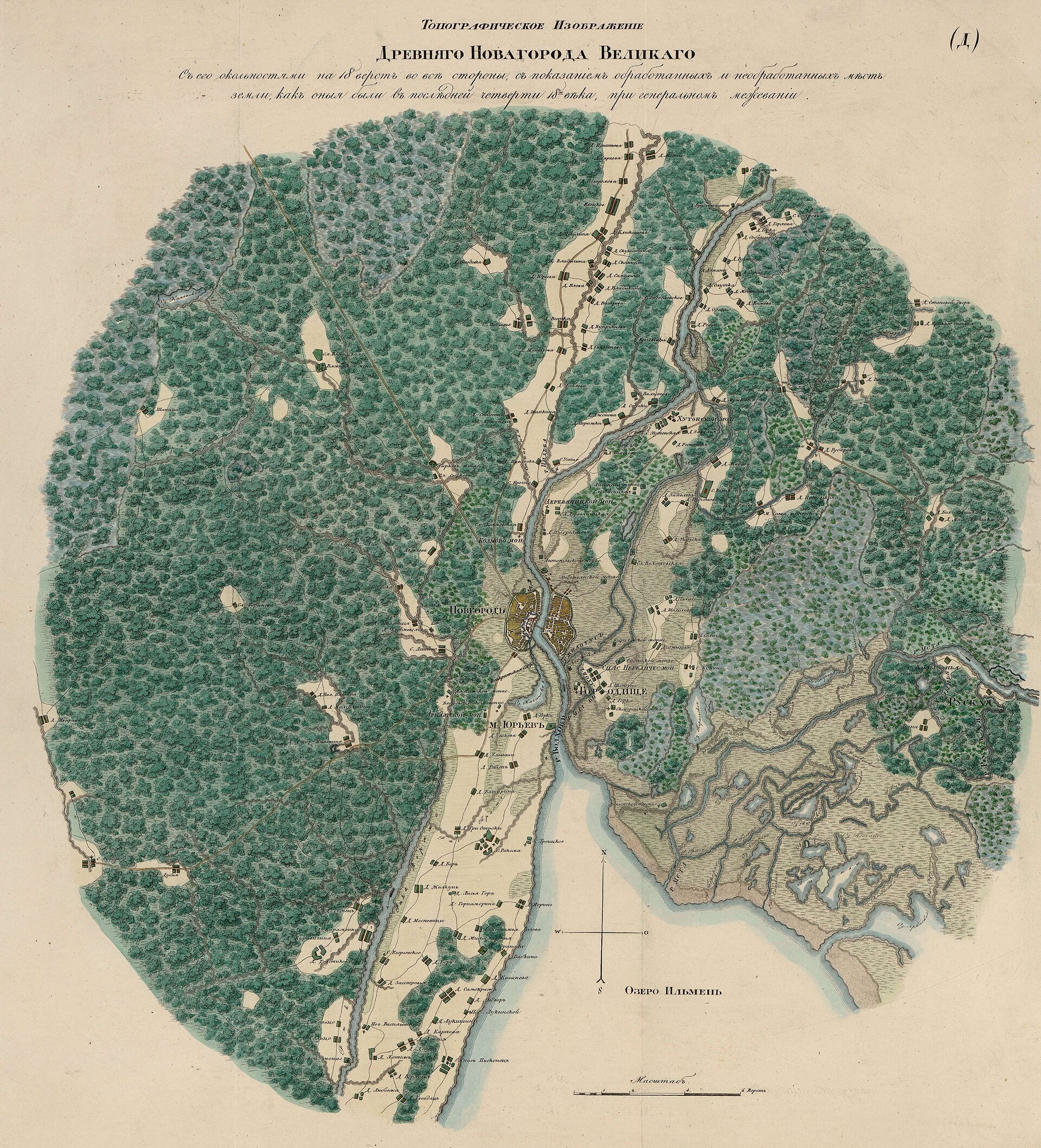
Topographic depiction of Ancient Veliky Novgorod, by N. N. Muravyov
Shows the kremlin and walled old town, the River Volkhov flowing into Lake Ilmen, town blocks, gates, roads and surrounding forests.
1828 · Н. Н. Муравьёв · Wikimedia Commons
Public domain (plate dated 1828)
More cities to explore
 RussiaSt PetersburgExplore it in 1760 · 1830 · 1913
 RussiaMoscowExplore it in 1500 · 1680 · 1890
 RussiaKitezhExplore it in 1237
 NetherlandsUtrechtExplore it in 1400 · 1700
Castles of Europe · Landmarks of Europe · create your own reconstruction.