Historic Cities · Russia
St Petersburg through the ages
Saint Petersburg, formerly known as Petrograd (Петроград) and later Leningrad (Ленинград), is the second-largest city in Russia, after Moscow, the nation's capital. Situated on the Neva River at the head of the Gulf of Finland on the Baltic Sea, its area of 1,439 square kilometers (556 sq mi) makes it the smallest administrative division of Russia by area.

St Petersburg in 1760
Elizabethan St Petersburg
This is the capital under Empress Elizabeth at the height of her baroque building boom, when Rastrelli's turquoise-and-gold palaces and Smolny's soaring blue domes are reshaping the marshy shoreline. The walk follows frozen waterways, wooden embankments and wide parade grounds between the Admiralty spire and the nearly finished Winter Palace, showing public life, markets and winter traffic in the young imperial capital.
The skyline is a sequence of low wooden houses, stuccoed baroque façades and gilded cupolas; Rastrelli's palaces gleam in pastel turquoise, white and gold, and Smolny's blue domes puncture the low horizon. Embankments remain earth and timber rather than granite, quays and bridges are temporary or wooden, and the Admiralty's thin gilded spire dominates the centre. In winter the Neva and canals ice over, sledges cross broad frozen avenues and smoke rises from small chimneys.
The route: 22 streets, squares and views
Gulf of Finland Approach → Strelka, Vasilievsky Island → Twelve Collegia → Kunstkamera by the Neva → English Embankment → Admiralty and Spire → Palace Square → Winter Palace Facade → Winter Canal → Palace Embankment → …
Step inside, 14 interiors
Harbour Merchants' Counting Room · Academy Assembly Hall · Natural History Cabinet · Admiralty Model Room · Jordan Staircase · Grand Audience Chamber · Hermitage Picture Cabinet · Marble Grotto Pavilion · Ice-Hill Festival Pavilion · Mirrored Ballroom of a Nobleman · Goldsmith's Workshop · Great Merchants' Arcade · Main Nave and Iconostasis · Cathedral Nave and Iconostasis
Planned from the Wikipedia record: History of Saint Petersburg.
St Petersburg in 1830
Pushkin's Petersburg
The imperial capital of the Romanovs, Saint Petersburg in 1830 is a city of new stone embankments, broad neoclassical squares and the Winter Palace’s low, ordered height. Walkers will pass the Bronze Horseman and the General Staff arch, thread Nevsky Prospect’s shops and bridges, and end where the Neva opens to the Gulf of Finland under the long white nights.
By 1830 the city reads as pale stone and sober neoclassicism: low, strict facades, granite embankments along the Neva and canals, and broad radial avenues leading to the Admiralty. The Winter Palace and the spire of the Admiralty set the permitted skyline; churches and colonnades punctuate long vistas. Streets are cobbled and narrow alleys still exist between grand façades, while river traffic (small sailboats, barges and rowed ferries) fills the waterways.
The route: 20 streets, squares and views
Gulf of Finland Approach → English Embankment → Palace Embankment & Hermitage → Palace Square: General Staff Arch → Bronze Horseman, Senate Square → Admiralty and Spire → Nevsky Prospect, The Beginning → Kazan Cathedral → Gostiny Dvor → Anichkov Bridge → …
Step inside, 13 interiors
Literary Salon · Military Gallery · Winter Palace Ball Room · Admiralty Council Room · Confectioner's Salon · Cathedral Nave · Covered Trade Hall · Music Salon · Main Auditorium · Moika Ballroom · Nave under Scaffold · Cathedral Interior · Stock Exchange Hall
Planned from the Wikipedia record: Saint Petersburg.
St Petersburg in 1913
Tercentenary Petersburg
This is the city at the height of imperial display and everyday modernity on the eve of the First World War, weeks into the Romanov tercentenary celebrations. The walk moves from the Neva's broad water and quay-lined avenues through theatres, tram-lined Nevsky Prospect, artisan workshops and bohemian cellars to the rostral columns and wide sky over Vasilievsky Spit.
The 1913 skyline reads as layered European capitals: gilded spires and green domes rise behind long pale stucco façades and the dark mass of the Winter Palace; granite embankments meet tidal grey water and cast-iron bridges with carved railings; electric trams hum along broad avenues, horse-drawn cabs jostle with early motorcars, and smokestacks and factory chimneys mark the industrial suburbs beyond the classical centre.
The route: 23 streets, squares and views
Kronstadt Harbour → English Embankment Pier → Peter and Paul Fortress → Palace Embankment → Palace Square → Admiralty Building → St Isaac's Square → Bolshaya Morskaya Street → Fabergé Workshop → Yusupov Palace, Moika → …
Step inside, 12 interiors
Cathedral Nave · Armorial Hall · Isaac's Nave · Goldsmiths' Atelier · Design Studio · Small Theatre · Main Auditorium · Cellar Salon · Bookshop Dome · Grand Salon · Merchant Arcade · Arrival Hall
Planned from the Wikipedia record: History of Saint Petersburg.
Its story
The story of St Petersburg.
A Baltic Seaport Taken from Sweden, 1611-1712
Before the 17th century the mouth of the Neva was inhabited by the Finnic Izhorians and Votians; Ingrian Finns moved in from Karelia and Savonia under Swedish rule, alongside Estonian, Karelian, Russian and German inhabitants. In 1611 Swedish colonists built the fortress of Nyenskans at the river mouth, and the small town of Nyen grew up around it. Peter the Great, interested in seafaring and maritime affairs, wanted a seaport through which Russia could trade with the rest of Europe, and a better one than Arkhangelsk on the White Sea, which lay in the far north and was closed to shipping in winter.
Peter took Nyenskans on 12 May 1703 during the Great Northern War and soon replaced the fortress. On 27 May, five kilometres inland from the gulf on Hare Island, he laid down the Peter and Paul Fortress, the first brick and stone building of the new city. It was built by conscripted serfs brought from all over Russia and, in some years, by Swedish prisoners of war, under the supervision of Alexander Menshikov; tens of thousands of the serfs died in the work. Peter named the place after the apostle Saint Peter and issued no naming act to fix a spelling, using several himself - Sanktpetersburk after the German, Santpiterburkh after the Dutch - before the name was normalised and russified.
He was calling the city his capital as early as 1704 and moved the seat of government there from Moscow in 1712, nine years before the Treaty of Nystad ended the war in 1721.
Court, Academy and Granite Embankments, 1712-1850
The first years of building clustered around Trinity Square near the fortress, but the city was soon laid out to a plan: by 1716 Domenico Trezzini had drawn a scheme putting the centre on Vasilyevsky Island in a rectangular grid of canals, never completed but still legible in the street layout. In 1724 Peter the Great established the Academy of Sciences, the University and the Academic Gymnasium here, and the Saint Petersburg Mint was founded in the same year.
Peter died in 1725 at fifty-two, his efforts to modernise Russia opposed by the nobility, with several attempts on his life behind him and a treason case involving his son. Peter II moved the seat back to Moscow in 1728, but in 1732, under Empress Anna, Saint Petersburg was again designated capital of the Russian Empire, and it remained the seat of the Romanov dynasty, the imperial court and the government for another 186 years. Catastrophic fires in 1736-1737 forced a new plan, commissioned in 1737 by a committee under Burkhard Christoph von Münnich, which divided the city into five boroughs and moved the centre to the Admiralty borough on the east bank between the Neva and the Fontanka, developing along the three radial streets that meet at the Admiralty building.
The Commission of Stone Buildings, established in 1762, ruled that no structure in the city might rise higher than the Winter Palace. Under Catherine the Great the banks of the Neva were lined with granite embankments in the 1760s to 1780s, and the Obvodny Canal, dug between 1769 and 1833, became the southern limit of the city. Only pontoon bridges were permitted across the Neva until the first permanent crossing, the Annunciation Bridge, opened in 1850.
Emancipation, Industry and Three Murdered Emperors, 1762-1905
The emancipation of the serfs under Alexander II in 1861, coming with industrialisation, greatly increased the influx of former peasants into the capital, and poor boroughs grew up unplanned on the outskirts. The city passed Moscow in population and industrial growth and became one of the largest industrial cities in Europe, with the naval base at Kronstadt, the Neva and a seaport on the Baltic behind it.
Assassination shadowed the throne. The first two Russian emperors to be assassinated were Peter III in 1762, supposedly in a conspiracy led by his wife Catherine the Great, and Paul I in 1801, killed by Nikolay Alexandrovich Zubov and fellow conspirators who brought Alexander I, the son of their victim, to power. The third, Alexander II, was murdered by terrorists in Saint Petersburg in 1881, on the spot now marked by the Church of the Saviour on Spilled Blood. The Revolution of 1905 began in the city and spread rapidly into the provinces. The Decembrist revolt against Nicholas I had already been suppressed on Senate Square in 1825, the day after he assumed the throne.
Petrograd, Leningrad and the Purge, 1914-1941
In 1914, soon after the outbreak of war with Germany, Nicholas II renamed the city Petrograd to expunge the German words Sankt and Burg; because the prefix "Saint" was dropped, the change also moved the city's eponym from the apostle to Peter the Great. In March 1917 Nicholas abdicated for himself and his son, ending the monarchy and over three hundred years of Romanov rule. On 7 November 1917 the Bolsheviks under Lenin stormed the Winter Palace in the October Revolution, ending the provisional government and transferring political power to the Soviets. German troops invading the West Estonian archipelago in September and October 1917 had threatened Petrograd with bombardment, and on 12 March 1918 Lenin moved the government of Soviet Russia to Moscow to keep it away from the state border. In mid-1919, during the civil war, anti-communist Russian forces with Estonian help tried to take the city, and Leon Trotsky mobilised the army and forced them back into Estonia.
The city emptied: from 2.4 million residents in 1916 the population fell below 740,000 by 1920 through revolution and civil war. On 26 January 1924, five days after Lenin's death, Petrograd was renamed Leningrad, and street names honouring communist figures replaced names given centuries earlier. Housing became a government-provided amenity, and "bourgeois" apartments so large that several families were assigned to each produced the communal flats, the kommunalkas, in which 68 per cent of the population lived by the 1930s, in very poor conditions. Many historic buildings, churches and cathedrals above all, were destroyed by the new regime for ideological reasons.
The minorities of Germans, Poles, Finns, Estonians and Latvians were almost completely transferred out of Leningrad during the 1930s. On 1 December 1934 Sergei Kirov, the Bolshevik leader of the city, was assassinated under suspicious circumstances, and the killing became the pretext for the Great Purge; approximately 40,000 people were executed in Leningrad during Stalin's purges. A general plan of 1935 turned the city's expansion southwards, away from the Finnish border, with a new city hall and a great square planned at the southern end of Moskovsky Prospekt; after the Winter War of 1939-1940 moved the border north, Nevsky Prospekt and Palace Square kept their role as the centre.
The 872-Day Siege and the Hero City, 1941-1965
German forces besieged Leningrad after the Axis invasion of the Soviet Union in June 1941. The siege lasted 872 days, from 8 September 1941 to 27 January 1944, and was one of the longest, most destructive and most lethal sieges of a major city in modern history. The city was cut off from food supplies except what came over the Road of Life across Lake Ladoga, which could not get through until the lake froze. More than one million civilians were killed, mainly by starvation; there were incidents of cannibalism, and around 2,000 residents were arrested for eating other people. Between 1941 and the end of 1943 the population fell from 3 million to fewer than 600,000 as people died in the fighting, starved or were evacuated.
On 1 May 1945 Stalin named Leningrad, with Stalingrad, Sevastopol and Odesa, a hero city of the war. The honorary title was given legal form on 8 May 1965, and the Presidium of the Supreme Soviet awarded the city the Order of Lenin and the Gold Star medal "for the heroic resistance of the city and tenacity of the survivors of the Siege".
Rebuilt and Purged Again, 1945-1991
In October 1946 territories along the northern coast of the Gulf of Finland, annexed from Finland in 1940 under the peace treaty that followed the Winter War, were transferred to the city, among them the town of Terijoki, renamed Zelenogorsk in 1948. Leningrad and its suburbs were rebuilt over the post-war decades, partly to pre-war plans.
The Leningrad affair of 1949-1952 grew out of the rivalry between Stalin's potential successors, with the leaders of the city party organisation - the second most significant in the country after Moscow - on one side. The entire leadership of Leningrad was destroyed, including the former mayor Kuznetsov and the acting mayor Pyotr Sergeevich Popkov and all their deputies: 23 leaders were sentenced to death and 181 to prison or exile, with rehabilitation following in 1954, while about 2,000 ranking officials across the USSR were expelled from the party and removed from their posts.
The Leningrad Metro, designed before the war, opened in 1955, though after Stalin's death in 1953 the ornamental excesses of Stalinist architecture were abandoned. From the 1960s to the 1980s new residential boroughs of near-identical functionalist blocks went up on the outskirts, and many families moved out of the kommunalkas of the centre into separate flats. The city absorbed about 3 million people in the 1950s and passed 5 million in the 1980s.
Saint Petersburg Again, 1991 onwards
On 12 June 1991 the city held mayoral elections and a referendum on its name alongside the first Russian presidential elections: 55 per cent voted for Saint Petersburg and 43 per cent for Leningrad, and the change took effect on 6 September 1991. Anatoly Sobchak took 66 per cent of the vote to become the first directly elected mayor. The surrounding oblast is still named Leningrad. Economic conditions then deteriorated sharply; food rationing was introduced for the first time since the 1940s and the city received humanitarian food aid from abroad, with recovery beginning only at the start of the 21st century. The title of city head was changed from mayor to governor in 1996.
The historic centre and its related monuments form a UNESCO World Heritage Site, with about 8,000 architectural monuments in the city, but its preservation has been contested: after 2005 the demolition of older buildings in the historic centre was permitted, and in 2006 Gazprom announced a tower opposite the Smolny Cathedral that would have risen far above the city's landmarks. Protests by residents and public figures were not entertained until December 2010, when, after a statement by President Dmitry Medvedev, the city sought another site; the project moved to Lakhta, north-west of the centre, where construction of the 462-metre Lakhta Center began in 2012.
The city is governed as a federal subject and federal city, and had 5,601,911 residents at the 2021 census, up from 4,879,566 in 2010, with more than 6.4 million in the metropolitan area. It is the de facto administrative centre of Leningrad Oblast and of the Northwestern Federal District, and the Constitutional Court of Russia moved here from Moscow in May 2008. It remains a trade gateway and an industrial centre - shipbuilding yards, heavy machinery, metallurgy, chemicals, publishing and brewing among them - and the main link between the Baltic and the rest of Russia through the Volga-Baltic Waterway.
From the archive
St Petersburg on paper: the old town as it was mapped.
A period plan or bird's-eye view of the old town, drawn between 1500 and 1850, the streets this page's reconstructions walk. Public domain, with its source named.
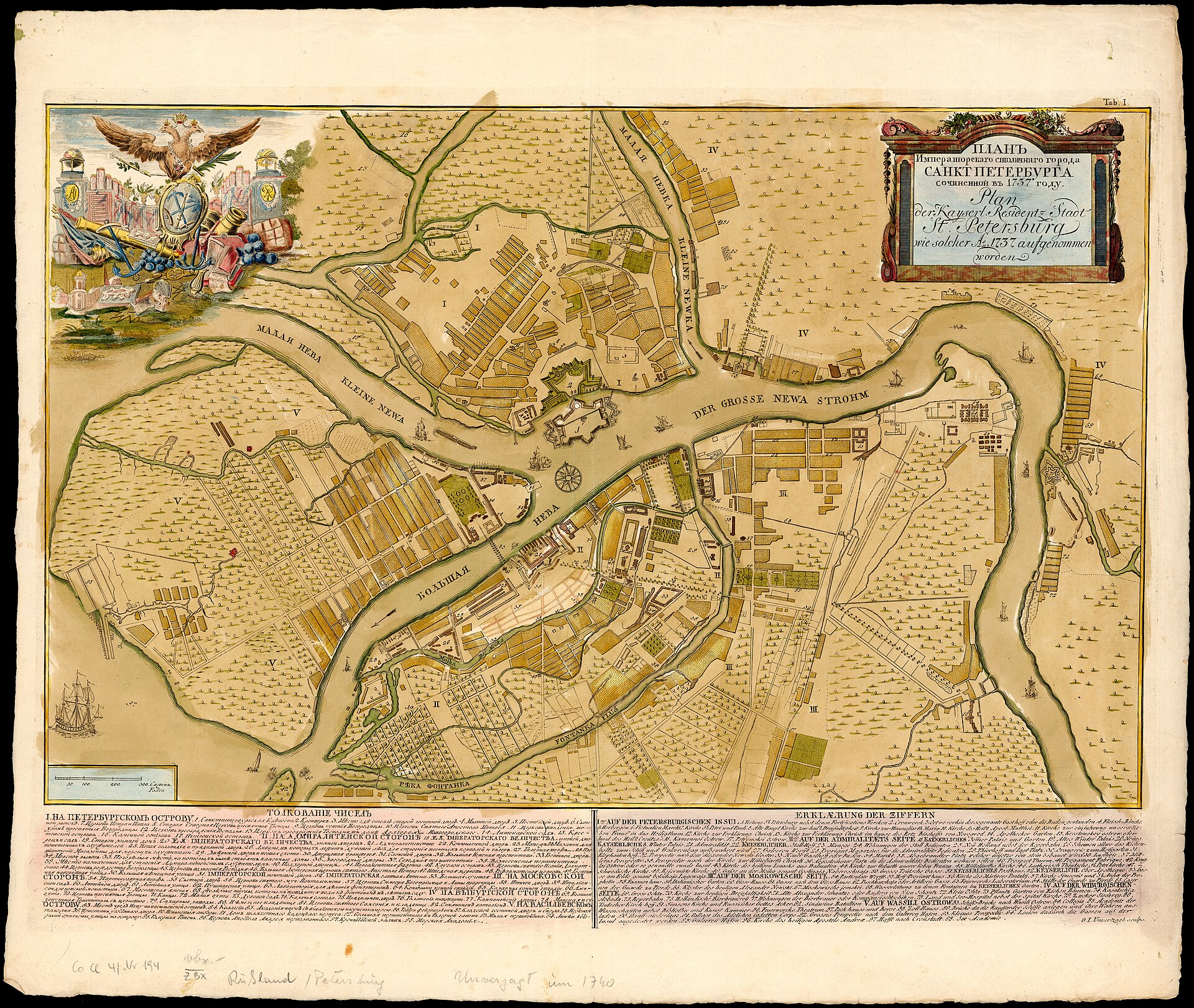
Plan of the Imperial capital city St Petersburg (Plan der Kayserl. Residentz Stadt St. Petersburg)
Detailed plan showing the Neva and Fontanka rivers, the Peter and Paul Fortress and cathedral spire, island street grid, wharves and bastioned defences.
1737 · Wikimedia Commons
Public domain (plate dated 1737)
In this city
Landmarks of St Petersburg, see each in its prime


Castles of St Petersburg

More cities to explore
 RussiaVeliky NovgorodExplore it in 1400
 FinlandHelsinkiExplore it in 1750 · 1900
 RussiaMoscowExplore it in 1500 · 1680 · 1890
 RussiaKitezhExplore it in 1237
Castles of Europe · Landmarks of Europe · create your own reconstruction.