Historic Cities · Finland
Helsinki through the ages
Helsinki, until about 1930 known in English by its Swedish name of Helsingfors, is the capital and most populous city in Finland. It is on the shore of the Gulf of Finland and is the seat of southern Finland's Uusimaa region. About 694,000 people live in the municipality, with 1.3 million in the capital region and 1.6 million in the metropolitan area.

Helsinki in 1750
Sveaborg's Helsinki
Helsingfors in 1750 is a small Swedish wooden town being reshaped by the new island fortress Sveaborg rising at the harbour mouth. The walk passes the fortress's bastions and dockworks, the town's low timber houses and wooden parish church, the market shore and quays, and the daily bustle where garrison officers, shipwrights and stone-cutters meet taverns and workshops.
Low timber roofs and narrow, unpaved lanes cluster on a rocky peninsula beside two busy harbours. Across the harbour a ring of stone-and-earth bastions and dry-dock works is rising on several islands, flanked by careened warships and small workboats. Colours are raw: unpainted pine, tar-black ropes, hooped barrels, and grey stone under pale northern light. The town's scale is modest; masts, scaffolds and chimneys punctuate a skyline of wood and stone.
The route: 21 streets, squares and views
Gulf of Finland → Skata Udde → Blockholm Isles → Sveaborg Outer Bastions → Sveaborg Dockyard Quay → Careening Beach → Dry Dock Works → Glöet Bay → Södra Hamnen → Norra Hamnen → …
Step inside, 13 interiors
Casemate Barracks · Officers' Mess · Fitting Shed · Shipwrights' Mould Loft · Masons' Staging · Harbour Tavern Common Room · Parish Nave · Merchant's Low-Beamed Parlour · Fish Smokehouse · Granite Dressing Shop · Cooper's Workshop · Ropewalk Shed · Salted Fish Shed
Planned from the Wikipedia record: History of Helsinki.
Helsinki in 1900
Imperial Helsinki
This is Helsinki at the height of its life as the white, neoclassical capital of the Grand Duchy of Finland under the Russian tsar. The walk moves from the harbour and Market Square through Engel’s Senate Square and the Esplanade to Uspenski’s red-brick domes, passing horse trams, fishing boats and new granite city blocks.
The skyline is a close, northern one: Engel’s white cathedral dome and its broad steps dominate the low, pale city, red-brick onion domes of Uspenski rise at the eastern harbour, and rows of low gabled warehouses and wooden houses edge the quays. Streets are paved or cobbled, trams run on iron rails, and façades are soapstone, granite and stucco in muted creams, russets and greys; tarpaulined market stalls and fishing skiffs cluster at the frozen south harbour in winter.
The route: 22 streets, squares and views
Approach from the Gulf → South Harbour Quay → Kauppatori (Market Square) → Harbour Fish Stalls → Katajanokka and Uspenski → Esplanadi (South End) → Esplanadi Promenade → Kappeli Pavilion → Aleksanterinkatu → Kluuvi and Midtown Blocks → …
Step inside, 14 interiors
Old Market Hall Fish Stalls · Harbour Fish Packing Shed · Uspenski Nave and Iconostasis · Hotel Drawing Room · Kappeli Café Salon · Haberdasher's Salesroom · Railway Waiting Room · Kaisaniemi Garden Café · Domed Reading Room · Great Lecture Hall · Nave of the Cathedral · Government Palace Council Chamber · Kruununhaka Tenement Parlor · Salted Fish Warehouse
Planned from the Wikipedia record: History of Helsinki.
Its story
The story of Helsinki.
Founded to Undercut Reval, 1550–1561
Before there was a town there was a trade. By the end of the Middle Ages the Helsinki region had become an important trading centre for wealthy peasants, priests and nobles, ranking after Vyborg and Pohja, with furs, wood, tar, fish and animals going out across the Baltic and salt and grain coming back. Much of that traffic ran to Reval, the Hanseatic city on the far shore of the Gulf of Finland, and the shipping route made the coast worth more than its scattering of villages suggested. Written chronicles from 1417 mention Koskela, the village by the rapids at the mouth of the River Vantaa where the town would be planted.
King Gustav I of Sweden founded Helsingfors there on 12 June 1550, explicitly as a rival to Reval and as a way of consolidating trade in southern Finland. Towns were not conjured out of nothing, so the king ordered the bourgeoisie of Porvoo, Raseborg, Rauma and Ulvila to move to the new site. The order did not achieve its intended effect. The bay proved too shallow to build a harbour in, and the king allowed the settlers to leave. When Sweden acquired north-eastern Estonia, Reval included, in 1561 during the Livonian War, the crown lost any reason to build up a competitor to a city it now owned, and Helsingfors was left a forgotten village for decades.
Moved, Burned and Fortified: 1640–1809
In 1640 Count Per Brahe the Younger, together with some descendants of the original settlers, shifted the centre of the town south to the Vironniemi peninsula by the sea, today's Kruununhaka, where Senate Square and the cathedral stand. The improved harbour still failed to attract traders. Through the second half of the seventeenth century the wooden town suffered regular fires, and by the beginning of the eighteenth century its population had fallen below 1,700. For a long stretch it was mainly a small administrative seat for the governors of Nyland and Tavastehus County, plagued by poverty, war and disease. The plague of 1710 killed the greater part of the inhabitants. Three years later, during the Great Northern War, the Russians took the town in May 1713 and the retreating Swedish administration set fire to parts of it. Even so the population recovered to around 3,000 by the opening of the nineteenth century.
Once Russia began asserting itself in the Baltic from the foundation of St Petersburg, the Swedish authorities decided the harbour mouth had to be held. Construction of the island fortress of Sveaborg (Viapori in Finnish, now Suomenlinna) began in 1748 on the islands at the entrance to the harbour, and the works did more for the town's standing than trade ever had.
The fortress did not do the job it was built for. During the Finnish War the Russians captured Helsingfors in March 1808 and besieged Sveaborg until it surrendered in May. About a quarter of the town was destroyed by fire in November of the same year. Finland passed from Swedish to Russian control in 1809 under the Treaty of Fredrikshamn, and was constituted as the autonomous Grand Duchy of Finland.
Made a Capital by Imperial Order, 1812–1852
On 8 April 1812 Emperor Alexander I moved the capital of Finland from Turku to Helsinki. The reasoning was political: Helsinki carried less Swedish influence than Turku, which faced Sweden across the Gulf of Bothnia, and it lay far closer to St Petersburg, which made a Finnish government seated there easier to control. Sveaborg made the new capital less vulnerable to attack from the sea.
The tsar then ordered the town rebuilt in neoclassical style as a modern capital along the lines of St Petersburg. Johan Albrecht Ehrenström's plan was set in motion in 1816 under the German-born architect Carl Ludvig Engel and turned on a single large urban square. The Government Palace went up on its east side in 1822, the Old Church and the Orthodox Holy Trinity Church in 1826, and Engels Teater, the town's first theatre, in 1827.
That same year the Great Fire of Turku destroyed the Royal Academy of Turku, then the country's only university, and it too was relocated to Helsinki, renamed the Imperial Alexander University in Finland after Alexander I and eventually becoming the University of Helsinki. Engel designed its main building, finished on the west side of Senate Square in 1832, and its library in 1844, now the National Library of Finland. The square was completed by the cathedral on its north side, built between 1830 and 1852 as the St Nicholas Church; it could not be begun until the old Ulrika Eleonora church on the site had been stripped of its altar and furnishings and demolished, and it was finished twelve years after Engel's death.
Railways and a Finnish-Speaking Majority, from 1862
The first Helsinki railway station opened in 1862 with services to Hämeenlinna, and the railway and industrialisation together drove the city's growth through the rest of the century. The numbers are blunt: 4,070 inhabitants in 1810, 11,100 by 1830, 20,700 by 1850, 43,300 by 1880 and 93,600 by 1900. Helsinki became the economic and cultural centre of Finland in the process.
The people arriving from the countryside mostly spoke Finnish, and the city's language balance tipped with them. In 1890, with a population of 61,530, Finnish speakers overtook Swedish speakers to become the majority. By the early twentieth century Helsinki was already predominantly Finnish-speaking, with a large Swedish-speaking minority; from the 1890s a mixed Finnish-Swedish slang with German and Russian influences, stadin slangi, grew up among the city's children and young people.
Russification, Independence and the Civil War, 1898–1918
The first ninety years of Russian rule had been good to the city, but in 1898 the tsar named the military officer Nikolay Bobrikov Governor-General of Finland, and the Russification of Finland began in 1899 under Nicholas II. Bobrikov's brief was to hasten that process and assimilate Finland more fully into the empire, by force if necessary, which made him extremely unpopular; in 1904 he was assassinated in the Government Palace in Helsinki by Eugen Schauman.
Finland took advantage of the Russian Revolution to obtain complete independence in 1917. The same social and political turmoil ran through Finland, and independence was followed immediately by a civil war of three and a half months between the socialist Reds and the conservative Whites and government. The signal to begin hostilities was a red lantern lit in the tower of the Helsinki Workers' Hall in Hakaniemi on 26 January 1918. Helsinki lay inside Red territory: the government left the city and reassembled in Vaasa, and the Finnish People's Delegation, the government of the Finnish Socialist Workers' Republic, was established in Helsinki on 28 January 1918.
German soldiers, allied to the White Guard, took Helsinki back from the Reds on 13 April 1918. Atrocities were committed by both sides during the conflict, and after the fighting ended thousands of Red prisoners died in White detention at several locations, among them the Suomenlinna fortress.
Bombed in Two Wars, 1939–1944
The Molotov–Ribbentrop Pact of August 1939 placed Finland in the Soviet Union's sphere of influence. The Soviets attacked on 30 November 1939, opening the Winter War, and Helsinki was bombed immediately as the war began and several times more before it ended. After an unfavourable peace, Finland took the opportunity to become a co-belligerent with Nazi Germany, fighting the Continuation War against the Soviet Union alone. That brought further bombings of Helsinki between 1941 and 1944, the heaviest being three massive raids in February 1944.
Reparations, the 1952 Olympics and a Capital of 1.6 Million
Finland was required to pay reparations to the Soviet Union after the war. Even so, Helsinki hosted the Games of the XV Olympiad in 1952. From the end of the Second World War into the 1970s there was a mass movement of people out of the Finnish countryside into the cities, and Helsinki above all: between 1944 and 1969 the city's population nearly doubled, from 275,000 to 525,600. Finland's rapid urbanisation in the 1970s, late by European standards, tripled the population of the metropolitan area and strained its transport, and the Helsinki Metro was built and put into service in 1982, extending into Espoo in 2017 and again in 2022. Housing shortages from the 1960s pushed residents out to Espoo and Vantaa, whose populations rose ninefold and thirteenfold respectively between 1950 and 2009. The city was European Capital of Culture in 2000 and World Design Capital in 2012.
Helsinki is the capital of Finland and the seat of the Uusimaa region, with 694,392 inhabitants in the municipality and 1,623,283 in the wider region. It remains officially bilingual in Finnish and Swedish, though the Swedish speakers who once formed the majority now number 37,349, or 5.4 per cent. Twenty-one per cent of residents have an immigrant background, twice the national average, most of them born in the former Soviet Union, Estonia, Somalia, Iraq, China and Russia, and at least 160 languages are spoken in the city. The Helsinki Synagogue of 1906 in Kamppi serves a congregation of over 1,200 of Finland's 1,800 Jews. Regular sailings to Stockholm, Tallinn and St Petersburg began as far back as 1837; in 2017 the Port of Helsinki overtook Dover to become the busiest passenger port in the world by combined liner and cruise passengers.
From the archive
Helsinki on paper: the old town as it was mapped.
A period plan or bird's-eye view of the old town, drawn between 1500 and 1850, the streets this page's reconstructions walk. Public domain, with its source named.
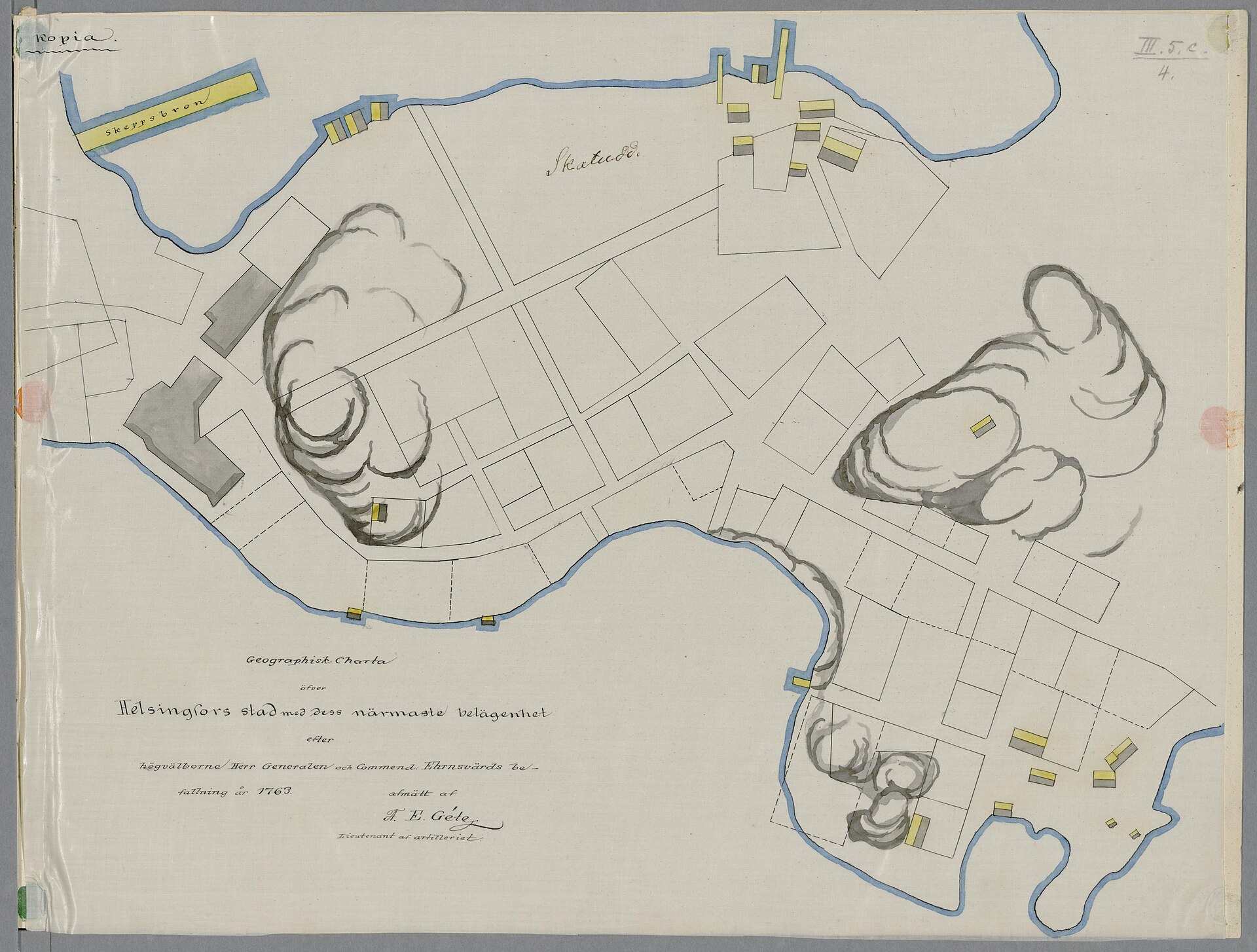
Geographisk charta öfver Helsingfors stad med dess närmaste belägenhet (surveyed by A. E. Géte)
Shows Helsinki's shoreline and harbour, the town's regular street grid and rectangular building blocks, quays and small clustered buildings on headlands.
1763 · surveyor A. E. Géte · Wikimedia Commons
CC0 (plate dated 1763)
In this city
Landmarks of Helsinki, see each in its prime


More cities to explore
 EstoniaTallinnExplore it in 1450 · 1560 · 1900
 FinlandTurkuExplore it in 1500 · 1825
 NetherlandsUtrechtExplore it in 1400 · 1700
 EnglandLondonExplore it in AD 200 · 1390 · 1600 · 1885
Castles of Europe · Landmarks of Europe · create your own reconstruction.