Historic Cities · Estonia
Tallinn through the ages
Tallinn is the capital and most populous city of Estonia. Located on a bay in northern Estonia, on the shore of the Gulf of Finland of the Baltic Sea, it has a population of 452,563 as of 2026 and administratively lies in Harju County. As of 2024, the population of the Tallinn metropolitan area is estimated at 646,315.

Tallinn in 1450
Hanseatic Reval
This walk visits Reval at the height of its Hanseatic prosperity: a fortified port town where Germanic merchants and Baltic traders meet. Expect limestone walls and dozens of defensive towers, a busy wooden quay stacked with salt and furs, broad merchant houses with hoists, and the twin heights of Toompea and the market-dominated Lower Town.
Reval in 1450 is a compact, crenellated silhouette of pale Ordovician limestone and red tile: high church spires, stout round artillery towers, and steep-roofed Gothic merchant houses crowded along narrow cobbled streets. The lower harbour is a forest of masts and booms beside blocky stone storehouses; Toompea rises as a turf-capped limestone island above the town. Colours are iron-grey stone, soot-dark timbers, and the browns and muted dyes of merchant dress.
The route: 21 streets, squares and views
Reval Bay Approach → Fat Margaret Tower → Lower Harbour Quays → Salt and Fur Warehouses → Viru Gate → Viru Street → Pikk Street → Pikk Street Merchants' Houses → Town Hall Square → Town Hall Pharmacy → …
Step inside, 14 interiors
Tower Gunroom · Shipwright's Workshop · Salt Storehouse · Gate Guardroom · Trading Hall · Council Chamber · Apothecary's Shop · Merchants' Hall · Confraternity Banquet Chamber · Mariners' Nave · High Choir of the North Spire · Fishwives' Hall · Hilltop Great Hall · Knights' Chapter House
Planned from the Wikipedia record: Tallinn.
Tallinn in 1560
Livonian War Reval
Reval stands at the fulcrum of the Livonian collapse: the town’s councils and merchants weigh Swedish protection while Russian armies and neighbouring powers rearrange the map. The walk shows stone walls topped with new cannon embrasures, crowded quays and guild-lined streets, mercenary camps and the great church spires that still define the skyline.
A compact Hanseatic port of stone and timber, Reval in 1560 reads as grey limestone walls, red-brown clay roofs, and a scatter of tall wooden church spires, St Olaf's towering above them all. Narrow cobbled lanes run between dense blocks of timber-framed houses and merchant brick façades; the harbour is thick with mast and tar, while artillery towers and fresh embrasures puncture the city curtain, smoke from hearths and forge-blasts smelling of iron and pitch.
The route: 22 streets, squares and views
Tallinn Bay (Reval Harbour) → Paks Margareeta Tower → Old Harbour Quay → Fish Market Quay → Viru Gate → Viru Street → Pikk Street → Great Guild Hall → Town Hall Square → Raeapteek (Town Pharmacy) → …
Step inside, 12 interiors
Sea-Facing Gun Platform · Merchants' Fraternity Chamber · Council Chamber · Apothecary Shop · Carved Choir · Soaring Nave · Upper Gun Deck · Powder Chamber · Embrasure Chamber · Stone Audience Chamber · Muster Courtyard · Anchor Forge
Planned from the Wikipedia record: Livonian War.
Tallinn in 1900
Tsarist Tallinn
This is Reval at the height of the Russian imperial era: newly crowned on Toompea by the onion domes of Alexander Nevsky Cathedral, a busy Baltic port sending steamers to St. Petersburg and a city where Estonian national feeling gathers in mass song. The walk moves from the harbour into the medieval streets, climbs Toompea and follows promenades and parks where citizens, dockworkers and park strollers share the same summer light.
A compact medieval silhouette of stepped gables, brick guildhouses and church spires sits beneath the limestone rise of Toompea, now punctuated by the glossy black-and-gold onion domes of the new Alexander Nevsky Cathedral. Narrow cobbled lanes open to bright market squares; the harbour shows cranes, wooden quays and coal-streaked steamers. Outside the walls, wooden fishermen’s rows and tree-lined imperial parks give way to brick workshops and railway sheds, all under cool northern light.
The route: 23 streets, squares and views
Reval Bay Approach → Fat Margaret Tower → Great Coastal Gate → Harbour Quay and Customs → Pikk Street → Great Guild Hall → Town Hall Square → St. Nicholas Square → Kiek in de Kök → Pikk Jalg Stair → …
Step inside, 12 interiors
Tower Gunroom · Customs Examination Hall · Merchants' Great Hall · Council Chamber · St. Nicholas Nave · Commandant's Chamber · Main Iconostasis · Railway Waiting Hall · Slipway Engineworks · Fish Market Hall · Grand State Hall · Choir Rehearsal Hall
Planned from the Wikipedia record: Tallinn.
Its story
The story of Tallinn.
Toompea, the Danish Conquest and Lübeck Rights, 3000 BCE–1265
Archaeological traces of a small hunter-fisher community in what is now the city centre are about 5,000 years old, the comb ceramic pottery dating to around 3000 BCE and corded ware to around 2500 BCE. A fortress was built on the hill of Toompea around 1050. Earlier researchers supposed that a stronghold, a harbour, a market and Russian and Scandinavian trading yards stood here before the conquest, but excavation has produced no firm finds for it and the written sources mention nothing beyond the stronghold. What made the site matter was its position as a port on the trade route between Novgorod and western Europe, and that made it a target when the Teutonic Order and the Kingdom of Denmark expanded during the Northern Crusades, a campaign in which Roman Catholic Christianity was imposed on the local population by force. The people of northern Estonia were among the last in Europe to be Christianised.
Valdemar II of Denmark's forces took the place in 1219, the year of the battle of Lyndanisse, fortified Toompea and raised a first wooden Dominican church. The Estonian name Tallinn has widely been taken as a derivation of Taani-linna, 'Danish castle', conceivably from the castle the invaders built on the site of the Estonian stronghold; from the thirteenth century the town was more widely known as Reval, a name drawn from the surrounding Estonian county of Revälä and preferred by the local Germans. The founding of the town proper can be dated to 1230, when the Order of the Brothers of the Sword, then briefly holding the place, brought in 200 German merchants from Gotland, settled them at the foot of Toompea and secured them burgher status and the rights that went with it. Lübeck town law was adopted on 15 May 1248; what law applied before is not known. In 1265 Margrete Sambor, mother of King Erik V and vicereine of Estonia, ordered the building of the earliest known defence work, the Margaret wall.
The Northernmost Hansa Town, 1285–1550
In 1285 Reval became the northernmost member of the Hanseatic League, the German-dominated mercantile and military alliance of northern Europe. Much of the transit trade between western Europe and Novgorod gathered into the hands of its merchants; the town was granted Hanseatic staple right in 1346, and after the Danes destroyed Visby in 1361 its weight in the trade and politics of the eastern Baltic grew further. The stretch from the early fifteenth century to the middle of the sixteenth was the town's flourishing period, when it led the League's eastern trade. By the mid-sixteenth century perhaps 7,000 to 8,000 people lived inside the walls, with more in the suburbs; the fortifications ran to 66 defence towers, and the lower town was fully enclosed by 1355.
Rule changed hands repeatedly above the merchants' heads. After the St George's Night Uprising of 1343 was put down by the Livonian Order, the important Danish castles of the duchy passed to the Order (Tallinn and Rakvere in 1343, Narva in 1345), and in 1346 Valdemar IV sold his Estonian possessions to the Teutonic Order's master Goswin von Herike for about 19,000 Cologne marks, roughly four tonnes of silver; the following year they were pledged on to the Livonian Order. Under Lübeck law the town below was effectively self-governing regardless. Toompea was another matter: it kept land and knightly law, held the seat of the Roman Catholic bishopric, and remained a separate town of largely aristocratic residents until 1877. In 1319 the Danish king granted a school privilege giving the cathedral chapter the sole right to keep a school and forbidding others; the cathedral school is first mentioned the same year.
Iconoclasm and the Feud with Lübeck
On 14 September 1524 a crowd of several hundred Germans and Estonians broke into the Dominican church of St Catherine, St Olaf's and the Church of the Holy Spirit and destroyed the images, statues, altars and relics held to be symbols of the old faith. Early in 1525 the town decided in favour of the Lutheran confession, though it was formally adopted only in the 1530s, after Lübeck itself had abandoned Catholicism. The weathervane figure of an old warrior, Old Thomas, was set on the town hall spire in 1530.
Trade fell away in the second half of the sixteenth century, partly with the general decline of Hanseatic commerce and the shifting of trading relations, and partly through a quarrel with Lübeck. From about 1516 Tallinn, and to a degree Tartu, tried to stop Lübeck merchants trading directly in the hinterland of the Livonian towns. Lübeck's ships answered by sailing past Tallinn altogether, straight to Narva and Vyborg, and relations between the towns worsened.
Swedish Rule, Bombardment and the Plague Siege, 1558–1721
War between Old Livonia and the Tsardom of Muscovy began in 1558, and the last master of the Livonian Order could not hold northern Estonia against Ivan the Terrible's forces. On 4 June 1561 the knighthoods of Harju, Viru and Järva swore allegiance to the king of Sweden, and on 6 June the lower town and its burghers gave their oath to Erik XIV and accepted Swedish authority; the former Order castle on Toompea surrendered after a siege. Northern Estonia was made the province of Estonia, with Tallinn as its centre and the seat of its governor. The Polish–Lithuanian Commonwealth also claimed the town as territory incorporated by the Treaty of Vilnius of 1561 and offered Sweden financial compensation for it, which Sweden refused; the dispute was one of the main reasons no Polish–Swedish alliance against Russia was formed in the 1570s.
In July 1569, during the Northern Seven Years' War, a combined Danish and Lübeck fleet came into Tallinn Bay, bombarded the town from the roads for thirteen days, stripped the harbour bare and carried off more than thirty merchant ships. Fighting resumed in northern Estonia in 1570, bringing the first and second sieges of Tallinn, in which the suburbs and surrounding lands were plundered and the Pirita convent destroyed. Later Swedish–Polish wars were fought in southern Estonia and Latvia and did not reach the town. Under the Swedish crown the Baltic became in effect a Swedish inner sea and seaborne trade grew safely; Narva's Russian trade grew so fast that by the middle of the seventeenth century the Swedish authorities weighed making Narva, rather than Tallinn, the capital of the Baltic provinces.
The Great Northern War reached the town only on 15 August 1710, when Russian forces surrounded it and cut off both food supplies and drinking water from Lake Ülemiste. Over a siege of 45 days in which no fighting took place, plague and hunger killed most of the garrison and the townspeople, about nine in ten. On 29 September 1710 the town, the Estonian knighthood and the Swedish garrison surrendered to Peter I. Sweden formally ceded Tallinn and the surrounding lands to the Russian Empire at the Peace of Nystad in 1721. The local institutions of self-government, the Magistracy of Reval and the Estonian Knighthood, kept their cultural and economic autonomy within the Governorate of Estonia.
Naval Base, Factories and Russification, 1721–1918
Tallinn and Paldiski mattered to the empire chiefly as naval ports on its western frontier. A viceroyalty replaced the governorate in 1783 and was wound up after Catherine II's death in 1796, when Paul I restored the Governorate of Estonia with Tallinn still its capital; in the last quarter of the eighteenth century the teaching of Russian was made compulsory in the schools of the Baltic governorate towns. Growth was held back by a building ordinance of 14 April 1825 restricting construction in the fortress and its suburbs, the ground around the fortress being divided into four distance zones, and the Defence Barracks were built on the bay between 1829 and 1840 by order of Nicholas I to protect the naval harbour. The restrictions were lifted only after 1 January 1858, when Tallinn was struck from the list of imperial fortresses.
Industry followed. Factories multiplied through the century (among them the Krull machine-building works in 1865, the Luther furniture factory in 1880, the Volta machine works and the Dvigatel wagon factory in 1899), and the Baltic Railway, built in the 1870s, linked the ports of Tallinn and Paldiski through Narva and Gatchina to St Petersburg and the interior governorates. The port kept its importance. Russification measures grew stronger in the closing decades of the century, and the Magistracy of Reval was abolished in 1889. Off the coast in June 1908 Nicholas II and Alexandra met Edward VII and Queen Alexandra, a meeting read as royal confirmation of the previous year's Anglo-Russian Entente and the first visit by a reigning British monarch to Russia. On 24 February 1918 the Estonian Declaration of Independence was proclaimed in the city; German occupation followed until the end of the war that November, after which Tallinn became the capital of independent Estonia.
Two Occupations, the Raid of 1944 and the Soviet Decades
Estonia was occupied by the Soviet army and annexed to the USSR in the summer of 1940, then occupied by Nazi Germany from 1941 to 1944. During the German occupation the city was bombed repeatedly by the Soviet air force. In the most destructive raid, on the night of 9–10 March 1944, more than a thousand incendiary bombs were dropped, starting large-scale fires; 757 people were killed, 586 of them civilians, and 20,000 were left without shelter. The German forces withdrew in September 1944 and the city was occupied again by the Soviet Union.
The half-century that followed changed who lived there. Ethnic Estonians had made up over 80 per cent of the population before the Second World War; by 2022 they were just over 53 per cent. As an urban area of industrial and military significance, Tallinn took a large influx of migrants from Russia and other parts of the USSR, and whole new districts (Mustamäe, Väike-Õismäe, Pelguranna and above all Lasnamäe, the most populous district of the city since the 1980s) were built by the Soviet authorities with the intent of housing Russian-speaking incomers. Around a third of the city's residents are first- and second-generation immigrants from Russia and the former Soviet Union, a majority of the Soviet-era arrivals now Estonian citizens. The sailing events of the 1980 Summer Olympics were held at Pirita, and the television tower, the Olümpia hotel, the new main post office and the Regatta Centre were built for them.
Capital of a Digital Republic, 1991–2025
Estonian independence was restored in 1991, and on 20 August that year Tallinn became once again the capital of a de facto independent country. The Old Town, Toompea included, was inscribed as a UNESCO World Heritage Site in 1997; the city hosted the Eurovision Song Contest in 2002 and was European Capital of Culture in 2011, sharing the title with Turku. It received the European Green Capital Award for 2023 and has pledged to cut greenhouse gas emissions by 40 per cent by 2030, though critics argued the award rested on false promises, since the '15-minute city' concept the bid won on was left out of the programme that followed and much of the remaining twelve-million-euro spend went on temporary, one-off projects.
More than half of Estonia's GDP is generated in the city, whose economy runs on information technology, tourism and logistics alongside its older functions as seaport and capital. Skype and Bolt both began here, and the NATO Cooperative Cyber Defence Centre of Excellence and eu-LISA, the European Union's IT agency, are based in the city. The Port of Tallinn is among the largest in the Baltic region. The population stood at 456,518 on 1 January 2025.
From the archive
Tallinn on paper: the old town as it was mapped.
A period plan or bird's-eye view of the old town, drawn between 1500 and 1850, the streets this page's reconstructions walk. Public domain, with its source named.
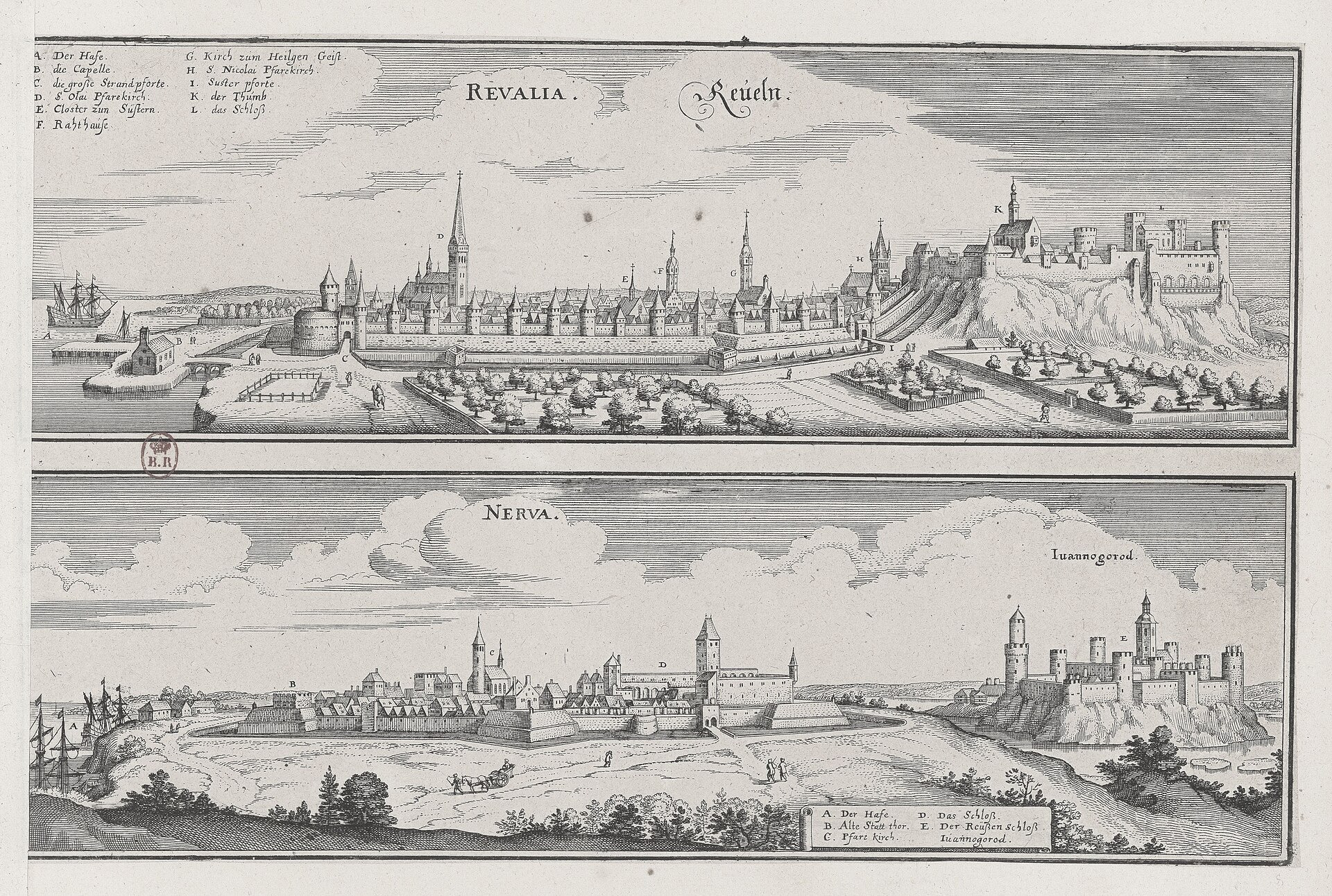
Bird's-eye view of Reval (Tallinn): 'Revalia' by Matthäus Merian
Walled Reval (Tallinn) showing the harbour, city walls and gates, multiple church spires and the Toompea castle on the rocky hill.
1650 · Merian, Matthäus (1593-1650). Cartographe · Wikimedia Commons
Public domain (plate dated 1650)
Ships tied to Tallinn
- German cruiser Nürnberg: Served the Soviet 8th Fleet from Tallinn as Admiral Makarov, its flagship from 1948
- SMS Schleswig-Holstein: Raised by the Soviets and towed to Tallinn, then beached as a gunnery target
Castles of Tallinn

More cities to explore
 FinlandHelsinkiExplore it in 1750 · 1900
 FinlandTurkuExplore it in 1500 · 1825
 NetherlandsUtrechtExplore it in 1400 · 1700
 EnglandLondonExplore it in AD 200 · 1390 · 1600 · 1885
Castles of Europe · Landmarks of Europe · create your own reconstruction.