Historic Cities · Russia
Moscow through the ages
Moscow is the capital and largest city of Russia, standing on the Moskva River in Central Russia. It has a population estimated at over 13 million residents within the city limits, over 19.1 million residents in the urban area, and over 21.5 million residents in its metropolitan area.

Moscow in 1500
Ivan III's Moscow
Moscow in 1500 is the ascending capital of the Grand Principality under Ivan III, with a freshly remade red-brick Kremlin at its heart and a sprawling wooden posad of merchants and craftsmen beyond. The walk moves from the river and approaches into the Kremlin, along trading rows and log-paved lanes, and finishes on the high stone of Borovitsky Hill looking back over the city.
The skyline is dominated by the new red-brick Kremlin walls crowned with swallowtail battlements and conical-roofed towers; inside its courtyards the Dormition Cathedral rises with five golden domes and the Faceted Palace shows its diamond-cut stone front. Outside the fortress a sea of wooden houses, shingle roofs and narrow log-paved streets stretches toward the Moskva, where rafts and wooden bridges cross brown water beside crowded trading rows and open market squares.
The route: 20 streets, squares and views
Sparrow Hills → Tver Road Approach → Arbat Street → Neglinnaya River Mouth → Kitay-gorod Quarter → Zaryadye Posad → Hollow Field (Poloye Pole) → Nikolskaya Gate → Spasskaya Gate → Konstantino-Elenensky Gate → …
Step inside, 13 interiors
Tver Road Inn Chamber · Icon Painter's Workshop · Posad Inn Hall · Gate Chapel of St Nicholas · Savior Gate Chapel · Assumption Nave · Faceted Chamber · Prince's Chapel · Boyar's Upper Chamber · Merchant's Counting House · Boatmen's Shed · Raftmen's Shelter · Fishmarket Hall
Planned from the Wikipedia record: History of Moscow.
Moscow in 1680
Tsar Alexis's Moscow
This is Moscow in the late seventeenth century, a dense capital still cradled by medieval walls and ringed by slobodas and monasteries. The walk moves from the Tver road into the Kremlin and across Kitay‑gorod's trading rows to the German Quarter and riverside quays, passing markets, sledges on packed snow and dozens of tent‑roofed churches and gilded onions crowded on the hill.
From afar the Kremlin hill reads as a forest of tents and onion domes: white stone walls and red towers, gilded cupolas flashing in low northern light, narrow wooden houses packing the slopes, and the layered roofs of Saint Basil's twisting above the hollow field. Kitay‑gorod's straight rows press eastward from the fortress toward the Yauza, while the Moskva River cuts a dark, reflective arc below the city.
The route: 22 streets, squares and views
Tver Road Approach → West Moskva Crossing → Spasskaya Gate → Hollow Field (Red Square) → Cathedral of the Intercession → Lobnoye Mesto → Ivan the Great Belltower → Terem Palace Exterior → Kitay‑gorod Wall and Towers → Ilyinka Street → …
Step inside, 13 interiors
Gate Chapel of the Saviour · Main Pokrovsky Nave · Upper Northern Chapel · Faceted Chamber · Bellsmen's Wood-lined Chamber · Tsarina's Painted Bedchamber · Terem Reception Chamber · Cloth Merchants' Covered Row · Goldsmith's Workshop · Great Covered Arcade · Fur Merchant's Counting-room · Timber Workshop and Showroom · German Merchant's Counting-house
Planned from the Wikipedia record: History of Moscow.
Moscow in 1890
Merchant Moscow
Moscow in 1890 is the great merchants' city of the Russian interior while the imperial court sits in Saint Petersburg. The walk moves from the river and the Kremlin into the shopping rows, Kitai‑gorod markets and the merchant mansions of Zamoskvorechye, showing horse trams, barges on the Moskva and new glass‑roofed trading arcades rising beside church domes and factory chimneys.
The skyline sits as a stitched horizon of onion domes, red‑brick museum towers, and squat Kremlin walls, pierced by church spires and the occasional factory chimney. Streets are narrow and cobbled in the centre, widening to arcaded shopping rows and embankment promenades. Building surfaces are brick, plaster and timber with fresh glass in new arcades; horse tram rails gleam on main streets and barges cluster along the Moskva.
The route: 22 streets, squares and views
Vorobyovy Gory (Sparrow Hills) → Borovitskaya Hill → Borovitskaya Tower Gate → Bolshoy Kamenny Bridge → Red Square (Ploshchad Krasnaya) → State Historical Museum → Upper Trading Rows → Cathedral of Vasily the Blessed → Nikolskaya Street → Kitai‑Gorod Walls → …
Step inside, 13 interiors
Kremlin Armoury Chamber · Great Hall of Historical Museum · Glazed Trading Arcade · Painted Nave of the Cathedral · Kitai‑Gorod Customs Office · Varvarka Church Refectory · Riverside Warehouse Counting Room · Tretyakov Picture Salon · Traktir Tea Room with Samovars · Merchant's Drawing Room with Paintings · Petrovka Haberdasher's Workshop · Bolshoi Auditorium Mid-Performance · Nave of Christ the Saviour
Planned from the Wikipedia record: History of Moscow.
Its story
The story of Moscow.
From Timber Fort to the Khan's Tax Collector, to 1389
The site was inhabited long before there was a town: finds on the Kremlin's ground belong to an Iron Age settlement of the Dyakovo culture. Finnic Merya and Muroma were among the pre-Slavic peoples of the area; around 950 the Slavic Vyatichi and Krivichi settled here. The city takes its name from the Moskva River, most plausibly from a Proto-Indo-European root meaning "wet", so that the name may signify a river at a marsh.
Moscow is first mentioned in the chronicles under the year 1147, as the place where Yuri Dolgorukiy and Sviatoslav Olgovich met - a minor town on the western border of Rostov-Suzdal. Dolgorukiy fortified it with a timber fence and a moat in 1156, and over that decade it became a fortified gorod with the first walls of the Kremlin. During the Mongol invasions of 1237-1238 it was sacked after the destruction of Ryazan; the Golden Horde burned it and killed its inhabitants. In 1263 the fort passed to Daniel, youngest son of Alexander Nevsky, as hereditary land, at the time reckoned the least valuable of his father's possessions.
Daniel came of age in the 1270s and from 1283 ruled an independent principality; in 1282 he founded the first monastery of Moscow, the wooden church of St Daniel-Stylite, now the Danilov Monastery. By his death in 1303 the principality had almost tripled in size, taking in the whole Moskva and its tributaries, a river network that made it self-sufficient and carried its trade. His descendants fought the princes of Tver for the grand princely throne: Yury won the khan's recognition in 1318 and lost the title four years later, and Ivan I recovered it by proving himself a loyal servant of the khan, collecting the Golden Horde's tribute from the dependent Russian princes and spending the proceeds on Moscow.
The metropolitan of the Russian Church moved his seat from Vladimir to Moscow; the first stone church, the Dormition Cathedral, was founded in 1326, and he chose to be buried in it - fixing the city as the spiritual centre of Russian Orthodoxy. The khan had backed Moscow to check the eastward expansion of the Grand Duchy of Lithuania, while meddling to stop it growing too strong. In 1353 the Black Death killed Simeon of Moscow, his sons and the metropolitan; the ruling house stayed small and succession settled into a line from father to son. In 1380 Dmitry Donskoy led a united Russian army to an important victory over the Mongols at Kulikovo, and on his death in 1389 the thrones of Vladimir and Moscow were permanently joined.
The Third Rome and the Italian Kremlin, 1425-1495
A civil war over Vasily II's succession opened in 1425, and Moscow changed hands several times before the last challenger was put down in 1450. Vasily rejected the Council of Florence and had the metropolitan arrested in 1441 for signing its union; seven years later Russian bishops elected a metropolitan of their own, which amounted to a declaration of autocephaly. The fall of Constantinople in 1453 was read in Russia as divine punishment for apostasy, and in 1492 the metropolitan called Moscow an imperial city for the first time. Under Vasily III the doctrine of Moscow as the "third Rome" developed further.
Ivan III, grand prince from 1462, fought the Tatars, united nearly all the Russian states with Moscow and laid the foundations of a centralised state. He conquered the far larger principality of Novgorod, which had allied itself with the hostile Lithuanians, enlarging his territory sevenfold to 2,800,000 square kilometres, and his defeat of the Tatars in 1480 traditionally marks the end of Tatar suzerainty. By 1500 the city held 100,000 people and was one of the largest in the world. Ivan had the Kremlin rebuilt by architects brought from Renaissance Italy: Petrus Antonius Solarius designed the wall and towers that still stand, completed in 1495. A trading settlement, or posad, grew east of the Kremlin at Zaradye, and in his time the Red Square, first called the Hollow Field, took shape.
Burned, Starved and Occupied, 1547-1682
In 1547 Ivan the Terrible was crowned in Moscow not only as grand prince but as the first tsar of all Russia; in the same year fires destroyed much of the town. In 1571 the Crimean Tatars, supported by the Ottomans, took the city and burned everything but the Kremlin; the annals record that only 30,000 of 200,000 inhabitants survived. When they attacked again in 1591 they were held off by walls built between 1584 and 1591 by a craftsman named Fyodor Kon, and in 1592 an outer earth rampart with 50 towers was thrown round the city, backed by a chain of fortified monasteries. The line of those ramparts is traced today by the Garden Ring.
The Russian famine of 1601-1603 killed perhaps 100,000 people in Moscow. From 1610 to 1612 troops of the Polish-Lithuanian Commonwealth occupied the city while their ruler Sigismund III tried to take the Russian throne; in 1612 Nizhny Novgorod and other Russian towns, led by prince Dmitry Pozharsky and Kuzma Minin, rose against them, besieged the Kremlin and drove them out. In 1613 the Zemsky Sobor elected Michael Romanov tsar, founding the Romanov dynasty. Further risings followed within the century: the Salt Riot of 1648, the Copper Riot of 1662 and the Moscow uprising of 1682.
The population doubled from about 100,000 to 200,000 in the first half of the 17th century, and the city spread beyond its ramparts. By the middle of the century a fifth of the inhabitants of Moscow's suburb came from the Grand Duchy of Lithuania, driven from their homeland by the Muscovite invaders. By 1682 there were 692 households north of the ramparts held by Ukrainians and Belarusians abducted from their home towns during the Russo-Polish War of 1654-1667; the district took the name Meshchanskaya sloboda, from the Ruthenian meshchane, "town people", a word that later acquired pejorative force. Disaster was regular: plague swept the city in 1570-1571, 1592 and 1654-1656, killing upwards of 80 per cent of the people in 1654-55, and fire burned out much of the wooden city in 1626 and 1648.
Plague, the Fire of 1812 and the Railway, 1712-1915
In 1712 Peter the Great moved his government to the newly built Saint Petersburg on the Baltic coast, and Moscow ceased to be the capital. Its population fell from 200,000 in the 17th century to 130,000 by 1750, then grew more than tenfold over the remaining life of the empire, reaching 1.8 million by 1915. Moscow State University was founded in 1755 and the Moskovskiye Vedomosti newspaper from 1756. The plague of 1770-1772 killed up to 100,000 people in the city, and a plague riot broke out from 15 to 17 September 1771.
When Napoleon invaded Russia in 1812 the Muscovites were evacuated, and the fire that followed is attributed principally to Russian sabotage; an estimated three-quarters of the city lay in ruin in its wake. A Commission for the Construction of the City of Moscow was established in 1813 and launched a large rebuilding programme with a partial replanning of the centre, taking in the Grand Kremlin Palace, the university and the Bolshoi Theatre.
The 645-kilometre railway to Saint Petersburg began operating in 1851, generally taken as the beginning of the country's railway era, and as the network grew Moscow became its central hub. In January 1905 the office of city governor, or mayor, was introduced and Alexander Adrianov became Moscow's first official mayor.
The Capital Returns and the Churches Come Down, 1917-1937
In November 1917, on learning of the uprising in Petrograd, Moscow's Bolsheviks began their own; Soviet power was established in the city on 2 November (15 November) after heavy fighting. Fearing foreign invasion, Vladimir Lenin moved the capital back from Petrograd to Moscow on 12 March 1918, and the Kremlin again became the seat of power.
The values imposed by communist ideology broke the tradition of preserving the city's heritage, and independent preservation societies, including those defending only secular landmarks, were disbanded by the end of the 1920s. An anti-religious campaign launched in 1929 coincided with the collectivisation of the peasants, and the destruction of churches in the cities peaked around 1932. Religious buildings were especially vulnerable in the capital of a deliberately secular state; among the losses were the Kazan Cathedral and the Cathedral of Christ the Saviour, both rebuilt in the 1990s, along with many smaller churches that were not. Stalin's plans for avenues, some more than ten lanes wide, were carried out at the cost of many historic buildings and districts, the Sukharev Tower among them. In 1937 letters were sent to the Central Committee proposing that Moscow be renamed Stalindar or Stalinodar; Stalin rejected the suggestion.
The Moscow Metro opened on 15 May 1935 as a Stalinist instrument to awe and control the population and school it in Soviet realist art. Lazar Kaganovich was in charge, and designed it so that riders would absorb the values of Stalinist civilisation. Soviet workers did the labour and the artwork of the 13 original stations, but the engineering designs, routes and construction plans were handled by specialists recruited from the London Underground. The secret police then arrested a number of the British engineers for espionage - that is, for having acquired detailed knowledge of the city's physical layout - and engineers of the Metropolitan Vickers Electrical Company were given a show trial and deported in 1933, ending the role of British business in the USSR.
Siege, Prefabs and the Ring Road, 1941-1991
During the war the State Defence Committee and the General Staff of the Red Army were based in Moscow, and in 1941 the city raised 16 divisions of national volunteers, more than 160,000 people. Many factories were evacuated with much of the government, and from 20 October the city was declared under siege; those who remained built and manned antitank defences while it was bombarded from the air. Between October 1941 and January 1942 German Army Group Centre was halted at the outskirts and then driven off in the Battle of Moscow. Casualty figures are disputed: for the period from 30 September 1941 to 7 January 1942, estimates run between 248,000 and 400,000 for the Wehrmacht and between 650,000 and 1,280,000 for the Red Army. On 8 May 1965 the city was awarded the title of Hero City.
The post-war housing crisis was met with high-rise blocks whose sections were built and partly furnished in the factory before being stacked into columns; over 11,000 such prefabricated blocks house most of the population. The pressure on religion resumed under Nikita Khrushchev, whose anti-religious campaign began in 1959: of the fifty churches operating in Moscow that year, thirty were closed and six demolished. The Moscow Ring Road opened in 1961 and marked the administrative boundary until suburbs beyond it were taken in during the 1980s. The city hosted the Summer Olympic Games in 1980, boycotted by the United States and other Western countries over the Soviet invasion of Afghanistan the year before, and in 1991 was the scene of a coup attempt by conservative communists opposed to Mikhail Gorbachev's liberal reforms.
Federal City of Thirteen Million, 1991 onwards
When the USSR was dissolved in 1991 Moscow remained the capital, now of the Russian Federation, governed as a federal subject and city of federal importance. The Kremlin is the official residence of the president, and the federal legislature, government and Supreme Court sit in the city; the Constitutional Court has been in Saint Petersburg since 2008. A market economy emerged after 1991, and the city now accounts for more than a fifth of Russia's gross domestic product.
Even as Russia's population shrank by six million after the fall of the USSR, Moscow kept growing, from below nine million to above ten during the 1990s and 2000s and to 13,010,112 at the 2021 census. On 1 July 2012 the city expanded south-west into Moscow Oblast, more than doubling its area from 1,091 to 2,511 square kilometres and gaining 233,000 people; the annexed territory was named Novaya Moskva, New Moscow. The city holds several UNESCO World Heritage Sites, and the Patriarch of Moscow, head of the Russian Orthodox Church, resides at the Danilov Monastery that Daniel founded in 1282.
From the archive
Moscow on paper: the old town as it was mapped.
A period plan or bird's-eye view of the old town, drawn between 1500 and 1850, the streets this page's reconstructions walk. Public domain, with its source named.
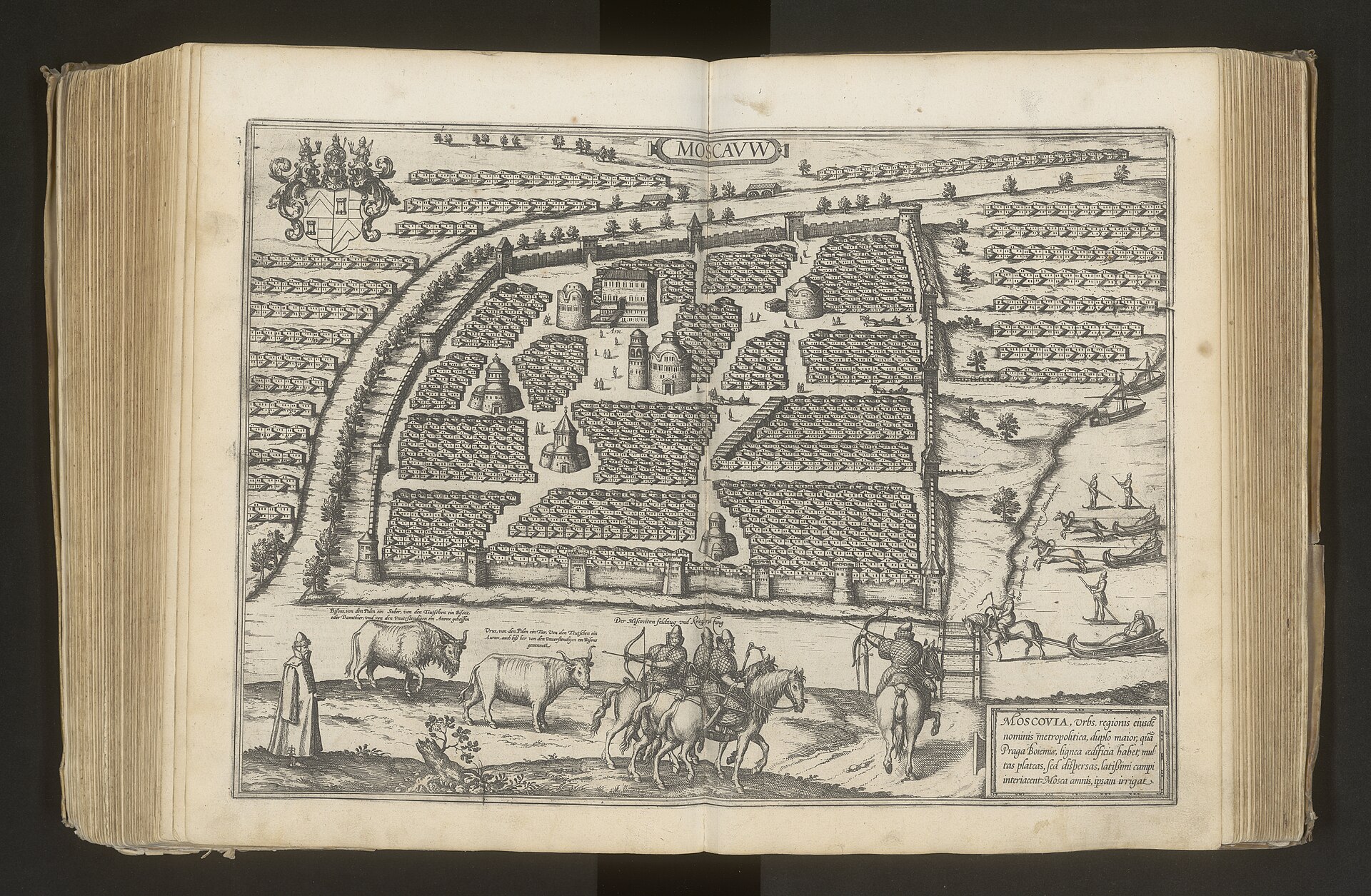
Bird's-eye view of Moscow, from Braun & Hogenberg's Civitates Orbis Terrarum
Walled old town showing curtain walls and towers, gates, clustered churches with domes, the riverbank with boats and rectilinear street blocks.
1612 · Georg Braun · Wikimedia Commons
Public domain (plate dated 1612)
In this city
Landmarks of Moscow, see each in its prime


More cities to explore
 RussiaSt PetersburgExplore it in 1760 · 1830 · 1913
 RussiaKitezhExplore it in 1237
 RussiaVeliky NovgorodExplore it in 1400
 NetherlandsUtrechtExplore it in 1400 · 1700
Castles of Europe · Landmarks of Europe · create your own reconstruction.