Historic Cities · Russia
Kitezh through the ages
Kitezh is a legendary and mythical city said to be beneath the waters of Lake Svetloyar in the Voskresensky District of the Nizhny Novgorod Oblast in central Russia. Reference to Kitezh appears for the first time in Kitezh Chronicle, an anonymous book from the late 18th century, believed to have originated among the Old Believers.

Kitezh in 1237
The Invisible City
This walk places the legendary city of Bolshoy Kitezh on the shores of Lake Svetloyar at the moment Batu Khan's host approaches according to the tale: a town of white‑stone churches, wooden gates and a lakeside path thronged with pilgrims. The route follows the pilgrim path, the birch‑lined shore, the monastery and the cathedral before the lake is said to hide the city from the eyes of the unready.
Kitezh's silhouette is low and spare: clusters of white‑stone churches capped by small gilded domes, a handful of wooden houses with steep shingled roofs, stout wooden palisades and gates, and a monastic complex by the water. Birch copses line a quiet shore and a narrow pilgrim track winds through dark forest. The palette is white, gold, dark timber and the deep blue‑grey of the lake; domes and crosses catch sunlight above a largely timber town.
The route: 9 streets, squares and views
Forest Road to Svetloyar → Batyeva Tropa → Wooden Outer Gate → Pilgrim Steps → Cathedral with Gilded Dome → Monastery Enclosure → Quay and Birch Shore → Town Market Square → High Bank Overlook
Step inside, 5 interiors
Prince's Stair · Icon Painter's Workshop · Cathedral Nave of the Holy Resurrection · Lakeside Bathhouse · Covered Market Hall
Planned from the Wikipedia record: Kitezh.
Its story
The story of Kitezh.
The Book Called the Chronicler, Compiled in the Late Eighteenth Century
Kitezh is a mythical Russian city, said to lie beneath the waters of Lake Svetloyar in what is now the Voskresensky District of Nizhny Novgorod Oblast. The earliest surviving account is the anonymous Kniga glagolemaya letopisets, the Book Called the Chronicler, sometimes referred to as the Kitezh Chronicle, which took its final form in the second half of the eighteenth century, and by one reckoning in the 1780s and 1790s, among the beguny or "runners", one of the priestless Old Believer groups. The historical dates the tale supplies do not correspond to reality.
The work is made of two separate and self-contained parts, both going back to the seventeenth century. In compiling the Tale of the City of Kitezh at the end of that century, the Old Believer authors appear to have drawn on the Kostroma Life of Yuri (Georgy) Vsevolodovich, who is the hero of the text and who suffers, in its words, "from Tsar Batu for the Christian faith and for the holy churches". The tale also gives the prince a fictitious pedigree, descending him from Saint Vladimir and making him the son of Saint Vsevolod Mstislavich of Novgorod, a genealogy that reinforces the motif of sanctity running through the whole legend.
What the Tale Tells: The Horde at Lake Svetloyar
In the account, Prince Georgy first builds Maly Kitezh, Little Kitezh, on the Volga, placed at present-day Krasny Kholm in the Yaroslavsky District of Yaroslavl Oblast, and sometimes identified with Gorodets, a town actually founded in 1152, more than thirty years before Georgy's birth in 1189. He then crosses the Uzola, the Sanda and the Kerzhenets, and on the shore of Lake Svetloyar builds Bolshoy Kitezh, Great Kitezh. Batu Khan, ruler of the Golden Horde from 1227 to 1255, is said to have heard of the town and sent his army towards it; Maly Kitezh falls, the prince withdraws into the woods, and a prisoner reveals the secret paths to the lake.
The tale has the Mongols reach a town with no fortifications at all, whose people make no attempt to defend themselves and pray instead for deliverance. As the attack begins, fountains of water are described bursting from the ground on every side, and the attackers fall back and watch the town go down into the lake, the last thing visible being the dome of a cathedral with its cross. The name Kitezh is popularly derived from Kideksha, the royal residence near Suzdal that the Mongols sacked in 1237, though Max Vasmer classed the place name as obscure.
The Historical Yuri Vsevolodovich and the Battle on the Sit
Real events lie under the story. Yuri Vsevolodovich, Grand Prince of Vladimir and Suzdal, fought Batu's army and was killed in an unequal battle on the River Sit. His association with Maly Kitezh, identified as Gorodets, has a historical basis: from 1216 to 1219, before he took the throne at Vladimir, the prince held Gorodets as an appanage. In 1237 Batu's army came up to Vladimir and Yuri withdrew into the Yaroslavl land, within which both Great and Little Kitezh were placed, and it was in the Yaroslavl land that the battle was lost.
V. L. Komarovich attempted to trace the legend to a documentary core in The Kitezh Legend: An Essay in the Study of Local Legends (1936), proposing among other hypotheses that the nucleus of the Kitezh chronicler was a fragment for the year 1164 taken from a lost Gorodets chronicle of Rostov origin. His reading was not taken further by later scholarship.
The Hidden City, Belovodye and the Path of Batu
The second part of the work, the Tale and Search for the Hidden City of Kitezh, carries no historical background at all. It belongs to the legendary and apocryphal literature of the earthly paradise, and the image of the hidden city sits between the earthly paradise of the oldest Russian apocrypha and Belovodye, the legendary land of happiness whose stories were popular among Russian peasants in the eighteenth century. The Kitezh legend joins traditions of natural disaster and foreign invasion to Christian motifs, and stands close to the folk tales of places that sank into the ground.
Around the text grew a body of claims about the lost city: that only those pure in heart and soul will find their way to it, that in calm weather bells and singing can be heard from under the water, and that the most pious may see the lights of religious processions and even buildings on the lake bottom. The road to the lake is still called Batyeva tropa, the Path of Batu. Lake Svetloyar is sometimes called the Russian Atlantis.
From Moskvityanin, 1843, to Rise of the Tomb Raider, 2015
The legend reached print in 1843, when S. P. Meledin set it out in the journal Moskvityanin. From there it passed into Russian art: Pavel Melnikov-Pechersky used it in In the Forests (1874), and Apollon Maykov, Nikolai Klyuev, Maximilian Voloshin, Sergei Gorodetsky, Maxim Gorky, Dmitry Merezhkovsky, Mikhail Prishvin and Konstantin Fedin all took it up, as did the painters Viktor Vasnetsov, Nikolai Roerich, Konstantin Korovin, Mikhail Nesterov, Ilya Glazunov and Nikolai Romadin. Nesterov painted Grad Kitezh (In the Forests) between 1917 and 1922; Konstantin Gorbatov painted The Invisible City of Kitezh in 1913 and The Sunken City in 1933.
Sergei Vasilenko wrote an opera on the legend in 1902, and Nikolai Rimsky-Korsakov's The Legend of the Invisible City of Kitezh and the Maiden Fevroniya (1907) fused it with motifs from Ermolai-Erazm's Tale of Peter and Fevronia. Anna Akhmatova took the city into the poem known as The Way of All the Earth, or Kitezhanka, the Woman of Kitezh. Yuri Norshteyn and Ivan Ivanov-Vano made the animated film The Battle of Kerzhenets (1971) from Rimsky-Korsakov's opera, the Strugatsky brothers borrowed the name in Monday Begins on Saturday (1965), and Werner Herzog devoted part of his documentary Bells from the Deep (1993) to people still searching for the city. The 2015 video game Rise of the Tomb Raider used a fictionalised Kitezh, relocated by its developers to north-eastern Siberia.
From the archive
Kitezh on paper: the city as it was pictured.
No surveyor ever drew this place. What survives instead is how it was imagined by the people who told its story: dated, public domain, with its source named.
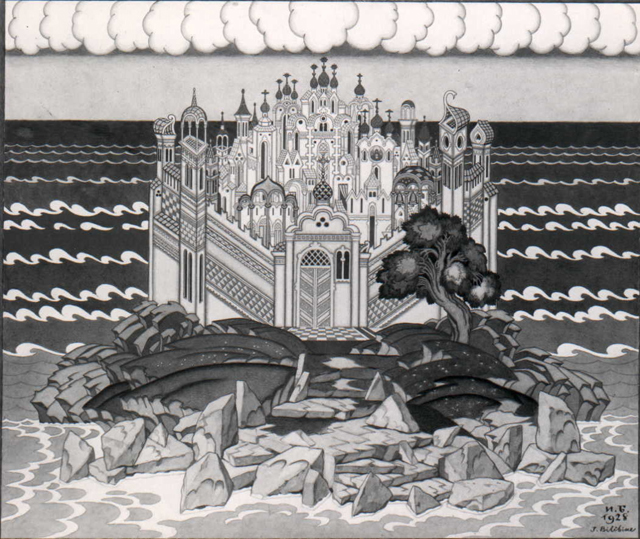
Grad Kitezh, Ivan Bilibin
Bilibin's drawing of the hidden city — walls, gate and crowded domes standing above the water. Made for the stage rather than from life; the city it shows has never been seen.
1928 · Ivan Bilibin · Wikimedia Commons
Public domain (drawn 1928)
More cities to explore
 RussiaSt PetersburgExplore it in 1760 · 1830 · 1913
 RussiaMoscowExplore it in 1500 · 1680 · 1890
 RussiaVeliky NovgorodExplore it in 1400
 NetherlandsUtrechtExplore it in 1400 · 1700
Other lost towns of Europe: Dunwich · Ravenser Odd · Rungholt · Vineta · Ys.
Castles of Europe · Landmarks of Europe · create your own reconstruction.