Historic Cities · France
Ys through the ages
Ys, also spelled Is or Kêr-Is in Breton, and Ville d'Ys in French, is a mythical city on the coast of Brittany that was swallowed up by the ocean. Most versions of the legend place the city in the Baie de Douarnenez.

Ys in AD 920
Kêr-Is Behind the Dyke
Kêr-Is is the low city built from the bay, held dry by a great sea dyke whose bronze sluice admits ships at certain tides. The walk moves from the approach across the Bay of Douarnenez, along the dyke and quays, past Gradlon’s palace and the cathedral square, to Dahut’s seaward tower and a high promenade that looks back over the city.
A low, compact skyline of stone and timber sits behind an immense stone dyke punctured by a single gleaming bronze sluice; beyond the wall the grey Atlantic stretches flat to the horizon. Gradlon’s palace flashes with pale marble, cedar panelling and glints of gilt, the cathedral’s spire rising a little above rows of low houses, quays sloping to tidal mud where small fishing boats ride at low water. Streets are narrow, windswept and salted by spray, the town’s colour largely the greys and browns of wet stone, wood and rope.
The route: 9 streets, squares and views
Douarnenez Bay Approach → Sea Dyke and Bronze Gate → Outer Slipway and Tide Channel → Lower Fishmarket Quay → Shipwrights' Row → Gradlon's Palace → Cathedral Square → Dahut's Tower → High Dyke Promenade
Step inside, 5 interiors
Sluice-Gate Chamber · Lower Fishmarket Hall · Shipwrights' Workshop · Great Hall of Gradlon · Cathedral Nave
Planned from the Wikipedia record: Ys.
Its story
The story of Ys.
Kêr Is, the Low City
In Breton the city is Kêr Is, which translates as 'low city' or 'city below': kêr is the Breton word for city, related to Welsh caer, Cornish ker- and more distantly Irish cathair, while Is answers to Welsh isel, Scottish Gaelic ìosal and Irish íseal, 'low'. The oldest Breton text in which it is named, the Ancien Mystère de saint Guénolé of the late fifteenth century, calls it an enezen a ys, 'the low island'. Most tellings place it in the Bay of Douarnenez, on the coast of Brittany.
The supposed site moved with the fashion of the telling while staying in Lower Brittany. Souvestre repeated the tradition placing the city in what is now the Bay of Douarnenez and set the still-visible part of its ruins on the Île Tristan; Paul Sébillot recorded that they had earlier been imagined at the Pointe du Raz. In the eighteenth century the city was placed in southern Finistère, and in the nineteenth writers such as Boucher de Perthes moved it north, towards Pontusval or between Perros-Guirec and Morlaix.
Le Baud's Chronicle, 1480, and the Saints' Lives
Legends about King Gradlon are much older than the drowned city, but the story of Ys itself appears to have taken shape between the end of the fifteenth century and the seventeenth. Its earliest known mention is in the Chronicques et Ystoires des Bretons of the Breton historian Pierre Le Baud, a manuscript completed in 1480. There Gradlon is king of the city and Dahut does not appear at all; the submersion is punishment for the sins of the inhabitants, Saint Corentin witnesses it and is afterwards consecrated bishop by Saint Martin, and Le Baud writes that Gradlon escaped miraculously, the remains still visible on the shore keeping the name Ys. The account is very short, but the story is already Christianised in it.
Sixteenth-century mystery plays on the life of Saint Winwaloe (Gwénolé) refer to the city, and in 1583 Bertrand d'Argentré recorded the belief in a drowned Ys while adding that there was no witness to it. Dahut enters in the seventeenth century, with Albert Le Grand's Vie des saincts de la Bretagne Armorique, which names her as the principal cause of the disaster and completes the Christianising by supplying divine punishment: Gwénolé warns Gradlon of the sins of a city given over to luxury, debauchery and vanity, God's wrath falls, and the king flees on horseback and takes refuge in Quimper. Arthur de La Borderie traced the luxurious, debauched court of every later version back to a second Life of Saint Guénolé, in which the saint reproaches Gradlon for the silks, the gold and the feasting he delights in.
The Key, the Dyke and the King's Daughter
The versions share a frame. Gradlon rules in Ys, a city built on land reclaimed from the sea and sometimes described as rich in commerce and the arts, his palace made of marble, cedar and gold; in some tellings he builds it at the request of his daughter Dahut, who loved the sea. A dyke keeps the water out, pierced by a gate opened for shipping at low tide, and the one key to that gate hangs on the king. Most versions make Gradlon pious and Dahut (sometimes called Ahez) wayward, frivolous, an unrepentant sinner or a sorceress, though in one old ballad it is Gradlon whom his own people blame for extravagances of every kind. Another strand holds that Ys was founded more than two thousand years before his reign, on ground then dry off the present coast, and that the sea already covered it at each high tide by the time he came to rule.
In most variants Dahut takes the key (of silver in some tellings, of gold in others) from her sleeping father, to let a lover in to a banquet or at that lover's flattering urging, and opens the gates in a wine-induced folly or by mistake, thinking she is opening the city gates. The sea kills everyone but the king. A saint, either Gwénolé or Corentin, wakes him and tells him to flee; he rides with his daughter behind him until a voice calls out, 'Throw the demon thou carriest into the sea, if thou dost not desire to perish', and Dahut falls from the horse. In Anatole Le Braz's version Gradlon throws her himself, on Gwénolé's order. In some tellings she becomes a morgen, a mermaid combing her golden hair and singing sad songs.
Émile Souvestre's telling departs from the rest. There Dahut keeps the silver keys about her own neck; she is a sorceress who has had the korrigans build works beyond men, and who tames sea dragons and gives one to every citizen. The people are rich enough to measure grain out with silver goblets, and their wealth has made them vicious: beggars are driven out like beasts, the church stands abandoned, and Saint Corentin's warning goes unheeded by Dahut and unenforced by a king who has lost his power. A red-clad, bearded stranger dances the city into a frenzy with his bagpipe, steals the keys, resumes his true shape as the demon and opens the dykes himself.
Barzaz Breizh to Guyot: the Legend in Print and in the Arts, 1839–1929
The story reached a wide public in the nineteenth century. Théodore Hersart de la Villemarqué's collection of popular songs, the Barzaz Breizh, appeared in 1839 and carried Breton folk culture into European awareness; the poem 'Livaden Geris', 'The Submersion of Ker-Is', was added in the second edition. Villemarqué worked from several versions of the song and assembled his own from the best of each, so his text carries traditions from different places at once: the stanza on Gradlon's horse, heard only once a year on the Black Night, may be borrowed from the Lai de Graelent, probably written in the late twelfth century. Elements appear to be adapted from the medieval Welsh poem on Cantre'r Gwaelod, a very similar legend of a land lost beneath the sea, in the Black Book of Carmarthen, which Villemarqué had studied at Jesus College, Oxford, in 1839; he wrongly took the Welsh of the sixth century to be the same language as the Breton of his own day.
Souvestre's 'Keris', in Le Foyer breton of 1844, did as much again for its currency (most nineteenth-century English tellings derive closely from it), though Souvestre is known for having rearranged and altered his material heavily. In the early 1890s Édouard Schuré's Les Grandes légendes de France introduced Malgven, a sorceress made Gradlon's wife and Dahut's mother, who then reappeared in retelling after retelling, including Charles Guyot's La Légende de la ville d'Ys d'après les anciens textes of 1926, which named the king's horse Morvarc'h and made it Malgven's gift. Françoise Le Roux and Christian-Joseph Guyonvarc'h regard both Malgven and the horse as literary invention rather than tradition, yet it is Guyot's version that has been told as the canonical Ys since the middle of the twentieth century, notably by Jean Markale and Michel Le Bris.
The artists followed the writers. E. V. Luminais's painting of Gradlon's flight from the city was a success at the Salon of 1884; Édouard Lalo's opera Le roi d'Ys, first performed in 1888, replaced Dahut with Margared, whose motive for opening the gates is jealousy of her sister's marriage; Claude Debussy's prelude La cathédrale engloutie was published in 1910, and M. C. Escher cut a woodcut of the same title in 1929.
Fragments Collected at Douarnenez and Callac
The oral tradition, when folklorists went looking for it, would not yield a whole story. Paul Sébillot found no complete spoken version and gathered only what he called debris, among them a version dated 1830 in which Ys could be saved by the blood of Christ: a mass was said and the chalice thrown from the top of the cathedral, and had anyone caught the vessel before it struck the ground and carried it unbroken to the Bay of Douarnenez to cast into the sea, the priest would have finished Saint Guénolé's mass and Ys would have come back to life as fine as it had been.
Anatole Le Braz collected fragments of the same body of belief in Lower Brittany, publishing them in La Légende de la mort en Basse-Bretagne in 1893 and in the enlarged edition of 1902. At Douarnenez in 1887 he took down from Prosper Pierre the motif of the city's sleep rather than its death: a sailor diving offshore saw a lit cathedral, and the rector told him that had he offered to serve the priest's mass, the whole city would have risen from the waves and France would have changed its capital. In Léon Marillier's introduction to the 1906 edition the drowned city is suspended rather than destroyed, everyone keeping the attitude they held at the moment of the catastrophe, the old women still spinning, the cloth merchants still selling the same piece of stuff to the same buyers. At Callac, Le Braz recorded a telling that put Ahez's dwelling a hundred leagues out to sea, from where she ranges the water singing, accompanied by a whale that devours the sailors she has seduced.
'Par Is': The City's Return and the Names It Explained
The legend also did explanatory work. The false etymology deriving Paris from Par Is, 'the equal of Is', is attested from Le Baud's first mention onward and has lasted into popular tradition; the printer Josse Bade compared the two names in 1526, and Souvestre recorded the nineteenth-century belief that the men of old time, looking for a name for their capital, called it Par-Is to declare their wish to match or surpass the splendour of Ys. Paris in fact takes its name from the Gaulish Parisii, whose capital Lutetia Parisiorum is the ancestor of the modern city.
A cluster of sayings turns on the city coming back. One that Le Braz recorded holds that on the day it happens, the first person to see the spire or hear the bells will become king of the city and all its territory; a Breton proverb has it that when Ys rises from the waves Brest and Ouessant will go down and Quimper be submerged. A version published in 1707 went the other way and prolonged the punishment: God allows the church bells to be heard still at the bottom of the ocean, and a storm sits permanently above the place where the city stood.
Dives off the Île de Sein, 2022–2025
Archaeological diving off the Île de Sein from 2022 revealed various underwater structures of human origin, among them a wall 120 metres long dated to 7,000 years ago. In 2025 marine archaeologists reported submerged ruins near the island, about six miles from the Bay of Douarnenez, and suggested that a real settlement lost to rising sea levels would have stayed in local memory and might lie behind the myth. Opinion on whether the city ever existed has long been divided: Arthur de La Borderie held that Ys had no historical reality at all, while Yann Brekilien wrote in 1981 that it had very certainly existed.
From the archive
Ys on paper: the city as it was pictured.
No surveyor ever drew this place. What survives instead is how it was imagined by the people who told its story: dated, public domain, with its source named.
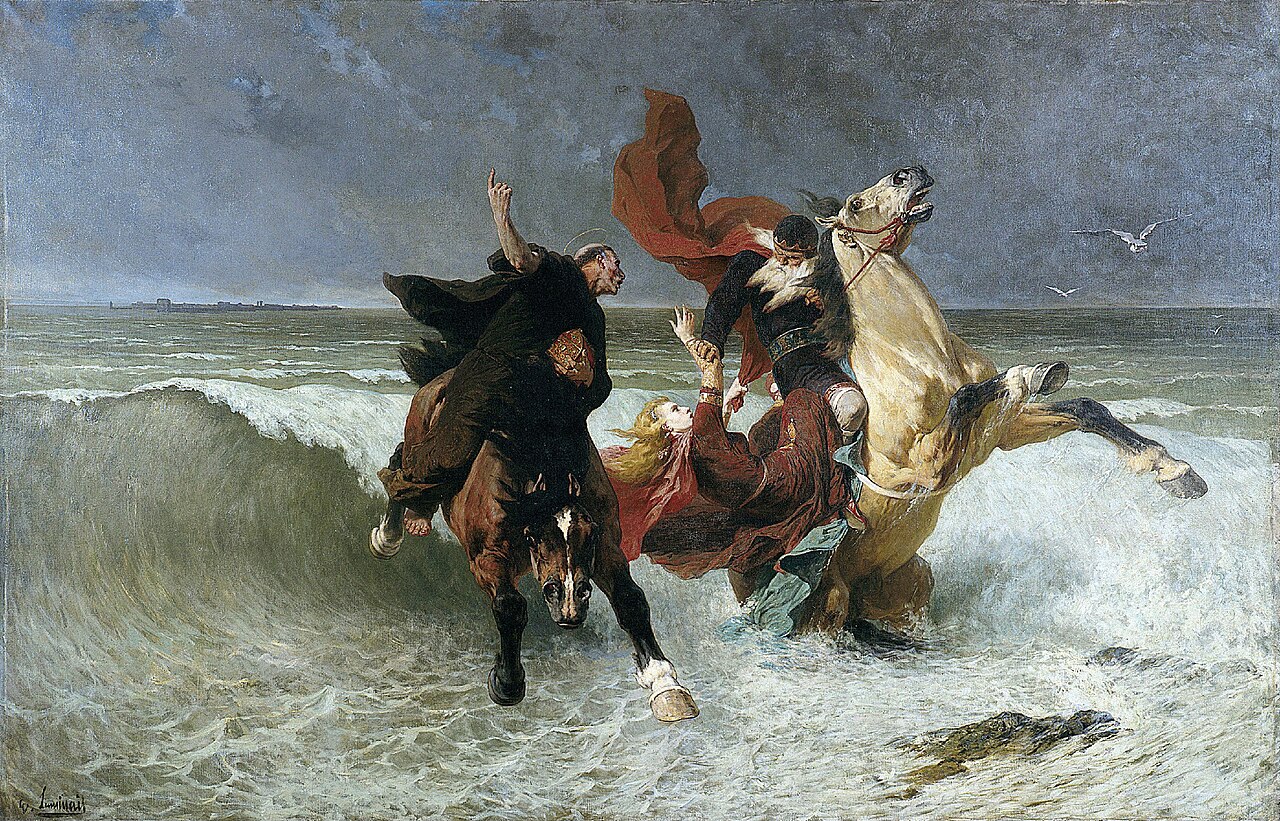
La Fuite de Gradlon, Évariste-Vital Luminais
The legend's best-known depiction: King Gradlon riding clear of the flooded city as Dahut is pushed from the saddle into the sea. A nineteenth-century painter's reading of the story, not a record of a place.
c. 1884 · Évariste-Vital Luminais · Wikimedia Commons
Public domain (painted c. 1884)
More cities to explore
 FranceSaint-MaloExplore it in 1720
 FranceMont-Saint-MichelExplore it in 1250
 FranceParisExplore it in 1250 · 1670 · 1789 · 1889
 FranceRouenExplore it in 1431 · 1540 · 1876
Other lost towns of Europe: Dunwich · Ravenser Odd · Rungholt · Vineta · Kitezh.
Castles of Europe · Landmarks of Europe · create your own reconstruction.