Historic Cities · England
Ravenser Odd through the ages
Ravenser Odd, also spelled Ravensrodd, was a port in the East Riding of Yorkshire, England, during the medieval period, built on the sandbanks at the mouth of the Humber estuary.
Ravenser Odd in 1340
The Port that Rivalled Hull
Ravenser Odd in 1340 is a compact sandport at the mouth of the Humber, still repairing quays and handling dozens of merchant ships in a season. The walk follows the single road across the bank, along timbered wharves and stores, past the market cross and chapel, and ends at the seaward promontory where seabirds and breakers govern the horizon.
Low rows of timber houses and piled warehouses lean from the sandbank; wharves and jetties of weathered oak thrust into the Humber where masts and white sails slip past on the ebb. The palette is tar-black rope, salted brown planking, faded cloth and the grey-green of the estuary, with constant wind, spray and squawking seabirds. Scale is modest, a tight cluster of streets and quays stitched to the single causeway that links the bank to the mainland.
The route: 10 streets, squares and views
Approach from the Humber → Harbour Quays → Custom House → Warehouses on Piles → Market Cross → Main Street → Town Chapel → Court and Prison → Causeway to the Mainland → Ravenser's Ear
Step inside, 5 interiors
Quayside Taproom · Customs Chamber · Merchants' Loft · Chapel Sanctuary · Borough Court Chamber
Planned from the Wikipedia record: Ravenser Odd.
Its story
The story of Ravenser Odd.
Hrafn's Eyr: A Town Built on the Humber Sandbanks
Ravenser Odd, also spelled Ravensrodd, stood on the sandbanks at the mouth of the Humber estuary, in the East Riding of Yorkshire. The name Ravenser comes from the Old Norse Hrafn's Eyr, 'Raven's Ear', for the sandbank promontory that carried it; the modern successor of that lost promontory is Spurn Point. The Count of Aumale founded the town in the middle of the thirteenth century, on ground the estuary itself had thrown up.
A Hundred Ships a Year: Parliament in 1295, Charter in 1299
The town lived off the shipping that passed its mouth. It kept wharves and warehouses, a court and a prison, and collected dues from more than a hundred merchant ships a year. In the thirteenth century it was a more important port than Kingston upon Hull, further up the Humber.
It sent two members to the Model Parliament of 1295, and by 1 April 1299, when it was granted a borough charter, it had more than a hundred houses and a flourishing market.
Six Grants of Quayage, 1329–1347
As the sandbanks shifted, the town began to be swept away. The king granted the townsmen quayage, funds to repair their damaged quay, in 1329, and again in 1333, 1335, 1340, 1344 and 1347. The repairs did not hold. An inquisition held in 1346 found the ongoing flood damage so severe that only a third of the townsfolk remained.
Flooded Out: The Winter of 1356–57 and the Grote Mandrenke of 1362
Storms over the winter of 1356–57 flooded the town completely, and it was abandoned. What was left of it was largely destroyed by the storm known as the Grote Mandrenke, or Saint Marcellus's flood, in January 1362.
Searching for the Foundations off Spurn Point
The site is now completely underwater. In 2022 it was being searched for off Spurn Point, in the hope that the foundations of the seawall and the harbour would still be there to find.
From the archive
Ravenser Odd on paper: the place as it was mapped.
A period map that sets the place down, drawn between 1500 and 1850, the ground this page's reconstructions walk. Public domain, with its source named.
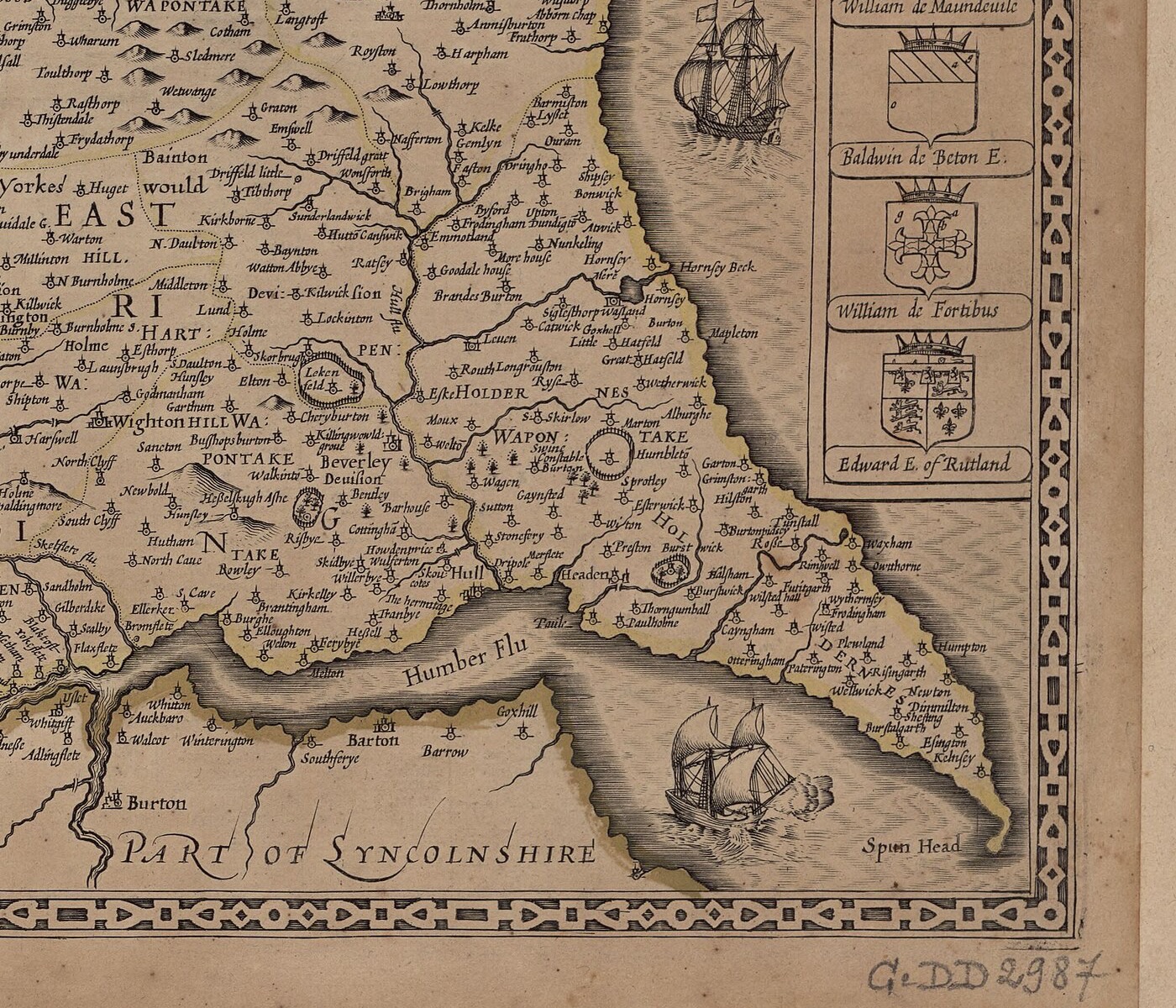
Spurn Head and Holderness, from John Speed's map of the North and East Ridings of Yorkshire
Speed draws the Humber mouth, Spurn Head and the crumbling Holderness shore where Ravenser Odd stood — the port itself already two and a half centuries under water when the plate was cut.
1610 · John Speed · Wikimedia Commons
Public domain (plate dated 1610)

More cities to explore
 EnglandLincolnExplore it in 1320
 EnglandYorkExplore it in AD 300 · AD 950 · 1420 · 1800
 EnglandLondonExplore it in AD 200 · 1390 · 1600 · 1885
 EnglandBathExplore it in AD 100 · 1500 · 1790
Other lost towns of Europe: Dunwich · Rungholt · Vineta · Ys · Kitezh.
Castles of Europe · Landmarks of Europe · create your own reconstruction.