Historic Cities · Sweden
Visby through the ages
Visby is an urban area in Sweden and the seat of Gotland Municipality in Gotland County on the island of Gotland with 24,330 inhabitants as of 2017. Visby is also the episcopal see for the Diocese of Visby. The Hanseatic city of Visby is one of the best-preserved medieval cities in Scandinavia, and, since 1995, it has been on the UNESCO World Heritage Site list.

Visby in 1350
The Hanseatic Rose
This is Visby at the height of its Hanseatic wealth: a compact limestone town ringed by a high stone wall and a dozen church towers rising above crowded packhouses. The walk follows the harbour pool and Strandgatan, passes merchants' yards and gate defences, and finishes on the heights where the town's churches and ships can be seen together.
A low, compact skyline of steep stepped-gable packhouses and church spires sits on pale Gotland limestone, the ring wall punctuated by stout towers. Red clay roofs and pale plaster faces catch the clear northern light above narrow streets; heavy timber hoist-beams project over the quay where clinker-built cogs lie huddled in the harbour pool. The whole town feels dense, sunwashed and sharply edged against Baltic sky.
The route: 15 streets, squares and views
Almedalen Roadstead → Kruttornet (Powder Tower) → Strandgatan Quay → Packhouses of Strandgatan → Liljehornska House → Gamla Apoteket → St Nicholas Church → St Karin and Friary → St Mary's (Vår Fru) → Rolandstorget → …
Step inside, 7 interiors
Kruttornet Powder Magazine · Cog Stern Cabin · Vaulted Packhouse Store Floor · St Karin Friary Cloister · St Mary's Bright Nave · Hansa Traders' Common Hall · Merchant Counting-House Chamber
Planned from the Wikipedia record: Visby.
Its story
The story of Visby.
The Sacrificial Place and the Harbour, 700–1161
The name is Old Norse: *vi*, a pagan place of sacrifice, and *by*, a settlement. The Gutasaga calls the place simply Wi, the holy place. The oldest finds here are structures read as beach huts, radiocarbon-dated to the seventh to ninth centuries. The burial ground found at Donners plats went out of use around the middle of the eleventh century, at roughly the point where the first traces of permanent settlement appear.
What made Visby dominant among those harbours was a guarantee. The Gutasaga holds that Gotland's first church, All Saints', was raised here, and the likeliest reason for building it was to create one place on the island where foreign merchants could be promised peace, matching the protection Gotlanders were given in foreign ports. Gotlandic coin was being struck in the town by about 1140, and the oldest known building still standing, the Kruttornet at the old harbour, has been tree-ring dated to between 1158 and 1161.
Merchants' Treaties and the Two Parishes, 1161–1294
In 1161 the Gotlandic merchants had their trading freedoms across Saxony confirmed by treaty with Henry the Lion. The Artlenburg document expresses the hope that the Gotlanders would visit Lübeck more diligently now that peace was restored, which implies a quarrel had preceded it, most plausibly Gotlandic alarm at growing German interest in the Novgorod market. The town first appears in surviving writing only in 1203, when Henry of Livonia's chronicle records pilgrims bound for Livonia putting in at Wysby and calls it a *civitas*, a large town. A council with both a German and a Gutnish bench is documented around 1231, far earlier than councils appear in other Nordic towns.
Both peoples lived in the town, and the older account of a German takeover has been overstated. The Gotlanders remained the leading element through the medieval centuries, holding the decision on the Russian trade throughout the thirteenth; as late as the end of the fourteenth they made up half the Visby merchants trading in the Netherlands and Flanders. What they took from the south was language and names. The arrangement produced a church settlement found nowhere else in Christendom: each of the three parishes below the Klint had two parish churches, one Gutnish and one German. The choir of St Mary's was consecrated on 27 July 1225, when Bishop Bengt of Linköping issued a charter of privilege for the town's burgesses; it too served two congregations under two priests.
The alliance with Lübeck did not last. After the Gotlandic trading yard in Novgorod was closed, Lübeck challenged Visby's leading position in 1294 and took it over by degrees.
Town Against Country: the War of 1288 and the Ring Wall
The quarrel that split the island in 1288 was not about trade. The farmers' own long-distance trading had largely ceased before the thirteenth century, and the ring wall, up by about 1270 at the latest, had been built for protection, with the countryside's agreement. The break came over tax. In 1285 the townsmen judged they had to meet King Magnus Ladulås's demand for an increase, against the country's wishes; the farmers answered by stationing a supervisor in the town, recorded in 1286. The burghers would not accept him, and in 1287 imposed tolls on the farmers' trade. Because all Gotland's long-distance trade went out through Visby harbour, that was a heavy blow, and the country attacked.
Magnus Ladulås intervened and, at Nyköping, found for the town, which was thereafter independent of the country. Visby was fined 2,000 marks for having waged war without the king's leave and for having built a wall around itself, a charge that is also the oldest surviving mention of the ring wall, and best read as the price of royal backing and of approval of the wall after the fact. Around 1300 the wall was rebuilt to its present height and acquired its towers; it still stands largely intact, 3.4 km around the old town.
Valdemar Atterdag and Korsbetningen, 1361–1408
In 1361 Valdemar IV of Denmark took Gotland. Eighteen hundred Gotlanders were killed in the battle fought before the town, at Korsbetningen east of the wall. What Visby did during that fighting is the hard part of the story: the likeliest reading is that the townsmen had gone back on an agreement with the farmers for a joint defence and stood by while the country levy, probably counting on help from inside, was cut down by Danish soldiers. Afterwards the inhabitants negotiated and gave up the town without a fight, in return for new privileges confirming its standing as a Hanseatic town. The tale that Valdemar burned or ransomed the town (with a merchant said to have talked the king into sparing it and plundering the farmers instead) is legend of uncertain footing, and may be a later attempt to excuse burghers who had broken their word.
Valdemar added King of Gotland to his titles, though he did not use it until 1362, with a first war against the Hanseatic towns in prospect. His handling of Visby helped push the League into that war, and although he was forced into concessions he kept the town; the Hanseatic diet of 1364 then declared Visby a free Hanseatic town, subject to neither Denmark nor Sweden. During the war between Albert of Mecklenburg and Queen Margaret the pirates known as the Victual Brothers established themselves on Gotland, taking and plundering the town in 1391, 1394 and 1398. They hit the burghers hard enough that the Teutonic Order intervened: 4,000 men landed in March 1398 and Gotland was handed over on 5 April.
Margaret then demanded the island for the Kalmar Union while the grand master demanded compensation for holding it. Danish forces besieged Visby from January 1404, lost heavily in a storming attempt on 25 February against a garrison the burghers backed, and settled for a truce that July. In 1408 the Order gave the island up to the union for 9,000 English nobles.
Visborg and the End of Hanseatic Visby, 1411–1534
Erik of Pomerania came to Gotland in 1411 and began building the castle of Visborg at the south end of the town, intending a permanent naval base from which to command the Baltic and extend the Kalmar Union around it. The war he started against the Hanseatic towns in 1426 was ruinous for Visby's trade, and when he settled in the castle in 1437, having left Denmark, he used the fleet lying in the roads for piracy of his own; commerce stopped. In 1441 a burgher wrote that he could not get off the island because of "war, warfare and hardship".
The union came for him. Christopher of Bavaria arrived in 1446 with 40 ships and 2,000 soldiers and besieged Visborg before a truce was agreed; two years later the Swedish king Karl Knutsson Bonde landed and took the town, but not the castle, which Erik defended in person. Relieved by a fleet sent by the new Danish king Christian I, Erik handed Visborg over to him against the promise of three Danish castles and 10,000 gulden a year, and died at Rügenwalde in 1459. The Danish period properly dates from the surrender of Visborg to Olof Axelsson Tott in 1448. In 1470 the Hanseatic League struck Visby off as a Hanseatic town, and when Lauritz Schinkel took the fief in 1509 he reckoned there were at most eighty people in the town he dared trust.
The end came in 1525. Søren Norby, holding Visborg for the deposed Christian II, was preying on Swedish, Danish and Hanseatic shipping alike, and Lübeck (backing Frederick I in the Danish succession quarrel) attacked at dawn on 12 May while Norby was campaigning in Blekinge. The town burned from four separate points, though the accounts differ on whose hand lit it: one has the Lübeckers firing it, the other the defenders, to delay the attackers as they fell back on the castle. Three churches went: the Dominicans' St Nicholas, the nuns' St Gertrude, and St James, already abandoned. The Reformation closed the rest, and in mid-Lent 1528 the burghers began taking their compensation for the sack out of the church of Drotten. In 1533–34 the Danish governor Henrik Rosenkrantz cleared the joined churches of St Hans and St Peter for the defence of Visborg, leaving St Mary's as the town's only working church.
Brömsebro to Bodisco, 1645–1808
Gotland returned to Sweden by the Treaty of Brömsebro in 1645, and the Swedish authorities set about encouraging Visby. War and epidemics undid most of it. In the spring of 1676 the Danish admiral Niels Juel landed at Klintehamn against no resistance at all and within two days had forced the town's small garrison to capitulate; the island stayed Danish until the end of the war, and when the peace obliged them to leave, the Danish commander blew up Visborg. Poverty is why so much of medieval Visby survives, from the sixteenth century to the eighteenth nobody could afford to pull down and build new. In 1720 the town had 1,186 people on the tax rolls; by the 1780s it briefly held a little over 5,000.
On 22 April 1808, during the Finnish War, 2,000 Russians under Admiral Nikolai Bodisco landed at Grötlingbo and marched on Visby without meeting resistance. They entered on 24 April, the inhabitants had to feed and house them, and Bodisco declared himself governor-general of Gotland. On 16 May Admiral Cederström landed Swedish troops at Sandviken in Östergarn; Bodisco capitulated without a drop of blood spilled, and the Russians marched out through the Österport on 17 May to embark at Slite. They had come after Easter by the Gregorian calendar but before it by the Julian one still used in Russia, so Visby kept Easter twice that year, and the cathedral became the first Swedish cathedral in which Russian Orthodox liturgy was celebrated.
Ruins, Steamers and the Tourist Town, 1866–2024
Decline had brought decay, but it had also spared the church ruins, the wall and the merchants' houses from active demolition, and in the early nineteenth century writers and artists began treating Visby as a monument. The economy turned with the traffic. Scheduled steamer sailings to the mainland began in 1866, and the first railway, Visby to Hemse, was started in 1878. A tourist trade begun in the mid-nineteenth century had grown into an established business by the turn of the century, and Gotland's tourist association, the oldest regional one in Sweden, was founded in 1896. The town had 8,375 inhabitants in 1900, ranking twenty-seventh in Sweden.
The twentieth century argued about what to keep. Building spread outside the wall and the population inside it fell away from the 1920s, and Östercentrum, laid out in the 1960s, shifted the centre of trade outside it. Clearing a whole block for the Borgen hall in 1958 drew no notable objection, but the demolition of the neighbouring Östertull block in 1972 produced the first modern public protest against demolition inside the walls. The railway had already gone: passenger services ended in September 1960 and the last of the harbour track was lifted in March 1964.
Almedalen Week, the political forum held in the park that was once the medieval harbour, was first held in 1968, and Medieval Week, now of real economic weight to the island, began in 1984. In 1995 the Hanseatic town of Visby was inscribed on the UNESCO World Heritage list, cited as an outstanding example of a north European walled trading town that has kept its townscape and its buildings. Employment shifted with the state: the decision to close Ericsson's factory, which had employed as many as 1,400 people on Gotland, came in 2003, while the National Heritage Board moved much of its work to Visby in October 2008. Higher education arrived in 1998 in the old malt factory and has been part of Uppsala University as Campus Gotland since 1 July 2013. The garrison, a fixture through the twentieth century, was wound up with its last regiment, P 18, after the 2004 defence resolution, and a new P 18 was raised in 2018. Visby holds around 26,000 people, is the seat of Region Gotland and of the Diocese of Visby, and is the only county seat in Sweden reachable from the mainland by boat and air alone.
From the archive
Visby on paper: the old town as it was mapped.
A period plan or bird's-eye view of the old town, drawn between 1500 and 1850, the streets this page's reconstructions walk. Public domain, with its source named.
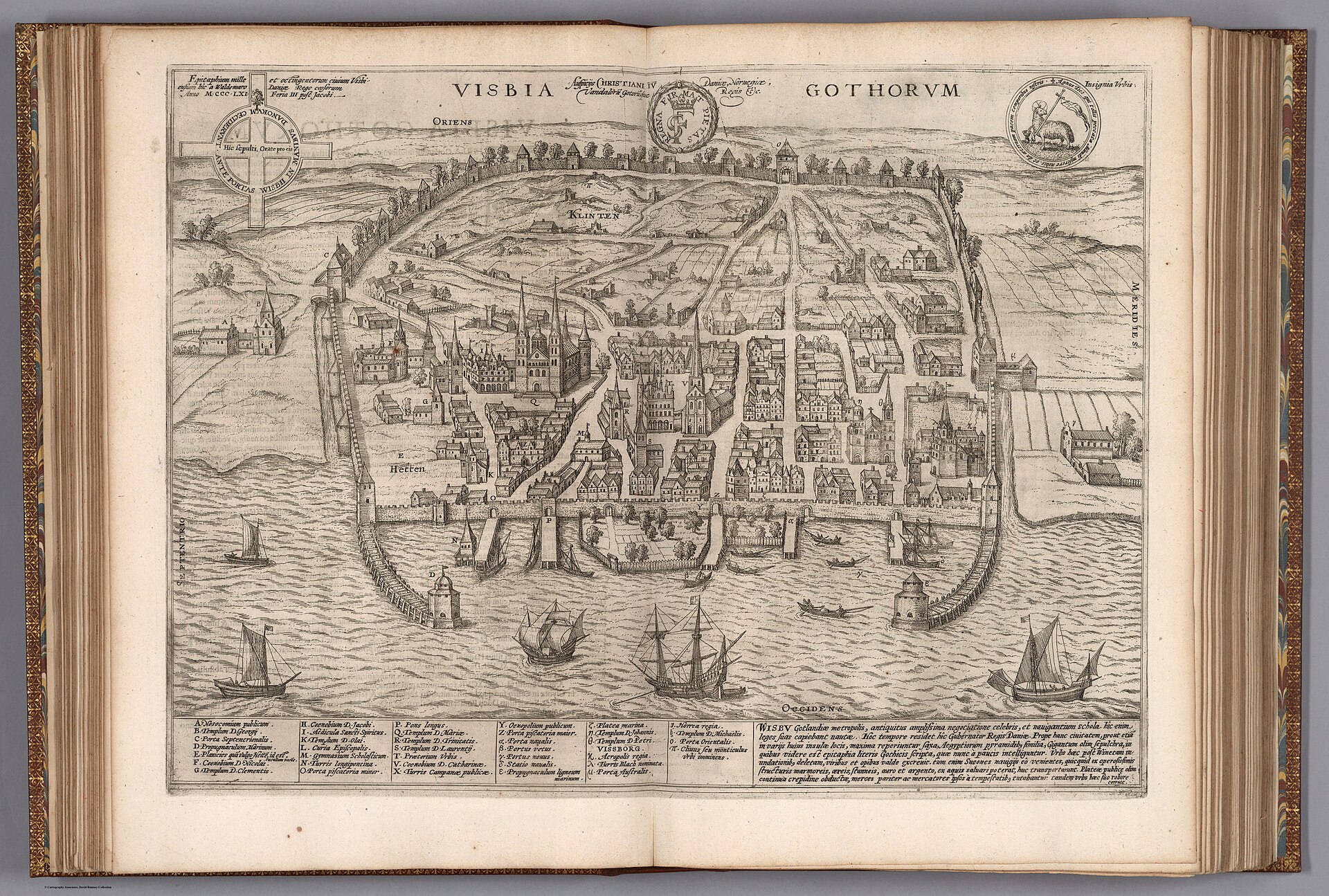
Bird's-eye view of Visby, from Braun & Hogenberg's Civitates Orbis Terrarum
Shows Visby's walled old town with sea-facing walls and piers, multiple defensive towers and gates, clustered church spires, and a clear street-block layout.
1590 · Braun och Hogenberg · Wikimedia Commons
CC0 (plate dated 1590)
Castles of Visby

More cities to explore
 SwedenStockholmExplore it in 1560 · 1690 · 1900
 NetherlandsUtrechtExplore it in 1400 · 1700
 EnglandLondonExplore it in AD 200 · 1390 · 1600 · 1885
 FranceParisExplore it in 1250 · 1670 · 1789 · 1889
Castles of Europe · Landmarks of Europe · create your own reconstruction.