Historic Cities · Sweden
Stockholm through the ages
Stockholm is the capital and most populous city of Sweden, as well as the largest urban area in the Nordic countries. Approximately 1 million people live in the municipality, with 1.6 million in the urban area, and 2.5 million in the metropolitan area. The city stretches across fourteen islands where Lake Mälaren flows into the Baltic Sea.

Stockholm in 1560
Vasa Stockholm
Stockholm in 1560 is Gustav Vasa's royal city: a densely packed medieval island dominated by the royal Tre Kronor castle and the Great Church, surrounded by busy wharves. Visitors will pass grain and iron squares, narrow merchant streets where German burghers trade, the castle slopes and waterfront chains, and islands with monastic ruins and shipyards.
The skyline is a tight cluster of gabled timber and half-timber houses, steep tiled roofs and church towers rising from a single crowded island ringed by wooden quays and small sailing ships. Colours are weathered oak, tar-blackened planking, ochre and red-painted façades, and the pale stone of Storkyrkan and the castle keep. Streets are narrow, shaded, and busy; the harbour is full of cranes, stages and piles of iron and copper awaiting export.
The route: 20 streets, squares and views
Stadsholmen from Mälaren → Kornhamnstorg → Kornhamn Quay → Järntorget → Järntorget Quay → Köpmangatan → Skomakargatan → Västerlånggatan → Österlånggatan → Stortorget → …
Step inside, 14 interiors
Cooperage · Iron Weighing House · Blacksmith's Forge · Merchant Shop and Storeroom · Shoemaker's Workshop · Merchant's Counting House · German Parish Nave · Nave with the St George Group · Castle Kitchen · Great Hall of the Keep · Castle Chapel · Chain Winch Chamber · Holy Spirit Hospital Ward · Shipwright's Loft
Planned from the Wikipedia record: History of Stockholm.
Stockholm in 1690
Imperial Stockholm
Stockholm in 1690 is the capital of a rising Baltic empire: a dense medieval island core ringed by new baroque palaces, naval quays and broad planned ridges. The walk follows the city’s working edges (castle and royal docks, palaces on Riddarholmen, the House of Nobility’s roofline, grain and silver unloading at the quays), before finishing on a high ridge overlooking the straits.
The skyline is a jumble of steep tiled roofs, church steeples and the low mass of Tre Kronor castle, pierced by tall masts and yards of warships at anchor along the eastern quay. Skeppsbron’s new palace façades and plastered merchant houses face narrow, cobbled lanes; Riddarholmen shows stone palaces and compact courtyards. The water is busy with rowing boats and laden hulks; colours are ochres, pale plaster, dark tarred wood and the green patina of copper roofs under clear northern light.
The route: 22 streets, squares and views
Riddarfjärden Approach → Södermalm Shore → Katarinabacken Vantage → Slussen Landing → Munkbron Quay → Västerlånggatan → Skomakargatan → Stortorget → Storkyrkan Exterior → Köpmangatan → …
Step inside, 12 interiors
Shoemaker's Workshop · Storkyrkan Stone Nave · Merchant's Counting Room · Copper Warehouse Bay · Granary Loft at Kornhamn · Royal Library Chamber · Royal Spiral Stair · Captain's Stern Cabin · Shipwrights' Frame Shed · Wrangel Palace Great Chamber · Noble Dining Hall · Shield-Hung Assembly Hall
Planned from the Wikipedia record: History of Stockholm.
Stockholm in 1900
National Romantic Stockholm
Stockholm at the turn of the century is a city of islands in swift change: boulevards and new National Romantic monuments rise beside medieval quay-rows and working docks. This walk follows ferries and horse trams between the new Nordic Museum and Skansen, across the palace and opera, into Söder's workshops and up to the cliffs that look out over the archipelago.
The skyline is an interlaced silhouette of brick towers, tiled roofs and mast‑packed quays, interrupted by the wrought-wire crowns of telephone and telegraph poles. Red-brown National Romantic façades and pale plaster houses face dark granite wharves; steam ferries trail black funnels through narrow channels while horse trams and bicyclists animate broad new boulevards. Light is cool and often clear over sea-smell and chimney smoke; scale shifts from intimate medieval lanes to open parks and harbour fronts.
The route: 22 streets, squares and views
Saltsjön Approach → Nybrokajen → Nybroplan and Grand Hôtel → Strandvägen Boulevard → Djurgårdsbron → Nordiska museet → Skansen Grounds → Rosendal's Gardens → Djurgårdsbrunnsviken Quay → Blasieholmshamnen → …
Step inside, 12 interiors
Winter Garden Conservatory · Stora Hallen · Halsingland Hearthroom · Archipelago Steamer Saloon · Grand Staircase Gallery · Merchants' Counting House · Central Telephone Exchange Office · Gilded Foyer · Royal Antechamber · Borshuset Trading Room · Shoemaker's Workshop · Cabinetmaker's Courtyard Workshop
Planned from the Wikipedia record: History of Stockholm.
Its story
The story of Stockholm.
Log Islet and the Karelian Threat
The name splits cleanly into two parts (stock, log, and holm, islet), and no serious explanation of it has been produced, which is why myths filled the gap. The explanation with most standing behind it concerns logs driven into the strait north of what is now the old town, dated by dendrochronological examination in the late 1970s to around 1000; the first element may also be connected to an old German word meaning fortification, and the islet is thought to be Helgeandsholmen.
The site appears in Norse sagas as Agnafit and in Heimskringla in connection with the legendary king Agne. In a longer view Stockholm is the capital of the Lake Mälaren region relocated: Birka held that position from roughly 790 to 975, Sigtuna from about 1000 to 1240. According to Erik's Chronicle the town is said to have been founded by Birger Jarl to protect Sweden from sea invasions by Karelians, after Sigtuna was pillaged in the summer of 1187. The earliest written mention of the name comes in letters of Birger Jarl and King Valdemar dated 1252, which say nothing of how the place looked.
Iron, Lübeck and the German Burghers
By the time the name was first written down, the mines of Bergslagen had made the site important to the iron trade, and the town rose on the Baltic commerce of the Hanseatic League, developing links with Lübeck, Hamburg, Gdańsk, Visby, Tallinn and Riga. German merchants invited by Birger Jarl are known to have mattered in its founding, and export was handled largely by those Germans, who lived by Kornhamnstorg, the grain harbour square, and Järntorget, the iron square. Craftsmen clustered around Stortorget and along Köpmangatan and Skomakargatan, merchant street and shoemaker street, whose names still record what was done in them.
By the close of the 13th century the place had become the largest town in Sweden and the de facto political centre and royal residence, and it has been inseparable from the Swedish government ever since. Its population at the end of the 15th century can be estimated at 5,000 to 7,000, small beside other European cities of the day but far larger than anything else in Sweden. Many of its inhabitants were Germans and Finns, the Germans forming the political and economic elite; there has been a Finnish minority in the city since the 13th century, and by the end of the 15th as much as a fifth of the population was Finnish.
Besieged for the Kingdom, 1436–1536
The city's oldest preserved charter, the Letter of Privilege of the Privy Council, was issued on 1 May 1436 as a reward for loyalty and service to the realm. It granted substantial rights and freedoms, confirmed the city as Sweden's political and economic centre, and is taken to mark the beginning of its standing as de facto capital. Whoever wanted the kingdom had to hold the city, and through the Kalmar Union of 1397 to 1523 it was besieged repeatedly by Swedish and Danish factions. A Danish fleet attacked and failed in 1452. Sten Sture the Elder beat Christian I at Brunkeberg in 1471, lost the city to Hans of Denmark in 1497, and took power again in 1501, which brought a Danish blockade from 1502 to 1509.
Christian II of Denmark took the city in 1520. On 8 November of that year many of its leading nobles and burghers were beheaded in the massacre known as the Stockholm Bloodbath, which set off the risings that broke the Kalmar Union. When Gustav Vasa besieged and took the city three years later, ending the union and the Swedish Middle Ages, he recorded that every second building in it stood abandoned. The city counted among the Hanseatic towns until 1536.
The Crown Takes the City, 1523–1611
Gustav Vasa restored the city's privileges but kept control by controlling the election of aldermen and magistrates, and much of the independence of the medieval town was lost as it became bound to the state; under Vasa's sons, from 1561 to 1611, the council still sat with a royal representative beside it. Vasa brought in the clergyman Olaus Petri (1493–1552) as city secretary, and with the two side by side the Reformation moved fast: sermons were preached in Swedish from 1525 and Latin was abolished in 1530. The large German-speaking and Finnish-speaking populations needed churches of their own, and the German and Finnish parishes, both still in existence, were created in the 1530s. The king ordered the demolition of the older churches and monasteries on the ridges around the city, along with its many charitable institutions.
Because the city had a wall it was exempt from the tax other Swedish towns paid, and under Vasa its fortifications were strengthened, with Vaxholm created in the archipelago to guard the inlet from the Baltic. The most important export was bar iron and the most important destination Lübeck; though Swedes settled in the city to trade under Vasa's sons, the trade and the capital behind it lay largely with the king and German merchants from Lübeck and Danzig. Around 1560 to 1580 most citizens, some 8,000 people, still lived on the central island of Stadsholmen, and Eric XIV's court made the royal castle the city's biggest employer.
Capital of an Empire, 1600–1697
The population reached 10,000 by 1600 and multiplied sixfold between 1610 and 1680, passing 50,000 by the mid-1670s. In 1634 the city became the official capital of the Swedish empire, and Chancellor Axel Oxenstierna wrote in 1636 that developing it was a prerequisite for the nation's power and strength. The rebuilding was set off by the great fire of 1625, which destroyed the south-western part of the present old town: Stora Nygatan and Lilla Nygatan were laid out, and along the eastern waterfront the medieval wall gave way to the row of palaces at Skeppsbron. New plans cut wide straight arteries through the ridges of Norrmalm, Östermalm, Kungsholmen and Södermalm, so thoroughly that in several districts no trace of the medieval layout survives.
Trade was the engine. Under the Bothnian Trade Coercion other Swedish towns lost their export privileges, and most of the lands around the Gulf of Bothnia became Stockholm's trade territory. Every good entering the city passed through one of six customs stations and roughly three-quarters were exported again; alone among Swedish towns it was wholly dependent on that transit, and by the second half of the century it could no longer be fed from the Mälaren region and depended on corn brought in from the provinces. Poverty was handled by new institutions: a first prison, Tukthuset, in 1624 with its inmates set to making textiles, and the Great Orphanage in Norrmalm in 1633. Begging was prohibited in 1642, including for those legally entitled to beg, where medieval opinion had granted poverty a religious worth, beggars were now taken to be idle, the right poor going to care houses and the rest to workhouses. Tre Kronor castle burned down in 1697 and was replaced in time by Stockholm Palace.
Plague, Stagnation and the Skeppsbro Nobility, 1710–1850
Plague killed about 20,000 people in 1710, some 36 per cent of the population. After the Great Northern War and the Treaty of Nystad in 1722 Sweden's standing as a European power was finished, growth halted and the economy slowed; the loss of Finland in 1809 removed the capital from the geographical centre of the kingdom, and the fortress of Karlsborg was built between 1819 and 1909 as a reserve capital for wartime. Between 1750 and 1850 the city stagnated, its population falling, with widespread unemployment, ill health, poverty, alcoholism and heavy mortality. War and drink left a surplus of women: in 1850 widows outnumbered widowers six to one. There were few children, and average life expectancy stood at 44.
The century was not without money. Mercantilism was pressed further, and it produced the Skeppsbro Nobility, the wholesalers of Skeppsbron who made fortunes shipping bar iron abroad and controlling the chartered companies; the Swedish East India Company, active from 1731 to 1813 and headquartered in Gothenburg, kept the city's shipyards busy, each ship recruiting 100 to 150 men here for voyages to China of one to two years. Repeated fires brought building codes that banned timber construction. Under Gustav III the city held its place as the political centre and grew as a cultural one: he laid out Gustav Adolf square and had the Royal Opera inaugurated there in 1782. Gustav IV Adolf was deposed in a coup in 1809. Most people still lived in the present old town; the ridges around it were largely rural slums without water or sewage, repeatedly swept by cholera.
Industry, the Lindhagen Plan and the Modern Capital, 1850–2022
In the second half of the 19th century the city regained its economic lead, turning into a trade and service centre and a gateway within Sweden. Industrialisation took hold around mid-century with the Ludvigsberg and Bolinder works of the 1840s and many that followed; gas works, sewers and running water came in during the 1850s and 1860s, the railway created the first suburb at Liljeholmen around its workshops, Central Station opened in 1871 and horse trams began running in 1877. In 1866 a commission under Albert Lindhagen produced a plan for the ridges meant to give people light, air and parks; in the 1880s more than 2,000 buildings were added there and the population rose from 168,000 to 245,000.
The growth came from migration out of poorer rural Sweden: by the end of the century fewer than 40 per cent of residents had been born in the city. Around the factories outside the customs boundary grew shacks whose sanitary conditions defied all description; these settlements were later made municipal societies so that health and building could be regulated. The Karolinska Institutet, formalised in 1811, and KTH Royal Institute of Technology, founded in 1827, were among the scientific institutes the century brought to the city; the General Art and Industrial Exposition was held on Djurgården in 1897, and the city hosted the 1912 Summer Olympics.
The municipal government moved into the Stockholm City Hall in 1923 and the metro opened in 1950. Industry shifted through the century from labour-intensive work towards high-technology and knowledge-based services. The Redevelopment of Norrmalm between 1950 and 1970 tore down much of the historic Klara district, to considerable controversy, though older blocks survived in Gamla stan, Södermalm, Östermalm and Kungsholmen. The city was integrated into Stockholm County in 1967 and its present municipal border fixed in 1971. It remains the capital of Sweden and the seat of its government and parliament, with a population of 984,748 in 2022; in December 2021 there were 252,750 foreign-born residents, 25.8 per cent of the total, the largest groups Iraqis, Finns, Iranians and Poles. Finnish, Meänkieli and the Sami languages hold protected minority status here, and Romani and Yiddish are recognised minority languages. Three synagogues serve a Jewish community of 4,300 members, the largest in Scandinavia.
From the archive
Stockholm on paper: the old town as it was mapped.
A period plan or bird's-eye view of the old town, drawn between 1500 and 1850, the streets this page's reconstructions walk. Public domain, with its source named.
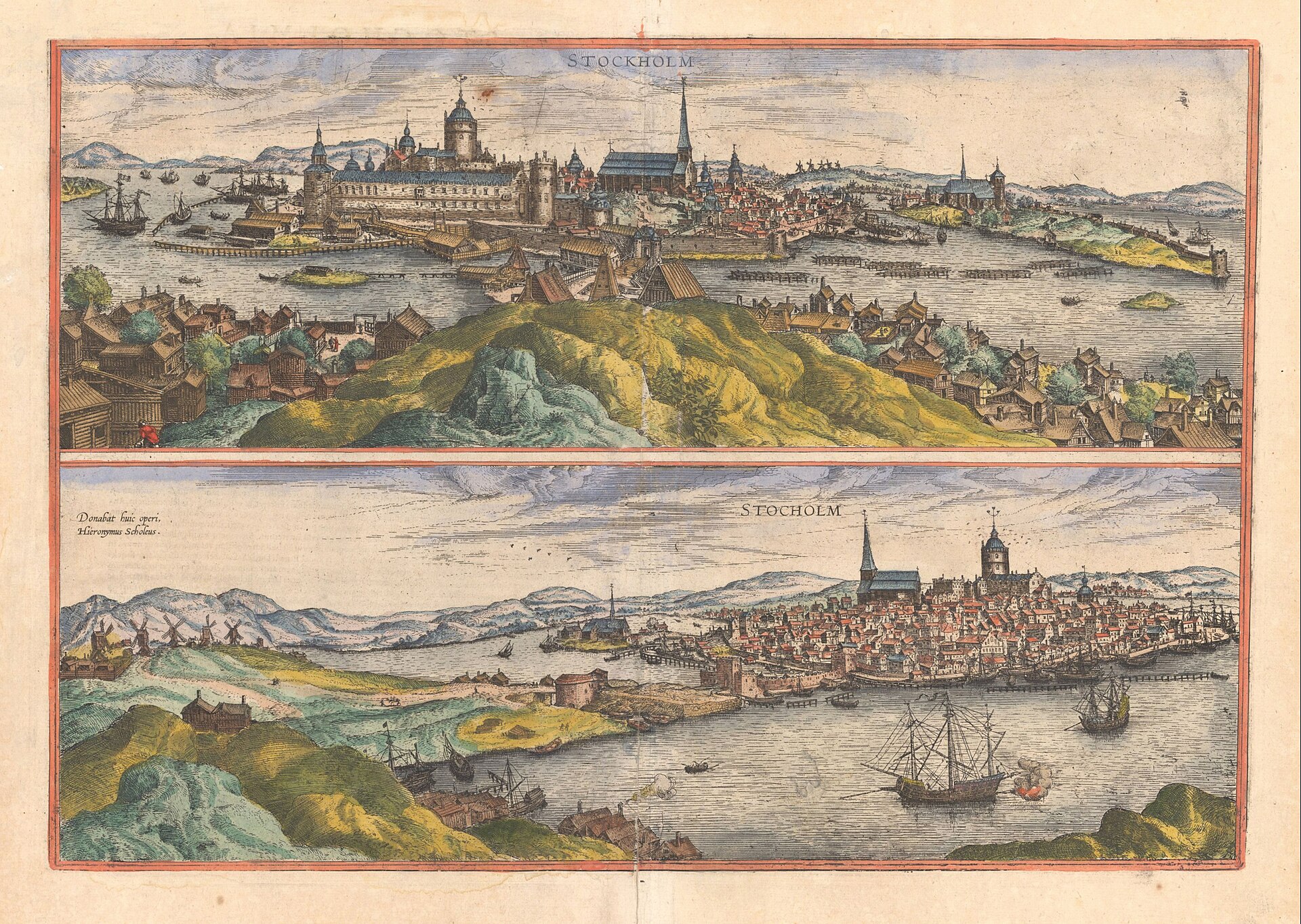
Bird's-eye views of Stockholm (north and south), from Braun & Hogenberg's Civitates Orbis Terrarum (Frans Hogenberg, c.1570)
Shows Stockholm's old town (Gamla Stan) with city walls and piers, Tre Kronor castle, Storkyrkan cathedral, surrounding harbour and bridges.
1570 · Koyos · Wikimedia Commons
Public domain (plate dated 1570)
In this city
Landmarks of Stockholm, see each in its prime
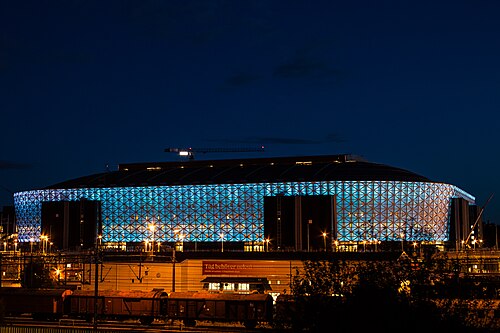


Ships tied to Stockholm
- Vasa: Built at the Stockholm navy yard under a 1625 contract; her guns cast in the city
Castles of Stockholm


More cities to explore
 SwedenVisbyExplore it in 1350
 FinlandTurkuExplore it in 1500 · 1825
 NetherlandsUtrechtExplore it in 1400 · 1700
 EnglandLondonExplore it in AD 200 · 1390 · 1600 · 1885
Castles of Europe · Landmarks of Europe · create your own reconstruction.