Myers
also Myer, Myres, Meyers
Dweller by the mire, or the steward at his post.
- Origin
- Yorkshire & the Humber, England
- Famous bearer
- Mike Myers (b. 1963), Canadian actor and comedian
- Register
- English family
Where the Myers name comes from
CoreHistoric reach
The seat of Myers
Seat vacantChief
No one leads the Myers community yet. When the movement opens, you can stand for its leadership, or help elect whoever does.
Current mission
No shared goal set yet. Once Myers has leadership, it sets the public focus: a restoration, a gathering, a real-world project that helps its own.
The Myers clan is being rebuilt. Join the waiting list for the movement today, and you help decide who leads it and what it does.
Help rebuild the Myers clan →What does the Myers name mean?
Two English roots run together in the name. The first is topographic, from Middle English mire, from Old Norse myrr, a 'marsh' or bog, so a dweller by the mire, densest in the old Danelaw north. The second is a status name from Old French maire, a mayor or steward, the chief officer of a town or estate. The name is also a frequent Anglicisation of the German and European-Jewish Meyer, a farm-bailiff, so the modern Myers pool draws on all three.
The history of Myers
Marsh, mayor, physician, Meyer: four roads into one name
Myers is not one name but several that arrived at the same spelling. The oldest layer is the ground itself: Middle English mire, from Old Norse myrr, a marsh or bog, so that the man whose holding sat at the edge of the wet ground was known by it, a reading thickest in the old Danelaw north where mire was everyday vocabulary. The second layer is an office rather than a place, Old French maire, the mayor or steward, chief officer of a town or of an estate. A third, recorded alongside them, is Old French mire, a physician.
The final s does real work. It was common in England for a servant to take his employer's name with an s added, which is how Vickers arose for the man who served a vicar, though the ending can equally mark a son. Either way, Myers reads as belonging to the maire. To that pool the nineteenth century added a fourth road, the German and European-Jewish Meyer, a farm-bailiff, which anglicised readily in Britain and America.
The man who actually ran the manor
Manorialism was the way land was held across medieval England and France: a large and sometimes fortified manor house where the lord and his dependents lived, and around it the labourers and serfs who worked the land to support themselves and him. He held a manorial court governed by public law and local custom, and drew income from far more than crops: charges for his mill, bakery and wine-press, the right to let pigs feed in his woodland, the revenues of his court, a payment on every change of tenant. Almost none of it did he collect himself. The lord's power was exercised through intermediaries, and the most important of them was the bailiff.
Bailiff was the Norman word for what the Saxons had called a reeve, the officer who executed the decisions of a court, and the district he worked was his bailiwick. As the two populations mixed, reeve narrowed to the shire courts, which is why sheriff is a contraction of shire-reeve, and bailiff took the lower ground: the hundred courts and the manorial courts. A bailiff of a manor did far more than serve summonses. He oversaw its lands and buildings, collected its rents, managed its accounts and ran its farms, the business Walter of Henley wrote his treatise about.
One detail explains a good deal about both the office and the name. Bailiffs were outsiders and free men, not usually drawn from the bailiwick they were set over. That made the post mobile and the man in it a stranger known by his function rather than by his father or his village, which is exactly the condition in which an occupational byname hardens into an inherited surname.
Stiweard, the keeper of the hall
The other title behind the name is older and English. Steward comes from Old English stiweard, from stig, a hall or household, and weard, a warden or keeper. It is attested from the eleventh century and travelled outward rather than inward: the Old French and Old Norse forms were both taken from the English word. The German and Dutch parallel, Statthalter and stadhouder, meaning place holder, was a separate formation, a calque of lieutenant.
In the earliest medieval sense the steward supervised the lord's estate and his household together. Within a century the household had grown enough to split the post, so that by the thirteenth century a great house commonly kept two: one for the estate, a majordomo for domestic routine. Stewards commonly earned up to three or four pounds a year. They kept their lord's castles while he was away and checked the taxes of the serfs on his manors, which is to say they were where an ordinary tenant met authority.
Meier, baljuw and Amtmann: the same job in every language
The office was invented independently across the continent and every language named it. In Flanders, Zeeland, Holland and Hainault the man who represented the ruler in town and country was the baljuw, from the French bailli. Elsewhere the local word won: schout in Holland, Antwerp and Mechelen, drossate in parts of Brabant, amman in Brussels, and at Asse and Leuven meier, the majordomo. In Germany, Switzerland and Austria the title was Amtmann, the senior official a territorial lord appointed to oversee the administration and jurisdiction of a manorial estate.
Meier, then, named the majordomo at Asse and Leuven and the farm-bailiff on a German estate, and it spread for the reason mayor and steward spread in England: every estate needed one, and the man who held the post was known by it.
Mire country, and the north the Normans had to break
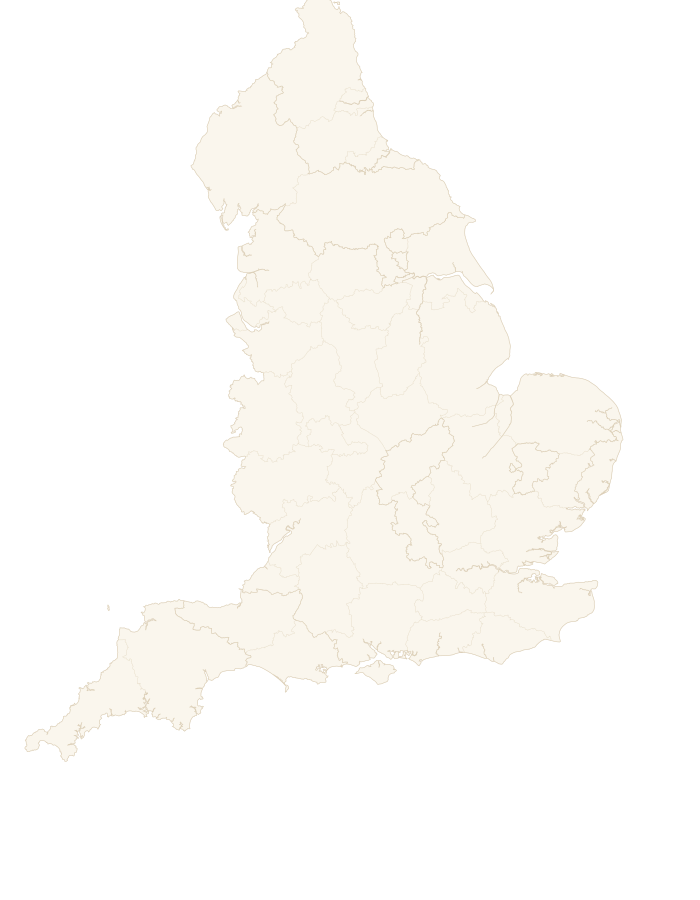
The topographic Myers belongs to a specific stretch of England. West and South Yorkshire, Lancashire and what is now Greater Manchester carry the modern weight of the name, with older presence in Cheshire, the Derbyshire Peak, North Yorkshire and the city of York. This is the country of the old Danelaw, where Old Norse myrr had been ordinary speech. A holding described by its mire was described usefully, and a man could be found by it.
It was also the last part of England to submit. Early in 1069 the newly installed Norman Earl of Northumbria, Robert de Comines, was massacred with several hundred soldiers at Durham. In the autumn a fleet sent by Sweyn II of Denmark joined a rising that beat the Norman garrison at York and seized the castles. William came north, forced the swollen River Aire at Pontefract, occupied York, and through the winter of 1069–70 his forces devastated Northumbria in the Harrying of the North. He wore his crown at York on Christmas Day 1069, then based himself at Chester and crushed what was left in Mercia.
What replaced the rising was administration, and that is where the name's other strand comes in. The Normans inherited an Anglo-Saxon system of shires, writs and land tax more sophisticated than anything in Normandy, kept the framework and changed the personnel, and in 1086 the Domesday survey catalogued the landholdings of the kingdom. Historians put the number of Norman landholders at around eight thousand in a country they came nowhere near outnumbering, which is why the manor and the officer who ran it mattered so much. In the north, he kept his accounts in mire country.
The Myers who wrote, preached and composed
Frederic W. H. Myers (1843–1901) was an English poet, classicist and philologist, and one of the founders of the Society for Psychical Research. Earlier in the century Frederic Myers (1811–1851) had been a Church of England clergyman and author. The name went on working in letters: Leo Myers (1881–1944) was a British novelist, and Rollo Myers (1892–1986) an English music critic, writer and translator.
Stanley Myers (1933–1993) carried it into cinema as a British film composer. Amy Myers (born 1938) is a British mystery writer and Ben Myers (born 1976) a British writer; Kevin Myers (born 1947) is an Irish journalist, Billie Myers (born 1971) a British rock singer and songwriter, and Andy Myers (born 1973) an English footballer.
Across the Atlantic, and out from there
In North America the name settled into the professions and the archives. Albert Cook Myers (1874–1960) was an American historian and Gustavus Myers (1872–1942) a reporter and feature writer. Theodore W. Myers (1844–1918) was a banker and Comptroller of New York City, and Quincy Alden Myers (1853–1921) sat as a Justice of the Indiana Supreme Court. Jerome Myers (1867–1940) was an American painter, and Malcolm Myers (1917–2002) a printmaker and professor known above all for his intaglio engravings.
Others turned the name into a system or a company. Isabel Briggs Myers (1897–1980) co-created the Myers-Briggs Type Indicator; Garry Cleveland Myers (1884–1971) was an American psychologist and Margaret Good Myers (1899–1988) an economist. Joel Myers (born 1939) founded AccuWeather, and Lon Myers (1858–99) set world records as an American runner.
Farther out again, Allan Myers (born 1947) is an Australian lawyer, businessman and philanthropist and Vali Myers (1930–2003) was an Australian artist, while the Canadian ice hockey players Tyler Myers (born 1990) and Philippe Myers (born 1997) carry it in the modern game. And the best-known bearer alive is Mike Myers (born 1963), the Canadian actor and comedian, the son of English emigrants from Liverpool, one generation from the English north.
Castles that share the Myers name
The same name on the map, look one up, see what it looked like in its prime, and recreate it to explore.

All castles in England → · Strongest castles in England → · Castles of Europe
Play As Your Clan
Hold a real castle against whatever you choose to send at it, take a ship out in her own service years, or stand at the shoulder of someone the record remembers. The chronicler sets the scene; the deeds are yours.
Notable bearers of the Myers name
- Mike Myers (b. 1963), Canadian actor and comedian
- Isabel Briggs Myers (1897–1980), co-creator of the Myers–Briggs indicator