Nolan
also O'Nolan, Ó Nualláin
Inaugurators of Leinster, chiefs of Forth in Carlow.
- Origin
- Leinster, Ireland
- Famous bearer
- Brian Ó Nualláin / Flann O'Brien (1911–1966), novelist and columnist
- Register
- Irish family
Where the Nolan name comes from
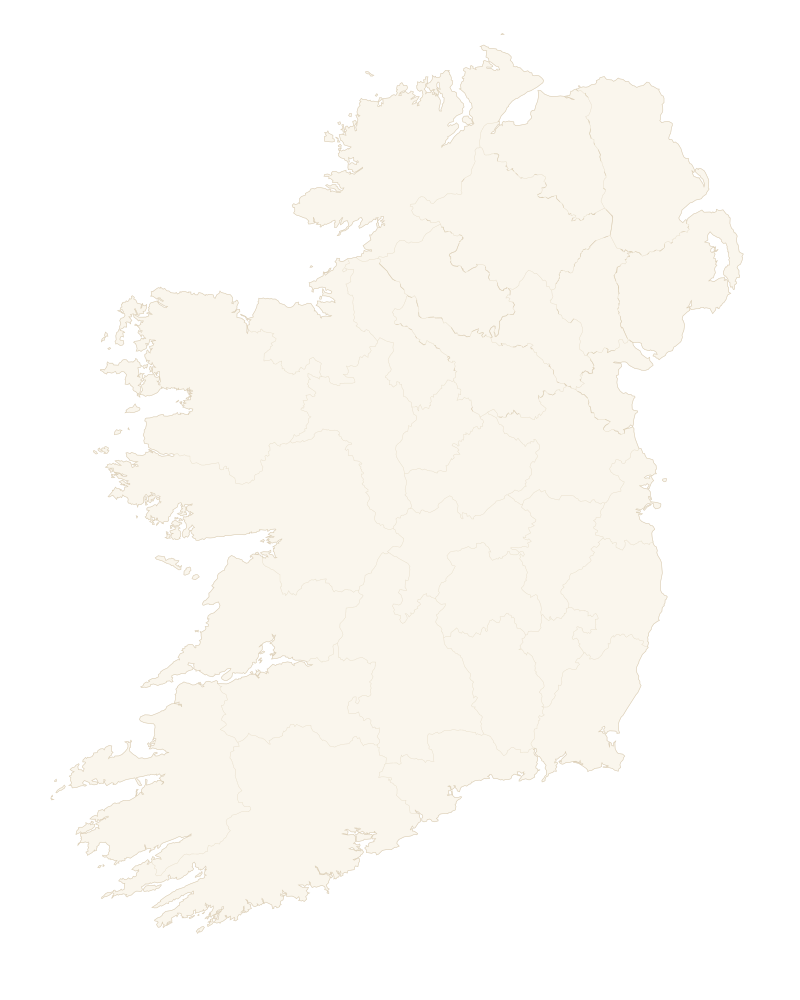
CoreHistoric reach
The seat of Nolan
Seat vacantChief
No one leads the Nolan community yet. When the movement opens, you can stand for its leadership, or help elect whoever does.
Current mission
No shared goal set yet. Once Nolan has leadership, it sets the public focus: a restoration, a gathering, a real-world project that helps its own.
The Nolan clan is being rebuilt. Join the waiting list for the movement today, and you help decide who leads it and what it does.
Help rebuild the Nolan clan →What does the Nolan name mean?
From Ó Nualláin, descendant of Nuallán ('shouter' or 'noble', from a personal name diminutive). The Ó Nualláin were chiefs of Fothairt (Forth) in modern county Carlow from the 11th to the 16th century, with seat at Tullow. Their inauguration as chiefs of Fothairt was the public ceremony at which the kings of Leinster were themselves nominally inaugurated, an unusual constitutional role for a sub-chiefly family. Other Ó Nualláin lines existed in Mayo and Cork but the Carlow sept is the principal source of the modern Nolan pool.
The history of Nolan
A shout, or a nobleman, on the Carlow plain
Nolan is the English spelling of Ó Nualláin, "descendant of Nuallán", a diminutive personal name read either as "shouter" or as "noble". The two readings are not really in competition. A Gaelic byname worked as a nickname first and hardened into a lineage name afterwards, and a man remembered for his voice and a man remembered for his rank could each leave the same word to his great-grandsons.
The Gaels were among the earliest peoples in Europe to fix surnames on the male line, and the Ó Nualláin were carrying theirs while most English households still had none. Hereditary surnames only settled across England and Lowland Scotland by about 1400. By then the Ó Nualláin had been a named lineage holding a named country in south Leinster since the eleventh century.
The sept that had the right to make a king
The chief of Fothairt (Forth, in what is now county Carlow) held a hereditary right that made the sept unusually ceremonial among Irish chiefly families: he inaugurated the kings of Leinster. The ceremony was performed at the rath of Knockaulin, Dún Ailinne, in modern county Kildare, and it made the Ó Nualláin constitutionally necessary to a provincial kingship they did not themselves hold. The men they raised were the Mac Murchadha kings, of whom the Ó Nualláin were sub-chiefs.
Under Brehon law an Irish chief was not an owner but a custodian, appointed by his kinsmen and answerable for the protection of the clan and its property, and succession ran by tanistry: on a chief's death the successor was elected from the agnatic cousins descended from a shared grandfather or great-grandfather. An inauguration was the moment at which an election became a reign. The family that performed it at Dún Ailinne held the hinge of Leinster politics rather than its sword.
Tullow, and a lordship the Normans reduced but did not end
The sept's country lay around Tullow, and Tullow is where the Ó Nualláin chiefs are placed from the eleventh century to the sixteenth. The Norman conquest of Leinster from the late twelfth century cut the political weight of the office away, and a lordship whose value lay in crowning provincial kings was worth less once provincial kings had stopped being crowned.
What the Normans could not do was move the people. The Ó Nualláin held their ground in Carlow through the later medieval centuries, and the surname stayed planted there and in the neighbouring counties of Wexford and Wicklow through every census taken since. Nolan is still read in Ireland as a Carlow name.
Two roads into the Nolan pool
Genealogists place the O'Nolans among the surnames thrown off by the Loígis of Leinster, the same population that produced the O'Mores, the O'Dorans, the O'Lawlors and the O'Dowlings.
Not every modern Nolan comes down that line. In Connacht the Uí Fiachrach Aidhne surname O'Houlihan was anglicised in some districts as Holland and in others as Nolan, so that two unrelated Gaelic lineages arrive at a single English spelling. The Carlow sept is the one the name is chiefly traced to.
The year the country became a county
The Gaelic order the Ó Nualláin belonged to was dismantled by administration rather than by battle. With the creation of the Kingdom of Ireland in 1541 the Dublin government set about drawing the chiefs into the new state, issuing them English titles and, in 1552, new coats of arms. The policy of surrender and regrant that came with those titles replaced tanistry with primogeniture, quietly disinheriting the whole body of cousins who had until then been eligible for election.
The county and the sheriff took the place of the "country" and the chief. After the Flight of the Earls in 1607 the Dublin administration held real control of the whole island for the first time and disarmed the native lordships. In the English record-keeping that followed, Gaelic surnames were flattened to fit: Ó became O', and then the prefix was dropped altogether. Ó Nualláin, O'Nolan and Nolan are one name caught at three stages of that process.
Myles na gCopaleen and the Cruiskeen Lawn column
Brian Ó Nualláin (1911–1966) kept the Irish form of the name for himself and wrote under neither it nor its English equivalent. As Flann O'Brien he published At Swim-Two-Birds and The Third Policeman; as Myles na gCopaleen he wrote the Cruiskeen Lawn column in the Irish Times from 1940 to 1966. He was born in Strabane, a long way north of the Carlow country the surname came out of.
He stands as the great experimental Irish modernist after Joyce, and the two halves of his working life ran side by side rather than in sequence, the novels and the newspaper column together. Of the three bodies of work that carry this name into the twentieth century, his is the one written in the language the name was made in.
A Sligo name that reached Highgate, and then Hollywood
Christopher Edward Nolan was born in central London on 30 July 1970, the second son of an Irish-born advertising executive from Sligo and an American mother. The household alternated between Highgate and Evanston, Illinois; he held British and American passports, made his first short films on his father's Super-8 camera in his early teens, and read English literature at University College London, where he ran the film society and met Emma Thomas, whom he married in 1997 and who has produced every feature he has directed since.
Following (1998), a black-and-white London thriller shot at weekends over fifteen months for about six thousand pounds, brought him to the attention of a Los Angeles independent producer. Memento (2000), the anterograde-amnesia story running forward in black-and-white and backward in colour, won the Independent Spirit Award for Best Feature, drew an Oscar nomination for its screenplay, and made him at thirty one of the most-discussed directors of the new American cinema. Warner Bros set the remake Insomnia (2002) as a test before handing him a franchise.
Batman Begins (2005), The Dark Knight (2008) and The Dark Knight Rises (2012) reset what a studio superhero picture could be; The Dark Knight took over a billion dollars and a posthumous Oscar for Heath Ledger. The Prestige, Inception, Interstellar, Dunkirk and Tenet followed, then Oppenheimer (2023) and the Best Picture and Best Director awards of 2024. He was knighted in the 2024 New Year Honours. The Leinster patronymic his father carried to London in the 1960s now sits in the front rank of English-language cinema.
Six sisters and one Dublin household
The Nolans of late-1970s Dublin-Irish pop were not an assembled line-up but a single family: Anne, Denise, Maureen, Linda, Bernie and Coleen, the daughters of Tommy Nolan and Maureen Nolan. A group of that size drawn entirely from one household is rare enough that the surname on the record sleeve was doing double duty: a stage name and a plain statement of who was in the room.
Champions of the Nolan name
The bearers whose lives are inseparable from this surname. Each has their own page, biography, achievements, geography, connection to the family.
The castles of the homeland
The great strongholds of the homeland, look one up, see what it looked like in its prime, and recreate it to explore.
 Ashford Castle, County MayoRestored · prime 1880
 Manderley CastleRestored · prime 1840
 Dublin CastleRestored · prime 1790
All castles in Ireland → · Strongest castles in Ireland → · Castles of Europe
Play As Your Clan
Hold a real castle against whatever you choose to send at it, take a ship out in her own service years, or stand at the shoulder of someone the record remembers. The chronicler sets the scene; the deeds are yours.
Notable bearers of the Nolan name
- Brian Ó Nualláin / Flann O'Brien (1911–1966), novelist and columnist
- Christopher Nolan (b. 1970), filmmaker (Memento, Inception, Oppenheimer)
- The Nolans, Dublin-Irish family pop group