Schmidt
also Schmitt, Schmitz, Schmied
The forge surname of the German lands, Smith's cousin by meaning, not by blood.
- Origin
- German
- Famous bearer
- Helmut Schmidt (1918–2015), Chancellor of West Germany (1974–1982)
- Register
- German family
The seat of Schmidt
Seat vacantChief
No one leads the Schmidt community yet. When the movement opens, you can stand for its leadership, or help elect whoever does.
Current mission
No shared goal set yet. Once Schmidt has leadership, it sets the public focus: a restoration, a gathering, a real-world project that helps its own.
The Schmidt clan is being rebuilt. Join the waiting list for the movement today, and you help decide who leads it and what it does.
Help rebuild the Schmidt clan →What does the Schmidt name mean?
Occupational, the smith, the man at the forge. From Middle High German smit / smid, the worker in metal. Schmidt is the most numerous occupational surname in the German-speaking lands, and its spelling maps the dialects: the Low German north and east keep the hard -dt (Schmidt), the Rhineland and Hesse soften to Schmitt and Schmitz, and the upper-German south and Switzerland wear it down to Schmid. It is the exact cognate of English Smith, Dutch Smit and Danish Smed, the same word for the same trade, arrived at independently in each tongue.
The history of Schmidt
Schmied, Schmidt, Schmitt, Schmitz: one trade, five mouths
The name is the job. It comes from Middle High German smit or smid, the worker in metal, and its modern spellings lay the dialects of the German-speaking lands over one word: the Low German north and east keep the hard -dt in Schmidt, the Rhineland and Hesse soften it to Schmitt and Schmitz, the upper-German south and Switzerland wear it down to Schmid.
Counted as one name, that group is carried by about 0.87 per cent of Germans, ahead of Müller and Möller at 0.83; counted spelling by spelling, Müller takes first place and Schmidt second. It is the exact cognate of English Smith, Dutch Smit and Danish Smed, nothing borrowed in any direction, but the same byname reached independently in each tongue for the man who worked the iron.
The Schmiede in the village and the Hufschmied on the road
Medieval Europe counted smithing among the seven mechanical arts, and before industry a village smithy was a fixture of every town. The Schmied heated wrought iron until it turned plastic and read the temperature by colour: red, orange, yellow, then the bright yellow-orange of true forging heat. He made and mended what every other trade used: ploughshares and wagon irons, hinges, tools, nails, lengths of chain.
Horses were the other half of the living. The first literary mention of nailed horseshoes anywhere is in Ekkehard's Waltharius, about 920, and the practice spread east and north across Europe by 1000. The Hufschmied who set them stood between a working farm and a lame one, and armies took him along into the nineteenth century, at travelling forges built as smithies on wheels. German culture kept him heroic, too: Wagner set Mime at an anvil to forge the sword Nothung and the Tarnhelm.
The Zunft and who was allowed to strike iron
In a German free city the guild's privilege was blunt: only its members could sell their goods or practise their craft inside the walls. The Zunft set prices, trading hours and the number of apprentices a master might keep. To work iron in such a town you climbed apprenticeship, journeymanship and mastery, or you did not work iron there at all. Guilds were welfare and politics as well: funds for the sick and for widows and orphans, and in the prosperous German cities a seat inside municipal government from which they sometimes challenged the patrician elites.
Enlightenment critics argued the monopolies throttled trade, and France abolished its guilds in 1791 with most of Europe following. Germany kept the shape and dropped the monopoly: there are no Zünfte now, but Innungen survive as voluntary public-law bodies headed by an Obermeister drawn from the master craftsmen, journeymen elect their own Altgesell, and regional Handwerkskammern govern the crafts of a district. A Schmidt training as a smith in Germany today still climbs a version of that ladder.
Why all ten of the commonest German surnames are jobs
German surnames came in during the Late Middle Ages and became heritable once central demographic records began. Occupational names are the largest class by far, and the ten commonest German surnames, counted spelling by spelling, are every one of them a job: Müller the miller, Schmidt the smith, Schneider the tailor, Fischer the fisherman, Weber the weaver, Meyer the farm steward, Wagner the cartwright, Schulz the constable, Bauer the farmer, Becker the baker. They are the ordinary occupations of about 1600, the moment the names froze into heredity, which is why they arose independently in every corner of Germany at once rather than spreading from one family.
German law still permits a change of surname for very few reasons, and one of them is a name that is simply too common: the examples the rule itself gives are Müller and Schmidt. Women once bore their own form of it, too: West Low German made Mrs Schmidt de Smidtsche, literally the Smithian, until official registration abolished the practice in the eighteenth and nineteenth centuries.
The Hof, the house sign and the name behind the name
Beneath the Nachname sits an older layer, the Hofname or farm name. Impartible inheritance tied a Hof to patrilineal descent over centuries, so the estate's name identified the family on it, and the Hofname was the first commoners' family name to become heritable, already in the fourteenth and fifteenth centuries. Ulrich Zwingli, born 1484, carried a surname that was in origin a Hofname, from Twing, a walled-in estate, though he never inherited the land.
Before street names and numbers, inns, mills and farmsteads went by house names, and those hardened into surnames too: Rothschild the red sign, Lachs the salmon, Bär the bear. Where farm name and family name had come apart, documents joined them with genannt in Germany and vulgo in Austria: Amann gen. Behmann.
Jewish families in the German lands were made to take fixed surnames late and by fiat: Prussia's Hoym Ordinance at Breslau in 1790, Napoleon's decree of 1808. Prussian officials imposed invented and sometimes insulting names, while poetical ones such as Rosenzweig were more often the families' own choice.
Ritter von Schmitt, from a Bamberg byname to the Bavarian bench
The trade name did not stay at the forge. The von Schmitt family, Bavarian with Franconian origins, traces to Johannes Kaspar I. Schmitt of Bamberg, who died between 1721 and 1772. His descendants were raised into the nobility by Luitpold, Prince Regent of Bavaria, and Otto, King of Bavaria: Josef Schmitt (1838–1908) made a hereditary Ritter in 1889, Gottfried Schmitt (1827–1908) in 1896.
Gottfried Ritter von Schmitt sat as President of the Supreme Court of the Kingdom of Bavaria; Josef was President of Upper Franconia. In the next generation Gottfried II (1865–1919) was a politician and member of the Reichsgerichtsrat, and Josef II (1875–1945) a privy councillor who co-chaired SKF. The title lasted until the Weimar Republic abolished nobility in 1919, a handful of generations from a Franconian byname to the highest bench in Bavaria.
Where the Schmidts went, and what they did there
Skill in iron is portable, and that made the German smith welcome wherever iron had to be worked from nothing. A frontier county in Ohio, Ontario or South Australia could not wait a generation to grow its own smith, and a Schmidt who could read a fire and draw out a weld carried his living in his hands across the Atlantic. Many were anglicised to Smith in the first or second generation, which is why the German Schmidt and the English Smith are two separate rivers of the same trade.
The name went east and north as readily as west. Poland respelt it Szmidt, carried by the Olympic athlete Józef Szmidt (1935–2024); Russia took it whole, in Pyotr Schmidt (1867–1906) of the 1905 revolution. Denmark gave it a prime minister in Helle Thorning-Schmidt, the Netherlands one of its best-loved writers in Annie M. G. Schmidt (1911–1995), Hungary a president in Pál Schmitt.
In Germany itself the most consequential bearer is Helmut Schmidt (1918–2015), Chancellor of West Germany from 1974 to 1982. Around him the name recurs in every generation: Arno Schmidt (1914–1979), the experimental novelist; Bernhard Schmidt (1879–1935), the Estonian-German optician whose Schmidt camera reshaped astronomy; Rudolf Schmitt (1830–1898), co-discoverer of the Kolbe-Schmitt reaction. And Harrison Schmitt, born 1935, was the twelfth man to walk on the Moon: a fair distance for a byname that began with a man at an anvil at the end of a village street.
The same name across Europe
Schmidt shares its meaning, not its bloodline, with these names from other corners of Europe: cognates, the same word for the same thing, formed independently in each language. Cousins by meaning, with separate ancestral stories a search box flattens into near-twins.
- FerrariItalianThe smith, Italy's Smith, and a name that means speed.
- KovalUkrainianThe smith, the bare forge-name of the steppe.
- KowalskiPolishOf the smith, Poland's Smith, in the gentry's -ski.
- LefebvreFrenchThe smith, Smith and Schmidt's French cousin.
- SmitDutchThe smith, Smith and Schmidt's Dutch cousin.
- SmithScotlandThe forge surname, the most common occupational name in Scotland and the world.
The castles of the homeland
The great strongholds of the homeland, look one up, see what it looked like in its prime, and recreate it to explore.
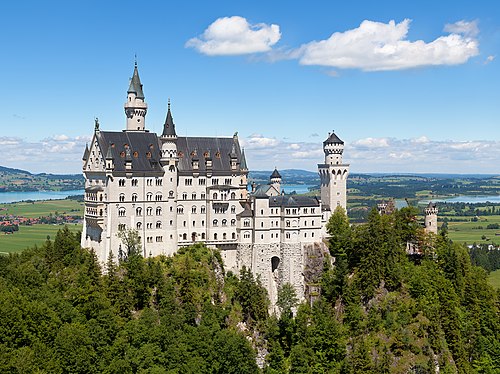 Neuschwanstein CastleStill standing · prime 1886
 Hohenzollern CastleRestored · prime 1867
 Eltz CastleStill standing · prime 1615
All castles in Germany → · Strongest castles in Germany → · Castles of Europe
Play As Your Clan
Hold a real castle against whatever you choose to send at it, take a ship out in her own service years, or stand at the shoulder of someone the record remembers. The chronicler sets the scene; the deeds are yours.
Notable bearers of the Schmidt name
- Helmut Schmidt (1918–2015), Chancellor of West Germany (1974–1982)
- Arno Schmidt (1914–1979), experimental novelist and man of letters