Wagner
also Wegner, Wegener
The wagon-maker, the trade that built the wagons that won the West.
- Origin
- German
- Famous bearer
- Richard Wagner (1813–1883), composer
- Register
- German family
The seat of Wagner
Seat vacantChief
No one leads the Wagner community yet. When the movement opens, you can stand for its leadership, or help elect whoever does.
Current mission
No shared goal set yet. Once Wagner has leadership, it sets the public focus: a restoration, a gathering, a real-world project that helps its own.
The Wagner clan is being rebuilt. Join the waiting list for the movement today, and you help decide who leads it and what it does.
Help rebuild the Wagner clan →What does the Wagner name mean?
The wagon-maker or cartwright, Middle High German wagener. The wheelwright who built and shod the carts and wagons was one of the most demanding trades of all, combining the skills of the joiner, the wheelwright and the smith. The Low German form is Wegner.
The history of Wagner
Wagener, the man who made the Wagen
The name is a job. It descends from the Germanic Waganari, wagon-maker or wagon driver, and reaches its modern spelling through Middle High German wagener. Low German gives Wegner, a form with its own footing in Silesia, and Wegener stands beside it; the surname was first recorded in Saxony. Two jobs sit inside the one word: in much of Germany it went to whoever hauled goods in high-sided wagons, while among some German populations, and the Pennsylvania Germans above all, it meant the maker: the wainwright, the cartwright.
There is no Wagner family the way there is a Habsburg family. German occupational surnames became heritable around 1600 and arose independently across the German lands at once, because every settlement of any size had the trade in it. A Wagner in Saxony and a Wegner in Silesia are not cousins; what they share is a craft.
Three trades standing in one shop
To build a wagon was to master three trades at once. The frame and body were the joiner's work; the wheel, dished so it would take a sideways load, was the wheelwright's; the iron tyre shrunk on hot, the hoops, pins and fittings were the smith's. The vocabulary records the vehicle, not the timber: English carpenter comes from the Latin carpentarius artifex, the maker of a carriage, while Old English wryhta, cognate with work, gave wright and wheelwright.
Timber was riven, hewn or sawn over a pit, and sawmills only came into use in Europe in the sixteenth century, so for most of the trade's life the stock was split and shaped by hand. A wheel that shook apart on a hill took a cart, a team and a season's crop with it. The smith made a part; the Wagner made the thing that had to hold together under a ton of load, on a bad surface, for years, which is why a good one was rarer and more valued than a smith alone.
The roads that broke wagons, and the armies that moved on them
Before the railway, everything overland moved on wood and iron a Wagner had assembled: grain to the mill, flour to market, timber, stone, salt, artillery. The wagon-maker mattered in a village the way the mill and the forge did, with one difference: the mill stayed put, and the wagon went out onto the road and had to survive it. How bad those roads were shows up in an odd corner of the record. Through the eighteenth century, agents for the Sheffield cutlery industry rode the British countryside offering carriers new carriage springs for old, because steel of the period was so variable that quality could not be judged at the point of sale, and a spring that had survived the rough roads without cracking had proved itself better metal than any works test could show.
An army, meanwhile, is a town obliged to travel, and it travelled on wagons. When Edward III took his forces into France in the first phase of the Hundred Years' War, they moved with an immense baggage train carrying its own forges, so that horses could be shod in the field; by 1350 the shoer of horses at the English court was a sworn office. Five centuries on, only the scale had changed: European armies, and both the Federal and Confederate armies in America, kept blacksmiths to repair wagons, tack and artillery from travelling forges which, coupled to a limber, were themselves wagons built as blacksmith shops on wheels. The wagon carried the workshop that repaired the wagons.
Why the name sits so high in the German tables
Counting variant spellings together, Wagner accounts for roughly 0.23 per cent of all German surnames, in the top dozen beside Schmidt, Müller, Schneider and Weber; counted separately it stands seventh. In Austria it is third in the country, behind only Gruber and Huber, on a count of 4,624. The name is also well established in Scandinavia, the Netherlands, eastern Europe and among Ashkenazi Jews. A reader called Wagner in Ohio or Otago holds the record of one craft, practised in many places by people who never met.
The Conestoga, and the end of the trade that named the name
The proudest chapter the name has abroad is a wagon. The Conestoga (the broad-wheeled freight wagon that hauled goods over the Appalachians and seeded the prairie schooner of the westward migration) was built by the German wagon-makers of the Conestoga valley in Pennsylvania. The vehicle that did more than any other to move the American frontier west was, by trade and by name, a Wagner's work.
Then the industry the wagon had served closed the shop. The eighteenth century brought the steam engine, the cut nail and the circular saw, and in the 1790s Henry Maudslay's screw-cutting lathe began replacing hand craftsmen with machinists in factories. The trade the wagon-maker leaned on went first: as demand fell, blacksmiths took in shoeing work to survive, and with the automobile many became the first motor mechanics. The name outlasted the craft by a century, which is the usual fate of an occupational surname and no reflection on the work.
The Wagners on the record
The best-documented Wagners are a theatre family of ordinary stock. Carl Friedrich Wilhelm Wagner (1770–1813), a police actuary, married a baker's daughter, Johanna Rosine (1778–1848), in 1798, and nearly all their surviving children went on the stage: Albert (1799–1874) as opera singer and stage director and Rosalie (1803–1837) as an actress. Carl Friedrich died in 1813, and the next year his widow took up with the painter and writer Ludwig Geyer (1779–1821), whose rumoured paternity of her youngest son is neither substantiated nor disproved.
That youngest son was Richard Wagner (1813–1883), the composer, married in 1836 to the actress Minna Planer (1809–1866) and in 1870 to Cosima Liszt (1837–1930), Franz Liszt's daughter, divorced that same year from the conductor Hans von Bülow. The profession stayed in the family: his son Siegfried (1869–1930) was a composer, conductor and stage director, Siegfried's sons Wieland (1917–1966) and Wolfgang (1919–2010) were stage directors after him, and the line runs on to Katharina Wagner (born 1978).
Richard Wagner was also an antisemite who put it in print, and that belongs in the record, not in a footnote to it, as does what came after him. In 1908 his daughter Eva von Bülow (1867–1942) married the author Houston Stewart Chamberlain (1855–1927); in 1943 his granddaughter Verena (1920–2019) married Bodo Lafferentz (1897–1974), a Nazi Party member and SS Obersturmbannführer. His granddaughter Friedelind (1918–1991) went the other way and left. The name on the door came out of a wagon shop, and what one famous bearer did with it is his, not the trade's.
Landmarks the Wagner held
Palaces, houses and great buildings tied to this name, look one up, or rebuild it to explore.
- Bayreuth Festival Theatre
Built 1872-1876 to Richard Wagner's specification for his festival; direction has stayed in the Wagner family for five generations, down to Katharina Wagner today.
The castles of the homeland
The great strongholds of the homeland, look one up, see what it looked like in its prime, and recreate it to explore.
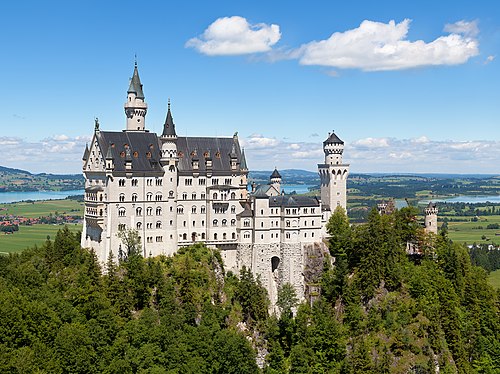 Neuschwanstein CastleStill standing · prime 1886
 Hohenzollern CastleRestored · prime 1867
 Eltz CastleStill standing · prime 1615
All castles in Germany → · Strongest castles in Germany → · Castles of Europe
Play As Your Clan
Hold a real castle against whatever you choose to send at it, take a ship out in her own service years, or stand at the shoulder of someone the record remembers. The chronicler sets the scene; the deeds are yours.
Notable bearers of the Wagner name
- Richard Wagner (1813–1883), composer