Theatre · France · Still standing
Moulin Rouge
The Moulin Rouge is a Paris cabaret on Boulevard de Clichy at Place Blanche, founded in 1889 and famous for its landmark red windmill. It is regarded as the birthplace of the modern can‑can and presents large musical dance revues. The original building burned in 1915 and the venue was rebuilt and reopened in 1925; it continued through the 20th century as a major Parisian music‑hall and tourist attraction.
First raised
AD 188
Its prime
1925
Today
Still standing
As it stood in 1925
What Moulin Rouge looked like in its prime.
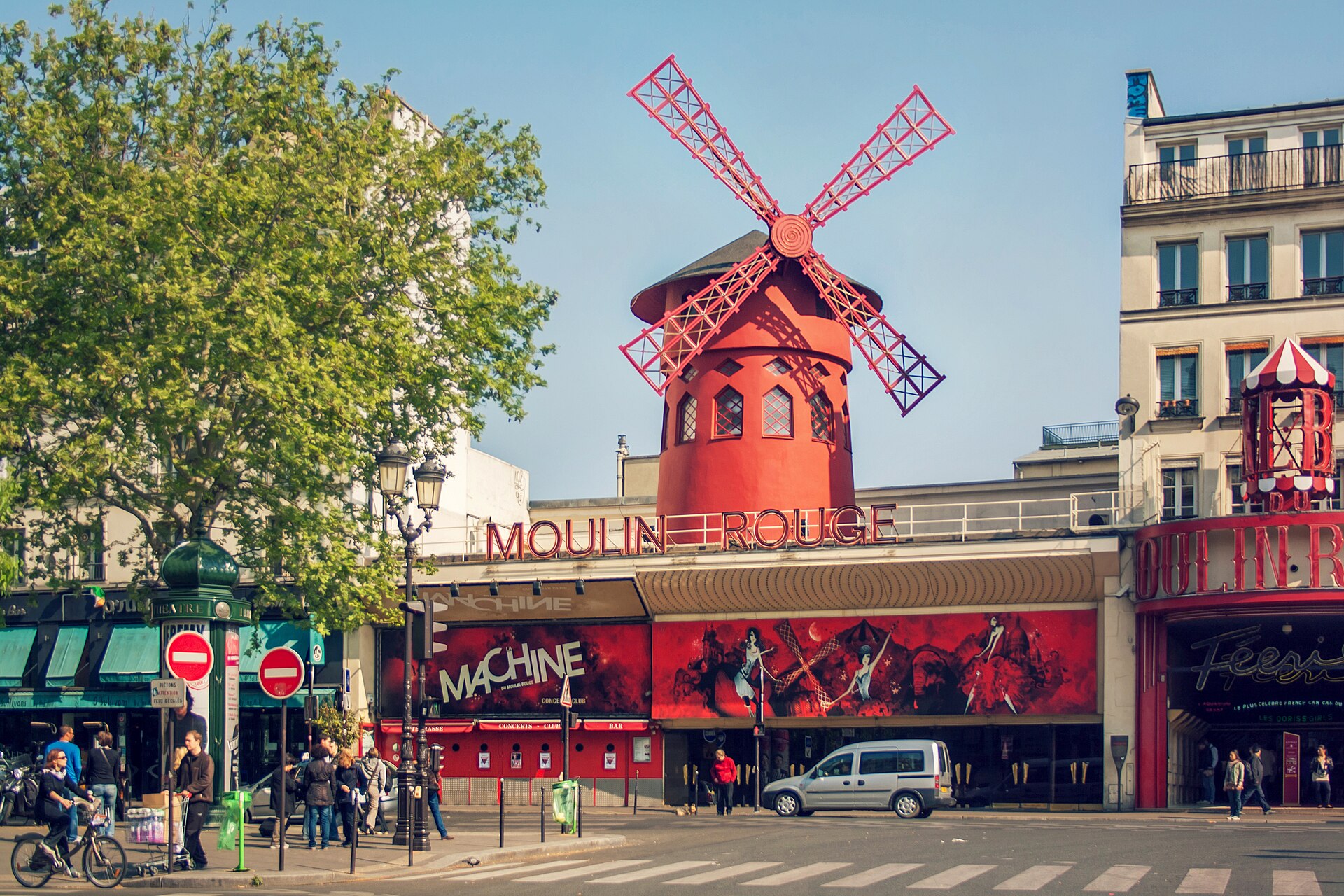
A low, horizontal Belle‑Époque theatre façade surmounted by a round, conical red mill tower with a shallow domed cap and four latticework blades; the tower has small diamond‑paned windows set into the drum. A long, curved marquee runs across the street level with large red poster panels and the neon letters spelling MOULIN ROUGE. The streetfront is urban (lampposts, a plane tree and adjacent pale stone apartment buildings) the mill and bright red paint read as the venue's dominant colour accent.
Its story
The story of Moulin Rouge.
Oller and Zidler Open the Red Mill, 6 October 1889
The Moulin-Rouge was inaugurated on 6 October 1889 at the foot of the Montmartre hill, on the site of the old Bal de la Reine Blanche. The date fell the day after the season's last night-fête at the owners' Jardin de Paris on the Champs-Élysées, whose regulars followed them to the Place Blanche. Its creator and owner Joseph Oller and his manager and partner Charles Zidler set out to draw the rich to go slumming in a fashionable Montmartre.
A giant stucco elephant from the 1889 Exposition Universelle stood in the garden, and the auditorium was built for quick scene changes and for mixing its audiences. Oller and Zidler nicknamed it "the First Palace of Women". The red mill on the roof, drawn by Adolphe Willette and lit at night to be seen from the Grands Boulevards, was the first electrified building in Paris.
La Goulue, the Cancan and Toulouse-Lautrec, 1889–1902
The French cancan, drawn from the quadrille, was danced in petticoats and split drawers by Jane Avril, Grille d'Égout, Nini Patte-en-l'Air, Yvette Guilbert and Louise Weber (La Goulue) the best-paid performer in Paris and Toulouse-Lautrec's favourite model, who appeared on the first of his Moulin-Rouge posters in 1891.
The first revue, Circassiens et Circassiennes, opened on 19 April 1890. On 26 October 1890 the Prince of Wales, the future Edward VII, booked a table to see the quadrille; La Goulue called to him from mid-kick, "Hey, Wales, the champagne's on you!" On 12 November 1897 the house closed for the funeral of Charles Zidler. The Exposition Universelle of 1900 filled it with foreigners, and imitation Moulin Rouges followed in other capitals. The last ball was held on 29 November 1902, after which the building became a théâtre-concert.
Operetta, Colette's Banned Kiss, and Rebuilding After the 1915 Fire
In January 1903 the Moulin-Rouge reopened after renovation by Édouard Niermans, with aperitif concerts and dinner-shows, and until the First World War it gave itself over to operetta. During Le Rêve d'Égypte on 3 January 1907, Colette exchanged a kiss on stage with her lover Mathilde de Morny; the piece was judged scandalous and banned. Mistinguett first appeared on 29 July 1907 in La Revue de la Femme and triumphed the next year with Max Dearly in La Valse chaloupée.
Fire destroyed the Moulin-Rouge on 27 February 1915. Reconstruction began only in 1921, under the architect Adolphe Thiers, and the rebuilt cabaret opened to the public in 1925.
The Mistinguett Revues and the Occupation, 1925–1944
Francis Salabert took over after the war and handed the revival to the impresario Jacques-Charles, who made the Revue Mistinguett (1925), Ça c'est Paris (1926) and Paris qui tourne (1928) with Mistinguett; American revues with the Hoffmann Girls were presented in Paris for the first time. Between June and August 1929 Lew Leslie's Blackbirds ran with the jazz singer Adelaide Hall and a company of a hundred Black artists.
Mistinguett left the stage in 1929 and the 1,500-seat theatre became one of the largest cinemas in Europe; the old ballroom was turned into a modern night club in 1937. Between 1940 and 1945 the cabaret was a dance hall, the Robinson Moulin-Rouge. The German occupation guide listed it as a Paris attraction, and its stage shows went on for occupation troops, noted in the memoirs of German officers such as Ernst Jünger and Gerhard Heller. In 1944, around the liberation of Paris, Édith Piaf (who had performed often at social gatherings for German forces during the war) appeared there with Yves Montand, then a beginner.
Jo France, the Clérico Family and the Fallen Blades, 1951–2024
On 22 June 1951 Georges France, known as Jo France, bought the Moulin-Rouge and began heavy renovation; the décor, largely executed by Henri Mahé, is still in place, and the dances and the French cancan came back. On 19 May 1953 the 25th Bal des Petits Lits Blancs was held there before President Vincent Auriol, with Bing Crosby making his first appearance on a European stage and Josephine Baker singing "J'ai deux amours".
In 1955 he passed the house to the brothers Joseph and Louis Clérico, owners of the Lido; Doris Haug founded the Doriss Girls there in 1957. Jacki Clérico took charge in 1962, enlarged the auditorium and installed a giant aquarium for an aquatic ballet; after Frou-Frou in 1963 he named every revue with an F, a run that reached Féerie in 1999. Clérico died in January 2013 and Haug in August 2014, and the cabaret marked its 125th anniversary on 6 October 2014. On 25 April 2024 the windmill's blades fell into the street and damaged the facade, with no injuries reported; it was restored on 5 July, before the Olympic torch relay passed on 15 July. It draws an average of 600,000 spectators a year.
Step inside
8 places to explore in 1925.
The record describes 8 distinct spots at Moulin Rouge, including 4 interiors: foyer / entrance hall, auditorium stalls facing the stage, stage during a can‑can revue and more. Create your own photoreal reconstruction and explore every one, more scenes means more photos, more angles and more of the immersive experience.
Build Your Own Castle
Recreate Moulin Rouge with AI to explore it.
The artist rebuilds it as it stood in 1925, a photoreal reconstruction that belongs to you alone. Pay with coins, no subscription needed.
Recreate Theatre to Explore →Nearby
Castles within reach of Moulin Rouge.


Landmarks within reach of Moulin Rouge.


More landmarks of France


Explore the city


