England · Ruin
Barnard Castle
Barnard Castle is a ruined medieval stone castle in the town of Barnard Castle, County Durham, England. Founded in the late 11th–early 12th century and altered in later medieval centuries, its most notable surviving fabric includes a large cylindrical keep and the remains of a 14th-century Great Hall and Great Chamber; the site is in the care of English Heritage.
Its prime
1477
Today
Ruin
As it stood in 1477
What Barnard Castle looked like in its prime.
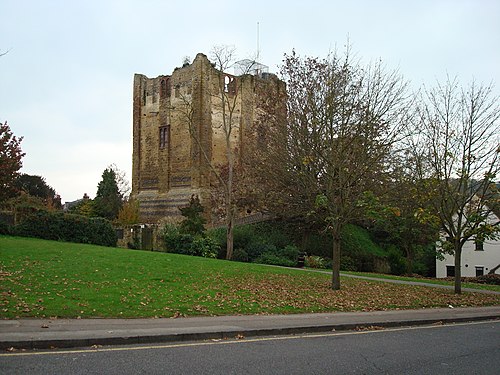
Broad grassy inner ward ringed by low rubble curtain walls and the bases of domestic ranges; a large cylindrical stone keep of coursed ashlar stands prominently, its drum pierced by narrow vertical arrow-slits. Surviving wall faces show mixed ashlar and irregular rubble masonry with several arched openings and collapsed sections; foundation outlines of halls and ranges are visible on the lawn. The castle sits within the town, seen against a low tree-line.
Its story
The story of Barnard Castle.
The Balliol Stone Castle, c.1095-1185
Guy de Balliol raised a stone castle here between about 1095 and 1125, on ground that had already been defended before he came. His nephew Bernard de Balliol and Bernard's son, Bernard II, enlarged it between 1125 and 1185. The County Durham town beneath it carries the same name.
Alexander II at the Walls, 1216, and the Fall of the Balliols
In 1216 Alexander II, King of Scotland, brought the castle under siege. It stayed in Balliol hands, though the Bishops of Durham disputed the family's ownership. The argument was settled by events in Scotland: when John Balliol was deposed as King of Scots in 1296 the castle passed to the Bishop of Durham, and around 1300 Edward I granted it away to the Earl of Warwick.
Warwick, Neville and Richard of Gloucester, 1477
In the fifteenth century the castle came by marriage from Anne Beauchamp, 16th Countess of Warwick, to her husband Richard Neville, 16th Earl of Warwick. In 1477, with the Wars of the Roses still running, Richard, Duke of Gloucester, the future Richard III, took possession of it in right of his wife Anne Neville. It became one of his favourite residences.
Bowes, Cromwell's Guns and the Stripping for Raby
By the rising of the Earls of Northumberland and Westmorland in Elizabeth's reign the castle was crown property, and it was garrisoned by Sir George Bowes of Streatlam. Bowes's withdrawal into its walls is generally taken to be the origin of "Barney Castle", County Durham dialect for a pathetic excuse, which Eric Partridge recorded in A Dictionary of Slang and Unconventional English in 1937.
In the Civil War Cromwell besieged it, and after a severe cannonading the garrison surrendered. After frequent grants and reversions the castle, its lands and appurtenances were bought by Sir Henry Vane the Elder, Member of Parliament and a leading figure in Charles I's household, first his Governor and later his Treasurer, who paid £18,000 for Raby Castle and Barnard Castle together. He made Raby his principal seat, took the roofs off Barnard Castle and carried its stone away to keep Raby in repair.
Step inside
8 places to explore in 1477.
The record describes 8 distinct spots at Barnard Castle, including 3 interiors: 14th-century great hall (interior), great chamber (14th century), chapel of st margaret in the outer ward. Create your own photoreal reconstruction and explore every one, more scenes means more rooms, more angles, and more of the place to stand in.
Build Your Own Castle
Recreate Barnard Castle with AI to explore it.
The artist rebuilds it as it stood in 1477, a photoreal reconstruction that belongs to you alone. Pay with coins, no subscription needed.
Recreate this castle →Defend this castle →Whose castle
Clans who held Barnard Castle.
The families that held Barnard Castle for a decade or more across its history, follow a name to its clan.
Balliol
Held by the Balliol family until John Balliol's deposition as King of Scotland in 1296, when it passed to the Bishop of Durham.
Beauchamp
Held by Anne Beauchamp, 16th Countess of Warwick, whose 15th-century marriage carried the castle to Richard Neville.
Neville
Held by Richard Neville, 16th Earl of Warwick, by marriage; Richard of Gloucester took possession by right of Anne Neville in 1477.
Vane
Purchased by Sir Henry Vane, ancestor of the Dukes of Cleveland, after frequent grants and reversions.
From the archive
Barnard Castle on paper: the measured plan and period views.
The survey plan and photographs below are the ground truth this page's reconstructions are checked against, drawn and photographed while the castle was still a working garrison. Every image is public-domain or openly licensed, with its source named.

Barnard Castle. The Castle LCCN2017659169
ca. 1890-1900 · Photochrom Prints Collection (via Wikimedia Commons)
Public domain
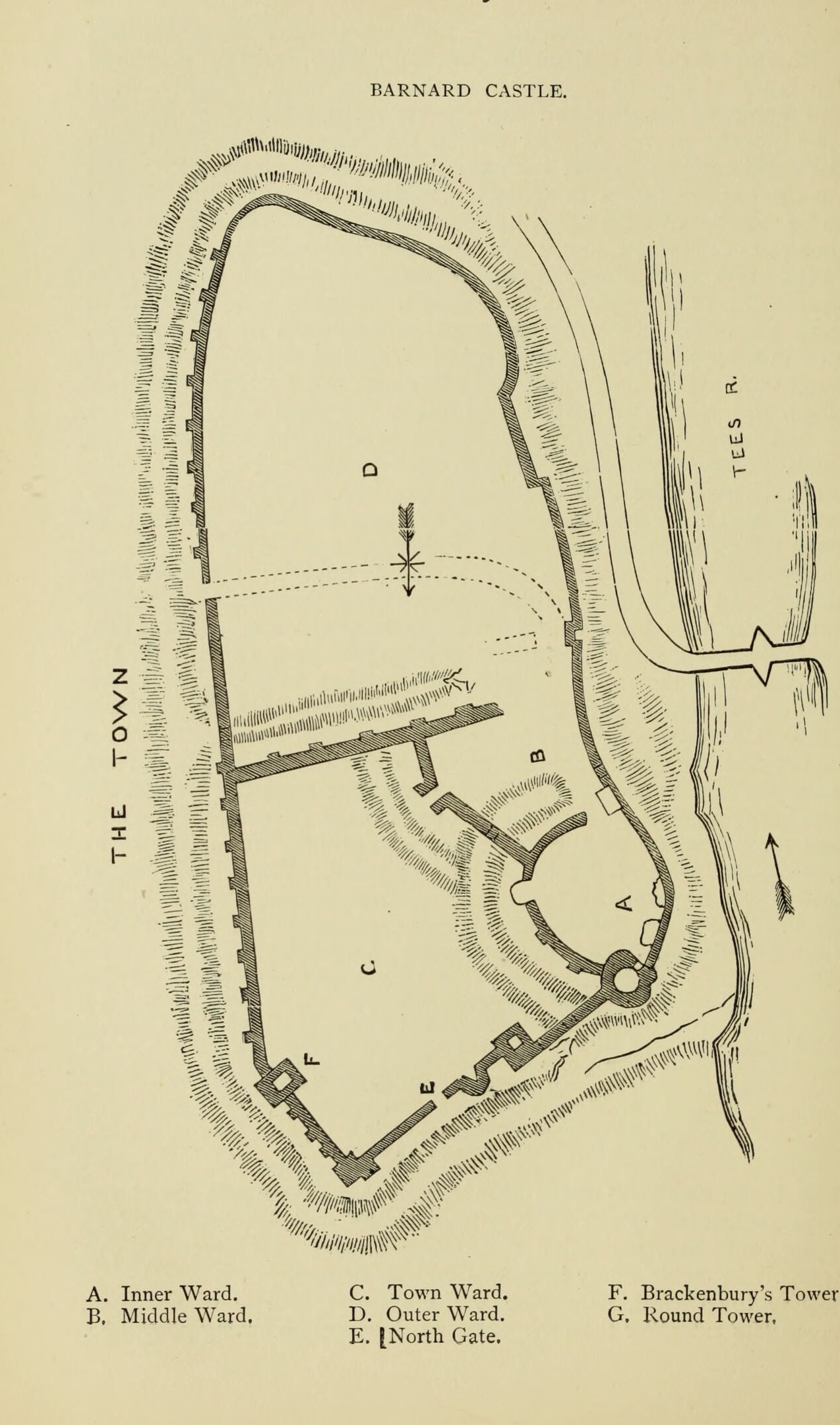
BARNARD CASTLE. A. Inner Ward. B. Middle Ward. C. Town Ward. D. Outer Ward. E. [North Gate. F. Brackenbury's Tower. G. Round Tower.
1884 · G. T. Clark, Mediaeval Military Architecture, vol. 1 (1884)
Public domain