England · Restored
Bolsover Castle
Bolsover Castle is an early 17th-century country house-style castle on the site of earlier medieval earthworks in Bolsover, Derbyshire. Built from 1612 onward by Sir Charles Cavendish with later alterations, it includes the Little Castle and a long Terrace Range and is now managed by English Heritage as a visitor site.
Its prime
1676
Today
Restored
As it stood in 1676
What Bolsover Castle looked like in its prime.
Perched atop its earthwork mound, the castle presents a compact group of ashlar stone ranges: a square, multi-storey 'Little Castle' with battlemented parapets, corner turrets and small white domed cupolas, linked to a long Terrace Range of crenellated parapets, pinnacles and regular rectangular mullioned windows. The east range appears as a gabled façade with large window openings. The whole complex sits above a wooded slope and retains clear silhouette of towers, parapets and stepped terraces.
Its story
The story of Bolsover Castle.
The Peverel Castle and King John's Double Game, 1155–1290
The first castle at Bolsover was raised by the Peverel family in the 12th century and passed to the Crown in 1155 on the death of William Peverel the Younger: a holding the Ferrers family, Earls of Derby, never stopped claiming. When Henry II's sons (Henry the Young King, Geoffrey Duke of Brittany and the future Richard the Lionheart) led a baronial revolt against their father, the king spent £116 on building at Bolsover and Peveril, and the garrison was increased to a force led by 20 knights, shared with Peveril and Nottingham for the duration of the rising.
William de Ferrers, 4th Earl of Derby, paid King John 2,000 marks for the lordship of the Peak, but the Crown kept Bolsover and Peveril. On 1 June 1216, with rebellion spreading across the country, John ordered Brian de Lisle to defend Bolsover if it could be held and to slight it if it could not. That same year John granted both castles to Ferrers to secure his support, but de Lisle refused to hand them over, and John, though both men were his supporters, gave Ferrers leave to take them by force. Bolsover fell to Ferrers' men after a siege in 1217.
The castle returned to Crown control in 1223, when £33 went on repairing the damage the Earl of Derby had done in capturing it. Over the next twenty years four towers were added, the keep and stretches of curtain wall repaired, and a kitchen and barn built, at a cost of £181. From 1290 the castle and manor were granted to a series of local farmers, under whose custodianship it slid into disrepair.
Talbots, Cavendishes and Smythson's Little Castle
Edward VI granted Bolsover to Francis Talbot, 5th Earl of Shrewsbury, in 1553. His son George, the 6th Earl, was keeper of Mary, Queen of Scots at Chatsworth, and in 1574 two Scottish servants in the Bolsover stable, Alexander Hamilton and John Stewart, fell under suspicion of secretly carrying letters to the captive queen.
After the 6th Earl's death in 1590, his son Gilbert sold the ruins to his step-brother and brother-in-law Sir Charles Cavendish, who wanted a new castle on the old site. Working with the builder and designer Robert Smythson, Cavendish began the 'Little Castle' on the medieval earthworks in 1612, a house designed for elegant living rather than defence. It was unfinished when both men died, in 1614 and 1617; the surviving building accounts are unusual for the period in recording female labour. Cavendish's sons William and Charles carried the work on under the influence of Inigo Jones's Italian-inspired architecture, completing the tower around 1621. On 30 July 1634 Ben Jonson's masque Love's Welcome at Bolsover was performed there during a royal visit.
Slighted by Parliament, Restored by a Duke
The Civil Wars of 1642 to 1651 interrupted construction. Bolsover was taken by the Parliamentarians, who slighted it, and the castle fell into a ruinous state. William Cavendish (created Marquess of Newcastle in 1643 and Duke of Newcastle-upon-Tyne in 1665) added a new hall and staterooms to the Terrace Range, and by his death in 1676 the castle had been restored to good order.
From the Portlands to the Nation, 1676–1945
The castle passed through Margaret Bentinck, Duchess of Portland, into the Bentinck family, becoming one of the seats of the Earls and Dukes of Portland. After 1883 it stood uninhabited, and in 1945 William Cavendish-Bentinck, 7th Duke of Portland, gave it to the nation. The Ministry of Works stabilised the buildings and began opening parts of them to the public; Bolsover is now in the care of English Heritage, protected as a Grade I listed building and a Scheduled Ancient Monument.
Step inside
8 places to explore in 1676.
The record describes 8 distinct spots at Bolsover Castle, including 2 interiors: the new hall (interior), staterooms in the terrace range. Create your own photoreal reconstruction and explore every one, more scenes means more rooms, more angles, and more of the place to stand in.
Build Your Own Castle
Recreate Bolsover Castle with AI to explore it.
The artist rebuilds it as it stood in 1676, a photoreal reconstruction that belongs to you alone. Pay with coins, no subscription needed.
Recreate this castle →Defend this castle →Whose castle
Clans who held Bolsover Castle.
The families that held Bolsover Castle for a decade or more across its history, follow a name to its clan.
Peverel
Built by the Peverel family in the 12th century; Crown property from 1155 on the death of William Peverel the Younger.
Talbot
Granted to Francis Talbot, 5th Earl of Shrewsbury, in 1553; sold by the 7th Earl after 1590.
Bought by Sir Charles Cavendish, who built the present castle from 1612 to 1617.
From the archive
Bolsover Castle on paper: the measured plan and period views.
The survey plan and photographs below are the ground truth this page's reconstructions are checked against, drawn and photographed while the castle was still a working garrison. Every image is public-domain or openly licensed, with its source named.

Bolsover Castle, Derbyshire, England-LCCN2002696662
ca. 1890-1900 · Photochrom Prints Collection (via Wikimedia Commons)
Public domain
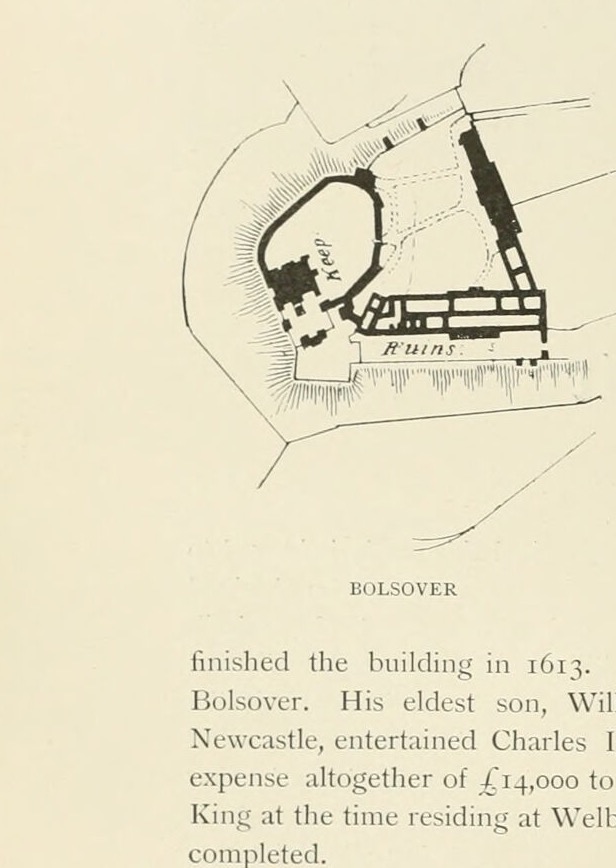
BOLSOVER
1897 · J. D. Mackenzie, The Castles of England, vol. 1 (1897)
Public domain
Nearby