England · Partial ruin
Clitheroe Castle
Clitheroe Castle is an early medieval castle on a steep limestone outcrop in Clitheroe, Lancashire, with a largely surviving square stone keep and portions of its curtain wall. The site served as the caput of the Honour of Clitheroe and today houses a museum while remaining a public war memorial. The keep is one of the smallest surviving stone-built keeps in England and stands visibly above the town.
First raised
1200
Its prime
1193
Today
Partial ruin
As it stood in 1193
What Clitheroe Castle looked like in its prime.
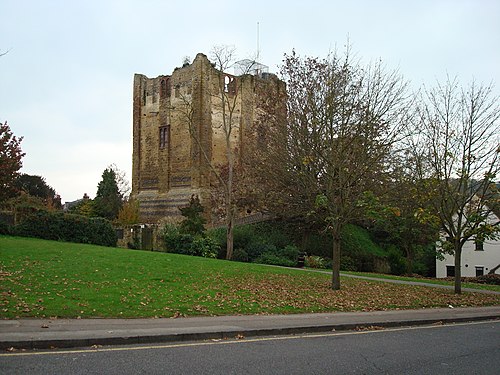
A compact, square stone keep rising from a stepped, terraced plinth on a steep limestone outcrop; flat pilasters at the corners give the illusion of corner towers. Walls of roughly coursed grey limestone contain recessed arrow-slits on three sides, an external first-floor doorway reached by an external stair at the northwest, and a large breached opening on the southeast wall. Surviving lengths of embattled curtain wall, gate piers on the drive, cobbled bailey and terraced garden slopes surround the mound.
Its story
The story of Clitheroe Castle.
The Honour of Clitheroe and the Battle of 1138
After the Conquest the hundred of Blackburnshire lay in the fief of Roger de Poitou. Under William Rufus, de Poitou granted Blackburnshire and the Bowland country north of the Ribble to Robert de Lacy, Baron of Pontefract; when de Poitou forfeited his English lands in 1102, Henry I let de Lacy keep them and added the vills of Chipping, Aighton and Dutton. Clitheroe became the caput of the new honour, an estate running along the western side of the Pennines. The site earns the position: a steep limestone outcrop rising 39 metres above the surrounding land, barring the Ribble pass that a Roman road had used.
Who raised the castle is disputed. The 14th-century Historia Laceiorum credits the Robert de Lacy who died in 1193, grandson of the first Robert; he is generally accepted as the builder of the keep, though some fortification is thought to have stood before it. A castle is thought to have stood by 1102, when Robert de Lacy granted Ralph le Rous lands "within the baillie and below", and charters of the 1120s mention the chapel of St Michael inside the walls.
In the summer of 1138 a Scottish force under William fitz Duncan harried the district and beat an English force at the Battle of Clitheroe. No account of the fighting mentions the castle, though it may be why the battle was fought there. In the 1190s it was garrisoned against the rebellion of Richard I's brother John.
From Lincoln to Lancaster, 1311-1322
Robert de Lacy died without an heir; the lands passed through a cousin to her grandson Roger, constable of Chester, who took the de Lacy name and whose descendants were Earls of Lincoln from 1232. When Henry de Lacy, third earl, died in London in 1311, his property passed to Thomas, 2nd Earl of Lancaster, who had married his daughter and heiress Alice. In 1315 Sir Adam Banastre rebelled against the earl, and Clitheroe was among the castles raided for weapons. Lancaster's attainder and death in 1322 sent the estate to the Crown; his brother Henry was later granted the lands, which in time became part of the Duchy of Lancaster.
A document of 1324 records a rebuilding on the scale of a great hall, which probably stood in the inner bailey: thirty wagon-loads of timber from Bowland, forty-five wagon-loads of stone slates for the roof, and five carpenters over seventeen weeks. The hundred court of the honour sat here, the steward acting as judge.
Edward IV's £200 and the Surveys of 1602 and 1608
A new chamber went up in 1425, and during the Wars of the Roses Edward IV ordered £200 spent on repairs, after which the castle seems to have been let go; Duchy records show a constable and a porter in the 1480s. It served as a jail: Henry VI, captured outside Clitheroe in 1464, may have been held there briefly, and in 1506 the porter himself was shut in his own jail after attending a meeting of armed men at Whalley. A survey of 1602 called the place very ruinous and its buildings likely to fall down; another in 1608 recorded that parts of them already had.
Prince Rupert's Garrison and the Slighting of 1649
In 1644 Prince Rupert, marching to relieve the parliamentarian siege of York, left a garrison at Clitheroe. They mended the main gateway and stocked the castle with provisions, then abandoned it after the royalist defeat at Marston Moor. When the Lancashire militia was ordered to disband in 1649 it refused, occupying the castle briefly in a dispute over unpaid wages. That same year Parliament listed Clitheroe among the castles to be slighted, though how much was pulled down is uncertain, since the 19th-century buttressing of the keep destroyed parts of the fabric that might have shown it. Its timbers, stone and chapel slate were valued for removal.
From the Duke of Albemarle to the War Memorial
Charles II gave the castle and its honour to the first Duke of Albemarle in 1660 as a reward for helping him regain the crown, and from the late 17th century it housed the steward of the honour. Ownership descended to the Dukes of Buccleuch; around the 1720s, when a new house was built for the steward, much of the surviving curtain wall seems to have come down, with garden terraces laid out. It served as the administrative centre of Blackburnshire until the town hall in Church Street was built in 1822.
By 1848 the ruined keep, the second smallest surviving stone-built keep in England, was in danger of collapse; at least £221 went on rebuilding the staircase tower, refacing walls in Chatburn limestone and adding buttresses. In November 1920 the borough council bought the site from Lord Montagu of Beaulieu for £9,500, raised by public subscription, as a memorial to the 260 men of the town who died in the First World War.
Step inside
10 places to explore in 1193.
The record describes 10 distinct spots at Clitheroe Castle, including 3 interiors: inner spiral staircase (western corner), castle chapel (bailey), great hall, auditor's chamber and buttery (bailey). Create your own photoreal reconstruction and explore every one, more scenes means more rooms, more angles, and more of the place to stand in.
Build Your Own Castle
Recreate Clitheroe Castle with AI to explore it.
The artist rebuilds it as it stood in 1193, a photoreal reconstruction that belongs to you alone. Pay with coins, no subscription needed.
Recreate this castle →Defend this castle →Whose castle
Clans who held Clitheroe Castle.
The families that held Clitheroe Castle for a decade or more across its history, follow a name to its clan.
de Lacy
Held by the de Lacy family, later Earls of Lincoln, until Henry de Lacy's death in 1311.
Lancaster
Passed to Thomas, Earl of Lancaster, in 1311; after his attainder and death in 1322 the honour merged into the Duchy of Lancaster.
Monck
Given to George Monck, 1st Duke of Albemarle, in 1660; the site remained in private ownership until 1920.
From the archive
Clitheroe Castle on paper: the measured plan and period views.
The survey plan and photographs below are the ground truth this page's reconstructions are checked against, drawn and photographed while the castle was still a working garrison. Every image is public-domain or openly licensed, with its source named.
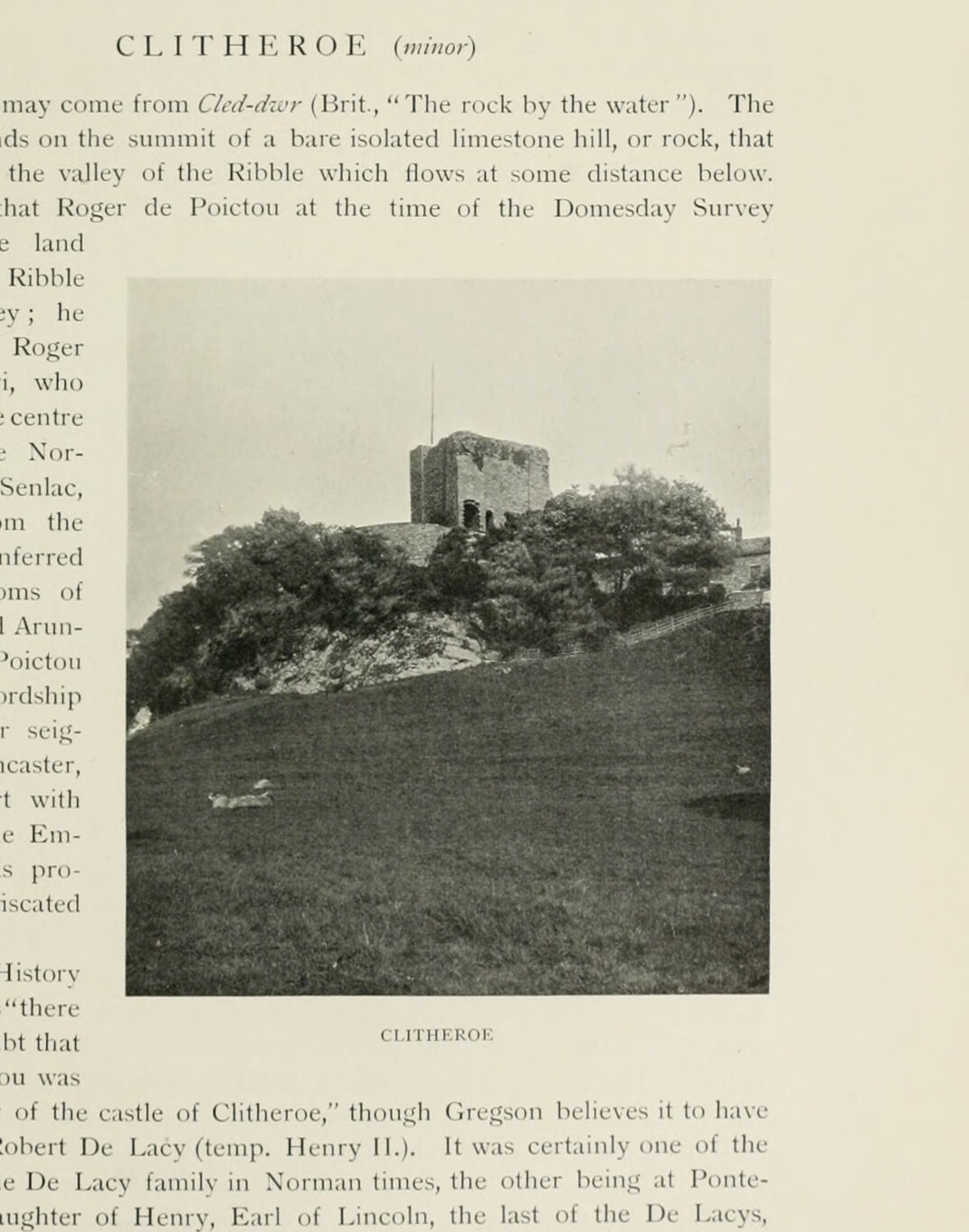
CLITHEROE
1897 · J. D. Mackenzie, The Castles of England, vol. 2 (1897)
Public domain
Nearby