England · Restored
Morpeth Castle
Morpeth Castle is a medieval castle on a mound overlooking the River Wansbeck at Morpeth, Northumberland. The 11th‑century motte and bailey was replaced in the 1340s by a stone castle whose much‑altered gatehouse survives; that gatehouse has been restored by the Landmark Trust and is now holiday accommodation.
Its prime
1340
Today
Restored
As it stood in 1340
What Morpeth Castle looked like in its prime.
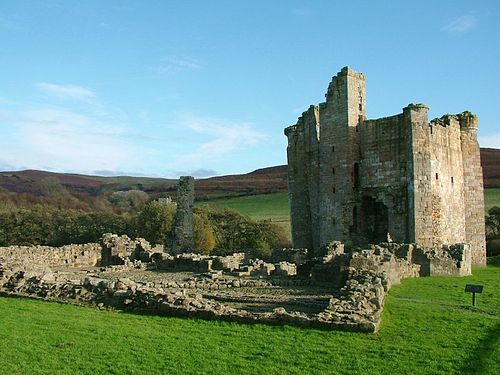
A squat, rectangular stone gatehouse of warm honey‑coloured sandstone forms the principal visible feature: a broad pointed arched timber entrance set in an ashlar façade, narrow vertical slit windows and pairs of mullioned windows above, and a crenellated parapet with projecting corbels along the roofline. A low curtain wall runs away from the gatehouse along the hillside; the whole stands on a raised motte above a grass‑covered slope overlooking the river and town.
Its story
The story of Morpeth Castle.
King John's Destruction and the New Castle of the 1340s
The first castle at Morpeth was a motte and bailey of the 11th century, raised on a hill overlooking the River Wansbeck in Northumberland and credited to Ralph de Merlay. King John destroyed it in 1216. A new castle was built in the 1340s, set within the bailey of the old one.
Held Through the Female Line: De Merlay, Greystoke, Dacre and Howard
The castle was held by, and passed by the female line through, several illustrious families (de Merlay, Greystoke, Dacre and Howard), none of whom resided there for any long period. In about 1860 the gatehouse was restored and converted to provide a staff residence.
Margaret Tudor's Refuge, 1516, and the Plot of 1598
In 1516 Margaret Tudor, sister of Henry VIII and widow of James IV of Scotland, spent four months at Morpeth Castle as she fled from her enemies in Scotland and sought refuge with her brother. In 1598 Edward Grey, constable of the castle, captured Robert Crawforth and Valentine Thomas, who claimed to have been involved in a conspiracy to assassinate Elizabeth I.
Twenty Days for Parliament, 1644
A garrison of 500 Lowland Scots held Morpeth for Parliament for 20 days against 2,700 Royalists. That defence, in 1644, was the one great military event in the castle's history.
Parish, Listing and the Landmark Trust, from 1866
Morpeth Castle had been a township, and from 1866 was a civil parish in its own right, until the parish was abolished on 1 April 1935 and merged with Morpeth. The castle was listed Grade I on 11 August 1950 and is a scheduled ancient monument. Little of the 14th-century structure survives beyond parts of the curtain wall and the much-altered gatehouse.
In 1988 the castle was rented on a long-term arrangement to the Landmark Trust, which carried out a complete refurbishment in 1990, restoring many of the gatehouse's original historic features and removing the modern extensions and swimming pool. The gatehouse can be rented from the Trust as holiday accommodation.
Step inside
8 places to explore in 1340.
The record describes 8 distinct spots at Morpeth Castle, including 2 interiors: gate passage through the gatehouse, first-floor gatehouse chamber. Create your own photoreal reconstruction and explore every one, more scenes means more rooms, more angles, and more of the place to stand in.
Build Your Own Castle
Recreate Morpeth Castle with AI to explore it.
The artist rebuilds it as it stood in 1340, a photoreal reconstruction that belongs to you alone. Pay with coins, no subscription needed.
Recreate this castle →Defend this castle →Whose castle
Clans who held Morpeth Castle.
The families that held Morpeth Castle for a decade or more across its history, follow a name to its clan.
de Merlay
Early holders of Morpeth; the castle passed through the female line from the de Merlays to the Greystokes.
Greystoke
Held Morpeth by descent through the female line from the de Merlays.
Dacre
Held Morpeth by female-line descent, between the Greystokes and the Howards.
The last of the great families to hold Morpeth, receiving it by female-line descent from the Dacres.
Nearby