
Ireland · Restored
Cahir Castle
Caisleán na Cathrach
Cahir Castle is a large medieval castle sited on an island in the River Suir in Cahir, County Tipperary, Ireland. Constructed from the 12th century and remodelled through the 15th–17th centuries, it remained an inhabited stronghold until decline in the 18th century and was restored and opened to the public in the 20th century.
First raised
1142
Its prime
1627
Today
Restored
Ranked among Europe’s castles
As it stood in 1627
What Cahir Castle looked like in its prime.
Stone-built castle occupying an island in the River Suir, formed of two adjoining medieval ranges: an older street-facing block and a later range that contains the Great Hall. The complex reads as contiguous roofed ranges linked by substantial stone walls rather than isolated freestanding keeps. In its prime the roofs, halls and defensive wallwalks would have been complete and in use, the later range housing the principal domestic and ceremonial rooms.
Its story
The story of Cahir Castle.
An O'Brien Stronghold on the Suir, 1142
Cahir Castle, one of the largest castles in Ireland, was built from 1142 by Conchobar Ua Briain, King of Thomond, on an island in the River Suir. The site was chosen deliberately: it stood on and near an earlier native stone fort (a cathair, which gave the place its name) in opposition to Norman expansion pushing north from Ardfinnan Castle, four miles to the south. The core of the present structure dates to thirteenth-century construction by the O'Brien family, and the castle was raised in two parts, the side nearest the street some two hundred years older than the other.
The Butlers of Cahir and the Siege of 1599
In 1375 the castle was granted to James Butler, newly created Earl of Ormond, for his loyalty to Edward III. His son James, the second Earl, passed the lands around the barony of Iffa and Offa West to his children, and by 1542 the first of the Barons Cahir had been created. The Butlers enlarged and remodelled the castle between the fifteenth and seventeenth centuries, but unlike their Anglican kinsmen, the Cahir branch sided with the Roman Catholic Irish in the Elizabethan wars.
That allegiance brought Essex's army to the walls. In 1599 the castle was captured after a three-day siege and placed for a year under the charge of Sir Charles Blount. Lord Cahir joined the Earl of Tyrone in 1601 and was attainted for treason, though he later obtained a full pardon. The castle saw a darker episode in 1627, when Cahir's son-in-law, Lord Dunboyne, murdered his distant cousin James Prendergast there in a dispute over an inheritance; he was tried for the killing but acquitted.
Two Surrenders: Inchiquin, Cromwell and the Treaty of 1653
During the Irish Confederate Wars the castle was besieged twice. In 1647 George Mathew, guardian of the young Lord Cahir, surrendered it to Murrough O'Brien, 6th Baron Inchiquin, himself a descendant of the castle's builder, after Inchiquin's victory at the Battle of Knocknanauss. In 1650 Mathew surrendered again, this time to Oliver Cromwell during his conquest of Ireland, without a shot being fired. The castle then hosted one of the war's closing acts: in March 1653, as resistance to the conquest collapsed, Edmund O'Dwyer met the English Colonel Jerome Sankey at Cahir and agreed a treaty for the surrender of the Irish forces in Counties Tipperary and Waterford two weeks later.
Ruin, the Last of the Butlers, and the State, 1961–1971
The castle fell into ruin in the late eighteenth century and was partially restored in the 1840s, when the Great Hall was partly rebuilt. Richard Butler Charteris, the last resident representative of the Butler-Charteris family at Cahir, died in 1961, after which the estate was broken up and sold. The castle passed to the Irish state, was designated a National Monument in 1964, and, restored by the Office of Public Works, opened to the public in 1971.
Step inside
4 places to explore in 1627.
The record describes 4 distinct spots at Cahir Castle, including 2 interiors: great hall, later range (domestic suites). Create your own photoreal reconstruction and explore every one, more scenes means more rooms, more angles, and more of the place to stand in.
Build Your Own Castle
Recreate Cahir Castle with AI to explore it.
The artist rebuilds it as it stood in 1627, a photoreal reconstruction that belongs to you alone. Pay with coins, no subscription needed.
Recreate this castle →Defend this castle →Whose castle
Clans who held Cahir Castle.
The families that held Cahir Castle for a decade or more across its history, follow a name to its clan.
Held by the Butlers, Barons Cahir, from 1375 for nearly 600 years.
From the archive
Cahir Castle on paper: the measured plan and period views.
The survey plan and photographs below are the ground truth this page's reconstructions are checked against, drawn and photographed while the castle was still a working garrison. Every image is public-domain or openly licensed, with its source named.
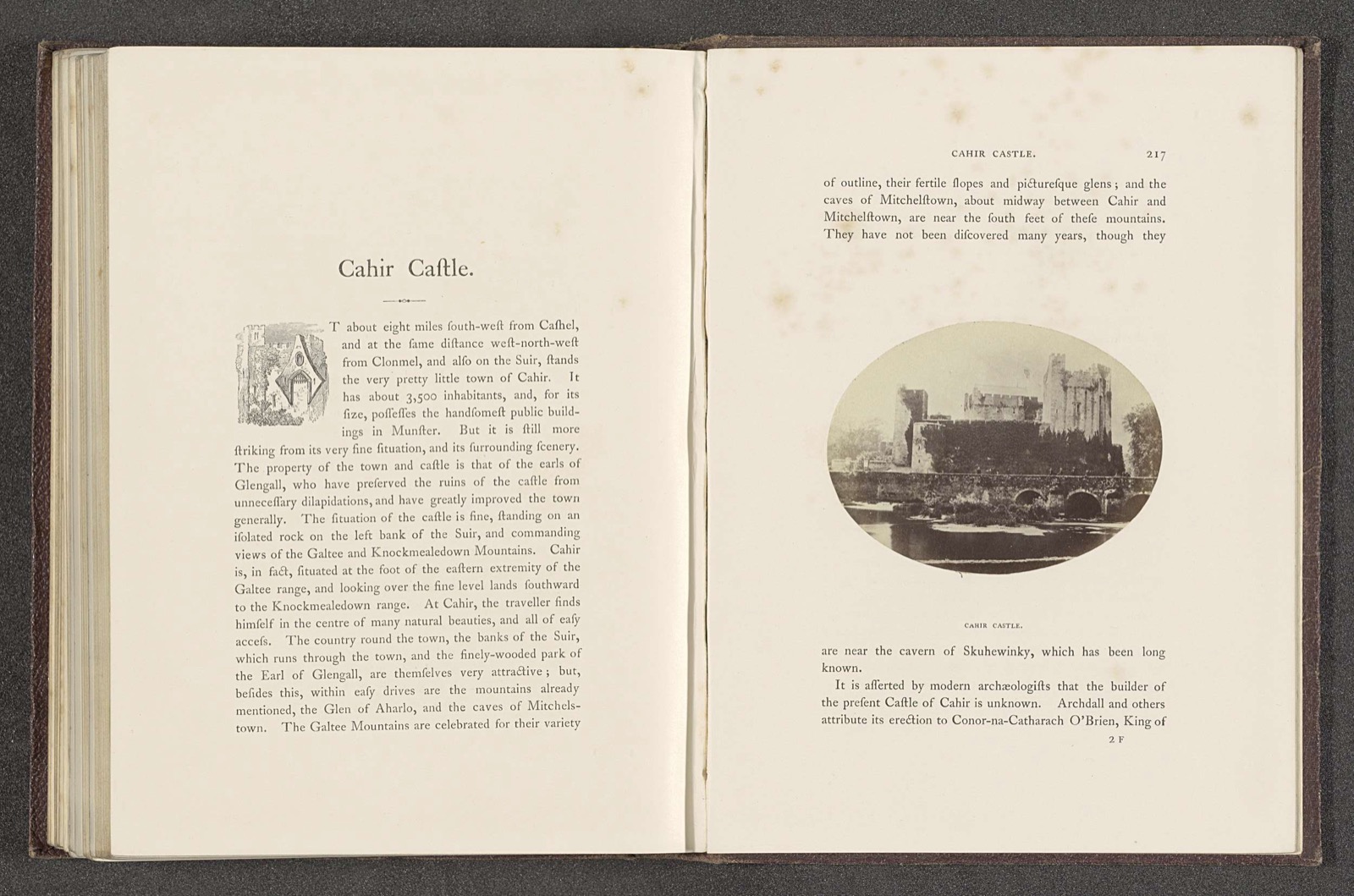
Gezicht op Cahir Castle
· Rijksmuseum (via Europeana)
Public domain
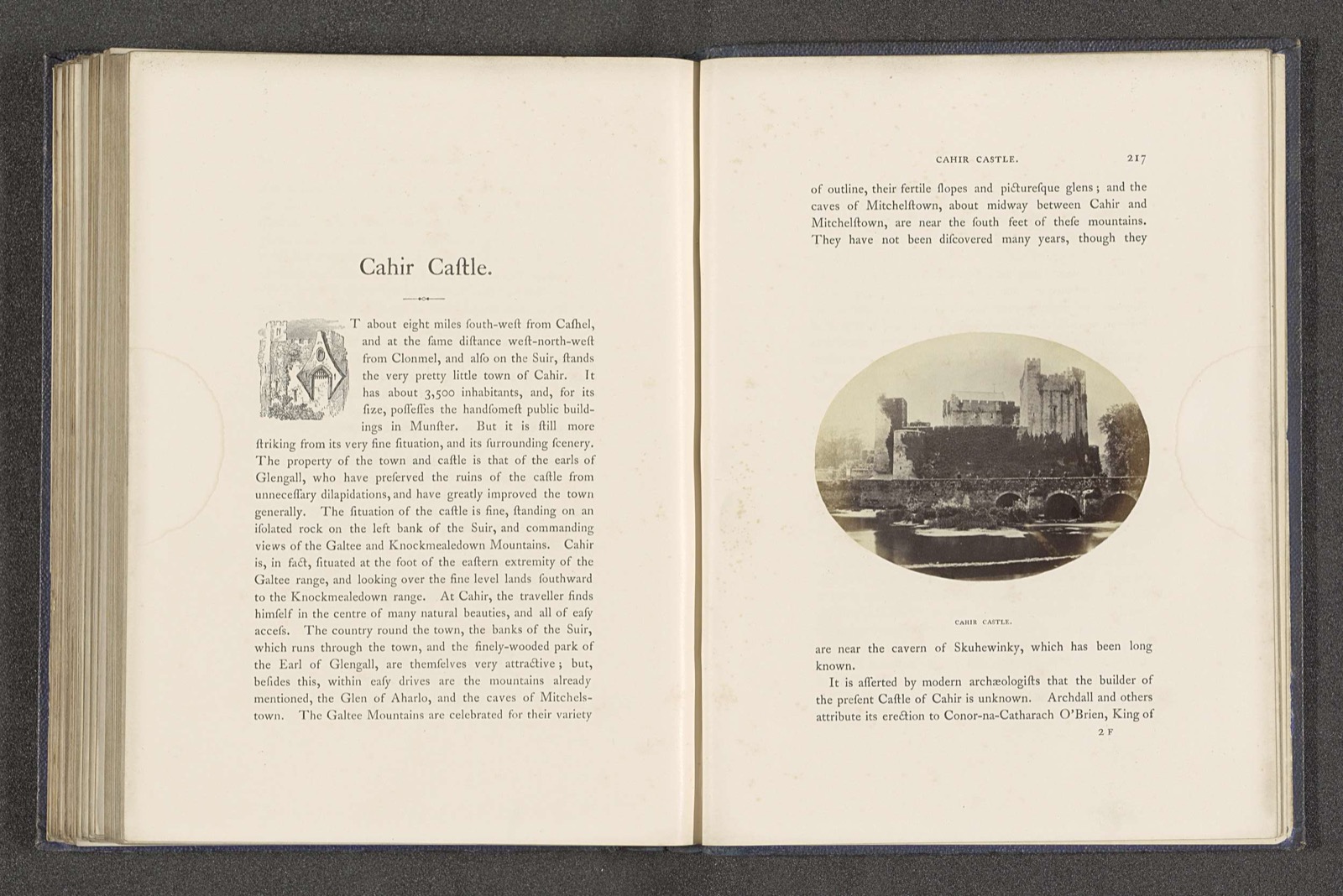
Gezicht op Cahir Castle
· Rijksmuseum (via Europeana)
Public domain


