Historic Cities · Germany
Aachen through the ages
Aachen is the 13th-largest city in North Rhine-Westphalia and the 27th-largest city of Germany, with around 261,000 inhabitants. It is the western-most major city in Germany, lying approximately 61 km (38 mi) west of Cologne and Bonn, directly bordering Belgium in the southwest, and the Netherlands in the northwest.

Aachen in AD 800
Charlemagne's Aachen
This is the imperial palace-city in the first decades of Charlemagne's permanent residence, when the new Palatine Chapel and the great Council Hall shape a compact royal quarter. The walk follows the palace square, the steaming springs and the timber workshops that cluster around the emperor's court, ending at a lofty tower that looks over the whole complex.
Aix-la-Chapelle in 800 is a compact, low-rise town gathered around red stone monuments and timber halls. The Palatine Chapel's octagon and its leaded cupola pierce the skyline, surrounded by whitewashed administrative buildings, covered wooden galleries and brick-faced basilicas. Narrow packed-earth streets run between markets, baths steaming into stone basins, and rows of workshops; colours are ochres, pale plaster, exposed oak and the dark gleam of polished bronze and marble spolia.
The route: 20 streets, squares and views
Decumanus Approach → Porta Orientalis (East Gate) → Bridge over the Wurm → Palace Market → Granus Tower (base) → Aula Regia Forecourt → Gallery's Monumental Porch → Palace Square → Palatine Chapel (exterior) → Westbau and Atrium → …
Step inside, 12 interiors
Covered Market Hall · Granus Tower Base Chamber · Great Council Hall · Stone Gallery Passage · Octagon beneath the Dome · Hot Spring Baths · Imperial Bathing Hall · Palace Scriptorium · Goldsmiths' Main Workshop · Royal Mint Workshop · Great Timber Hall Chamber · West Atrium with Exedrae
Planned from the Wikipedia record: Palace of Aachen.
Aachen in 1500
Coronation Aachen
Aachen in 1500 is the still-recognised coronation city of the German kings, where the little Carolingian octagon sits grafted to a new Gothic, glass-walled choir and the town hall rises over the old palace foundations. The walk moves from the outer gate and springs into narrow market streets, past cloth-weavers and needle-makers, to the cathedral precinct crowded with pilgrims for the seven-yearly relic showing.
Aachen’s skyline is dominated by the squat octagonal Palatine Chapel and the tall, luminous Gothic choir whose great expanses of glass make the east end read like a reliquary. The octagon’s quarry-stone and ancient columns show traces of red plaster; around them a dense town of timber-framed houses with steep tiled roofs, narrow streets and fortified stone gates press close to medieval walls and the winding Wurm river.
The route: 22 streets, squares and views
Lousberg Slope → Ponttor Gate → Pontstraße → Wurm Bridge → Aquae Granni Springs → Bathhouse Courtyard → Tuchgasse → Nadelgasse → Markt (Great Market) → Fischmarkt → …
Step inside, 12 interiors
Ponttor Gate Guard Chamber · Spring Well Niche · Bathhouse Steam Chamber · Weavers' Loom Workshop · Needle-makers' Forge Shop · Great Market Hall Interior · Town Hall Coronation Chamber · Domed Octagon Interior · Imperial Throne Antechamber · Gothic Choir Heiltum Hall · Aula Regia Foundation Vault · Marschiertor Toll Room
Planned from the Wikipedia record: Aachen Cathedral.
Its story
The story of Aachen.
Aquae Granni: The Springs, the Sixth Legion and the Ripuarian Franks, 3000 BC–AD 470
People came here for the water. Flint quarries on the Lousberg, the Schneeberg and the Königshügel were worked between 3000 and 2500 BC, and barrows on the Klausberg show Bronze Age occupation around 1600 BC. In the Iron Age the marshy Aachen basin was settled by Celtic peoples, perhaps drawn by its hot sulphur springs, where they worshipped Grannus, god of light and healing, although no proof of a Celtic settlement here at the outbreak of the Gallic War has yet been found. The Roman name, Aquae Granni, meant the waters of Grannus.
It appears to have been the Roman 6th Legion that first channelled the hot springs into a spa at Büchel, at the start of the first century AD, adding the Münstertherme spa and a probable sanctuary to Grannus at the end of the same century; legend instead credits a founder named Grenus under Hadrian, around AD 124. The resort town covered 25 hectares; there were bathhouses near Burtscheid and a temple precinct called Vernenum near modern Kornelimünster and Walheim. A Jewish community lived in Aachen during the Roman period.
Roman civil administration broke down as the baths and other public buildings were destroyed around AD 375 at the start of the migration period; the last Roman coins found here date from the reign of Gratian, 375 to 383. Rome withdrew its troops, but the town stayed populated, and by 470 it was held by the Ripuarian Franks and subordinated to their capital at Cologne.
Charlemagne's Winter Court, 765–855
Pepin the Short had a castle residence built in the town, drawn by the hot springs and by a position between the Rhineland and northern France. Einhard records that Pepin kept both Christmas and Easter at Aquis villa in 765–766, so the place was already equipped to carry the royal household for months at a time. Charlemagne came to spend Christmas at Aachen for the first time in 768, the year of his coronation as king of the Franks, and from 792 until his death in 814 he spent most winters there; the town became the focus of his court and the political centre of his empire. Beyond the Palace and the Palatine Chapel no source attests to significant building work under him. The chapel was begun around 796 and was, on completion around 798, the largest cathedral north of the Alps. Odo of Metz built it on the model of the Basilica of San Vitale at Ravenna. Charlemagne was buried in the church he had built. His original tomb has been lost, and his alleged remains are kept in the Karlsschrein, the shrine into which he was moved after being declared a saint, a sainthood the Roman Curia never officially acknowledged.
A Jewish community lived beside the royal palace under the Carolingians; in Jewish texts the city was called Aish or Ash. In 797 a Jewish merchant named Isaac travelled with two of Charlemagne's ambassadors to the court of Harun al-Rashid, and returned to Aachen in July 802 bringing an elephant, Abul-Abbas, as a gift for the emperor.
The court also made books. The Ada Gospels and the Coronation Gospels may both have been produced at Aachen under Charlemagne. Under Louis the Pious, from 814 to 840, substantial quantities of ancient texts were copied here, among them legal manuscripts and patristic texts. Work of outstanding quality was still being produced under Lothair I, between 840 and 855, and then the Aachen scriptorium's output ended.
Coronation Church and Free Imperial City, 870–1531
By the terms of the Treaty of Verdun the town fell inside Middle Francia under the emperor Lothair, passed to Lothair II as king of Lotharingia under the Treaty of Prüm, and came to East Francia by the Treaty of Meerssen in 870. In 936 Otto I was crowned king of East Francia in the collegiate church Charlemagne had built. The place was raided by the West Franks under Lothair in 978, during a revolt of the nobles in Otto II's reign, and the imperial palace was attacked again by Odo of Champagne while Conrad II was away. Frederick Barbarossa ordered walls built around palace and town between 1172 and 1176, and granted the city rights in 1166 that made it an imperial city.
Barbarossa's canonisation of Charlemagne in 1165 turned the chapel into a destination for pilgrims. For the next five hundred years most kings of Germany who ruled the Holy Roman Empire were crowned there; the original audience hall Charlemagne had built was pulled down and replaced by the present city hall in 1330, and the last king crowned in Aachen was Ferdinand I in 1531, after which Frankfurt became the preferred coronation place.
Between coronations the city lived off cloth. Its proximity to Flanders gave it a modest position in the trade in woollen cloths, helped by imperial privilege, and in 1372 it became the first coin-minting city in the world to place an Anno Domini date regularly on a general circulation coin, a groschen. As a free imperial city it answered to the emperor alone, but it was politically far too weak to influence any of its neighbours; its only dominion was over Burtscheid, ruled by a Benedictine abbess and forced to send all its traffic through the Aachener Reich. During the 13th century many Jews in the city converted to Christianity, as the records of the Aachen Minster show, and in 1486 the Jews of Aachen presented gifts to Maximilian I at his coronation.
Expulsions, the Fire of 1656, and the Spa Trade
The city began to lose power and influence from the early 16th century. In 1598, after Spanish troops invaded from the Netherlands, Rudolf deposed all Protestant office holders in Aachen and went as far as expelling them from the city. In 1614 Aachen was besieged during the War of the Jülich Succession. Religious changes were forced on the city several times and Protestant communities were banned, but hardly any fighting took place there during the Thirty Years' War. The Jewish community was expelled from the city in 1629; six Jews were allowed to return in 1667, and most of the community settled in Burtscheid. The great fire of 1656 destroyed most of the city, which was rebuilt largely in the Baroque style.
The springs kept working. In 1542 the Dutch humanist and physician Francis Fabricius published a study of the health benefits of the hot springs, and by the middle of the 17th century Aachen had a considerable reputation as a spa: in part because it was then, and remained well into the 19th and early 20th century, a place of high-level prostitution. The condition that most often brought patients was syphilis; only by the end of the 19th century had rheumatism become the chief object of cures at Aachen and Burtscheid.
Aachen was chosen for several congresses and peace treaties. The first opened on 2 May 1668 and produced the treaty that ended the War of Devolution; the second ended with the treaty of 1748 that closed the War of the Austrian Succession. A constitutional crisis broke out in the Aachen government in 1789, and in 1794 French troops under General Charles Dumouriez occupied the city, which lost its status as a free imperial city. Even that late, the Abbess of Burtscheid was still being prevented from building a road linking her territory to the neighbouring estates of the duke of Jülich: the city sent its handful of soldiers to chase away the road-diggers.
French Department, Prussian District: Needles, Cloth and the Cologne Railway, 1801–1900
On 9 February 1801 the Peace of Lunéville took Aachen and the whole left bank of the Rhine from the Holy Roman Empire and granted them to France, and the city became the chef-lieu of the département de la Roer. In 1815, after the Second Treaty of Paris and by agreement at the Congress of Vienna, it passed to the Kingdom of Prussia; a third congress met here in 1818 to decide the fate of occupied Napoleonic France. Prussia created the Regierungsbezirk Aachen and placed it in the Grand Duchy of the Lower Rhine, from 1822 the Rhine Province. The city was one of Prussia's most socially and politically backward centres until the end of the 19th century.
Industrialisation swept away most of the medieval rules of production and commerce. From 1838 the railway from Cologne to Belgium ran through the city; by 1880 the population was 80,000. Overcrowding and sanitary conditions were severe until 1875, when the medieval fortifications were given up as a limit on building and better housing went up in the east of the city, where drainage was easiest. The tramway opened in December 1880 and was electrified in 1895; Burtscheid was merged into Aachen in 1897. Into the 1930s the city made railway locomotives and carriages, iron, pins, needles, buttons, tobacco, woollen goods and silk goods, and the Polytechnicum that became RWTH Aachen University was established in 1870.
The Jewish community offered homage to the Prussian king Friedrich Wilhelm III in its synagogue on 16 May 1815, and in 1862 built a large synagogue, later known as the Old Synagogue.
Occupation, Kristallnacht and the Battle of Aachen, 1918–1945
After the First World War, whose Belgian campaign had begun at Aachen, the city was occupied by the Entente until 1930 along with the rest of German territory west of the Rhine. It was one of the places caught up in the Rhenish Republic: on 21 October 1923 an armed mob took over the city hall and the republic lasted about a year.
By 1933, 1,345 Jews lived in Aachen. The synagogue was destroyed on Kristallnacht in 1938. By the outbreak of war in 1939 many Jews had emigrated or been arrested and only 782 remained; at the end of the war in 1945 there were 62 Jews left in the city. By 2003, 1,434 Jews were living in Aachen again.
More than 120 air strikes hit Aachen between 1940 and 1944. Two Allied raids, on 11 April and 24 May 1944, destroyed it radically: the first killed 1,525 people, among them 212 children, and bombed six hospitals; the second sent 442 aircraft against two railway stations, killed 207 and left 15,000 homeless, and the raids wrecked the Eilendorf and Burtscheid districts. From 12 September to 21 October 1944 the city and its fortified surroundings were besieged by the US 1st Infantry Division with the 3rd Armored Division; around 13 October the 2nd Armored Division reached Würselen and the 30th Infantry Division closed the encirclement on 16 October. Direct assaults through the defended streets forced the German garrison to surrender on 21 October 1944. Aachen was the first German city captured by the Western Allies and its residents welcomed the soldiers as liberators. What was left of it was destroyed, in some areas completely, mostly by American artillery fire and by demolitions the Waffen-SS defenders carried out; medieval churches and the Rathaus were damaged, though the cathedral came through largely unscathed. Four thousand inhabitants were still there, the rest having followed evacuation orders. The first Allied-appointed mayor, Franz Oppenhoff, was assassinated by an SS commando unit.
Border City of the Federal Republic: World Heritage, the Charlemagne Prize and RWTH
After the surrender the Supreme Headquarters Allied Expeditionary Force acted as military government, and Aachen fell into the British occupation zone under Belgian control. British Military Government Ordinance No. 46 created the Land Nordrhein/Westfalen on 23 August 1946, and on 23 May 1949 the city became part of the Federal Republic of Germany. Since 21 October 2009 it has been the seat of the Städteregion Aachen.
Since 1950 a committee of citizens has awarded the Charlemagne Prize each year at the City Hall to people of outstanding service to the unification of Europe. The cathedral and its treasury were inscribed on the UNESCO World Heritage List in 1978, the first German and the second cultural monument in the world to be listed.
Aachen has around 261,000 inhabitants across 161 square kilometres, the westernmost major city in Germany, bordering Belgium to the south-west and the Netherlands to the north-west. Its economy now runs on the university: RWTH Aachen, established as a Polytechnicum in 1870, has made the city a technology hub, and its Klinikum Aachen is the largest single-building hospital in Europe.
From the archive
Aachen on paper: the old town as it was mapped.
A period plan or bird's-eye view of the old town, drawn between 1500 and 1850, the streets this page's reconstructions walk. Public domain, with its source named.
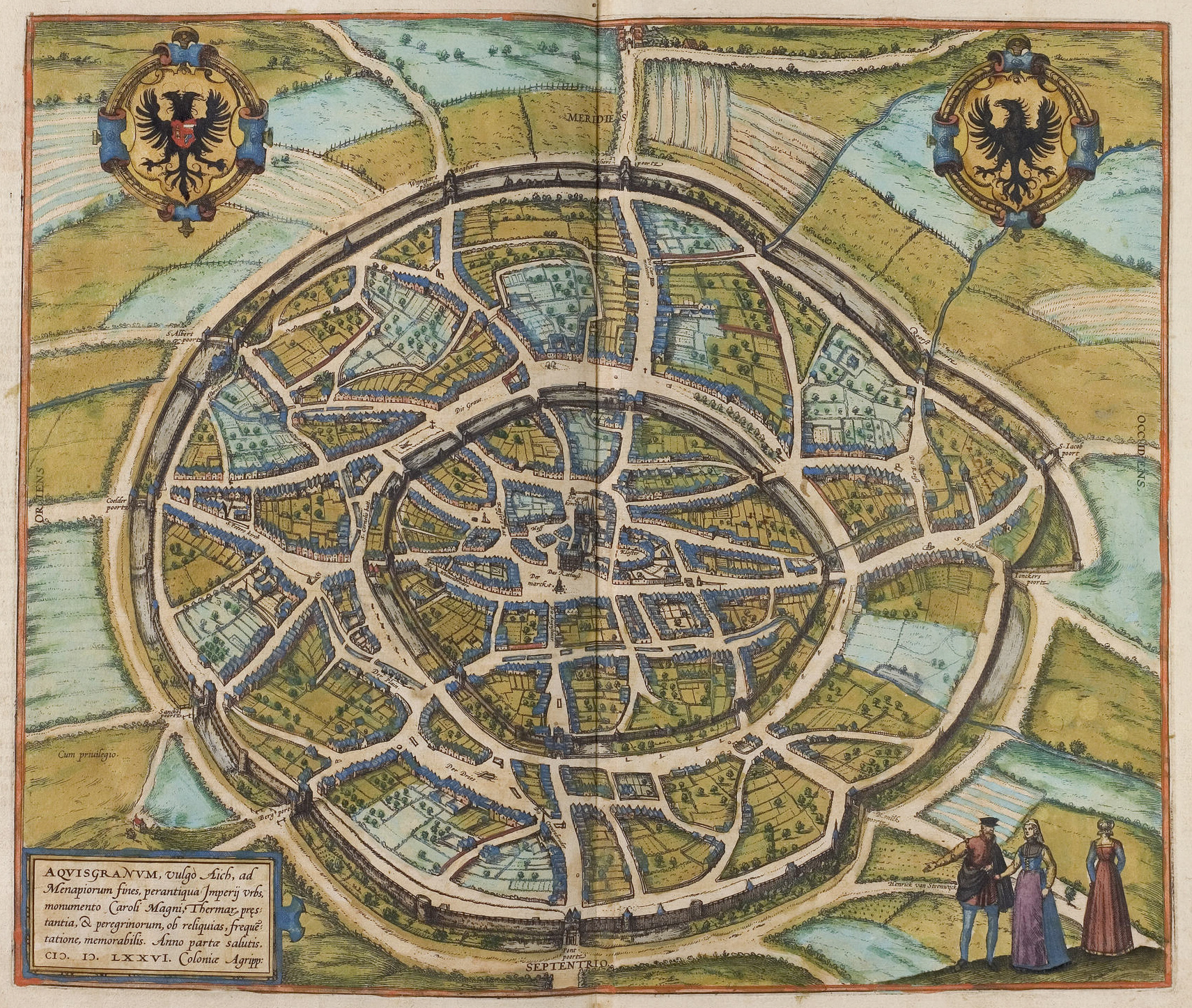
Town plan of Aachen (Aquisgranum), from Braun & Hogenberg's Civitates Orbis Terrarum
Concentric fortified plan with outer walls, moat and gates, radiating streets and blocks centred on the Palatine Chapel (Aachen Cathedral).
1572 · Georg Braun; Frans Hogenberg · Wikimedia Commons
Public domain (plate dated 1572)
In this city
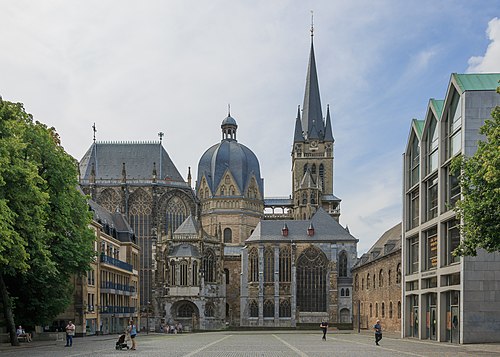
Landmarks of Aachen, see each in its prime


More cities to explore
 NetherlandsMaastrichtExplore it in 1770
 GermanyCologneExplore it in AD 150 · 1250 · 1880
 GermanyBerlinExplore it in 1750 · 1871 · 1928
 GermanyMunichExplore it in 1500 · 1700 · 1900
Castles of Europe · Landmarks of Europe · create your own reconstruction.