Historic Cities · Ukraine
Lviv through the ages
Lviv is the fifth-largest city in Ukraine, as well as the largest city in the western part of the country, with a population of 723,403. It serves as the administrative centre of Lviv Oblast and Lviv Raion, and is one of the main cultural centres of Ukraine. The city also hosts the administration of Lviv urban hromada.

Lviv in 1600
Lwów of the Three Rites
Lwów in 1600 is a fortified, multi‑confessional trading city on the crossroads between the Black Sea and the Baltic, where Latin, Greek, Armenian, Jewish and German merchants live and work side by side. The walk threads from the road and gate into the cobbled Rynek, past carved patrician houses, guild stalls, the Armenian courtyard and the Dormition’s new tower, then up to the High Castle.
A compact walled town of red‑tile roofs, stone church towers and round defensive towers along a mudded moat; narrow cobbled streets open suddenly onto the broad Rynek ringed by two‑ and three‑storey stone townhouses with carved doorways and wooden eaves. The Poltva runs in a ditch below the walls, merchants’ wagons and pack oxen crowd the approaches, and three distinct church towers puncture a low skyline.
The route: 20 streets, squares and views
Road from Kraków → Krakowska Gate → Krakowska Street → Rynek (Market Square) → Ratusz (Town Hall) → Patrician Tenements of Rynek → Cloth Market (Sukiennice) → Armenian Cathedral Courtyard → Armenian Street → Ruska Street → …
Step inside, 14 interiors
Trading House Counting Room · Butchers' Market Hall · Great Council Chamber · Patrician Merchant's Vaulted Hall · Cloth Merchants' Longroom · Armenian Cathedral Dome · Silk Weavers' Upper Chamber · Brotherhood Refectory · Korniakt Tower Belfry · Cathedral Nave and Choir · Synagogue Study Hall · Arsenal Armourers' Workshop · Riverside Tannery Loft · High Castle Great Hall
Planned from the Wikipedia record: History of Lviv.
Lviv in 1900
Habsburg Lemberg
Lemberg in 1900 is the provincial capital of Habsburg Galicia at the height of its stuccoed, late‑Imperial makeover: new palaces and a grand opera close formal promenades while electric trams slice the streets. The walk shows boulevards and market squares where Poles, Ukrainians and Jews trade, coffee houses and confectioners bustle, polytechnic and university students pass, and the Poltva runs hidden beneath a vaulted promenade.
The skyline is a tangle of domes, spires and mansard roofs set above continuous three‑ to five‑storey stucco facades in creams, ochres and pale pinks; occasional grand palaces with carved stone and wrought‑iron balconies punctuate the boulevards. Cobble streets channel horse traffic and new electric tramlines, gas and electric lamps glow at dusk, and the Opera’s ornate neo‑Renaissance volumes close an axial boulevard above the vaulted Poltva river.
The route: 21 streets, squares and views
Wysoki Zamek (High Castle) → St George's Cathedral → Dworzec Główny (Main Station) → Virmenska (Armenian Street) → Rynek (Market Square) → Ratusz Tower → Boim Chapel → Dominican Church → Latin Cathedral → University Forecourt → …
Step inside, 12 interiors
Armenian Cathedral Nave · Viennese Coffee House Salon · Market Hall Arcade · Boim Chapel Interior · Dominican Nave · University Lecture Theatre · Polytechnic Assembly Hall · Opera Auditorium · Mirror Hall · Poltva Vault · Potocki Marble Salon · Great Synagogue Prayer Hall
Planned from the Wikipedia record: History of Lviv.
Its story
The story of Lviv.
Lev's Town: The Princely Foundation on the Poltva
The ground beneath the old town has been occupied since the fifth or sixth century, and a stronghold stood on Castle Hill by the tenth. Lviv appears as a town in its own right only in the mid-13th century, first mentioned in 1259, with a source of 1261 recording that its fortifications were demolished at the Tatars' demand.
Accounts differ on when the town began: its origins are usually dated to the first half of the 13th century, with a rebuilding on an earlier settlement in 1241–42 after the Mongol invasion, while other accounts give a foundation by Daniel of Galicia in 1250. Daniel, subordinate to the Golden Horde, named it for his son Lev (Leo's city, Latinised as Leopolis), and after Daniel's death Lev rebuilt it around 1270 and made it the capital of Galicia–Volhynia. It was multi-ethnic from the outset: alongside Ruthenians it held Germans, Jews, Tatars, Karaites and Armenians fleeing the Seljuq and Mongol invasions; around 1300 it had twelve churches, eight Orthodox, two Catholic and two Armenian.
Magdeburg Law, the Staple Right, and the Sieges That Failed
The local branch of the Rurik dynasty died out in 1323, and after its heir Boleslaus of Masovia was poisoned by the local nobles in 1340, Casimir III of Poland claimed the succession and, by the Polish annals, captured and burned Lviv and carried off its merchants and the ducal treasure. He established direct Polish rule in 1349; the Lithuanians destroyed the city in 1353; and on 17 June 1356 Casimir moved it to a new site and granted it Magdeburg rights, under which the city was run by a council elected by its wealthier citizens. He made Lviv the capital of the Ruthenian lands and encouraged Polish nobles, Germans, Jews and Armenians to settle.
In 1434 the Ruthenian domain became the Ruthenian Voivodeship with Lviv as its capital, and in 1444 the city was granted the staple right, which made it one of the major trading centres on the routes between Central Europe and the Black Sea. Trade drew settlers who stayed: Germans, Poles and Czechs, most of them polonised by the end of the 15th century, and in the early modern period one of the largest concentrations of Scots and Italians in Poland. Strong Protestant communities were part of the pattern from the 16th century, and a Jesuit Collegium of 1608 was granted the title of university in 1661. By the first half of the 17th century it held some 25,000 to 30,000 people and about thirty craft organisations.
Repeated sieges that failed earned the city the motto Semper fidelis. Cossacks under Bohdan Khmelnytsky took the High Castle in 1648 and killed its defenders, but accepted a ransom rather than sack the town; it was one of two major Polish cities not captured in the Swedish Deluge from 1655. The run ended in 1704, when Swedish troops under Charles XII took the city after a short siege and pillaged it, the first capture by a foreign army since the Middle Ages. Plague early in the 18th century killed about 10,000 people, some 40 per cent of the population.
Lemberg, Capital of Galicia, 1772–1914
The First Partition of Poland in 1772 handed the city to the Habsburgs, and as Lemberg it became the capital of the new crownland of Galicia and Lodomeria. Its population rose from roughly 30,000 at annexation to 196,000 by 1910, and the speed of that growth made poverty in Austrian Galicia sharply worse. Blaming the Polish nobility for the region's backwardness, the administration Germanised schools and offices: the university opened in 1784 was closed in 1805 and reopened in 1817 as a German academy. Dissent broke out in 1848, when a petition asked the emperor for local self-government and education in Polish and Ukrainian; National Guards threw up barricades in the town centre, and on 6 November the Imperial Austrian Army bombarded it for three hours, burning the town hall and many streets of houses.
Most of those demands were granted twenty years later: a Galician Sejm opened in 1861, and from 1873, after the Ausgleich of 1867, Galicia was in practice an autonomous province with Polish and, far less, Ruthenian as official languages. By the 1910 census Lviv was the fourth-largest city of Austria-Hungary, with 51 per cent Roman Catholics, 28 per cent Jews and 19 per cent Ukrainian Greek Catholics, and 86 per cent using Polish against 11 per cent Ukrainian. It carried the Ossolineum; the Prosvita literacy society, the Shevchenko Scientific Society and the seat of the Ukrainian Catholic Church, at a time when publication in Ukrainian was banned under Russian rule; and the Lemberger Togblat of 1904, the world's first Yiddish-language daily newspaper.
The West Ukrainian Republic, November 1918, and Polish Rule to 1939
Russian troops held the city from September 1914 until Austria-Hungary retook it in June 1915. As the Habsburg state collapsed, officers of the Sich Riflemen under Captain Dmytro Vitovsky seized control on the night of 31 October to 1 November 1918, and the West Ukrainian People's Republic was proclaimed on 1 November with Lviv as its capital. The Polish majority in a city of over 200,000 rose in arms at once; a Ukrainian garrison of about 1,400 could not hold the centre, and regular Polish forces pushed the Ukrainian troops out by 22 November. On taking the city, elements of the Polish soldiery looted and burned much of the Jewish and Ukrainian quarters and killed approximately 340 civilians; the pogromists were tried by the Polish authorities and three were executed. The authorities then closed all Ukrainian institutions and societies, made mass arrests of Ukrainians and dismissed most Ukrainian civil servants; no Ukrainian sat on the city council until 1927.
The Ukrainian Galician Army besieged the city until Polish forces relieved it in May 1919, and the war ended that July. The Council of Ambassadors assigned Galicia to Poland on 14 March 1923 on the express condition of an autonomous regime in its eastern part, a provision the interwar Polish government never honoured.
Between the wars Lwów was the third-most populous city in Poland, growing from 219,000 inhabitants in 1921 to an estimated 318,000 by 1939. Jews were more than a quarter of the population and Ukrainians a sizeable minority. The Polish government closed many Ukrainian schools, shut all but one of the university's Ukrainian departments, and dismissed most Ukrainian professors; an underground Ukrainian university was set up in response. The Ukrainian share of the population fell from around 20 per cent in 1910 to under 12 per cent by 1931. Public displays of Jewish and Ukrainian culture were limited, while parades commemorating the Polish defence of 1918 became frequent.
Occupation, Pogroms, the Ghetto and Janowska, 1939–1944
Germany invaded Poland on 1 September 1939 and reached the suburbs on 12 September; Soviet troops, invading from the east on 17 September under the Molotov–Ribbentrop Pact, replaced the Germans around the city, and General Władysław Langner surrendered on 21 September. A rigged plebiscite then absorbed the city into the Ukrainian Soviet Socialist Republic. Deportations eastward of Poles and Jews began immediately (about 30,000 in the first months of 1940 alone) with a smaller share of Ukrainians deported as well. When Germany invaded the Soviet Union on 22 June 1941, the NKVD spent a week executing the prisoners held in the Brygidki and Zamarstynów prisons; around 8,000 were murdered.
German troops entered on 30 June 1941. The German administration falsely blamed the prison massacres on Jews, and Einsatzgruppen and civil collaborators organised a pogrom presented as retaliation for the NKVD killings, though Jews had been killed in that purge too. Nearly 4,000 Jews were murdered during the four-week pogrom from late June to late July 1941. A second pogrom on 25 July, called the Petliura Days after Symon Petliura, killed nearly 2,000 more, most shot in groups by civilian collaborators after being marched to the Jewish cemetery or to Lunecki prison. Many Holocaust scholars attribute much of the killing to Ukrainian nationalists, though the killers' actual political orientation and their relation to the Organization of Ukrainian Nationalists remain debated. On 30 June Yaroslav Stetsko had proclaimed in the city a Ukrainian state that, in the words of its own Act of Proclamation, would work closely with National-Socialist Greater Germany under Adolf Hitler. The Germans had not approved it, and after 15 September 1941 the organisers were arrested: Stetsko, Stepan Bandera and others sent to concentration camps, where both of Bandera's brothers were executed.
Before the war the city held the third-largest Jewish population in Poland, swollen to over 200,000 as refugees arrived, with 97 synagogues standing in 1939. Polish university professors were among the first killed in the city in 1941. The Lwów Ghetto, established in the Zamarstynów district after the pogroms, held around 120,000 Jews, most of whom were deported to the Belzec extermination camp or killed locally over the next two years. At the Janowska camp on the outskirts, an orchestra of prisoners from the Lviv opera was made to play a tune known as the Tango of Death during torture and executions, and forty of its musicians were shot one by one on the eve of the Soviet advance; at the camp's liquidation the SS and their local auxiliaries murdered at least 6,000 more. By the time Soviet forces arrived, accounts put the surviving Jewish population of the city at between 200 and 800. Thousands were hidden by residents at risk of the death penalty, and the Greek Catholic Metropolitan Andrey Sheptytsky organised a large rescue effort. The Polish Home Army rose on 21 July 1944; the Soviet 3rd Guards Tank Army took the city on 27 July, and the Home Army's local commanders were invited to a meeting with the Red Army and arrested there, their leaders later executed.
Expulsion, Soviet Factories and Independent Ukraine
At Yalta, Stalin insisted on keeping the territory annexed in 1939; Roosevelt wanted Poland to retain the city and its oilfields, and he and Churchill gave way. Through the winter and spring of 1945 the NKVD arrested and harassed Poles (still 66.7 per cent of the population on 1 October 1944 by Soviet reckoning) releasing them only on signing papers agreeing to emigrate. A border agreement signed in Moscow on 16 August 1945 ceded the region formally. Most of the remaining Polish population was expelled to the territories Poland gained from Germany, Wrocław above all; by 1959 Poles were 4 per cent of the population. The city entered the Ukrainian Soviet Socialist Republic having lost an estimated 80 to 90 per cent of its prewar population.
Migrants arrived from the Ukrainian-speaking countryside and elsewhere in the Soviet Union, drawn by industry. Russification was general Soviet policy, combined here with the dissolution of the Ukrainian Greek Catholic Church at the state-sponsored Synod of Lviv, which transferred all its parishes to the Russian Orthodox Church. After Stalin's death cultural policy relaxed, and through the 1950s and 1960s the city expanded sharply as plants were moved here from the eastern USSR, the LAZ bus works alone employing upwards of 30,000. In the years of glasnost and perestroika the city became the centre of Rukh, the movement campaigning for Ukrainian independence.
With the dissolution of the Soviet Union in 1991 the city became the capital of Lviv Oblast in independent Ukraine, and during the Orange Revolution its assembly rejected the fraudulent first results of the 2004 presidential election. The historic centre has been on the UNESCO World Heritage list since 1998 and is now also listed as endangered because of the Russian invasion. After the invasion began in February 2022 the city served as the country's de facto western capital, with embassies and government agencies relocated from Kyiv, and had taken in more than 200,000 people displaced from elsewhere in Ukraine by 18 March 2022. Missile strikes on 18 April 2022 killed seven civilians and wounded eleven, and on the night of 8 January 2026 the city was struck by an intermediate-range ballistic missile for the first time. Lviv is the fifth-largest city in Ukraine, with an estimated population of 723,403 in 2025.
From the archive
Lviv on paper: the old town as it was mapped.
A period plan or bird's-eye view of the old town, drawn between 1500 and 1850, the streets this page's reconstructions walk. Public domain, with its source named.
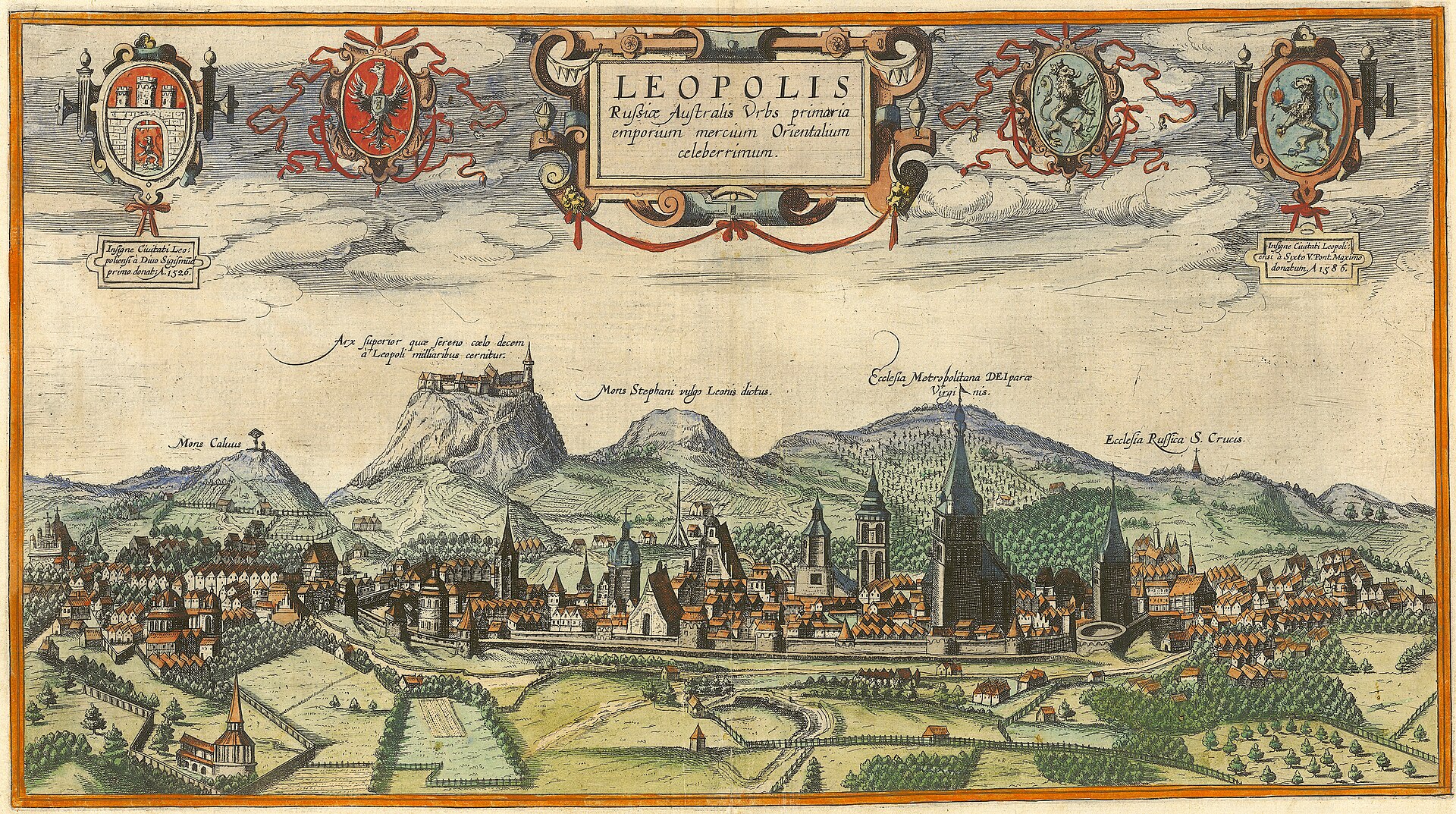
Bird's-eye view of Leopolis (Lviv), from Georg Braun & Frans Hogenberg's Civitates Orbis Terrarum
Depicts the walled old town with gates and towers, parish churches and a large cathedral, street blocks and the fortified hill with castle.
1618 · Georg Braun · Wikimedia Commons
Public domain (plate dated 1618)

Castles of Lviv

More cities to explore
 PolandKrakówExplore it in 1400 · 1570 · 1900
 UkraineKyivExplore it in 1050 · 1650 · 1900
 NetherlandsUtrechtExplore it in 1400 · 1700
 EnglandLondonExplore it in AD 200 · 1390 · 1600 · 1885
Castles of Europe · Landmarks of Europe · create your own reconstruction.