Historic Cities · Ukraine
Kyiv through the ages
Kyiv, also spelt Kiev, is the capital and most populous city of Ukraine. Located in the north-central part of the country, it straddles both banks of the Dnieper River. As of January 2022, the population of Kyiv was 2,952,301, making it the seventh-most populous city in Europe. Kyiv is an important industrial, scientific, educational, and cultural center.

Kyiv in 1050
Kyiv of the Rus
Kyiv in 1050 is the grand capital of Yaroslav the Wise at the height of Kyivan Rus', testing itself against Constantinople in stone churches, written law and river trade. This walk moves from the Dnieper’s banks through the Golden Gate and St. Sophia’s precincts down to the Podil quays and the nascent caves of the Pechersk monastery, showing craftsmen, boats and princely courts on the hills.
The skyline is a mix of gleaming stone churches crowned with multiple gilded domes and a dense scatter of low wooden houses with thatch and shingle roofs clustered on steep hills. Earthen ramparts and wooden palisades ring parts of the upper town; smoke and drying hides scent the air toward the river. Colour comes from painted church façades, dyed wool garments and the bright banners of merchant ships riding the Dnieper’s brown current.
The route: 20 streets, squares and views
Dnieper Approach → Askold's Grave → Podil Quay → Pochaina Mouth → Podil Market → Yaroslav's Court → Borychev Descent → Golden Gate → Detinets (Prince's Court) → St. Sophia Cathedral → …
Step inside, 14 interiors
Ferry Guard House · Riverside Warehouse · Wooden Market Hall · Grand Feasting Hall · Tavern Hall on the Descent · Chapel above the Gate · Prince's Audience Chamber · Nave beneath the Oranta Mosaic · Parish Church Nave · Tannery and Cooper's Workshop · Byzantine Cloth Merchant's Shop · Shipwright's Assembly Shed · Monk's Cell and Scriptorium · Church of the Near Caves
Planned from the Wikipedia record: Kievan Rus'.
Kyiv in 1650
Cossack-era Kyiv
This is Kyiv in the years after Bohdan Khmelnytsky's 1648 entry, when the city is the spiritual heart of Ruthenia and an active centre of Cossack politics, learning and trade. Visitors will see vaulted Rus' cathedrals beginning to wear new baroque gilding, the monks and presses of the Pechersk Lavra, the scholars of Mohyla's Collegium and the crowded wooden quays and merchant streets of Podil.
Dense domes and bell-towers puncture a river-side skyline: old white stone cathedrals with newly applied gilded cupolas stand beside clusters of small wooden houses on steep slopes. The broad Dnieper carries laden barges and skiffs; Podil's quays are a forest of masts and awnings. Streets are narrow, steep and usually packed with carts, goats, market stalls and groups of Cossack elders in sheepskin cloaks.
The route: 22 streets, squares and views
Dnieper Approach → Podil Quay → Pochaina Mouth → Podil Market Square → Mostova Street → Merchant Houses → Lyadsky Bridge → Lyadsky Gate → Uzviz Ascent → St. Michael's Monastery → …
Step inside, 12 interiors
Fishmongers' Shed · Boatwright's Loft · Merchant's Trading Room · Gate Guardroom · Refectory Church · Grand Cathedral Nave · Sophia Chapter House · Collegium Debating Hall · Gate Chapel of the Saviour · Far Caves Chapel · Printing Press Room · Scriptorium and Icon Workshop
Planned from the Wikipedia record: Cossack Hetmanate.
Kyiv in 1900
Boomtown Kyiv
Kyiv in 1900 is a booming provincial capital of the Russian Empire, its skyline a scatter of gilded Orthodox domes, chestnut‑lined hills and new bourgeois façades. The walk passes the city's new public infrastructures (electric trams along Khreshchatyk, an ostentatious opera house, the Polytechnic school and the old Lavra), where pilgrims, merchants and factory owners meet on the same streets.
The city presents tight, hilly profiles: onion domes and bell towers glinting gold above green chestnuts, timber and low brick houses in Podil, broad newly‑laid boulevards framed by late‑19th‑century stone and stucco façades, and the Dnieper's wide, muddy curve threaded with riverboats. Khreshchatyk's tram wires and shopfronts mark a modern spine; quay traffic and market stalls give the riverbanks a busy, irregular edge.
The route: 24 streets, squares and views
Pechersk Riverbank → Kyiv Pechersk Lavra → Pechersk Quay → Arsenal Square → Mariinskyi Park → Mariinskyi Palace → Instytutska Street → Kyiv Polytechnic Institute → St. Volodymyr's Cathedral → Saint Sophia Cathedral → …
Step inside, 14 interiors
Dormition Cathedral Nave · Imperial Arsenal Vault · Ceremonial Ballroom · Engineering Lecture Hall · Saint Sophia Nave · St. Michael Nave · Artists' Atelier · River Merchants' Warehouse · Bessarabka Market Hall · Sugar Baron's Marble Salon · City Duma Chamber · Grand Opera Auditorium · Khreshchatyk Photographic Studio · Merchant Exchange Floor
Planned from the Wikipedia record: History of Kyiv.
Its story
The story of Kyiv.
Kyi's Hill and the Khazar Tribute
The city's origins are uncertain and debated. In the 1970s it was officially designated as founded in 482 and its 1500th anniversary celebrated in 1982, though by other criteria the settlement may be 2,000 years old or more. The Primary Chronicle records a legend in which four siblings built a town on three hills above the Dnieper and named it after the eldest, Kyi, a derivation Mykhailo Hrushevsky called an etymological myth.
Slavic settlement in the area begins at the end of the 5th century, and excavation suggests commercial activity in the Podil district in the 7th or 8th century, though dendrochronological analysis of log dwellings there reaches back only to 887. The Primary Chronicle says the Slavic inhabitants had no ruler of their own and paid tribute to the Khazars, and a hill-fortress called Sambat, Old Turkic for high place, was built to defend the area. Position made the place: by the 7th or 8th century the Dnieper was the standard road between Scandinavia and Byzantium, and the Desna gave access by portage to the Don and Oka-Volga basins.
Capital of Rus', 882–1240
The Primary Chronicle has Oleg the Wise, a relative of the Varangian chieftain Rurik, taking the city in 881 or 882, though the date is uncertain and historians including Omeljan Pritsak hold instead that Khazar rule continued as late as the 920s. From Oleg's seizure the city was the capital of Kyivan Rus' under the Rurikid dynasty. In 988 Prince Volodymyr converted to Christianity and ordered the inhabitants baptised en masse in the Dnieper. Under his son Yaroslav the Wise, grand prince from 1019 to 1054, the city reached its height; in 1051 Yaroslav assembled the bishops at St Sophia Cathedral and had Hilarion made the first native-born metropolitan of Rus'.
The inner Principality of Kyiv emerged in 1132 as the Rus' polity fragmented, and the city's political weight fell away amid the rivalries of competing princes. In 1169 Andrei Bogolyubsky of Suzdal sent an army drawn from eleven other princes against Mstislav II Izyaslavich; it won and sacked the city for three days. Rurik Rostislavich burned it again in 1203. On 6 December 1240 a Mongol army under Batu Khan destroyed it completely: the Mongols had meant to take the place unharmed, but when the garrison threw down the bodies of the envoys sent to demand surrender they broke the gates, killed much of the population and razed the city.
Lithuanian Voivodeship to Cossack Entry, 1362–1686
The city became a provincial capital of marginal importance on the edge of stronger neighbours. It passed to the Grand Duchy of Lithuania after Algirdas beat a Golden Horde army at Blue Waters in 1362, and was ruled by Lithuanian princes until 1471, when Casimir Jagiellon abolished the Principality of Kyiv and established the Kyiv Voivodeship. Crimean Tatars attacked frequently, and in 1482 Khan Meñli I Giray sacked the town. Magdeburg rights were extended from 1494 and settled by a charter of Sigismund I the Old in 1516; Sigismund II Augustus granted the Jewish community equal rights on the grounds that they paid the same taxes as the burghers of Podil.
Under the Union of Lublin of 1569 the city passed from Lithuania to the Crown of Poland, and its standing as an Orthodox centre strengthened as Roman Catholicism expanded under Polish rule. In 1632 the Orthodox Metropolitan Peter Mogila founded the Kyiv-Mohyla Academy to preserve Ukrainian culture and the Orthodox faith; though run by the church, it taught to standards close to western European universities. Bohdan Khmelnytsky's Cossacks entered the city in 1648, bringing it under the Cossack Hetmanate, whose own capitals lay elsewhere; in January 1654 Khmelnytsky signed the Treaty of Pereyaslav with the Tsardom of Russia to secure support against the Polish Crown. Tsar Alexis expelled the city's Armenians in 1660. The Truce of Andrusovo of 1667 ceded the city to Russia, on paper for two years only, the Eternal Peace of 1686 made it permanent, and Catherine the Great abolished Ukrainian autonomy in 1775.
Sugar, Rail and Russification, 1811–1900
The Great Fire of Podil in 1811 devastated the city, and the rebuilding that followed changed its layout fundamentally. St Vladimir University was founded in 1834, the year Nicholas I abolished the city's Magdeburg law by decree. Poles remained prominent long after the region left Poland: there were over 43,000 Polish noblemen in the province in 1812 against roughly 1,000 Russian nobles, Polish was the language of the city's schooling in the 1830s, and Poles formed the majority of the university's students until their enrolment was restricted in the 1860s, out of fear of a Polish insurrection in the city.
In the winter of 1845–46 the historian Mykola Kostomarov founded a secret society, the Brotherhood of Saints Cyril and Methodius, which argued for a federation of free Slavic peoples with Ukrainians as a distinct group rather than part of the Russian nation; the authorities suppressed it in March and April 1847. Russification followed through Russian migration and measures such as the Valuev Circular of 1863: of some 240,000 people counted in the 1897 census, about 56 per cent spoke Russian, 23 per cent Ukrainian, 12.5 per cent Yiddish and 7 per cent Polish. The industrial revolution of the late 19th century made the city an important trade and transport centre of the empire, specialising in sugar and grain shipped out by railway and down the Dnieper; by 1900 it was an industrial centre of 250,000 people.
Kyiv's Jews: Expulsion, Pogrom, Babi Yar and After
Jews in the city are first mentioned in a 10th-century letter, and the community remained small until the 19th century. Expelled in 1654, Jews were probably unable to settle again until the early 1790s. Nicholas I expelled seven hundred of them on 2 December 1827, and in 1836 the Pale of Settlement legislation barred Jews from the city and fenced its districts off from them, so that by mid-century Jewish merchants at the fairs could stay no more than six months. Settlement was nonetheless driven by the prohibition on Jewish residence in Russia proper, and a large community formed with its own culture and business interests. Pogroms in the early 1880s (given as 1881 in one account and 1882 in another), and again in 1905 killed about a hundred Jews between them. On the eve of the First World War the Jewish population was over 81,000, and in 1939 there were approximately 224,000 Jews in the city.
Some fled ahead of the German invasion that began in June 1941. On 29 and 30 September 1941, at Babi Yar within the city, at least 33,771 Jews from Kyiv and its suburbs were massacred by the SS Einsatzgruppen, according to their own reports; the killing was carried out by the Wehrmacht, the SS, the Ukrainian Auxiliary Police and local collaborators. Babi Yar was used for further mass murder over the following years (captured Soviet citizens, Ukrainians, Romani, prisoners of war and anyone suspected of aiding the resistance) perhaps 60,000 people more. Jews began returning at the end of the war and met another pogrom from 4 to 7 September 1945, in which around a hundred were beaten, thirty-six hospitalised and five died of their wounds. From the 1970s into the 1990s, with special permission from the Soviet government, a significant part of the city's Jewish population emigrated to Israel and the West. The community numbers about 20,000 in the 21st century and has two major synagogues, the Great Choral and the Brodsky Choral.
Republics, Famine and Occupation, 1917–1991
The Central Rada, a Ukrainian self-governing body headed by the historian Mykhailo Hrushevsky, was established in the city in 1917 and on 7 November became the government of an independent Ukrainian People's Republic, capital here. The city then changed hands repeatedly: Bolshevik Red Guards took it after the January Uprising of 29 January 1918, driving the Rada to Zhytomyr; the Imperial German Army held it from March under the Treaty of Brest-Litovsk; an independent Ukraine was declared under Symon Petliura after the German withdrawal; the Red Army retook it in January 1919, the White armies in August, the Bolsheviks that December; and the Polish Army captured it on 7 May 1920 before being driven out. When the Ukrainian SSR was formed in 1922 the capital was Kharkiv. In 1932–33 the city suffered in the Holodomor along with most of Ukraine: food was issued to workers on cards against a daily norm, supply was short even with the cards, and people queued overnight for bread.
The capital was moved from Kharkiv to Kyiv in 1934. The destruction of churches begun in the 1920s reached its height in the 1930s (St Michael's Golden-Domed Cathedral demolished, St Sophia Cathedral confiscated, clergy repressed), and political trials were staged to purge Ukrainian nationalists, Western spies and opponents of Stalin within the party. In the late 1930s clandestine mass executions began: thousands of residents, mostly intellectuals and party activists, were arrested at night, court-martialled, shot and buried in mass graves at Babi Yar and in the Bykivnia forest, and tens of thousands were sentenced to GULAG camps. In 1940 the city was a site of the Soviet executions of Polish officers and intelligentsia carried out as part of the Katyn massacre.
Nazi Germany occupied the city on 19 September 1941. Before withdrawing, the Red Army had laid more than ten thousand mines with wireless detonators; set off on 24 September once the Germans had settled in, they collapsed many major buildings, set the city alight for five days and killed more than a thousand Germans. Under the Hunger Plan drawn up before the invasion the city's inhabitants were classed as superfluous eaters to be got rid of by cutting off all food supplies, which would go to the Wehrmacht and to Germany; that part of the plan was never fully implemented. The city was heavily bombarded and largely destroyed: one building was left standing on Khreschatyk, the main street. The Red Army retook it on 6 November 1943, and it was later given the title Hero City. Recovery brought an aerospace, microelectronics and optics complex and migrants from rural Ukraine and Russia; pro-Ukrainian intellectuals were persecuted as nationalists, and universities in the 1970s discouraged from using Ukrainian. The Chernobyl accident of 1986 polluted some areas of the city with radioactive dust; residents were neither told of the danger nor recognised as its victims, and on 1 May 1986, days after the accident, local party leaders ordered Kyivans including hundreds of children into a mass parade in the centre to prevent panic.
Capital of Independent Ukraine, 1991–2026
After 57 years as capital of the Ukrainian SSR, the city became the capital of an independent Ukraine in 1991, and has remained the country's largest and wealthiest city; its dependence on the armaments industry has gone, hurting science and technology, while services and finance grew. Mass protests over the 2004 presidential election began at Maidan Nezalezhnosti on 22 November 2004 in support of Viktor Yushchenko. In February 2014 the city was the site of the Revolution of Dignity, and that year the former boxer Vitali Klitschko became mayor. Its population was 2,952,301 in January 2022.
During the Russian invasion of 2022 an offensive tried to encircle and besiege the city, approaching from the Belarusian border, while teams of soldiers and mercenaries entered it in what was widely reported as an attempt to assassinate President Volodymyr Zelenskyy and change the government. Russian forces took much of northern Kyiv Oblast up to the city's edge but never occupied any part of the city itself; the assault was defeated and the oblast retaken on 2 April 2022, after which evidence of systematic war crimes was found, particularly in the satellite town of Bucha. Missile and drone attacks continued: a strike on 1 March 2022 destroyed part of the Kyiv television tower and killed five, one on 8 July 2024 damaged the Okhmatdyt children's hospital and killed twenty-two, and one on 2 July 2026 killed at least thirty. Large attacks knocked out power, heating and water for much of the city in winter, and inner metro stations served as air-raid shelters.
From the archive
Kyiv on paper: the old town as it was mapped.
A period plan or bird's-eye view of the old town, drawn between 1500 and 1850, the streets this page's reconstructions walk. Public domain, with its source named.
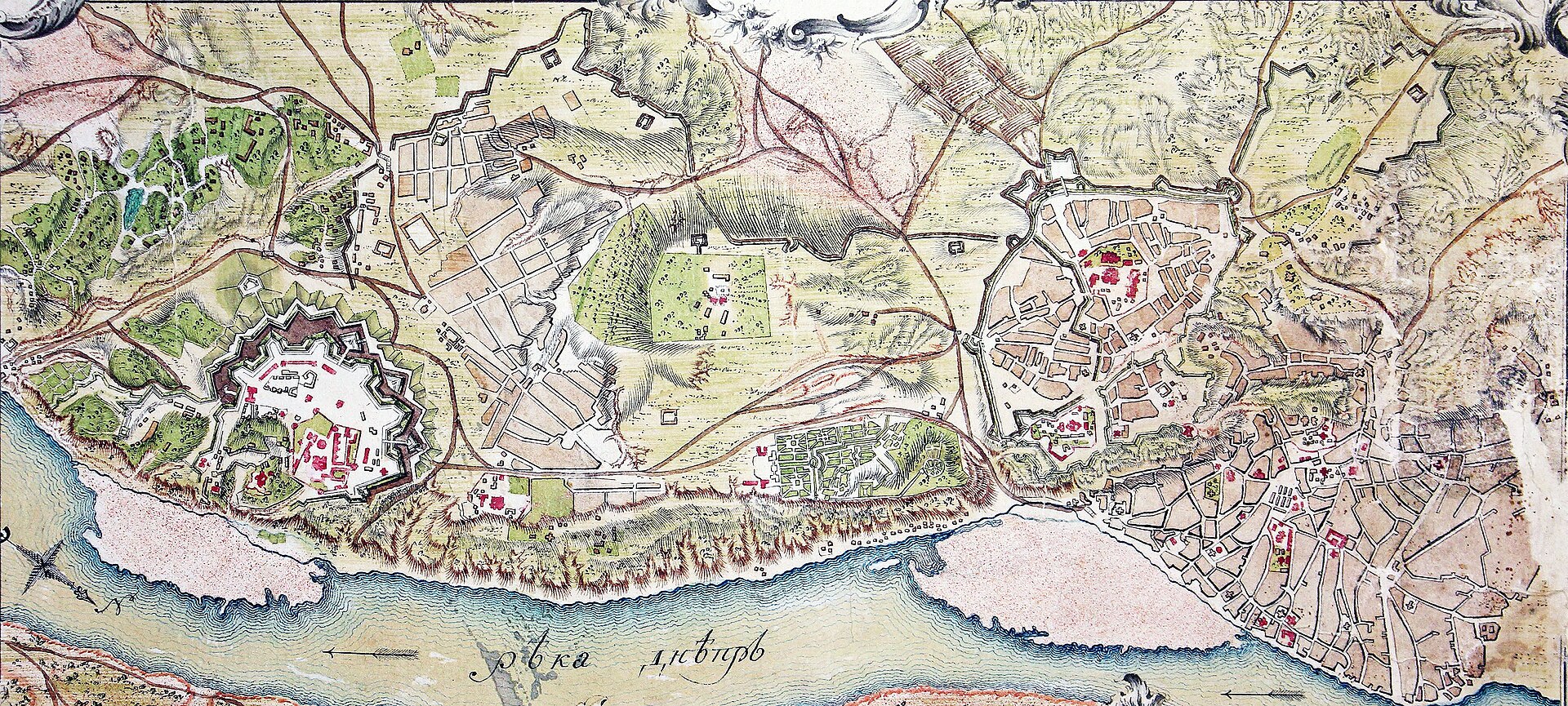
Plan of Kyiv showing Pechersk and Old Kyiv fortresses and Podil (c.1780)
Depicts the Dnieper River, bastioned Pechersk and Old Kyiv fortresses, the Podil street grid, and fortification walls with bastions and gates.
1780 · Unknown author Unknown author · Wikimedia Commons
Public domain (plate dated 1780)
In this city
Landmarks of Kyiv, see each in its prime


More cities to explore
 UkraineLvivExplore it in 1600 · 1900
 NetherlandsUtrechtExplore it in 1400 · 1700
 EnglandLondonExplore it in AD 200 · 1390 · 1600 · 1885
 FranceParisExplore it in 1250 · 1670 · 1789 · 1889
Castles of Europe · Landmarks of Europe · create your own reconstruction.