Historic Cities · England
Norwich through the ages
Norwich is a cathedral city and district of the county of Norfolk, England, of which it is the county town. It lies by the River Wensum, about 100 mi (160 km) north-east of London, 40 mi (64 km) north of Ipswich and 65 mi (105 km) east of Peterborough. The population of the Norwich City Council local authority area was estimated to be 144,000 in 2021, which was an increase from 143,135 in 2019.

Norwich in 1490
England's Second City
Norwich in 1490 is at the height of its medieval cloth wealth: wool and worsted from east Norfolk fill its wharves and its markets, and a church for every week of the year rises from lanes inside the long stone walls. This walk follows the river and streets from Mousehold Heath into the close and through merchant quarters, passing cathedral spire, castle keep, trading halls, staithes and the market under the castle.
A dense, low skyline of stone towers and timber gables sits behind a looping dark ribbon of the River Wensum and a continuous stone curtain of town wall. The pale Caen limestone of the cathedral and the white Norman keep catch light above a forest of small steeples; closer in, black-and-ochre jettied houses, red-tile roofs and chequered flint public buildings form narrow, cobbled lanes crowded with carts, packhorses and cloth bundles.
The route: 16 streets, squares and views
Mousehold Heath View → Magdalen Gate → Tombland → Erpingham Gate → Cathedral Close → Norwich Cathedral and Spire → Pulls Ferry → Bishop's Palace → Cow Tower → Dragon Hall, King Street → …
Step inside, 8 interiors
Cloister garth and chapterhouse · Choir with painted bosses · Staithe warehouse · Bishop's great hall · Great trading hall · Weaver's long hall · Guildhall council chamber · Nave with rood loft
Planned from the Wikipedia record: Norwich.
Its story
The story of Norwich.
Northwic, the Mint and the Norman Refoundation
The Roman regional capital of the Iceni, Venta Icenorum, stood about five miles to the south near Caistor St Edmund and fell into disuse around 450. The Anglo-Saxons settled the site of the modern city some time between the 5th and 7th centuries, founding Northwic, "north harbour", from which Norwich takes its name; Mercian coins and Rhineland pottery of the 8th century suggest long-distance trade already running through it, and Viking settlers established an Anglo-Scandinavian district near the north end of what is now King Street at the end of the 9th century. Between 924 and 939, in Æthelstan's reign, Norwich was fully established as a town with its own mint, and the word Norvic appears on coins found across Europe. In 1004 it was raided and burnt by Sweyn Forkbeard, the Viking king of Denmark.
By the Norman Conquest it was one of the largest towns in England; Domesday Book in 1086 records about twenty-five churches, a population of between 5,000 and 10,000, and a place described officially as the Port of Norwich. The Normans then took it in hand. Domesday records that ninety-eight Saxon homes were demolished to make room for Norwich Castle, and a new focus of settlement grew around it, the "New" or "French" borough, centred on a market place laid out in 1071-74 which survives as Norwich Market. In 1096 Herbert de Losinga, Bishop of Thetford, began Norwich Cathedral with limestone shipped from Caen in Normandy and moved his see there. After a riot between citizens and monks in 1274 Norwich became the only complete English city to be excommunicated by the Pope.
The Jews of Norwich: 1144, 1190 and the Well Uncovered in 2004
The first recorded presence of Jews in Norwich is 1134. In 1144 a boy, William of Norwich, was found dead with stab wounds, and the Jews of the city were accused of ritual murder. William was treated as a martyr and pilgrims made offerings at a shrine in the cathedral until the 16th century, though the records suggest there were few of them. In February 1190 all the Jews of Norwich were massacred except for a few who found refuge in the castle.
In 2004 workers preparing ground for a shopping centre uncovered the bones of seventeen people, eleven of them children, at the site of a medieval well. Forensic examination judged them most probably the remains of Jews killed in such an attack, and DNA analysis found the victims were related, probably members of a single Ashkenazi family. A paper published on 30 August 2022 confirmed the remains as most likely Ashkenazi Jews, and found that many carried medical disorders most often seen in Ashkenazi communities.
Wool, Walls and the Staple, 1280-1404
The city walls were built between 1280 and 1340; at about two and a half miles they enclosed, with the river, a larger area than the City of London. Around this time Norwich was made a county corporate and became the seat of one of the most densely populated and prosperous counties in England. The engine of it was wool from Norfolk's sheepwalks: Michael Drayton's Poly-Olbion of 1612 still ranked the staple port of Norwich with "towns of high'st regard the fourth of all the land", and the wealth the trade generated paid for so many churches that Norwich has more medieval churches than any other city in western Europe north of the Alps. Its markets reached from Scandinavia to Spain, it housed a Hanseatic warehouse, and under the Statute of the Staple of 1353 Great Yarmouth, the port for Norwich, was designated a staple port for export to the Low Countries.
The city's institutions followed its money: Norwich has returned two members of Parliament since 1298, the office of Mayor dates from 1403, and from 1404 the citizens elected two sheriffs. Julian of Norwich's Revelations of Divine Love, of 1395, is held to be the first book written in the English language by a woman. Norwich remained England's second city after London for several centuries before industrialisation, which came late here because of the city's isolation and lack of raw materials.
Kett's Rebellion, the Strangers and the Flight to Dedham
In the summer of 1549 rebels led by Robert Kett camped on Mousehold Heath outside Norwich and, on 29 July, took control of the city with the support of many of its poorer inhabitants. The rising was directed against the enclosure of land by landlords, which left peasants with nowhere to graze their animals, and against the general abuses of power by the nobility; unlike most popular challenges of the Tudor period it appears to have been Protestant in character. It ended on 27 August when an army defeated the rebels, and Kett was convicted of treason and hanged from the walls of Norwich Castle. Perhaps in response, Norwich became the first provincial city to impose compulsory payments for a civic scheme of poor relief.
The rebellion had linked Protestantism with the plight of the urban poor, and that link was reinforced by the arrival of Dutch and Flemish "Strangers" fleeing persecution by the Catholics, who eventually numbered as much as a third of the city's population. Many were Flemish Protestants from the Westkwartier, where the first Calvinist fires of the Dutch Revolt had spread, and the people of Ypres in particular chose Norwich over other destinations. The great stranger immigration of 1567 brought a substantial community of Flemish and Walloon Protestant weavers, said to have been made welcome; the merchant's house that was their earliest base is still known as Strangers' Hall. Their arrival boosted trade with mainland Europe and pushed the city towards religious reform and radical politics, and the pet canaries they bred locally became in time the emblem of the city's football club. The traffic ran the other way too: Michael Metcalf, a 17th-century Norwich weaver persecuted by the Anglican church for his Puritan beliefs, fled the city and settled in Dedham, Massachusetts.
The Great Blow and the Jacobin City, 1640s-1790s
Norwich began the Civil War with a large element of Royalist sympathy, but parliamentary recruitment took hold and the Royalist party was stifled by a lack of commitment from the aldermen and by isolation from Royalist-held regions. Factional violence culminated in the Great Blow of 1648, when parliamentary forces tried to quell a Royalist riot and the gunpowder store in the city's Committee House was set off by accident in the city centre; the explosion has been ranked among the largest of the century. After the Restoration of 1660 the cloth industry entered a golden age comparable only to those of the West Country and Yorkshire, but unlike other cloth regions Norwich weaving concentrated in and around the city itself, producing an urban society of leisure time, alehouses and public argument.
The argument was the point. Late-17th-century Norwich was riven between Whig and Tory, the mayoral election of 1716 ended in a riot, and the city's Jacobitism perhaps ended only with 1745, well after it had ceased to be a significant movement outside Scotland. Britain's first provincial newspaper, the Norwich Post, appeared in 1701, and by 1726 there were rival Whig and Tory presses. Freemen with the right to trade and vote numbered about 2,000 in 1690 and over 3,300 by the mid-1730s, at one point a third of the adult male population, an unusually deep franchise in the age of rotten and pocket boroughs. Despite severe outbreaks of plague the city held almost 30,000 people and was the wealthiest town in England. The city took to calling itself the Athens of England; Pitt, watching its radical Dissenting circles campaign against the war with France, denounced it as "the Jacobin city".
Shawls, Mustard and Shoes: What Replaced the Wool Trade
By the 1790s the wool trade faced intense competition, first from Yorkshire woollens and then increasingly from Lancashire cotton, and the loss of continental markets after Britain went to war with France in 1793 made it worse. The early 19th century brought de-industrialisation and bitter dispute, with wage cuts and recrimination against the owners through the 1820s, while the hungry poor took their complaints onto the streets. From the 1780s the manufacture of Norwich shawls was an important industry for nearly a century, but changing Victorian fashion eventually ended it. The city's isolation was such that until a railway link was established in 1845 by Morton Peto it was often quicker to travel to Amsterdam by boat than to London.
What replaced the wool was insurance, food, footwear and engineering. The wine merchant and banker Thomas Bignold founded the Norwich Union Society for the Insurance of Houses, Stock and Merchandise from Fire in 1797; Colman's mustard was founded in 1814 and worked from a factory at Carrow until the site closed in 2019; and Caley's, which began in mineral water and moved into chocolate and Christmas crackers, was absorbed into Rowntree-Mackintosh in 1969, its Norwich factory closing in 1996 after 120 years. The early 20th-century city also made shoes on a large scale, along with clothing, joinery and structural engineering, with Boulton & Paul, the iron founders Barnards and the electrical engineers Laurence Scott and Electromotors among the notable employers.
The Baedeker Raids of April 1942 and What Followed
Norwich was bombed as part of the Baedeker raids, named for the tourist guides used to select targets of cultural and historic value rather than strategic importance. The heaviest attacks came on the nights of 27/28 and 29/30 April 1942, hitting Morgan's Brewery, Colman's Wincarnis works, City Station, the Mackintosh chocolate factory and the shopping streets of St Stephen's and St Benedict's. Those two raids killed 229 people and injured a thousand; bombing across the war killed 340, the highest air-raid casualties in Eastern England. Of the city's 35,000 dwellings, 2,000 were destroyed and 27,000 damaged.
The council had a redevelopment scheme ready before the war, published in 1945 as The City of Norwich Plan. It never properly materialised, but through the 1960s and early 1970s large areas of the city were cleared. In 1960 the inner-city district of Richmond was condemned as slums: some fifty-six acres went, including 833 dwellings, 612 of them classed as unfit for habitation, with residents moved out under compulsory purchase to high-rise blocks and new estates. An inner ring road took whole streets lined with Tudor and Georgian buildings, along with sections of the city wall. Other losses of these years included three theatres, the Corn Exchange of 1861 and the Free Library of 1857. It has been said that more of Norwich's architecture was destroyed by the council in the post-war schemes than during the war itself.
The University of East Anglia was founded on the outskirts in 1963, and its creative writing programme, established by Malcolm Bradbury and Angus Wilson, has counted Kazuo Ishiguro and Ian McEwan among its graduates. The manufacturing economy gave way to services through the 1980s and 1990s, with business and financial services now the largest employment sector, and Norwich was designated England's first UNESCO City of Literature in May 2012. It is the county town of Norfolk and had a population of about 144,000 in 2021; the two-tier arrangement of city and county councils is due to be replaced from 2028 by a single Greater Norwich authority.
From the archive
Norwich on paper: the old town as it was mapped.
A period plan or bird's-eye view of the old town, drawn between 1500 and 1850, the streets this page's reconstructions walk. Public domain, with its source named.
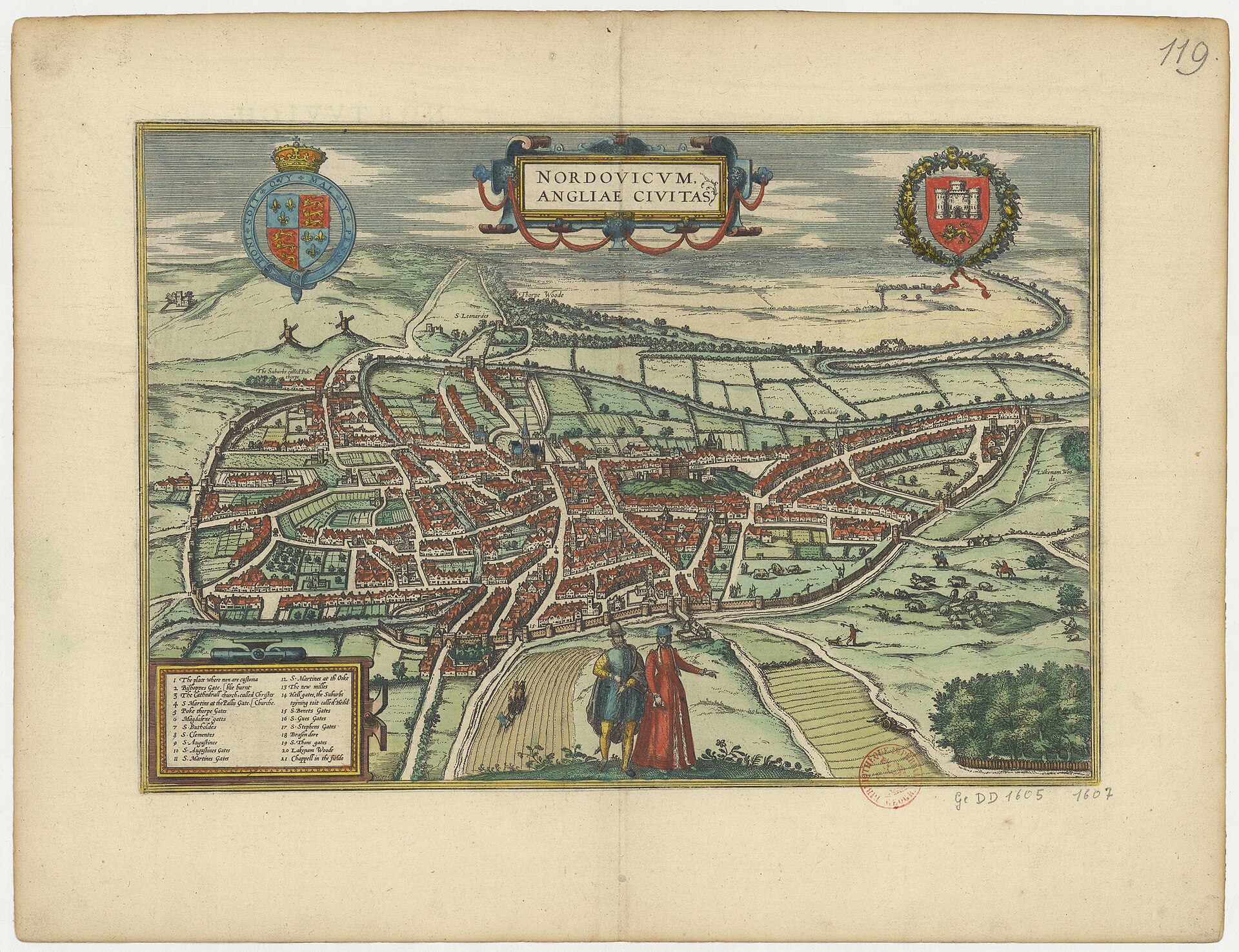
Bird's-eye view of Norwich (Nordovicum), from Georg Braun & Frans Hogenberg's Civitates Orbis Terrarum
Shows Norwich's medieval walls and gates, street layout, the River Wensum loop, the cathedral and numerous numbered parish churches.
Public domain (plate dated 1645)


Castles of Norwich


More cities to explore
 EnglandDunwichExplore it in 1280
 EnglandCambridgeExplore it in 1450 · 1660 · 1890
 EnglandLondonExplore it in AD 200 · 1390 · 1600 · 1885
 EnglandYorkExplore it in AD 300 · AD 950 · 1420 · 1800
Castles of Europe · Landmarks of Europe · create your own reconstruction.