Historic Cities · Spain
Santiago de Compostela through the ages
Santiago de Compostela, alternatively abbreviated to Santiago or Compostela, is the capital of the autonomous community of Galicia, Spain. It is located in the province of A Coruña, in the northwest of the Iberian Peninsula. The city has its origin in the shrine of Saint James the Great, now the Cathedral of Santiago de Compostela, as the destination of the Way of St.

Santiago de Compostela in 1200
Pilgrims' Compostela
This is Compostela at the height of the medieval pilgrimage, when the cathedral's west portico by Master Mateo is newly carved and the city receives long columns of walkers. The walk follows the pilgrims' approach from Monte do Gozo down the streets, through gates and market squares, past hospices and the archbishop's palace, ending beneath the cathedral's busy south front.
A dense knot of low granite buildings, narrow wet streets and close arcades, rooflines of simple slate and rough tile, and the newly carved mass of the cathedral rising above them; granite walls wear dark with rain. Markets and hospitals crowd the squares, pilgrims with scallop shells and hooked staffs thread between masons' scaffolds and clerics in sober habits, while gulls and the river mists add a grey Atlantic light.
The route: 21 streets, squares and views
Monte do Gozo → Porta do Camiño → Rúa do Franco → Rúa do Vilar → Praza de Mazarelos → Praza do Obradoiro → Pórtico de la Gloria → Cathedral Steps → Palacio de Xelmirez → Praza da Quintana → …
Step inside, 12 interiors
Tavern Hall on Franco · Nave and Incense Crossing · West Porch Pilgrim Portal · Apostle's Crypt · Archbishop's Audience Hall · Palace Kitchen Hearth · Monastic Refectory · Hospice Dormitory · Covered Market Hall · Silversmith's Workshop · Money Changers' Arcade · Campanile Bell Chamber
Planned from the Wikipedia record: Camino de Santiago.
Santiago de Compostela in 1750
Baroque Compostela
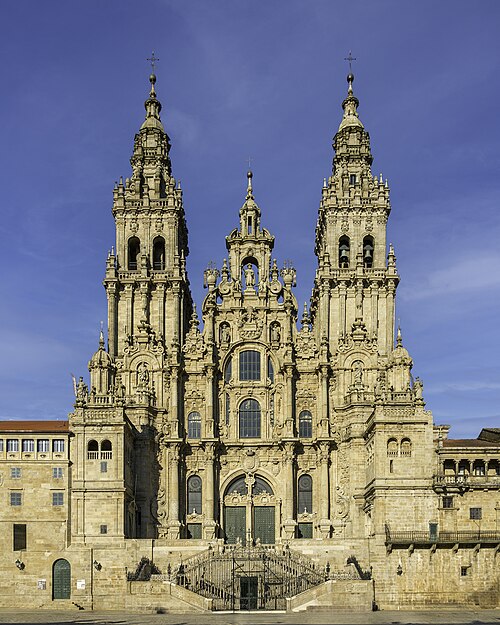
The Romanesque core of Compostela has been newly dressed in Baroque granite: the Obradoiro façade’s twin towers now rise above the square and the Hostal dos Reis Católicos fronts the cathedral steps. This walk follows arriving pilgrims through the Porta do Camiño into narrow, wet granite streets, past monastic masses and the university courts to high viewpoints over the city.
A compact old town of dark, fine-grained granite blocks and red-brown tile roofs, where newly carved Baroque ornament crowns Romanesque masses. The Obradoiro’s twin towers puncture a low skyline; monastery roofs and cloisters cluster close to the cathedral. Streets are narrow, cobbled and often running downhill toward the cathedral, their stones polished by rain to a faint silver sheen. Frequent overcast skies and Atlantic moisture lend a muted, cool light.
The route: 22 streets, squares and views
Monte do Gozo → Porta do Camiño → Rúa do Pino → Rúa da Acibechería → Praza da Quintana → Rúa das Praterías → Praza do Obradoiro → Obradoiro Façade → Hostal dos Reis Católicos → Pazo de Raxoi → …
Step inside, 14 interiors
Chapel at Monte do Gozo · Pilgrims' Dormitory Hall · Apothecary and Herb Room · Portico of the Glory Nave · Silversmith's Main Workshop · Presbytery beneath the High Altar · Chapel of the Reliquary Treasure · Main Cloister of the Hostal · Pilgrims' Refectory Hall · Council Chamber of the Pazo · Fish‑Kitchen of the Tavern · Monastery Church of San Martiño · Monastic Kitchen at San Martiño · Fonseca College Cloister
Planned from the Wikipedia record: Santiago de Compostela.
Its story
The story of Santiago de Compostela.
A Roman Burial Ground Under the Cathedral
Under the ground the cathedral now occupies stood a Roman settlement, tentatively identified with the mansio of Assegonia, which existed from the second half of the first century to the fifth. The settlement went; its burial ground did not. Reused as a quarry, the necropolis stayed in use perhaps as late as the seventh century and the Suevic kingdom. Excavations inside the cathedral during the nineteenth and twentieth centuries uncovered a Roman cella memoriae, or martyrium, with a small cemetery of Roman and Suevic date grown up around it and later abandoned; it has sometimes been attributed to Priscillian, though without further proof.
The Suebi occupied the area in the early fifth century, settling across Galicia and Portugal as Roman authority collapsed. In the sixth century the district was assigned to the bishopric of Iria Flavia under the partition known as the Parochiale Suevorum, ordered by King Theodemar, and in 585 Leovigild annexed the Suevic kingdom as the sixth province of the Visigothic realm. Arab raiders may have reached the district between 711 and 739. By about 750 the see of Iria had been absorbed into the Kingdom of Asturias.
The Find Attributed to Saint James, and the Name Compostela
At some point between 818 and 842, in the reign of Alfonso II of Asturias, bishop Theodemar of Iria, who died in 847, claimed to have found remains which he attributed to Saint James the Greater; some accounts narrow the date to the years between 820 and 835. The claim was accepted in part because Pope Leo III and Charlemagne, who had died in 814, had recognised Asturias as a kingdom and Alfonso II as its king, and had built close political and ecclesiastical ties with it.
The Asturian kings had a use for the discovery. Galicia's loyalty was uncertain, and they worked on several fronts to hold it: claiming the Gothic inheritance in law and religion, setting a man of royal blood to govern the province, and, at Alfonso II's own expense, raising a church over the burial and hedging it with privileges. A settlement was founded around that church which enjoyed royal prerogatives from the outset, giving the monarchy a patron saint and a town in the middle of Galicia tied to the crown. The pilgrimage centre growing there was known to the writer Usuard by 865, and by the tenth century the place was being called Compostella.
Documents of the ninth, tenth and eleventh centuries call the site Arcis Marmoricis, and it also went by the Latin generics Locus Sanctus and Locus Sancti Iacobi. Twelfth-century chroniclers explained Compostela from compositum tellus (the Chronicle of Sampiro, written in 1150, glosses it "Compostella, id est bene composita") against a folk etymology deriving it from campus stellae, "field of the star", after the star said to have guided Theodemar to the grave. Richard Fletcher, Joan Coromines and Ramón Menéndez Pidal now agree on the first line: Latin compositum tella, a well-ordered burial ground, possibly the pre-Christian cemetery on the site.
Coronations, Viking Raids and al-Mansur, 910–1111
The town filled first from the villages around it, gathering about the permanent clerical community (the bishop of Iria and the monks of Antealtares), that kept the tomb. A privilege attributed to Ordoño II of León in 915 is said to have laid down that anyone who stayed forty days without being reclaimed as a serf became a free man with the right to live in Compostela. The first inhabitant known by name is a foreigner: Bretenaldo Franco, first recorded in 955.
After Asturian political power moved from Oviedo to León in 910, Compostela grew politically useful in its own right. Kings of Galicia and of León were acclaimed by the Galician nobility and crowned and anointed by the local bishop here: Ordoño IV in 958, Bermudo II in 982, Alfonso VII in 1111, by which time the town was the capital of the Kingdom of Galicia. Two twelfth-century kings, Fernando II and Alfonso IX, the last kings of León and Galicia before both were joined to Castile, were buried in the cathedral.
Norse raiders tried the town through the tenth century and into the first years of the eleventh; in the Nordic sagas Galicia appears as Jakobsland, the land of Saint James. Bishop Sisenand II was killed fighting them in 968 and ordered a walled fortress built around the shrine, the enclosure known as the Locus Sancti Iacobi, taking in the church, the present Quintana square and the house of San Paio. On 10 August 997 the town was assaulted and partly destroyed by Ibn Abi Aamir, al-Mansur, whose Andalusian force rode with Christian lords who all took a share of the booty; the commander showed no interest in the relics and left the tomb alone. The inhabitants came back and rebuilt, and in the middle of the eleventh century bishop Cresconio ringed the whole town with ditches, a new wall and defensive towers, covering the quarters that had grown up outside the old palisade, and claimed for the city the rank of an apostolic see.
Gelmírez, Mérida's Mitre and the Codex Calixtinus, 1075–1230
Bishop Diego Peláez began the Romanesque cathedral in 1075. As the pilgrimage grew, the church's rank rose with it: in 1120 the bull Omnipotentes Dispositione of Pope Calixtus II transferred the metropolitan see of Mérida provisionally to Compostela, Mérida then being under Muslim rule, and made Diego Gelmírez an archbishop. Freed from the old authority of Braga (which kept most of the dioceses of the emerging kingdom of Portugal) the church of Santiago held jurisdiction over most of those of León and Asturias. After Alfonso IX took Mérida, Pope Gregory IX ordered the old see restored by a bull of 29 October 1230, but the king placed the newly conquered territory under the Compostelan archbishop Bernardo II, and Santiago's metropolitan rank became permanent.
The archbishops were territorial lords as well: the great fief they governed ran from the river Iso to the Atlantic, and the armed response to the Norse invasions was organised from here. Gelmírez crowned Alfonso Raimúndez, the future Alfonso VII, king of Galicia in his own cathedral. In the closing years of his archbishopric the Codex Calixtinus was assembled, a body of texts presented as the work of Pope Calixtus II and the principal source for the history of the pilgrimage; the bull Regis Aeterni of Pope Alexander III granted the Jacobean Holy Year in 1181.
How fast the cult spread beyond Galicia is disputed. By some accounts the site had already become a pan-European place of peregrination by the middle years of the eleventh century; others hold that before the eleventh and twelfth centuries devotion to Saint James was an essentially Galician affair, backed by Asturian and Leonese kings to win over faltering Galician loyalties. What is not disputed is where it ended: a shrine second only to Rome and Jerusalem, drawing a large and multinational population into the town.
The Townsmen Against Their Lord, from 1117
The archbishop was the secular and jurisdictional lord of the city and of its semi-independent fief, the Terra de Santiago, and the townspeople fought him for self-government for two centuries. The first rising came in 1117, a burgher revolt against Gelmírez and Queen Urraca, and the pattern of confrontation with the prelate, headed by the local council, outlived them both.
It reached its height under the archbishop Bérenger de Landore. The city was in arms from 1318, the revolt led by the nobleman Afonso Suárez de Deza, and it ended on 16 September 1320, the day of wrath, when the archbishop, having invited the city's counsellors to talks at his castle of A Rocha Forte, had them killed. Peace was signed on 27 September.
The street network inside the walls took its shape between the twelfth and thirteenth centuries. The arrival of the Black Death brought a heavy fall in population, which only began to recover after 1380; in the fifteenth century the town held between four and five thousand people.
Pilgrims' Hospice, University, and the Audiencia Lost in 1578
In 1492 Isabella of Castile and Ferdinand II of Aragon founded the Hostal dos Reis Católicos on the square before the cathedral as a hospice for pilgrims; it is now a parador. The cathedral chapter under its dean, Diego de Muros III, pressed both that royal hospital and the Estudio Viejo, out of which the university grew: accounts date the foundation to 1495, under Lope Gómez de Marzoa, and to the early sixteenth century. The work of archbishop Alonso III de Fonseca gave the city a fresh pull within Galicia even as its relative weight fell.
Santiago was the seat of the Royal Audiencia of the Kingdom of Galicia from 1508, but pressure from the church moved the court to A Coruña in 1578. A period of decline set in at the beginning of the seventeenth century. The name of the city was carried by one of the four military orders of Spain, alongside Calatrava, Alcántara and Montesa.
The Relics Hidden, and the Capital of Galicia
Santiago de Compostela was captured and sacked by the French during the Napoleonic Wars. The remains attributed to the apostle were hidden in a cist in the crypts of the cathedral and lost for close to a century afterwards. The 1884 bull Omnipotens Deus of Pope Leo XIII accepted the authenticity of the relics; the Vatican has remained uncommitted as to whether they are those of Saint James the Greater, while continuing to promote the wider benefits of pilgrimage to the site. Pope Benedict XVI made a ceremonial pilgrimage here on his visit to Spain in 2010.
The municipality in its present form dates from 1834 and covers 220.01 square kilometres of A Coruña province. The city is the capital of the autonomous community of Galicia and the seat of its government and parliament, and its old town was designated a UNESCO World Heritage Site in 1985. The population stood at 96,260 in 2019, with 178,695 in the metropolitan area; in 2010 there were 4,111 foreigners living in the city, 4.3 per cent of the total, the largest groups Brazilian, Portuguese and Colombian.
The economy still leans heavily on public administration, the university, cultural tourism and industry, with timber processing, vehicle building, telecommunications and electronics among the newer firms. Pilgrim numbers have risen since the regional government's campaign for the Holy Year of 1993: more than 272,000 people completed the route in the Holy Year of 2010, and 277,854 in 2016. On 24 July 2013 a train derailed at speed on a bend as it approached the city's station, killing 79 people and injuring at least 130.
From the archive
Santiago de Compostela on paper: the old town as it was mapped.
A period plan or bird's-eye view of the old town, drawn between 1500 and 1850, the streets this page's reconstructions walk. Public domain, with its source named.
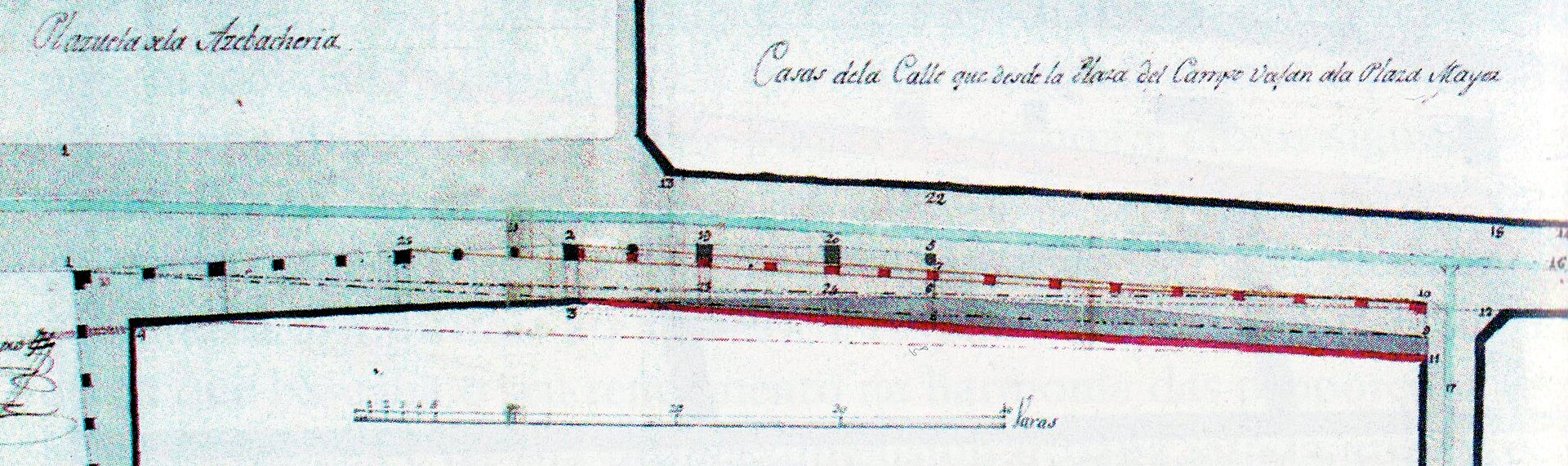
Plan of the Rúa da Acibechería, Santiago de Compostela, by Miguel Ferro Caaveiro
Plan of the final stretch of Rúa da Acibechería showing building plots, arcaded soportales and the street alignment in the old town.
1799 · Miguel Ferro Caaveiro · Wikimedia Commons
Public domain (plate dated 1799)
In this city
Landmarks of Santiago de Compostela, see each in its prime
More cities to explore
 PortugalPortoExplore it in 1500 · 1790 · 1900
 PortugalCoimbraExplore it in 1750
 SpainBarcelonaExplore it in 1350 · 1888 · 1915
 SpainMadridExplore it in 1630 · 1800 · 1925
Castles of Europe · Landmarks of Europe · create your own reconstruction.