Historic Cities · Germany
Trier through the ages
Trier, formerly and traditionally known in English as Trèves and Triers, is a city on the banks of the Moselle in Germany. It lies in a valley between low vine-covered hills of sandstone in the west of the state of Rhineland-Palatinate, near the border with Luxembourg and within the Moselle wine region.

Trier in AD 310
Imperial Trier
Augusta Treverorum in 310 is a western imperial residence swelling with building works, court servants, soldiers and merchants as Constantine establishes monumental architecture. The walk passes the great Porta Nigra, the newly completed brick basilica of the imperial palace, the half-built imperial baths, river quays and the amphitheatre tucked into the surrounding vineyards.
The skyline is a mix of low rows of timber-framed and stone-insulated houses with red tile roofs, punctuated by the dark stone bulk of the Porta Nigra, the broad brick mass of the new basilica (Aula Palatina) and scaffolds around vast bath blocks. Streets run in a Roman grid; the Moselle carries flat-bottomed barges to timber quays and long horrea store amphorae and grain. Outside the walls, vine-clad slopes and the semicircular amphitheatre rise among small farmsteads.
The route: 22 streets, squares and views
Moselle Bend Panorama → Vineyard Track → Stone Bridge Approach → Western Bridgehead Gate → Porta Nigra → Cardo by the Gate → Forum Romanum → Viehmarkt and Forum Baths → Horrea at St. Irminen → Moselle Quays → …
Step inside, 14 interiors
Western Bridge Guardroom · Bridgehead Customs Office · Gate Guard Chamber · Forum Basilica Hall · Viehmarkt Market Hall · St. Irminen Horrea Vault · Riverfront Grain Horreum · Imperial Audience Hall · Palace Reception Hall · Imperial Baths Hypocaust · Barbara Baths Tepidarium · Amphitheatre Vaulted Corridors · Potters' Kiln House · Mausoleum Burial Chamber
Planned from the Wikipedia record: Augusta Treverorum.
Trier in 1150
Archbishops' Trier
Trier in 1150 is a powerful archiepiscopal city built on Roman foundations, where Roman gates and a great cathedral anchor a dense medieval town. Walkers will pass the Porta Nigra converted to a church, the cathedral's Romanesque westwork and the busy Hauptmarkt, then descend to quays where Moselle wine is loaded and see monastic houses and Roman ruins that still shape streets and sightlines.
The skyline mixes massive Roman stone (the squat, rusticated Porta Nigra and the long, plain mass of the Aula Palatina) with a new Romanesque cathedral westwork of towers and an extra apse; tight lanes of timber-framed houses with steep, slate or shingle roofs crowd market squares; the Moselle cuts a slow, reflective ribbon with vineyards climbing red-sandstone slopes; open-air markets, timber carts and the occasional clerical procession animate the compact stone-and-timber town.
The route: 22 streets, squares and views
Vineyard Approach → Römerbrücke West Bank → On the Roman Bridge → East Bank Landing → Porta Nigra Gate → Porta Nigra Exterior → Street to Hauptmarkt → Hauptmarkt → Market Cross → St Gangolf's Square → …
Step inside, 13 interiors
Bridgekeeper's Lodge · Riverside Customs Hall · Lower Church Interior · Upper Church Nave · Meat Hall · Market Hall Under the Cross · Westwork Chapel of the Robe · Cathedral Nave · Chapter House Scriptorium · Cloister Garth and Ambulatory · Riverside Wine Cellar · Vintner's Press House · Abbey Choir and Radiant Chapels
Planned from the Wikipedia record: Trier.
Trier in 1810
Napoleonic Trier
Trier in 1810 is a provincial centre under French imperial administration, its medieval and ecclesiastical order recently dismantled and Roman remains newly exposed. The walk shows the Moselle valley city where vintners' carts, French engineers, classical scholars and secularised abbeys rub shoulders beneath the towers of the cathedral and the freshly revealed Porta Nigra.
The city sits in a hollow of red sandstone hills clothed in vineyards, a ribbon of the Moselle cutting past stone quays and low warehouses. Roofs are mostly grey slate and red tile over timber-framed houses and stucco facades; church towers and Roman masonry punctuate a compact, irregular skyline. Streets are narrow, cobbled and busy with horse-drawn carts, porters and soldiers. The recently exposed dark Roman stone of the Porta Nigra contrasts with pale new repair work and the pale classical façades added under French rule.
The route: 21 streets, squares and views
Petrisberg Panorama → Römerbrücke Approach → Moselle Quay and Cranes → Vintners' Landing → Old Crane (Alte Krahnen) → Porta Nigra Exterior → Niederstraße and Gate Street → Hauptmarkt and Fountain → St Gangolf's Church → Marktstraße Merchants' Row → …
Step inside, 12 interiors
Moselle Warehouse Cellar · Vintner's Press House · Old Crane Storage Hall · Porta Nigra Vaulted Passage · Market Street Counting House · Cathedral Nave · Liebfrauen Choir Chapel · Aula Palatina Great Hall · Amphitheatre Arena · Baths Hypocaust Vaults · Simeonstift Cloister · Matthias Abbey Shrine Chapel
Planned from the Wikipedia record: Trier.
Its story
The story of Trier.
Augusta Treverorum: Founded by 16 BC, Destroyed in 275
The Celtic Treveri had occupied this area since the last pre-Christian centuries, and Roman forces under Julius Caesar subdued them between 58 and 50 BC. A military camp went up in 30 BC on the hill later christened the Petrisberg and was abandoned within months; no later than 16 BC the Romans founded Augusta Treverorum at its foot, the city of Augustus in the land of the Treveri. When the German provinces were reorganised in 16 BC, Augustus determined that it should become capital of the province of Belgica. An amphitheatre was built shortly before AD 100, and by the first half of the second century a Roman circus had reached monumental proportions. Trier is considered the oldest city in Germany, and the oldest seat of a bishop north of the Alps.
The city rose in importance as chief town of Gallia Belgica during the empire's third-century crisis. From 271 to 274 it was the second city of the breakaway Gallic Empire, proclaimed at Cologne under Postumus and then based at Trier under Victorinus, Tetricus I and Tetricus II. From the second half of the third century Trier was the seat of an archbishopric, Eucharius its first bishop. In 275 an invasion by the Alamanni destroyed the city.
Capital of the Gauls, 293–407
Diocletian judged an imperial presence in the Gauls urgent and installed first Maximian, then Constantius Chlorus, as caesars at Trier; from 293 to 395 the city was one of the residences of the Western Roman emperor. Constantius set up a mint that became the principal mint of the Roman West. Under Constantine the Great (306–337) the city was rebuilt: the Palastaula, known today as the Constantine Basilica, and the Imperial Baths were begun under Constantius and completed around 314, the largest surviving Roman baths outside Rome. In 326 parts of the imperial family's private palaces were converted into a large double basilica, whose remains are still partly recognisable around the cathedral.
From 318 Trier was the seat of the Gallic prefecture, which governed the western Roman provinces from Morocco to Britain. Athanasius was first exiled to the city by Constantine in 336, and Constantine's son Constantius II resided here from 328 to 340. Ambrose, later bishop of Milan, was born at Trier around 340. Valentinian I made it an imperial residence again from 367 to 375, when it was the largest city north of the Alps. Gratian lived here for most of his reign until his assassination in 383, and Magnus Maximus ruled the prefecture of Gaul as emperor from Trier between 383 and 388. Shortly after the Vandals, Alans and Suebi invaded Gaul, the prefecture was relocated in 407 to Arles on the Rhône.
From the Frankish Sacks to the Archbishop-Electors, 411–1583
Germanic attacks from 350 had been repulsed by the emperor Julian, but after 407 the Romans held northern Gaul only tenuously until the end of the 450s, when control passed to the Franks and to local commanders claiming to represent central authority. Trier was sacked four times in the early fifth century (on one reckoning in 411, 413, 421 and probably 428 or 435), and again by Attila's Huns in 451. Arbogast was its last Roman administrator, and the city became definitively part of Frankish territory around 485. Estimates of its fourth-century population run from about 75,000 to perhaps 100,000; by the beginning of the sixth century roughly 5,000 people remained.
Under Merovingian and then Carolingian rule a small romance-speaking population survived into the early eighth century. The Treaty of Verdun in 843, by which Charlemagne's grandsons divided the empire, placed Trier in the kingdom of Lotharingia, and after the death of Lothair II it passed in 870 to the East Frankish realm. Of the abbeys founded in the early Frankish period only one of importance survived the wars and the French secularisation at the beginning of the 1800s, the Benedictine house of St Matthias; the first three bishops of Trier are buried there alongside the apostle Matthias, the only tomb of an apostle in Europe north of the Alps. In 882 the Great Danish Army sacked Trier and burnt most of its churches and abbeys, ending the systematically built Roman town. Medieval legend recorded in the Gesta Treverorum in 1105 made Trebeta, son of Ninus, the founder of the city.
Power passed to the archbishops in 902. As chancellor of Burgundy the Archbishop of Trier was one of the seven electors of the Holy Roman Empire, a right that originated in the twelfth or thirteenth century and lasted until the French Revolution. From the tenth century onwards the city made repeated attempts to win autonomy from the archbishopric and never succeeded. A charter granted by Emperor Otto IV in 1212 and confirmed by Conrad IV was undone in 1309, when Trier was forced once more to recognise the authority of Baldwin of Luxembourg. Elected in 1307 at twenty-two and brother of the emperor Henry VII, Baldwin added considerable territory to the electorate and built many castles in the region; when he died in 1354 the city was prospering. Charles IV confirmed its standing as an archbishopric city in 1364, and the bid for self-rule came definitively to an end in 1583.
Witch Trials, French Armies and Annexation, 1473–1803
The University of Trier was founded in 1473. From 1581 to 1593 intense witch persecutions ran through the region, taking in nobility as well as commoners. They reached the city itself in 1587 and led to the deaths of about 368 people there, described as perhaps the largest mass execution in peacetime Europe, and the persecutions as perhaps the largest witch trials in European history. The number executed across the whole diocese has never been established; a total of 1,000 has been suggested but not confirmed.
The Thirty Years' War reached Trier late, through the French–Habsburg rivalry and a quarrel between the townspeople and Archbishop Philipp Christoph von Sötern. In 1630 the city asked the Spanish government in Luxemburg for help against the archbishop's absolutist tendencies; Spain sent troops and a garrison, the archbishop used French troops to regain Trier in 1632 and 1645, and a surprise Spanish attack in 1635 was followed by ten years of Spanish occupation and his imprisonment, the pretext on which the Franco-Spanish War began. The cathedral chapter stripped him of power in 1649 with mercenaries and Lorraine troops.
French troops occupied the city in 1673 and destroyed every church, abbey and settlement outside the walls; imperial troops forced them out after the Battle of Konzer Brücke in 1675. Trier was captured again in 1684 and its walls and fortresses destroyed, and after a further capture in 1688 the French army systematically destroyed towns across the electorate in 1689, blowing up nearly all its castles and burning the only bridge over the Moselle at Trier; Louis XIV issued the order for this destruction but commanded that the city itself be spared. When the French withdrew in 1698 they left a starving town without walls and 2,500 inhabitants. Occupations returned during the War of the Spanish Succession in 1702, again from 1705 until 1714, and once more the year after the War of the Polish Succession began in 1734, the French staying until 1737.
The archbishop-electors had moved their residence to Philippsburg Castle at Ehrenbreitstein near Koblenz in the seventeenth century, and the last of them, Clement Wenceslaus of Saxony, moved to Koblenz itself in 1786. In August 1794 French Republican troops took Trier, ending the old electorate; clerical property was sold or put to use as stables, and the university was dissolved in 1797. That year Prussia and Austria ceded all German territory on the left bank of the Rhine to France, and the Treaty of Lunéville confirmed the city as French in law in 1801. Trier became capital of the Département de la Sarre in 1798; Napoleon's concordat with Pius VII in 1801 made it a diocese with the department's much reduced boundaries, Charles Mannay became its first bishop in 1802, and the first Mass since 1794 was celebrated in the cathedral in 1803.
Prussian Trier and the Revolt of 1848
Prussian troops took Trier in 1814, and the Paris peace treaties of 1814 and 1815 restored the Franco-German border of 1792. The city was proclaimed part of the Kingdom of Prussia in 1815 within the Grand Duchy of the Lower Rhine and became the seat of the Regierungsbezirk Trier, merged into the Rhine Province in 1822. New customs frontiers to the west sent the economy into a steady decline that lasted until 1840. Karl Marx was born in the city in 1818.
Recovery began from 1840, as neighbouring Luxembourg, an important market for Trier-made goods, joined the German Customs Union in 1842. The town of 15,500 produced mainly leather, cloth, wine and tobacco, ironworks were founded at Quint nearby, and paddle-wheel steamers connected Trier with Koblenz and Metz on the Moselle. The railway to Saarbrücken and Luxembourg opened in 1860, the line to Cologne across the Eifel in 1871, and the Moselle railway to Koblenz in 1879.
During the revolutions of 1848 the city council petitioned King Frederick William IV of Prussia for wider civic liberties, and the lawyer Ludwig Simon was elected to represent Trier in the first German parliament at Frankfurt. After Prussian soldiers killed one citizen and wounded others in a melee, townspeople raised black-red-gold flags, rang the church bells, organised a militia and took down the emblems of Prussian rule; a second clash left two more dead, and barricades went up. The commander of the VIII Prussian army corps threatened to shell Trier, and the citizens took the barricades down. Some were jailed for their democratic sympathies; Simon emigrated, as many others did, and died in Switzerland. Emigrants from Trier settled New Trier Township in Illinois, and New Trier in Minnesota about 1856. The city became part of the German Empire at the Prussian-led unification in 1871.
Kristallnacht, the Bombs and the Surrender of March 1945
The synagogue on Zuckerbergstrasse was looted during the Kristallnacht pogrom of November 1938 and completely destroyed in a bomb attack in 1944. Stolpersteine set into the city's pavements commemorate those murdered and exiled during the Shoah. In June 1940 more than 60,000 British prisoners of war captured at Dunkirk and in northern France were marched to Trier, which served as a staging post for soldiers sent on to German prisoner-of-war camps.
From September 1944 the city lay a short distance from the fighting and was shelled almost daily by American artillery. On 19 December at 15:30 thirty British Lancaster bombers dropped 136 tonnes of high-explosive bombs; on 21 December at 14:35 ninety-four Lancasters and forty-seven American fighter-bombers dropped 427 tonnes of high-explosive, incendiary and napalm bombs; two days after that a further 700 tonnes were released over the city. Research by the historian Adolf Welter puts the death toll of the December 1944 attacks at 420 or more. Across the whole war 1,600 houses were completely destroyed, and it cost Trier roughly 35 per cent of its population, 30,551 people, leaving about 57,000 inhabitants in 1945. On 2 March 1945 the city surrendered to the US 10th Armored Division with minimal resistance.
Rhineland-Palatinate, the Restored University and World Heritage
Trier became part of the new state of Rhineland-Palatinate after the war, and Marx's birthplace, the Karl-Marx-Haus, opened in 1947. The incorporation of several surrounding localities on 7 June 1969 restored the pre-war population and pushed it past 100,000, which gave the city Großstadt status. The university, dissolved in 1797, was re-established in 1970 as part of a combined Trier–Kaiserslautern institution and became independent again in 1975. The restored cathedral reopened on 1 May 1974.
The city celebrated its two-thousandth anniversary in May 1984, and in 1986 its Roman monuments, together with the cathedral and the Liebfrauenkirche, were inscribed as a UNESCO World Heritage Site. Excavation for an underground garage near the Roman bridge turned up 2,558 Roman gold coins on 9 September 1993. Five people were killed in a vehicle-ramming attack on 1 December 2020, and the Ehrang/Quint district was heavily damaged and flooded on 16 July 2021. Trier is an urban district of Rhineland-Palatinate and, with a population of around 110,000, the fourth-largest city in the state after Mainz, Ludwigshafen and Koblenz.
From the archive
Trier on paper: the old town as it was mapped.
A period plan or bird's-eye view of the old town, drawn between 1500 and 1850, the streets this page's reconstructions walk. Public domain, with its source named.
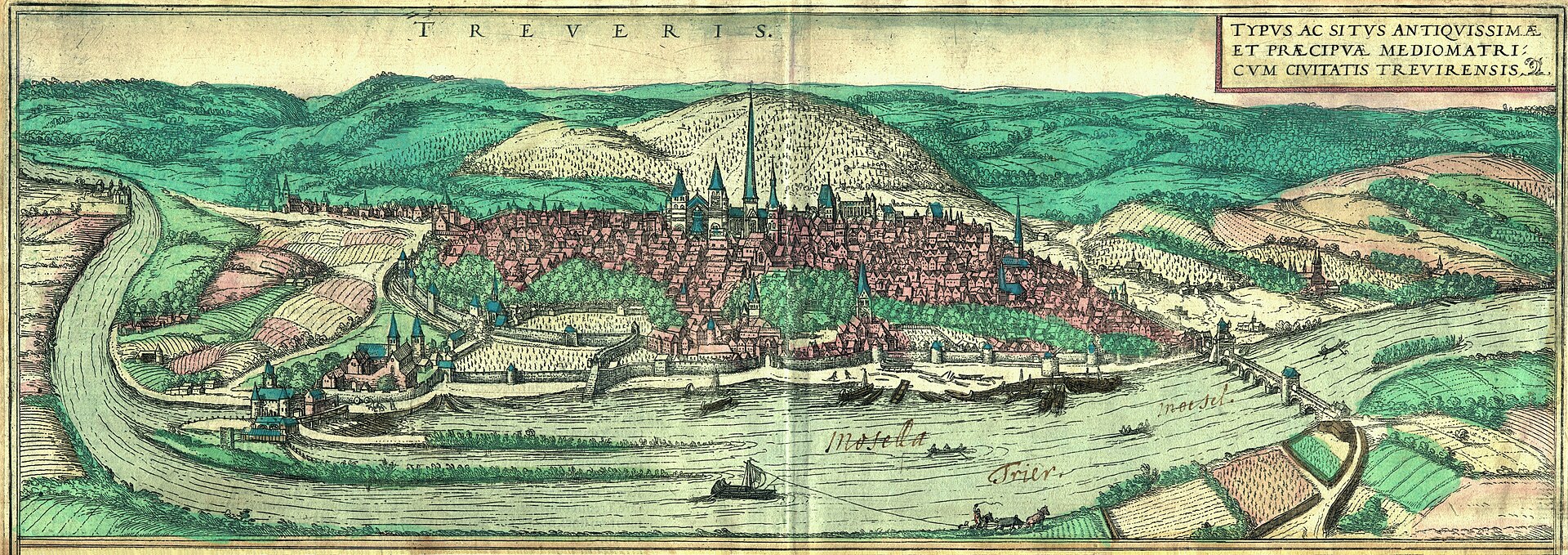
Bird's-eye view of Trier, from Georg Braun & Frans Hogenberg's Civitates Orbis Terrarum
Walled medieval town with gates, dense street blocks, the cathedral spires, the Moselle river and the timbered bridge are all clearly shown.
1572 · Georg Braun / Frans Hogenberg · Wikimedia Commons
Public domain (plate dated 1572)


More cities to explore
 LuxembourgLuxembourg CityExplore it in 1860
 GermanyAachenExplore it in AD 800 · 1500
 GermanyBerlinExplore it in 1750 · 1871 · 1928
 GermanyMunichExplore it in 1500 · 1700 · 1900
Castles of Europe · Landmarks of Europe · create your own reconstruction.