Historic Cities · Lithuania
Vilnius through the ages
Vilnius is the capital of and largest city in Lithuania and the most-populous city in the Baltic states. The city's estimated July 2026 population was 619,405, and the Vilnius urban area has an estimated population of 767,907.

Vilnius in 1600
Vilnius of the Grand Duchy
Vilna at the turn of the seventeenth century is the busy capital of the Grand Duchy of Lithuania, a multi‑confessional city where the royal palace and castle hill preside over dense parishes and workshops. This walk follows the main gates, the market and the university quarter to the brick façade of Saint Anne, the Jesuit churches, riverside quays and the hilltop castle terrace.
The skyline is a close-knit patchwork of steep tile roofs, church towers and chimneys rising from timber and low stone houses clustered inside stout medieval walls. Red brick Gothic fronts and pale plastered façades mix with wooden gables; narrow, rutted streets lead between courtyards and cloisters. The Neris and Vilnia rivers cut the plan, bridges and quays crowded with boats, while spires and bell‑towers of Catholic and Orthodox churches punctuate the skyline.
The route: 22 streets, squares and views
Neris River Approach → Medieval Bridge over Neris → Neris Quay → Gate of Dawn (Aušros Vartai) → City Walls, Northeastern Bastion → Didžioji Street (Great Street) → Pilies Street (Castle Street) → Cathedral Square → Royal Palace (Lower Castle) → Gediminas' Tower → …
Step inside, 13 interiors
Chapel of the Dawn · Cathedral Nave · Audience Hall · Grand Duke's Private Chamber · University Great Hall · University Library · Jesuit Church Nave · Brick Chapel Interior · Bernardine Nave · Wooden Synagogue Hall · Ruthenian Church Interior · Italian Masons' Workshop · Boatwright Shed
Planned from the Wikipedia record: History of Vilnius.
Vilnius in 1900
Vilna of the Litvaks
Vilna in 1900 is a crowded provincial capital under the Russian Empire and the foremost centre of Eastern European Jewish learning and print. This walk passes the Gate of Dawn and its pilgrims, the sunken courtyard of the Great Synagogue, Hebrew presses and bookshops, market squares and the wooden suburbs that still fringe the old town.
The skyline in 1900 is a close cluster of red-tile and zinc roofs pierced by church towers and the white bulk of collegiate façades, with the lone surviving fragment of the old walls at the Gate of Dawn. Streets are narrow and cobbled, edged with low masonry houses and rows of wooden tenements in the suburbs; the Vilnia and Neris rivers cut green corridors through the dense town. Signboards and shop-fronts show Polish, Russian and Yiddish lettering; smoke and steam from trains and bakeries hang in cold air.
The route: 20 streets, squares and views
Vilna Train Station → Green Bridge → Bernardine Garden → Gate of Dawn → Aušros Vartų Street → Pilies Street → Town Hall Square → Vokiečių Street → St. Anne's Church → Cathedral Square → …
Step inside, 12 interiors
Bernardine Church Nave · Gate of Dawn Chapel · Hebrew Presses Press Room · Town Hall Great Hall · St. Anne's Gothic Nave · Cathedral Nave and Choir · University Lecture Hall · Bimah under the Vault · Beit Midrash of Study Houses · Strashun Library Reading Room · Covered Market Hall · Užupis Silversmith's Workshop
Planned from the Wikipedia record: History of Vilnius.
Its story
The story of Vilnius.
Gediminas's Letters and the Teutonic Raids, 1323–1390
The earliest settlements here appear to be Mesolithic, and the most densely populated ground was the confluence of the Neris and the Vilnia; some historians identify the place with Voruta, a forgotten capital of King Mindaugas. It enters the written record as Vilna in 1323, in the letters of Grand Duke Gediminas, which name it the capital of the Grand Duchy; the name comes from the Vilnia, the tributary river whose name means ripple. Gediminas built a wooden castle on a hill and in 1325 sent a circular letter to the principal Hansa towns inviting Germans and Jews into his domains, with free access for men of every order and profession.
The Teutonic Order raided repeatedly through the 14th century and never took the castle, though large parts of the town burned in 1365, 1377 and 1383. The future Henry IV of England, then Henry Bolingbroke, spent 1390 backing an unsuccessful Teutonic siege with 300 knights, buying captured Lithuanian women and children to take back to Königsberg for conversion. Vilnius was granted city rights by Jogaila in 1387, after the Christianization of Lithuania and the building of the cathedral, where the Bishop of Vilnius placed Gediminas's Cap on each new monarch's head.
Capital of the Grand Duchy, 1387–1547
The town was populated at first by local Lithuanians and grew as craftsmen and merchants of other nationalities settled; by the 16th century German merchants and artisans, Jews and Tatars had settled too. In 1413 it became capital of the Vilnius Voivodeship under the Union of Horodło, and between 1503 and 1522 it was walled with nine gates and three towers against Crimean Tatar attacks.
Around 1520 Francysk Skaryna established eastern Europe's first printing house in Vilnius, printing the Little Traveller's Book in 1522, the first book printed in the Grand Duchy. The town reached the peak of its development under Sigismund II Augustus, who moved there in 1544 and brought his royal court from Kraków in 1547. The gradual Polonization of Vilnius had begun in the late 14th century, through an influx of Polish clerics, craftsmen and merchants and the assimilation of non-Polish burghers, and it quickened once the court arrived.
The University, the Babylon of Europe and the Sack of 1655
After the Union of Lublin created the Polish–Lithuanian Commonwealth in 1569, the city gained Vilnius University, founded by Stephen Báthory in 1579 and soon the most notable scientific centre of the Grand Duchy. Migrants came from east and west, and larger Jewish, Orthodox and German communities established themselves beside the old citizenry; so many nations lived there that Western sources of the 16th to 18th centuries called it the Babylon of Europe. Polish advanced with them: 5% of townspeople's acts were written in Polish in the 15th and 16th centuries, but 53% by the middle of the 17th.
In 1655, during the First Northern War, Vilnius was captured by the forces of the Tsardom of Russia, pillaged, burned and its population massacred; the death toll of around 20,000 included a large proportion of the city's Jews, and its growth lost momentum for many years. The numbers recovered, and during the Commonwealth's decline Vilnius became known as the Jerusalem of the North, a major religious-cultural centre of Eastern European Jewry and, as Yerushalayim D'Lita, a world centre of Torah study whose major scholar of Judaism and Kabbalah was Rabbi Eliyahu Kremer, the Vilna Gaon.
Vilna Governorate and Four National Revivals, 1795–1905
The Third Partition of Poland in 1795 ended the Grand Duchy and four centuries as its capital, and Vilnius became capital of the Vilna Governorate within the Russian Empire's Northwestern Krai. The walls were pulled down between 1799 and 1805, leaving only the Gate of Dawn, and Alexander I re-established the Polish-language university in 1803. Napoleon seized the city in 1812 on his push towards Moscow; when the campaign failed, 80,000 French soldiers died in the retreat here and were buried in the trenches they had dug months earlier. After the November Uprising the university was closed on 1 May 1832. The railway reached the city in 1860, and lines to St Petersburg, Kaunas and Warsaw opened in 1862.
During the January Uprising of 1863 there was heavy fighting in the city, pacified by Mikhail Muravyov, nicknamed The Hanger for the number of executions he organised. Polish was then banned from public use; the Latin alphabet had been prohibited for Belarusian in 1859 and was prohibited for Lithuanian in 1865, bans not lifted until 1904. By the 1897 census 40% of the population gave Yiddish as its mother tongue, 31% Polish, 20% Russian, 4.2% Belarusian and 2.1% Lithuanian.
The late 19th and early 20th centuries carried four national revivals at once: Jewish, Polish, Lithuanian and Belarusian. Some leaders of the Jewish revival argued for a new Jewish state in the Vilnius region with the city as its capital; the first Belarusian weekly, Nasha Niva, was founded there. On 4–5 December 1905 the Great Seimas of Vilnius assembled over 2,000 delegates and demanded an autonomous ethnic Lithuanian state within the empire with its parliament in Vilnius.
Changes of Hand and the Wilno Voivodship, 1915–1939
Germany occupied Vilnius from 1915 to 1918, and under that occupation, on 16 February 1918, the Council of Lithuania proclaimed the Act of Independence in the city, naming Vilnius capital of the restored state. The German garrison withdrew on 1 January 1919 and handed authority to a local Polish committee against the pleas of the Lithuanian administration; on 5 January Bolshevik forces took the city and proclaimed it capital of the Lithuanian–Byelorussian Soviet Socialist Republic. The Polish Army seized it on 19 April 1919, Soviet forces took it again in July 1920, and after the Battle of Warsaw the Red Army handed it to Lithuania under the Soviet–Lithuanian Peace Treaty.
On 9 October 1920 the 1st Lithuanian–Belarusian Division under General Lucjan Żeligowski seized the city in a staged mutiny and declared it capital of the Republic of Central Lithuania. Elections held on 8 January 1922 were boycotted by Lithuanian, Jewish and Belarusian organisations, and the fraud noted by the League of Nations observer Colonel Chardigny was Lithuania's stated pretext for refusing to recognise the result. The Central Lithuanian parliament voted on 20 February 1922 to annex the whole area to Poland, with Vilnius as capital of the Wilno Voivodship, and the Council of Ambassadors recognised it as Polish in 1923. Lithuania never accepted it: the city stayed the constitutional capital of the Lithuanian state while Kaunas served as a temporary one, the border was closed, relations broken, and the two countries remained in a de facto state of war until the Polish ultimatum of 1938.
Polish statistics for 1920–1939 put the city at 65% Poles and 28% Jews, and the 1931 census counted 195,000 inhabitants, the fifth-largest city in Poland. The university reopened as Stefan Batory University with Polish as the language of instruction, and ghetto benches were introduced there. Repression of the Lithuanian minority hardened under Voivode Ludwik Bociański, whose secret memorandum of February 1936 set out measures against them: almost all Lithuanian schools and reading rooms were closed and Lithuanian organisations banned, their members imprisoned or deported, until Lithuanian education in all of Poland was reduced to one private primary and one private secondary school in Vilnius. The city was at the same time an informal capital of Yiddish, with the Museum of Jewish Culture founded in 1919 and YIVO, the Institute for Jewish Research, in 1924, alongside Jewish theatres, newspapers and schools. Four YIVO directors emigrated to New York.
The Ghettos and Paneriai, 1939–1944
After the Molotov–Ribbentrop Pact and the Soviet invasion of eastern Poland, the Red Army took Vilnius on 19 September 1939 following a one-day defence. The Soviet Union warned Lithuania that the city would go to the Byelorussian SSR unless its future was settled on Soviet terms, and by the treaty of 10 October 1939 it passed to Lithuania in exchange for Soviet military bases; only about a fifth of the Vilnius region was returned. A month of Soviet rule left the city starving, its museums and archives looted and many people imprisoned or deported. The Lithuanian army entered on 28 October. At the end of that month the local Polish population began a four-day anti-Jewish pogrom in which one person was killed and some 200 wounded; it stopped when 35 Soviet tanks briefly re-entered the city.
The Lithuanian authorities then set about de-Polonizing it. Stefan Batory University was reformed into Vilnius University on 15 December 1939, and Polish offices, schools, cultural organisations and businesses were closed; by June 1940 roughly 4,000 Polish teachers had lost their jobs. By 28 March 1940 everyone who had not been a citizen of the town in October 1920 was declared a refugee: some 12,000 were granted Lithuanian citizenship while 150,000 inhabitants, mostly Poles, were declared foreigners, excluded from many jobs and forbidden to travel by train. In June 1940 the Soviet Union seized the city again and made it capital of the Lithuanian SSR; between 35,000 and 40,000 inhabitants were arrested by the NKVD and sent to the gulag or deported to Siberia or Kazakhstan.
Nazi Germany took the city in June 1941. Two ghettos were set up in the old town centre; the smaller was liquidated by October, and the second lasted until 1943, its population regularly reduced in the operations known as Aktionen. A ghetto uprising on 1 September 1943 failed and could not prevent the ghetto's final destruction. About 95% of the local Jewish population was murdered, many of them among the 100,000 victims of the mass executions at Paneriai, about 10 km west of the old town; most of the remaining 30,000 killed there were Poles: prisoners of war, members of the intelligentsia, and members of the Armia Krajowa, which was then fighting both Germans and Lithuanians. The city's largest synagogue, built in the early 1630s, was destroyed under the German occupation and its remains later demolished by the Soviet authorities.
Soviet Capital and Restored Capital, 1944–2023
The Germans were forced out in July 1944 by the combined pressure of the Polish Home Army, in Operation Ostra Brama, and the Red Army. Between 1944 and 1947 opponents of the regime were interrogated at the NKVD palace on Lukiškės Square, executed, and buried at Tuskulėnai Manor. The Soviet government then moved the Polish population out of Lithuania and Belarus, and most of the city's Poles were expelled; many of those who stayed were arrested, murdered or sent to the gulag. By the end of the war only about 111,000 people were left, against roughly 200,000 before 1939, and a Polish-Jewish city with a small Lithuanian minority was Lithuanized almost at once. Russification and immigration from other Soviet republics produced a substantial Russian-speaking minority, the surviving Jews emigrated steadily to Israel, and Lithuanians moving in from the rest of the country drove a rapid rise in population. The city had suffered relatively little wartime damage, but in the decade after the war both ghetto areas and the whole quarter on Pilies Street were torn down.
Mass demonstrations against Soviet rule began in 1987, and 150,000 to 200,000 people gathered in Vilnius on 23 August 1988. The Supreme Council of the Lithuanian SSR restored the independent Republic of Lithuania on 11 March 1990. The Soviet Union sent troops on 9 January 1991, and in the attack on the State Radio and Television Building and the Vilnius TV Tower on 13 January 14 people were killed and more than 700 seriously injured. Soviet recognition followed later in 1991, after the failed coup in Moscow.
Vilnius is the capital and largest city of Lithuania, with an estimated 619,405 inhabitants in July 2026, and its Old Town was declared a UNESCO World Heritage Site in 1994. For the first time in modern history Lithuanians are a clear majority of its people, 63.2% in 2011 and 67.4% in 2021. The Vilnius region produces 42% of the country's GDP. It was a European Capital of Culture in 2009 and held the NATO summit on 11–12 July 2023.
From the archive
Vilnius on paper: the old town as it was mapped.
A period plan or bird's-eye view of the old town, drawn between 1500 and 1850, the streets this page's reconstructions walk. Public domain, with its source named.
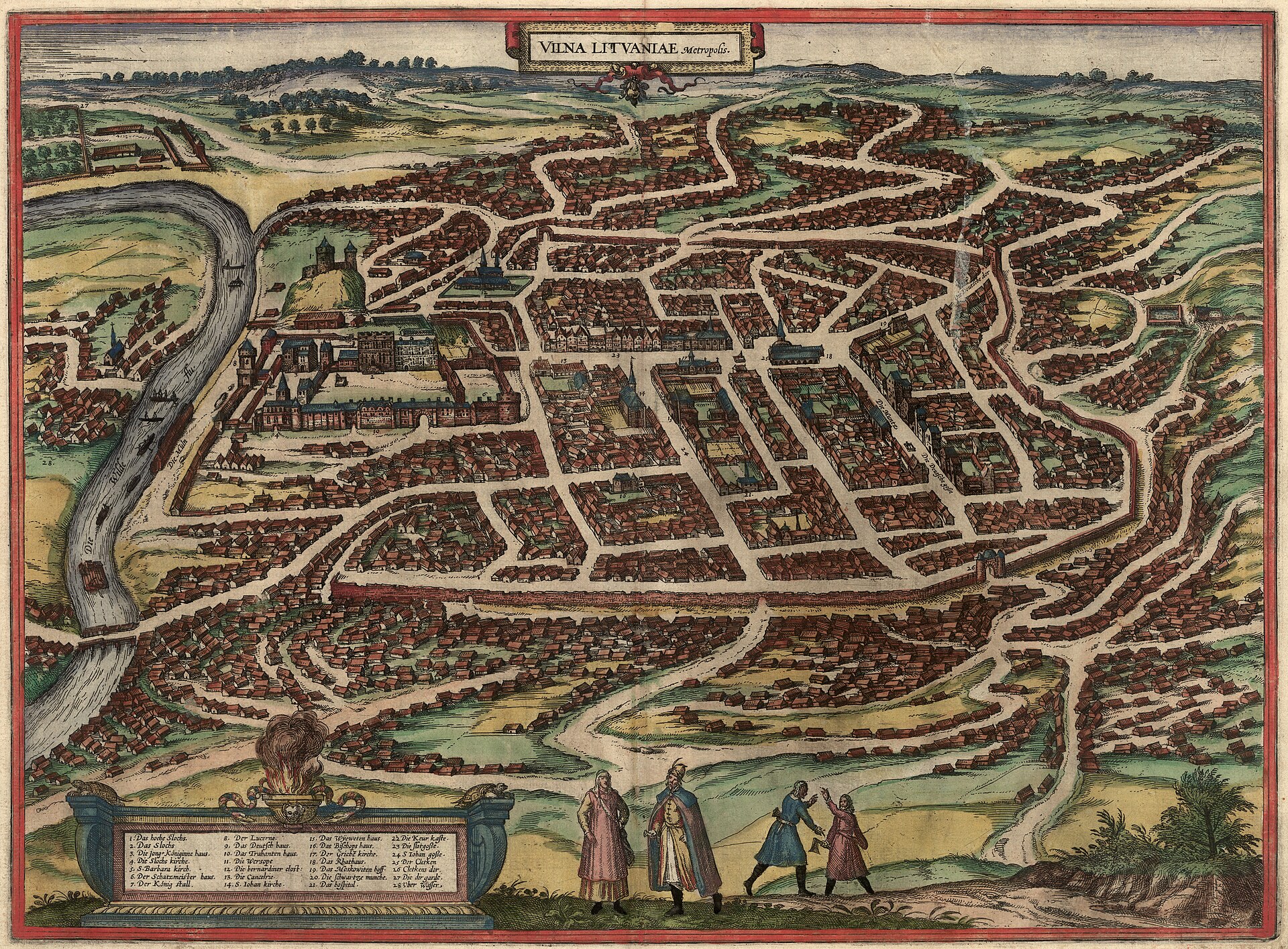
Bird's-eye view of Vilna (Vilnius), from Braun & Hogenberg's Civitates Orbis Terrarum
Walled old town with gates and street grid, Gediminas Castle on its hill, several churches and the river are clearly depicted.
1616 · Georg Braun · Wikimedia Commons
Public domain (plate dated 1616)
Castles of Vilnius


More cities to explore
 LatviaRigaExplore it in 1400 · 1900
 NetherlandsUtrechtExplore it in 1400 · 1700
 EnglandLondonExplore it in AD 200 · 1390 · 1600 · 1885
 FranceParisExplore it in 1250 · 1670 · 1789 · 1889
Castles of Europe · Landmarks of Europe · create your own reconstruction.