Historic Cities · Latvia
Riga through the ages
Riga, officially Riga State City, is the capital, primate, and largest city of Latvia and the second largest in the Baltics. Home to 588,911 inhabitants, the city accounts for a third of Latvia's total population. The population of Riga metropolitan area, which stretches beyond the city limits, is estimated at 847,162.

Riga in 1400
Hanseatic Riga
Riga in 1400 stands as a bustling Hanseatic entrepôt where brick cathedrals, timber houses and stout walls meet the Daugava's busy quays. The walk follows the river approach, the Livonian Order's castle, guild squares and the market streets where cogs load flax, hemp and wax for the Baltic trade.
A low, compact skyline of tall church spires, Dome Cathedral's massed brick and St. Peter's needle of wood, rises above a tight web of timber-framed merchants' houses and narrow lanes. Red-brown brick, tar-blacked planking and pale thatch dominate. Stone fortifications, round towers and a crenellated wall rim the town; the riverfront bristles with masted cogs, halyards, hemp bales and wooden cranes. Street widths vary from alley to market square; banners and guild signs supply bright colour against cloudy northern light.
The route: 21 streets, squares and views
Daugava Approach → Riga Castle (from river) → Castle Quay Warehouses → Powder Tower and South Wall → Town Gate (Rātsvārti) → Vaļu (Wall) Street → Skārņu Street → Audeju (Weavers) Street → Peldu Street → Great Guild Hall (exterior) → …
Step inside, 15 interiors
Great Hall of the Order · Castle Armoury Chamber · River Hemp Warehouse · Powder Tower Magazine · Gatehouse Toll Chamber · Weavers' Guild Workshop · Furriers' Cutting Hall · Great Guild Merchant Hall · Blackheads' Banqueting Hall · Butchers' Guild Hall · St. Peter's Nave · Cathedral Nave · Cathedral Brick Cloister · Hemp and Wax Warehouse · Spire Watch Chamber
Planned from the Wikipedia record: History of Riga.
Riga in 1900
Art Nouveau Riga
Riga in 1900 is a boom town of the Russian Empire whose skylines of church spires and baroque roofs are being joined by a new layer of elaborate Jugendstil facades. This walk follows the river approach into the old port, threads the rebuilt esplanade and canal, passes Alberta iela's sculpted apartment fronts and ends on the park terraces that look back over the city.
The skyline is a thicket of tall church spires, St. Peter’s and the Dome dominate, with narrow red-tiled roofs and chimneys between them. Stone warehouses and timber quays line the brown Daugava; the new districts rise as four- to five-storey brick and stucco apartment blocks clothed in cream, ochre and grey, their facades dense with masks, floral stucco and wrought-iron balconies. Streets are narrow, cobbled and busy with horse-drawn trams, carts and pedestrians.
The route: 22 streets, squares and views
Riga from the Daugava → Pontoon Bridge → Pārdaugava Quay → Central Railway Station → Powder Tower → Daugava Embankment → Town Hall Square → House of the Blackheads → St. Peter's Square → Dome Cathedral → …
Step inside, 13 interiors
Grand Waiting Hall · Powder Tower Chamber · Brotherhood Banquet Hall · St. Peter's Nave · Dom Cathedral Nave · Great Guild Concert Hall · Merchant Warehouse Interior · Song Society Hall · Opera Auditorium · Painted Stairwell Murals · Jugendstil Tiled Kitchen · Market Hall Interior · Printing Office Press Room
Planned from the Wikipedia record: History of Riga.
Its story
The story of Riga.
The Old Port on the Daugava
The Daugava, the Western Dvina, was a trade route from antiquity, the Baltic leg of the Viking navigation that portaged across to the Dnieper and ran on to Byzantium. A sheltered natural harbour about 15 km upriver from the river's mouth, the site of the present city, is recorded as a place of settlement, the Duna Urbs, as early as the 2nd century, and was settled by the Livs, a Finnic people who arrived in the 5th and 6th centuries. Excavations at Rātslaukums and at the corner of Peldu and Ūdensvada streets show 12th-century inhabitants who were mainly Kurs, Kursified Livs and Livs of the Daugava basin, working bone, wood, amber and iron alongside fishing, animal husbandry and trade.
The Chronicle of Henry of Livonia calls the place portus antiquus, the ancient port, and describes dwellings and warehouses holding corn, flax and hides. Those warehouses give the best-documented explanation of the city's name, recorded by the German historian Dionysius Fabricius in 1610: the granaries standing in great number along the bank, which the Livs called rias, the Latvian rija, whose soft consonant hardened into a German g.
Crusade, Bishop Albert and the Staple Port, 1158–1229
Bremen merchants shipwrecked at the mouth of the Daugava set up a trading outpost near Riga in 1158, and German traders were coming by way of Gotland in growing numbers. Christianity had reached Latvia long before, but the monk Meinhard of Segeberg, arriving from Gotland in 1184, intended mass conversion; he settled among the Livs at Ikšķile upstream, was consecrated Bishop of Livonia in 1186, and died there in 1196 having failed. His replacement, Berthold of Hanover, landed in 1198 with a large body of crusaders and began forcing conversion; he was killed in battle soon afterwards and his forces defeated, Latvian legend says the Liv warrior Imants speared him, while ecclesiastical history blames his unruly horse. Pope Innocent III then proclaimed a crusade against the Livonians, with forgiveness of sins for all who joined, and Albert, nephew of the Prince-Archbishop of Bremen, was consecrated bishop in 1199. He landed in 1200 with 23 ships and 500 Westphalian crusaders and in 1201 moved the seat of the bishopric from Ikšķile to Riga, extorting the elders' agreement by force.
The Order of the Livonian Brothers of the Sword was founded under Albert's aegis in 1202, and he divided conquered land to hold a permanent garrison where crusaders had served a year and gone home: the Church took Riga and two-thirds of everything taken, the Order a third. What he built for trade outlasted what he built for war. He obtained papal bulls decreeing that all German merchants must conduct their Baltic trade through Riga, and a campaign against Polotsk in 1212 forced free river passage, conceded Koknese and Jersika and ended Liv tribute to Polotsk, opening the Dvina to Vitebsk, Smolensk and Novgorod.
The merchant citizenry pressed against their bishop throughout: in 1221 they won the right to administer Riga themselves and adopted a city constitution, and a papal settlement in 1225 released them from tax to the bishop and gave them the election of their own magistrates and councillors. Riga was incorporated into the Holy Roman Empire as a prince-bishopric in 1226 and Albert died in January 1229. The year 1201 is still kept as the city's founding, a date bound up with the Kulturträger story that later German and ecclesiastical historians told of Germans bringing civilisation and religion to Livonia.
In the Hansa and the Reformation, 1282–1581
From 1282 Riga was a member of the Hanseatic League, and its function within that network was as the gateway to trade with the Baltic tribes and with Russia. The League's protectionism favoured its German members and bred competitors: in 1298 the citizens of Riga and the Lithuanian Grand Duke Vytenis concluded a treaty by which a pagan Lithuanian garrison would defend the city against one of the sharpest of them, the Teutonic Order, a contract that held until 1313. Hansa power was already weakening by the end of the 14th century, as the alliances of Lithuania with Poland and of Sweden with Denmark and Norway cut into it.
As that influence receded the city became the object of foreign ambition. It accepted the Reformation in 1522, ending the power of the archbishops; during iconoclast rioting in 1524 a venerated statue of the Virgin Mary in the cathedral was denounced as a witch and given a trial by water in the Daugava, floated, and was burnt at Kubsberg. With the demise of the Livonian Order in 1561 during the Livonian War, Riga held the status of a free imperial city for twenty years, until the Treaty of Drohiczyn ended the war for the city in 1581 and brought it under the Polish–Lithuanian Commonwealth.
Swedish and Russian Masters, 1621–1721
In 1621, during the Polish–Swedish War, Riga and the outlying fortress of Daugavgrīva passed to Gustavus Adolphus of Sweden, who had entered the Thirty Years' War for political and economic gain and in favour of German Lutheran Protestantism. The city withstood a Russian siege during the Russo-Swedish War of 1656–1658 and remained under the Swedish crown until 1710 with a great deal of self-government. Between November 1709 and June 1710 Peter the Great's forces besieged and took Riga, which was struck by plague at the time; the city capitulated along with the other Livonian towns and the gentry, largely retaining its privileges, and was made capital of the Governorate of Riga, later Livonia. Sweden's dominance in the north was over, and Russia's was formalised by the Treaty of Nystad in 1721.
Timber Port, Russification and the Latvian Awakening, 1721–1905
By the end of the 19th century Riga was one of the most industrially advanced and economically prosperous cities in the Russian Empire. More than half of the 800,000 industrial workers in the Baltic provinces worked there, and by 1900 the city ranked third in Russia after Moscow and Saint Petersburg by numbers of industrial workers. At the beginning of the 20th century it was the empire's largest timber export port and third by volume of external trade.
The Baltic Germans, successors to Albert's merchants and crusaders, held their dominant position through those centuries despite the ground shifting beneath them. German remained the city's official language of administration, and all birth, marriage and death records were kept in German, until Russian was imposed in 1891 as the official language of the Baltic provinces under Alexander III's policy of Russification. Latvians began to supplant Germans as the largest group in the mid-19th century: the German share fell from 42.9% in 1867 to 25.5% in 1897 and 13.9% by 1913, while the Latvian share rose from 23.6% to 41.6% over the same three decades, in a city where by 1881 most people had been born outside it.
A Latvian bourgeoisie rose with the industry, and the city became a centre of the Latvian National Awakening, with the Riga Latvian Association founded in 1868 and the first national song festival organised in 1873. The nationalist movement of the Young Latvians was followed during the industrial boom by the socialist New Current, and the sequence culminated in the 1905 Revolution, led in Latvia by the Latvian Social Democratic Workers' Party.
Independence, Occupation and the Riga Ghetto, 1917–1944
The German army entered Riga on 3 September 1917 after the battle of Jugla, and the Treaty of Brest-Litovsk of 3 March 1918 handed the Baltic countries to Germany, making Riga capital of the Duchy of Courland and Semigallia. The armistice of 11 November 1918 obliged Germany to renounce the treaty, as Russia also did, and independence was declared on 18 November 1918 with Riga as capital. Through the War of Independence the city was contested between the Latvian Socialist Soviet Republic established by the Red Army, Freikorps battalions of Baltic Germans and demobilising German soldiers, and the Latvian Provisional Government. Trade then turned west, the United Kingdom and Germany replacing Russia as Latvia's principal partners. The 1935 census counted 385,063 inhabitants: 63% Latvian, 11.3% Jewish, 10% German, 7.4% Russian, 4.1% Polish. The majority of the Baltic Germans were resettled in late 1939, after some seven centuries in the city.
Soviet forces invaded on 17 June 1940, and three days later President Kārlis Ulmanis was forced to approve a pro-Soviet government. Rigged elections followed on 14–15 July, the ballots instructing that only the list of the Latvian Working People's Bloc be deposited and without any changes; the complete results were published in Moscow twelve hours before the polls closed. Arrests followed, including of leaders of the former government. The June deportation of 13–14 June 1941 removed an estimated 15,600 men, women and children from Latvia, among them 20% of its last legal government; Stalin's deportations also took thousands of Latvian Jews, and across the Baltic states the total was 131,500.
Germany occupied Latvia from 1941 to 1944. On 25 October 1941 the Nazi authorities moved all Jews from Riga and the vicinity into the ghetto in the Maskavas neighbourhood. Most of Latvia's Jews, about 24,000 people, were killed on 30 November and 8 December 1941 in the Rumbula massacre. A concentration camp was built at Kaiserwald and another at Salaspils nearby. Polish forced labourers from Tczew maintained contact with the Polish resistance movement and conducted espionage on local German activity. The Red Army retook Riga on 13 October 1944, and by the end of the war the remaining Baltic Germans had been expelled to Germany.
Soviet Riga and the Restored Capital, 1944–2022
Deportations to Siberia resumed after 1945, usually on accusations of having collaborated with the Nazis or of supporting the post-war anti-Soviet resistance. Forced industrialisation and planned large-scale immigration of non-Latvians, particularly Russians, changed the city's composition: Latvians made up 70% of Riga in 1940, 45% by 1959 and 36.5% by 1989, with Russians outnumbering Latvians from the end of the 1960s. The historic centre had been heavily damaged by bombing, and much was rebuilt: St Peter's Church, which lost its wooden tower to a fire caused by the Wehrmacht, was renovated in 1954, while the House of the Blackheads was destroyed outright, its ruins demolished and a facsimile built in 1995.
Latvia declared full de facto independence on 21 August 1991, after unsuccessful attempts by Soviet OMON units to restore local Soviet authority during the Barricades, and the Soviet Union recognised it on 6 September; all Russian military forces left between 1992 and 1994. Some local Russians and Ukrainians lost their citizenship in the change and left for Russia and the West, and nearly all of the Jewish population emigrated. Soviet-era immigrants and their children born before 1991 were not automatically granted Latvian citizenship, and in 2022 citizens of Latvia made up 79.0% of the city's population, non-citizens 15.3%.
Riga is the capital and a state city of Latvia, and its historic centre is a UNESCO World Heritage Site noted for its Art Nouveau and 19th-century wooden architecture. The city holds about a third of the country's population and generates more than half its GDP, but it has fallen from just over 900,000 inhabitants in 1991 to under 600,000 through emigration and low birth rates, and Vilnius has passed it in size. The Freeport handled a record 41.8 million tons of cargo in 2014; by 2024 its turnover had halved, largely with the fall in trade with Russia after the sanctions that followed the invasion of Ukraine. In 2022 the city council voted to demolish the Monument to the Liberators of Soviet Latvia and Riga from the German Fascist Invaders, and the obelisk was toppled on 25 August that year.
From the archive
Riga on paper: the old town as it was mapped.
A period plan or bird's-eye view of the old town, drawn between 1500 and 1850, the streets this page's reconstructions walk. Public domain, with its source named.
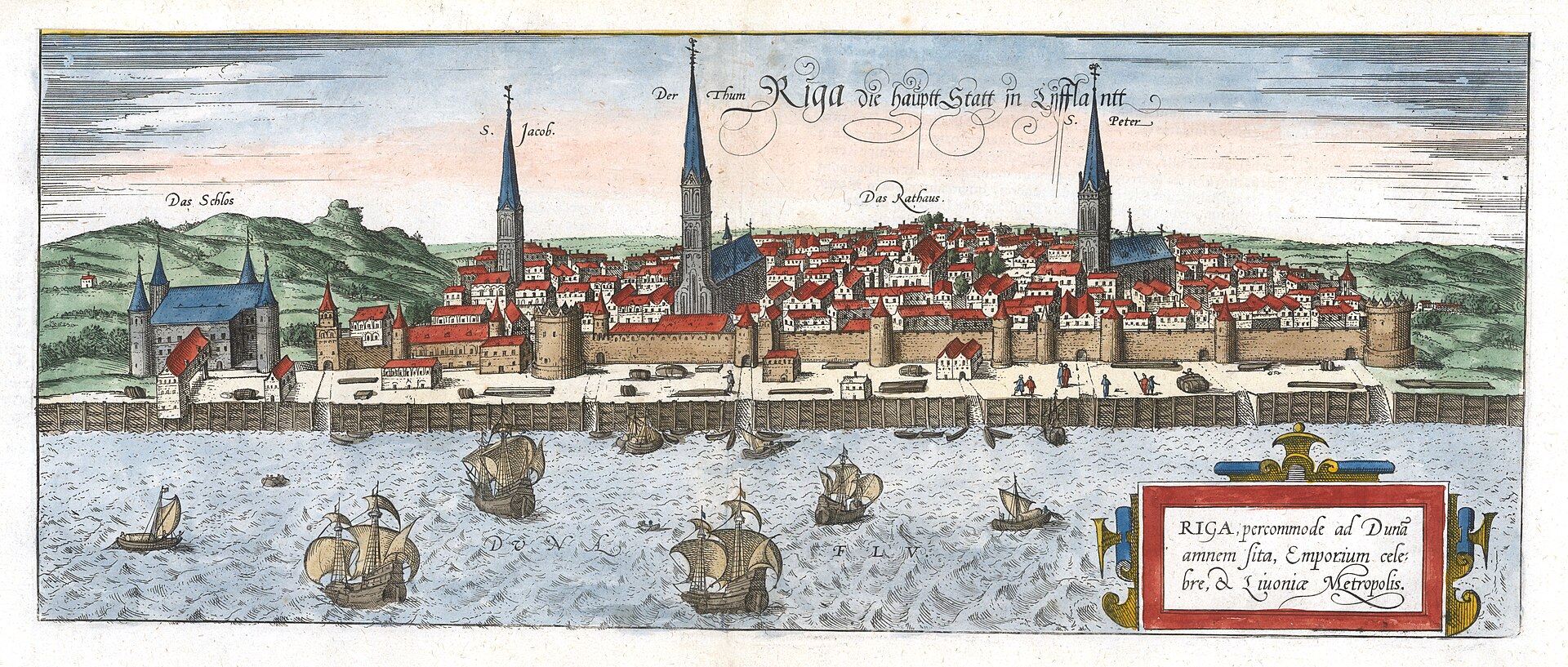
Panorama of Riga, from Braun & Hogenberg's Civitates Orbis Terrarum
Walled riverside panorama showing the Daugava with ships, city walls and towers, and the tall spires of St Jacob and St Peter beside the Rathaus.
1572 · 1581 Braun & Hogenberg: of "Civitates Orbis Terrarum." · Wikimedia Commons
Public domain (plate dated 1572)

Ships tied to Riga
- German cruiser Prinz Eugen: Fired 265 main-battery shells into Tukums in the Gulf of Riga, August 1944
- SMS Moltke: Torpedoed by the submarine E1 covering the 1915 assault into the Gulf of Riga
- Vasa: Her planking and rigging hemp were shipped through Riga
Castles of Riga

More cities to explore
 LithuaniaVilniusExplore it in 1600 · 1900
 EstoniaTallinnExplore it in 1450 · 1560 · 1900
 NetherlandsUtrechtExplore it in 1400 · 1700
 EnglandLondonExplore it in AD 200 · 1390 · 1600 · 1885
Castles of Europe · Landmarks of Europe · create your own reconstruction.