Clan Crawford
also Clan Crawford, Craufurd, Crauford
The ford of the crows, an upper-Clydesdale name.
- Origin
- Glasgow & Strathclyde, Scotland
- Motto
- Tutum te robore reddam
- Famous bearer
- The Lindsay Earls of Crawford, premier earls of Scotland
- Register
- Scottish clan
The Crawford arms, crest badge, tartan and country

Crest badgeClan member crest badge - Clan CrawfordCeltus · CC BY-SA 3.0 
TartanCrawford tartanMicheletb · CC BY-SA 4.0 
TartanCrawford tartan (Vestiarium Scoticum - text)As printed in the Vestiarium Scoticum, 1842, a collection whose claimed medieval source was never produced, and which is now generally held to be a forgery. Families adopted its patterns anyway, and wear them still.TilmannR · CC0 
Coat of armsCrawford of Loudon armsBorne by the Loudon line, one branch of the name rather than all of it.Newm30 · CC BY-SA 4.0 
Coat of armsCrawford of Auchinames armsBorne by the Auchinames line, one branch of the name rather than all of it.Czar Brodie · CC BY-SA 3.0


.svg)


- Crest badge: The chief's crest inside a belt and buckle: the badge a clansman wears to show whose following he is in.
- Tartan: The checked cloth the family is known by.
- Coat of arms: Granted to an individual and inherited down that one documented line. These are the arms of particular families of the name, not of everyone who shares the surname.
What is the Crawford clan tartan?
Two Crawford setts are shown above, one of them the thread count as written out in the Vestiarium Scoticum of 1842. They are not rival claims to be picked between; they are different records, and different weaves, of the same family cloth. A sett is the block of coloured bands the cloth is built from, repeated in both directions; the whole plaid is that one square enlarged.
Crawford is a Lowland name, and Lowland families did not wear Highland dress; the 1746 proscription that broke the tradition in the north took nothing from them, because there was nothing there to take. The Crawford sett is a 19th-century assignment, made when tartan stopped being Highland and became Scottish and fixed by the Bannockburn weavers’ pattern books, the royal visit to Edinburgh in 1822, and the Vestiarium Scoticum of 1842. Nobody polices any of it. Wearing the Crawford sett declares allegiance to the name, not descent from any particular line of it.
CoreHistoric reach
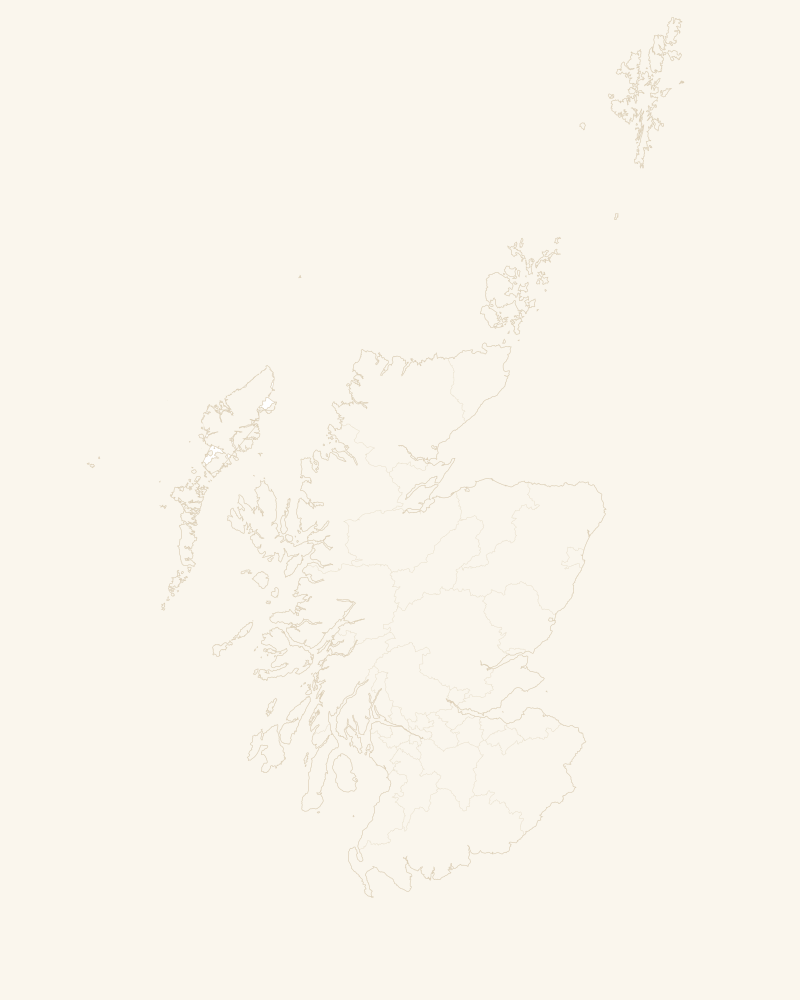
The seat of Clan Crawford
Seat vacantChief
No one leads the Clan Crawford community yet. When the movement opens, you can stand for its leadership, or help elect whoever does.
Current mission
No shared goal set yet. Once Clan Crawford has leadership, it sets the public focus: a restoration, a gathering, a real-world project that helps its own.
The Crawford clan is being rebuilt. Join the waiting list for the movement today, and you help decide who leads it and what it does.
Help rebuild the Crawford clan →Motto
Tutum te robore reddam
“I will make you safe by strength”
What does the Crawford name mean?
Territorial, from the barony of Crawford in upper Clydesdale in Lanarkshire, from Old English crawe, 'crow', and ford, the 'ford of the crows' on the upper Clyde. A Lowland Scots family seated there from the twelfth century, the Crawfords held the barony before the Lindsays, who carried the place-name into the premier earldom of Scotland, the Earldom of Crawford, created in 1398.
The history of Clan Crawford
The ford of the crows on the upper Clyde
Crawford is a locative name, taken from a place before it was ever taken by a family. The elements are Old English crawe, in Scots craw, meaning crow, and ford, the crossing: the ford of the crows. There are places of the name in Dorset and Lancashire, but the surname is most probably from the Scottish one, the barony of Crawford in upper Clydesdale in Lanarkshire, with the neighbouring barony of Crawfordjohn giving the form in use by around 1160. In Gaelic the surname corresponds to MacCreamhain, and in Irish to Mac Crabhagain.
That is a territorial surname, and it works the way feudal landholding worked. The earliest bearers are written with the Norman preposition de, of or from, attached to the estate rather than to a father: John de Crauford appears in Scotland between 1147 and 1160, Galfridus de Crauford between 1188 and 1202, and Nicolaus de Crauford in England in 1205. Names of this kind were taken up first among the nobility and gentry and spread downward, and by 1400 most families in Lowland Scotland used hereditary surnames.
One caution belongs here, because it catches almost every reader who goes looking. The Earldom of Crawford, created in 1398 and the premier earldom on the Union roll, is a Lindsay title, not a Crawford one. The Lindsays carried the name of the Clydesdale barony into their earldom after the Crawfords had held it; the earls are a different family with a different history.
A stag at Holyrood and a sheriff of Ayr
The clan's own account of itself is Scandinavian and Anglo-Saxon in origin. An early eighteenth-century belief that the Crawfords were Norman is now treated as a mistake, though the early names of all the principal Crawford families are Norman ones and some scholars have argued for Anglo-Danish ancestry instead. Tradition holds that a Reginald, son of the Earl of Richmond, was among the Norman knights settled in Scotland by David I.
The oldest Crawford story is a hunting story. The king's life was saved from a stag, the incident led to the founding of Holyrood Abbey, and Sir Gregan Crawford is said to have been the man who saved his royal master. The clan crest is a stag's head erased Gules, with a cross crosslet fitchee Sable between the antlers, ringed by the motto Tutum te robore reddam, I will give you safety through strength.
Recorded history begins in earnest with Sir Reginald Crawford, appointed sheriff of Ayr in 1296. The clan's own account states flatly that his sister married Wallace of Elderslie and was the mother of William Wallace; the record's history is more careful, calling the Wallace descent traditionally held rather than proven, and placing the Crawford mother at Loudoun rather than in the sheriff's own house. The two accounts do not agree, and the page will not pretend they do. What both carry is that the Crawfords rallied to their Wallace cousin through the war that followed.
Auchinames, Craufurdland and a charter from Bruce
The house of the sheriff of Ayr threw off the two branches that carry the rest of the story: the Crawfords of Auchinames in Renfrewshire and the Crawfords of Craufurdland in Ayrshire. Auchinames is reckoned the chiefly line, and it held its lands by grant of Robert the Bruce in 1320, which is as good a warrant as a Scottish family can produce. From those two stems the name fanned out through Renfrewshire and Ayrshire in cadet lines.
The castles tell the same spread. Auchinames Castle stood in Renfrewshire and Craufurdland Castle in Ayrshire, the seat that still carries the family name. Loudoun Castle in Ayrshire was Crawford before it passed to the Campbells. Kilbirnie Place in Ayrshire had come earlier to the Craufurds of Jordanhill, and that line died out in the eighteenth century.
Almond is the one a visitor can still walk to. The Crawfords built it in about 1470, an L-plan tower three miles west of Linlithgow with a vaulted basement, a hall on the first floor and a kitchen in the wing, rising four storeys to a garret. It was called Haining Castle until the seventeenth century. In about 1540 it passed by marriage to the Livingstones, who added an extension at the south-west corner, and the name changed to Almond when James Livingstone was made Baron Livingstone of Almond in 1633. It stands as a scheduled monument, its entrance on the long south-east face giving access to the first floor.
Burgundy, Flodden and the taking of Dumbarton
Sir William Crawford was knighted by James I of Scotland and served with the Scots forces sent to Charles VII of France. In 1423 he was wounded at the siege of Creyult in Burgundy, a reminder that a Lowland laird's military horizon in the fifteenth century ran a long way past the Clyde.
The sixteenth century cost the family heavily on its own ground. John of the Craufurdland branch was killed at Flodden in 1513, and so were the Lairds of Auchinames. At Pinkie Cleugh in 1547 the Laird of Auchinames was killed in his turn. Thomas Crawford of Jordanhill fought at Pinkie too, was taken prisoner there and afterwards ransomed.
In 1569 Thomas Crawford entered the household of Henry Stuart, Lord Darnley, on Darnley's marriage to Mary, Queen of Scots. After the murder he named Maitland of Lethington and Sir James Balfour as conspirators in it. He gave the deposed queen no sympathy, and in 1570 he took Dumbarton Castle from her forces with a hundred and fifty men.
The twentieth Laird and the friend he would not disown
John Walkinshaw Crawford, the twentieth Laird, joined the army young and rose to lieutenant-colonel. He fought in the victory at Dettingen in 1743 against the French and distinguished himself two years later at Fontenoy: plain service to the house of Hanover.
Then the rising of 1745 set service against friendship. Crawford was a close friend of the Earl of Kilmarnock, chief of Clan Boyd, who came out for the Jacobites. When the earl went to the scaffold Crawford went with him, stood by him at the end and saw to the solemnities of his funeral, which was the last thing a friend could do and the one thing an officer of King George was not supposed to do. His name was put to the bottom of the army list for it. He was restored in 1761 and appointed falconer to the king, and he died in 1793.
His estate went to law. Crawford had left everything to Sir Thomas Coutts, and Elizabeth Craufurd contested the will, pursued it through the courts and won her case in the House of Lords in 1806. That branch of the family united the Houison, or Howieson, name with the Craufurd one, and their descendants live at Craufurdland still, in a castle the sixteenth Laird had greatly extended in the seventeenth century.
The Light Division at Ciudad Rodrigo
Sir Alexander Craufurd of Kilbirnie was created a baronet in 1781. His son Robert Craufurd commanded the Light Division through the Peninsular War.
He died in 1812 leading his troops in the assault on the fortress of Ciudad Rodrigo. A monument to him was raised in St Paul's Cathedral in London.
A Lowland clan, a late tartan, and no chief since 1904
Crawford is a Lowland clan, and the old notion that Highlanders had clans while Lowlanders merely had families is a nineteenth-century convention rather than a law or a fact. An Act of the Scottish Parliament of 1587 speaks of the chiefs and chieftains of all clans, as well on the highlands as on the borders, and the Court of the Lord Lyon treats clan and family as interchangeable words for one legally recognised body.
What that body needs is a chief, and Clan Crawford no longer has one, which makes it an armigerous clan. The last was Hugh Ronald George Craufurd, who sold Auchenames, Crosbie and the other estates and went out to Canada in 1904; he died at Calgary in 1942, leaving three male heirs. Hugh Crawford, twenty-first Laird of Auchinames, likewise sold the ancient clan lands and emigrated to Canada in the early years of the century.
The tartan is younger than most people assume, and worth knowing about before buying any. There was certainly no Crawford tartan around 1739. The first record of one is the Crawfovrd of the Vestiarium Scoticum of 1842, the Sobieski Stuarts' book that claimed to reproduce an ancient manuscript of clan setts, and it is the pattern worn as Crawford today. The same century produced the sept lists, drawn up by clan societies and tartan manufacturers to attach as many surnames as possible to a clan whether or not a historical connection existed. Crawfords have a barony, a charter and a crest of their own, and need none of that machinery.
Where the name stands now
Crawford is the 289th commonest surname in Great Britain, carried by 30,292 people. Its heartland is exactly where the barony was: in South Lanarkshire it is the fifth commonest surname of all, with 3,384 bearers. It is eighth in Highland with 3,394, twenty-fifth in Belfast with 3,328, and it sits in strength in Greater Manchester, Lancashire, the West Midlands, Essex and Yorkshire. Canada, Northern Ireland and Scotland are among the countries holding the highest proportions of Crawford families.
The name became a forename as well, which is rare, and a mark of how much people thought of it. Crawford Long (1815–1878) was an American surgeon, Crawford Howell Toy (1836–1919) an American scholar, Crawford Pasco (1818–1898) an Australian naval officer, Crawford Greenewalt (1902–1993) an American chemical engineer, Crawford Gates (1921–2018) an American composer and Crawford Kilian (born 1941) a Canadian novelist. Given at the font rather than inherited, the name kept crossing oceans on its own.
As a surname it has carried just as far. Broderick Crawford (1911–1986), the American actor, won the Academy Award for Best Actor for All the King's Men and later headlined the television series Highway Patrol. Cindy Crawford, born 1966, is the American model who made the name globally recognisable. From a crow-haunted ford on the upper Clyde to a Bruce charter, Dumbarton rock and a monument in St Paul's, it has been a good name to carry.
Historic Places, Rebuilt
Explore the streets and seats the Crawford name knew, rebuilt with AI as they stood in history.
Castles the Crawford held
Strongholds this name held for a decade or more, look one up, or rebuild it to explore.
- Almond Castle
The estate belonged to the Crawfords, who built the castle in about 1470 and held it until about 1540.
Castles that share the Crawford name
The same name on the map, look one up, see what it looked like in its prime, and recreate it to explore.

All castles in Scotland → · Strongest castles in Scotland → · Castles of Europe
Play As Your Clan
Hold a real castle against whatever you choose to send at it, take a ship out in her own service years, or stand at the shoulder of someone the record remembers. The chronicler sets the scene; the deeds are yours.
Notable bearers of the Crawford name
- The Lindsay Earls of Crawford, premier earls of Scotland
- Cindy Crawford (b. 1966), American model
- Broderick Crawford (1911–1986), American actor