Clan Grant
also Clan Grant, Grand, le Grand
Stand fast, Craigellachie, the clan of Strathspey.
- Origin
- The Highlands & Islands, Scotland
- Motto
- Stand fast
- Famous bearer
- Sir James Grant of Grant (1738–1811), founder of Grantown-on-Spey
- Register
- Scottish clan
Ranked of all time
The 10 Oldest Clans in Scotland
The Grant arms, crest badge, tartan and country

Crest badgeClan member crest badge - Clan GrantCeltus · CC BY-SA 3.0 
TartanGrant tartanMicheletb · CC BY-SA 4.0 
TartanGrant 1714 tartanThe pattern as it was recorded in 1714.Micheletb · CC BY-SA 4.0 
Coat of armsArms of Grant of that Ilk (modern)The chief's own arms, borne by the head of the name alone; “of that Ilk” is the designation that says so.Newm30 · CC BY-SA 4.0 
Coat of armsArms of Grant of that Ilk (ancient)The chief's own arms, borne by the head of the name alone; “of that Ilk” is the designation that says so.Newm30 · CC BY-SA 4.0


.svg)
.svg)
- Crest badge: The chief's crest inside a belt and buckle: the badge a clansman wears to show whose following he is in.
- Tartan: The checked cloth the family is known by.
- Coat of arms: Granted to an individual and inherited down that one documented line. These are the arms of particular families of the name, not of everyone who shares the surname.
What is the Grant clan tartan?
Two Grant setts are shown above, one of them the sett as it was recorded in 1714. They are not rival claims to be picked between; they are different records, and different weaves, of the same family cloth. A sett is the block of coloured bands the cloth is built from, repeated in both directions; the whole plaid is that one square enlarged.
Almost no clan tartan is medieval. Highland dress was proscribed from 1746 until 1782, and when it returned it returned as ceremony rather than everyday cloth, so the surname-to-sett map was fixed after the break, by the Bannockburn weavers’ pattern books, the royal visit to Edinburgh in 1822, and the Vestiarium Scoticum of 1842. The Grants wore tartan long before any of that. What the registers fixed was which one. Nobody polices any of it. Wearing the Grant sett declares allegiance to the name, not descent from any particular line of it.
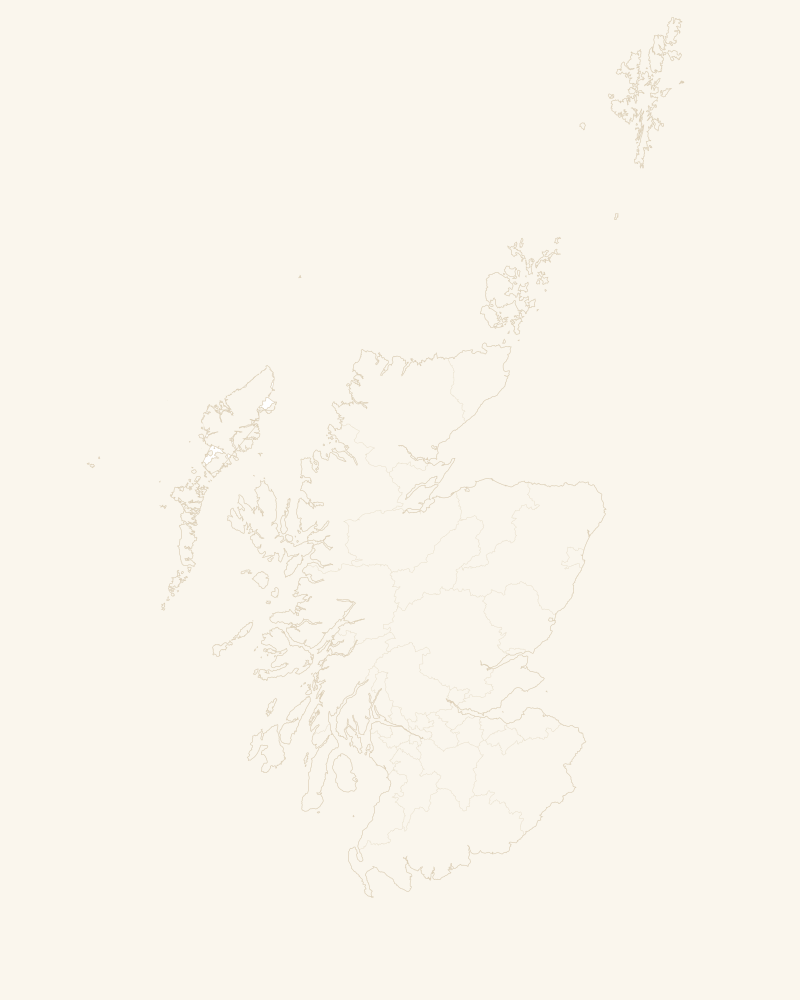
CoreHistoric reach
The seat of Clan Grant
Seat vacantChief
No one leads the Clan Grant community yet. When the movement opens, you can stand for its leadership, or help elect whoever does.
Current mission
No shared goal set yet. Once Clan Grant has leadership, it sets the public focus: a restoration, a gathering, a real-world project that helps its own.
The Grant clan is being rebuilt. Join the waiting list for the movement today, and you help decide who leads it and what it does.
Help rebuild the Grant clan →Motto
Stand fast
What does the Grant name mean?
Most likely from the Anglo-Norman French le grand, 'the great' or 'the tall', a byname carried north by a twelfth- or thirteenth-century incomer family. Gaelic tradition instead links the Grants to the ancient Siol Alpin kindred alongside the MacGregors. Whatever the root, by the fourteenth century the Grants were a settled Strathspey power, lords of Freuchie and, from 1694, of the regality of Grant.
The history of Clan Grant
Le Grand, and the sheriff who held Stratherrick
The chiefly line descends from Normans who arrived in Scotland during the medieval period bearing the French name le Grand, 'the tall' or 'the large'. The first Grants on record in Scotland appear in the thirteenth century, when they acquired the lands of Stratherrick, and the earliest of them who can be named held office rather than merely land: Sir Laurence le Grant, son of Gregory le Grant, was Sheriff of Inverness. That detail is worth more than the etymology, because it places the family inside royal administration in the north before they held a foot of Speyside.
A second origin ran alongside the Norman one and was never quite given up. The Grants, with the Mackinnons and the MacGregors, claimed descent from the Siol Alpin, the kindred of Alpin, father of the Kenneth MacAlpin who united the Scottish kingdom in 843. Such founder-claims were standard equipment for a powerful clan, and in practice the progenitors of clans can rarely be authenticated further back than the eleventh century, with an unbroken lineage traceable only from the thirteenth or fourteenth. What is documented is the wave the Grants belong to: by the fourteenth century Scotland had absorbed an influx of Norman, Anglo-Norman and Flemish kindreds, the Camerons, Frasers, Menzies, Chisholms and Grants among them, who became Highland chiefs by settling among Gaelic-speaking men who accepted their protection.
Dunbar, Bruce, and a Comyn castle taken by Grants and MacGregors
During the Wars of Scottish Independence the Grants were supporters of William Wallace, and two of them, John and Randolph Grant, were taken prisoner at the Battle of Dunbar in 1296. The clan afterwards backed Robert the Bruce in the competition for the Scottish Crown, and Bruce's victory confirmed the Grants in their lands of Strathspey. That confirmation was the making of them: Bruce introduced feudal tenures during the wars, awarding charters for land in order to harness the fighting prowess of the clans, so that Grant clanship became a tie of feudal obligation to the Crown as well as of local kinship.
The acquisition of Castle Grant followed in the fourteenth century. It had been a Clan Comyn stronghold, and tradition holds that it was taken from the Comyns by a combined force of Grants and MacGregors, the same kindred the Grants claimed as cousins in the Siol Alpin descent and would call on again in the wars of the 1580s. The lands of Ballindalloch in Banffshire, first held by the Ballindalloch family, passed to the Grants in 1499, and the Muckrach estate lay in Grant hands by the sixteenth century.
The Speyside estate was assembled by inheritance as much as by the sword. The next available reference to the family is Duncan le Grant in 1434, and after him Sir Duncan Grant of Freuchie, who inherited land in the Dulnain valley in upper Speyside from his mother, Matilda of Glencarnie. Her family had partially owned that ground since 1180, when the Crown gave Kinveachy, some ten miles south-west of Castle Grant, to Gille Brigte, Earl of Strathearn. The chiefs took their designation from Freuchie, and Freuchie Castle would not be renamed Castle Grant until 1694.
A commission to police Strathspey, and a champion sent to England
In 1535 James Grant, 3rd Laird of Freuchie, was made responsible for the policing of Strathspey, an appointment that turned the chief's private authority into a public one and made him answerable to the Crown for the good behaviour of the valley. By the sixteenth century the clan and its chief had become powerful enough to play a part in national politics, their main allies being the Clan Gordon, whose chief was the powerful Earl of Huntly.
The clan's standing was displayed abroad as well as at home. In 1580 Robert Grant, champion of the Grants, defeated an English champion at a jousting tournament while on an embassy in England. Ballindalloch became the family home of the Macpherson-Grants in 1546, a run of ownership unbroken since and the reason the castle is billed as the pearl of the north.
Ballindalloch, Darnaway, and the retreat that lost Glenlivet
Towards the end of the sixteenth century the Grants began to quarrel with their old allies the Gordons over religion, the Grants being Protestant and the Gordons Catholic. In 1586 the Earl of Huntly allied himself with the Clan MacDonald and the Clan Cameron, both of which had a history of raiding Grant lands. The Grants answered by bringing in the Clan Gregor, and came off worse in a clash at Ballindalloch.
The feud reached the castle gates four years later. In November 1590 Huntly came to Ballindalloch to arrest the Tutor; Freuchie joined with the Tutor's men and with the Earl of Moray at Darnaway Castle, where pistols and cannon fire killed John Gordon, brother of the Laird of Cluny, and deepened the quarrel between Huntly and Moray past mending. The clan's actions in this period resulted in the murder of the Earl of Moray and in the defeat of the Earl of Argyll at the Battle of Glenlivet in 1594, where the Chief of Clan Grant ordered his men to retreat as soon as the action began, a treacherous move that led directly to the defeat of Clan Campbell of Argyll.
Ballindalloch survived the feud and is still lived in. Its Z-plan core stands beneath eighteenth- and nineteenth-century extensions, in parkland through which both the Spey and the Avon run, held by the Macpherson-Grants and opened to visitors in summer.
Urquhart, Loch an Eilein, and the tower Patrick Grant built in 1598
In 1509 Urquhart Castle, on its headland over Loch Ness, was granted to the Grants. Founded in the thirteenth century and fought over through the Wars of Independence, it had passed from the Durward lords to the Comyns and become a royal castle raided repeatedly by the MacDonald Lords of the Isles. The Grants strengthened it against those continued MacDonald raids and held it for four centuries, until 1912. By the mid-seventeenth century it was largely abandoned, and in 1692 it was partly blown up to keep it out of Jacobite hands; its ruins are now among the most-visited in Scotland.
Loch an Eilein Castle, near Aviemore, came into Grant possession in 1567 and proved the more useful fortress. Jacobites attacked it after their defeat at the Battle of Cromdale in 1690 and were beaten off.
Muckrach is the best-dated Grant building of them all. The estate belonged in the sixteenth century to John Grant of Freuchie, laird of Clan Grant, who in 1583 passed it to his second son and heir Patrick Grant, later knighted by James VI and designated 'of Rothiemurchus'. Patrick had the tower house built in 1598 as the original seat of the Grants of Rothiemurchus, with timber used as part of the stone walls. Above the main portal a carved panel pairs the family arms and the date 1598 with the monograms of Patrick and Jean Grant and the inscription 'In God is al my Trest'. Unroofed in 1739, the L-plan tower stood ruinous into the twentieth century, was listed category A in 1971 for its standing as the first Rothiemurchus seat, and was restored by the architect Ian Begg between 1978 and 1985.
Sixteen thousand merks for sheltering MacGregors
In 1613 King James VI wrote to John Grant of Freuchie, chief of Clan Grant, complaining that he was sheltering outlaws of the Clan MacGregor on his ground. The chief responded by sending the notorious Alistair MacAllister MacGregor to Edinburgh. The King was not satisfied, and in 1615 he fined Grant 16,000 merks for protecting the MacGregors. The clan produced outlaws of its own in the same years: James Grant of Carron was driven outside the law in the early seventeenth century by a feud inside Clan Grant itself.
During the Wars of the Three Kingdoms of 1639 to 1651 the clan fought for the Covenant. Captain David Grant led his forces in support of the Covenanter army against the Royalists at the Battle of Tippermuir in 1644. In October 1645 the Clan Cameron raided Grant lands; the Grants gave chase and caught them at the Battle of the Braes of Strathdearn, where the Cameron men were defeated and many of their clansmen slain.
In 1651 James Grant, 7th of Freuchie and 18th Chief, led the clan as a Covenanter and suffered much as a result, before later supporting the Marquis of Montrose. An alliance between Grant and the Earl of Huntly in this period led to the annihilation of the Clan Farquharson.
The Highland King, Cromdale, and the company that became the Black Watch
In 1689 Ludovic Grant, 8th of Freuchie and 19th Chief, known as the 'Highland King', declared for William of Orange and afterwards supported the Hanoverian succession. Led by him, the majority of the clan were steadfast Loyalists. The Grants of Glenmoriston went the other way and stayed there, committed Jacobites throughout the period, fighting at the Battle of Killiecrankie in July 1689. The split ran through one surname, and it was still open in the '45.
The fighting reached the clan itself in May 1690, when Clan Grant provided the bulk of the Williamite force under Sir Thomas Livingstone that defeated the Jacobites at the Battle of Cromdale. In the rising of 1715 the main part of the clan again supported the British Government, though the Laird of Grant withdrew his forces in a manner that led to the defeat of government troops at the Skirmish of Alness. Soon afterwards the Grants helped retake Inverness from the Jacobites at the siege of that year. At Sheriffmuir in 1715 Grants fought on both sides, and when the government won, many of the Jacobites surrendered to General Alexander Grant, 2nd of Grant, 20th Chief.
General George Wade put the clan's fighting force at 850 men in 1715 and, in his report on the Highlands of 1724, at 800. In 1725 six Independent Highland Companies were formed to support the Government: one from Clan Grant, one from Clan Fraser of Lovat, one from Clan Munro and three from Clan Campbell. In 1739 ten such companies were regimented as the 43rd Highlanders, the Black Watch, so that a Grant company stands among the origins of that regiment.
Glenmoriston's war: Prestonpans, Culloden, and the ships to Barbados
In the rising of 1745 the Chief of Clan Grant supported the British Government, as did most of the clan, and once again withdrew his troops in a way that led to the defeat of government forces, this time at the Battle of Inverurie. The Grants of Glenmoriston made the opposite choice. They fought at the Battle of Prestonpans in 1745 and are credited with winning the day by the timeliness of their reinforcement, and they fought again at Culloden in 1746 under the command of the Duke of Perth.
Eighty-four Grants of Glenmoriston were captured at Culloden. In violation of the terms of their surrender they were transported to Barbados and sold there as indentured servants, a single branch of one Highland surname carried out of the country in a body.
The division was at its starkest at the Siege of Inverness in 1746, where the commander of the British-Hanoverian Government forces was Major George Grant while among the Jacobite commanders was Colonel James Grant. Two men of the name held opposite ends of the same siege lines.
The town built so the clansmen would not have to leave
Clan Grant was one of the few Highland clans not to be affected by the Clearances, and that was a decision, not an accident. The 'Good Sir James' Grant, chief from 1773 to 1811, built the town of Grantown-on-Spey for the express purpose of providing for his clansmen and keeping them from having to emigrate, founding it in 1765 and equipping it with schools, mills, factories, a hospital and an orphanage. Elsewhere in Gaeldom the opposite was happening: chiefs restricting the right of tacksmen to sublet, tacks auctioned to the highest bidder in plain breach of the principle of dùthchas, and the middle tier of Highland society emigrating with its capital. Grantown-on-Spey stands as a monument to Sir James's loyalty to his people.
The clan's manpower went into the army instead of the emigrant ships. Two regiments were raised from Clan Grant in the later eighteenth century: the Strathspey Fencibles, known as the Grant Fencibles, in 1793, disbanded in 1799; and the 97th Regiment of Foot, the Inverness-shire Highlanders or Strathspey Regiment, in 1794, which served as marines aboard Lord Howe's fleet before being drafted into other regiments in 1795.
Craigellachie, Duthil, and the returning member
The clan's crest is a burning hill, and it represents Craig Elachie, the Rock of Alarm above Strathspey. When signal fires were lit on its summit, the clansmen gathered there to organise an attack or a defence, which is what the motto Stand Fast is answering. The arms of Baron Strathspey, as matriculated by the 32nd Chief in 1950, are gules three antique crowns or, with the Nova Scotia baronet's inescutcheon in the dexter canton. The present chief is the Rt Hon The Lord Strathspey, Sir Michael Grant of Grant, Bt, 7th Baron Strathspey, 34th hereditary chief of the clan.
The name went abroad and kept coming back. On his world tour in 1877 Ulysses S. Grant came to Scotland and was accepted as a returning member of Clan Grant. In July 2012, visiting Winnipeg, the chief declared the Métis leader Cuthbert Grant a member of the clan, creating a new sept in Canada; people came to the events arranged for Lord Strathspey's visit from Scotland and from the Yukon, Montana and Manitoba, where Grant descendants had settled.
The stones have had a harder century than the name. Castle Grant, the chiefs' seat from the fifteenth century, was sold by the family in 1983 and passed the following year to a development company after the Clan Grant Society failed in its bid to buy it; in September 2014 it went to Sergey Fedotov, formerly head of the Russian Author Society, who was afterwards arrested for fraud, and its present owners, who bought it in 2022, are restoring the Z-plan tower house as their family home. The clan's gathering place is now Duthil Old Parish Church and churchyard outside Duthil in Inverness-shire, which serves as the Clan Grant Centre, holding memorials to clansmen including Field Marshal Sir Patrick Grant (1804-1895) and the mausoleum of the Earls of Seafield.
Historic Places, Rebuilt
Explore the streets and seats the Grant name knew, rebuilt with AI as they stood in history.
Historic Places, Rebuilt · New
The great castle guarding the Great Glen, newly granted to the Grants of Freuchie, whole above Loch Ness.
Historic Places, Rebuilt · New
The old castle above the River Ness, the market cross and the seven-arched bridge, on the eve of Culloden.
Castles the Grant held
Strongholds this name held for a decade or more, look one up, or rebuild it to explore.
- Urquhart Castle
Granted to the Grants in 1509, later the Earls of Seafield, and held for centuries.
- Castle Grant
Main stronghold and seat of the chiefs of Clan Grant from the fifteenth century until the family sold it in 1983; renamed from Freuchie Castle in 1694.
- Ballindalloch Castle
The lands passed to the Grants in 1499.
- Muckrach Castle
Built in 1598 by Patrick Grant as the original seat of the Grants of Rothiemurchus, a branch of Clan Grant.
Castles that share the Grant name
The same name on the map, look one up, see what it looked like in its prime, and recreate it to explore.
 Palace of the Grand Master of the Knights of RhodesRestored · prime 1480
 Castle GrantRestored · prime 1694
All castles in Scotland → · Strongest castles in Scotland → · Castles of Europe
Play As Your Clan
Hold a real castle against whatever you choose to send at it, take a ship out in her own service years, or stand at the shoulder of someone the record remembers. The chronicler sets the scene; the deeds are yours.
Notable bearers of the Grant name
- Sir James Grant of Grant (1738–1811), founder of Grantown-on-Spey
- Ulysses S. Grant (1822–1885), Union general and US President
- Duncan Grant (1885–1978), Bloomsbury painter
- Hugh Grant (b. 1960), actor