Clan Davidson
also Clan Davidson, Mac Dhàibhidh
Sons of David, Clan Chattan of Strathspey.
- Origin
- The Highlands & Islands, Scotland
- Motto
- Sapienter si sincere
- Famous bearer
- Arthur Davidson (1881–1950), co-founder of Harley-Davidson Motor Company
- Register
- Scottish clan
The Davidson arms, crest badge, tartan and country

Crest badgeClan member crest badge - Clan DavidsonCeltus · CC BY-SA 3.0 
TartanDavidson tartanMicheletb · CC BY-SA 4.0 
TartanDavidson Half Tartan, Modern“Modern” colours: the deeper shades chemical dyes produced from the 1860s. The same pattern, not a newer one.Unknown author Unknown author · Public domain 
Coat of armsDavidson of Davidson armsBorne by the Davidson line, one branch of the name rather than all of it.Czar Brodie · CC BY-SA 3.0


- Crest badge: The chief's crest inside a belt and buckle: the badge a clansman wears to show whose following he is in.
- Tartan: The checked cloth the family is known by.
- Coat of arms: Granted to an individual and inherited down that one documented line. These are the arms of particular families of the name, not of everyone who shares the surname.
What is the Davidson clan tartan?
Two Davidson setts are shown above, one of them the same pattern in “modern” colours, the deeper shades chemical dyes gave from the 1860s. They are not rival claims to be picked between; they are different records, and different weaves, of the same family cloth. A sett is the block of coloured bands the cloth is built from, repeated in both directions; the whole plaid is that one square enlarged.
Almost no clan tartan is medieval. Highland dress was proscribed from 1746 until 1782, and when it returned it returned as ceremony rather than everyday cloth, so the surname-to-sett map was fixed after the break, by the Bannockburn weavers’ pattern books, the royal visit to Edinburgh in 1822, and the Vestiarium Scoticum of 1842. The Davidsons wore tartan long before any of that. What the registers fixed was which one. Nobody polices any of it. Wearing the Davidson sett declares allegiance to the name, not descent from any particular line of it.
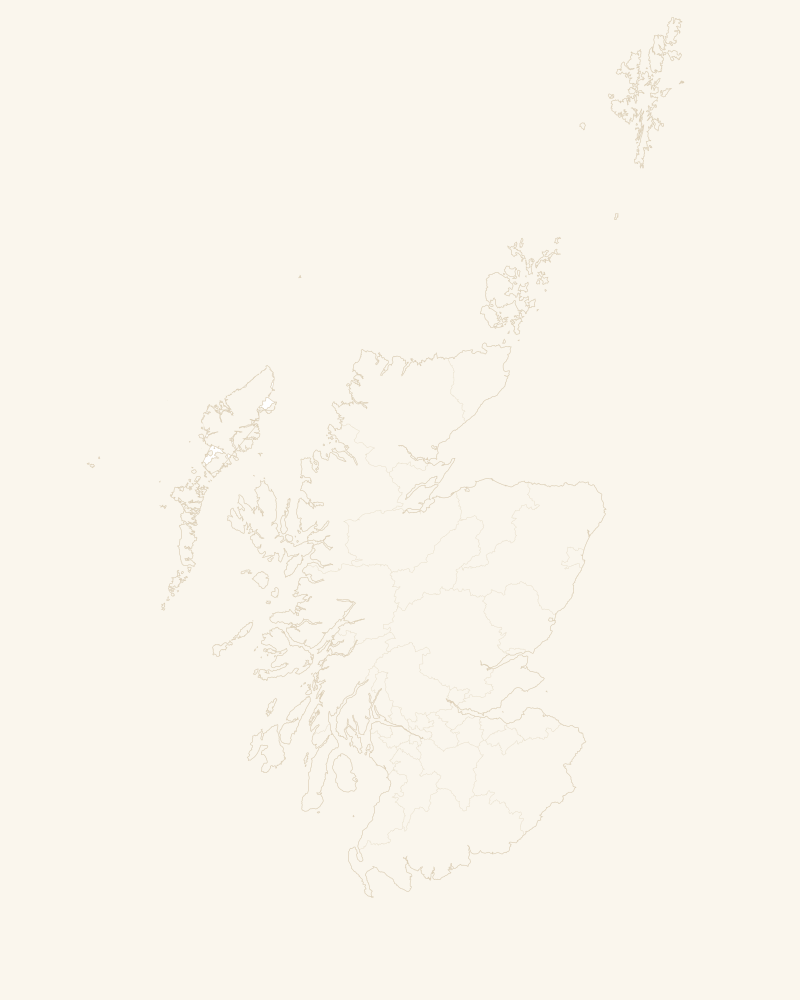
CoreHistoric reach
The seat of Clan Davidson
Seat vacantChief
No one leads the Clan Davidson community yet. When the movement opens, you can stand for its leadership, or help elect whoever does.
Current mission
No shared goal set yet. Once Clan Davidson has leadership, it sets the public focus: a restoration, a gathering, a real-world project that helps its own.
The Davidson clan is being rebuilt. Join the waiting list for the movement today, and you help decide who leads it and what it does.
Help rebuild the Davidson clan →Motto
Sapienter si sincere
“Wisely if sincerely”
What does the Davidson name mean?
Patronymic, son of David. The eponymous David is held by clan tradition to be David Dubh of Invernahavon, a son of Muriach Cattanach in the 13th century, making the Davidsons a sub-sept of Clan Chattan, the great Highland confederation centred on the Mackintoshes. The clan's territory was the Badenoch district of upper Strathspey, around modern Newtonmore. The Davidson chiefs were an inner-circle Clan Chattan family until they were nearly destroyed in 1370 at the Battle of Invernahavon, after which the surviving Davidsons reorganised under the Mackintosh banner.
The history of Clan Davidson
Mac Dhaibhidh, and three accounts of who David was
The name is a patronymic in its plainest form, son of David, anglicised in the Highlands from the Gaelic mac Daibhidh, the given name itself carrying the sense of the beloved one. In Gaelic practice that formula attached to a kindred, not a household: clan surnames were borne by the descendants and dependants of an ancestor rather than by everyone who lived in a clan's territory, and only when a non-Gaelic-speaking administration began recording the Highlands were such names applied wholesale to a district. The Davidson country was Badenoch, in upper Strathspey around what is now Newtonmore, and the affiliation was Clan Chattan, the confederation whose captaincy lay with the Mackintoshes.
Which David the name remembers is genuinely disputed. William Skene, in Celtic Scotland, has the Davidsons co-founding the Chattan confederation together with the Macphersons, the two making up what is called Old Clan Chattan, and traces the family to a son of Gilliecattan Mhor, chief of Clan Chattan in the 11th to 12th century. Sir Aeneas Macpherson, John Burk and William Anderson descend them instead from a younger son of Muriach, parson of Kingussie, who became captain of Clan Chattan on his brother's death, obtained a papal dispensation in 1173 and married a daughter of the Thane of Cawdor. Of that marriage's five sons the one who matters is David Dow, David the Black, whom Burk makes the fifth son and Anderson the fourth, and from him the Davidsons of Invernahavon are said to descend.
A third account, the Kinrara manuscript, cuts the line somewhere else entirely. It descends the family from David Dubh of Clan Cumming, and names as first chief a David who married Slane Mackintosh, daughter of the sixth chief of Clan Mackintosh and of the confederation. That David's father is given as Donald, third son of Robert Comyn, a grandson of John III Comyn, Lord of Badenoch, and on this reading the followers came to be called Clan Dhai because the Comyn name had been proscribed in 1320. Clan tradition itself holds to David Dubh of Invernahavon, son of Muriach Cattanach, in the 13th century. Three accounts point three ways, and no charter closes the argument.
Invernahavon, 1370: the quarrel over the right of the line
The battle that shaped everything afterwards was fought about 1370 at the confluence of the river Truim and the Spey. On the field it was the Chattan confederation against Clan Cameron. Inside the confederation it was something else: the Davidsons and the Macphersons, both Chattan families, disputed which of them was entitled to command the right wing. The Mackintoshes, as chiefs of the confederation, found for the Davidsons, and the Macphersons withdrew from the field rather than accept it.
The Camerons took the opening. With the Macphersons standing off, the Davidsons bore the fighting and were, in the flat phrase of the record, wiped out as a fighting force. The Macphersons did eventually come in and the Camerons were beaten, so the confederation ended the day holding the ground. The family that had won the argument over precedence had been all but destroyed by winning it.
What followed was slow. The Davidsons reformed under continued Clan Chattan affiliation, and the chief was recognised as a sub-chief of Mackintosh into the modern era, a standing that says plainly what Invernahavon had cost: an inner-circle Chattan family came out of it a dependent one.
Thirty against thirty on the North Inch
In 1396 thirty men a side met on the North Inch at Perth. Most of the evidence makes it Clan Cameron against Clan Chattan, the Chattan thirty drawn from a confederation that included both Davidsons and Macphersons. Lowland accounts tell it differently, as a fight between the rival Davidsons and Macphersons themselves.
The two readings cannot both be right and the sources do not resolve it. That the North Inch continued the Davidson and Macpherson quarrel is the tradition the family carries, but the record is contested rather than decided. What is firm is the year, the place, the thirty a side, and that Clan Chattan was one of the parties.
After the North Inch the chief of Clan Davidson is said to have moved north, and it is from that move that the two later houses appear, the Davidsons of Cantray and the Davidsons of Tulloch. The weight of the name shifted off the Badenoch braes towards Inverness and the Ross-shire coast.
The provost who died at Harlaw, and the burgh Davidsons
In 1411 Robert Davidson, Provost of Aberdeen, was killed at the Battle of Harlaw leading the Burgesses of Guild of Aberdeen against Donald of Islay, Lord of the Isles. It is a particular kind of Davidson: not a Highland chief bringing out a following, but the head of a burgh council marching its merchants and craftsmen out to stop an army. A suit of armour said to have been worn by the provost at Harlaw is preserved by the local city council.
The name spread with the burghs. By the 16th century Davidsons could be found from Ayr in the south to Aberdeen in the north. Tradition holds that in the 15th century the Davidson chief and some of his followers settled at a property called Davidston, in the parish of Cromarty on the Black Isle, and that Davidston was sold in the 18th century when the chief bought the estate of Tulloch in Ross-shire.
The documented Cromarty line begins later, and in the council chamber. Donald Davidson and Alexander Davidson are the first Davidsons recorded there, living in the new town and listed as in the council in July 1670. Another Alexander, known as Clerk Davidson, was town clerk of Fortrose and married Elizabeth Bremmer, second daughter of a burgess of Fortrose, in November 1689. From that Alexander descended the Davidson lairds of Tulloch Castle, who became chiefs of the clan: the chiefship came back through burgh office and a clerk's marriage rather than through a Highland lordship.
Tulloch Castle: bought in 1762, out of Davidson hands by 1917
Tulloch was old before any Davidson held it. It dates at least to the late 14th century, when it was the birthplace of Mariota Leslie, daughter of Euphemia I, Countess of Ross, and wife of Donald Macdonald, Lord of the Isles. In 1542 Duncan Bane was granted a charter of the lands, and the Bains of Tulloch held the estate until Kenneth Bayne, eighth laird, sold it to his cousin Henry Davidson in 1762.
That purchase gave the clan a seat again. Tulloch Castle became the seat of the chiefs of Clan Davidson in the 18th century, and the family held it until 1917, when Duncan Davidson, eleventh baron, died and left castle and barony to his daughter and her son, Colonel Angus Vickers of the Vickers aircraft company. The clan's own account says only that the castle was later sold by the Davidsons; the castle record has it passing by bequest in 1917. The two versions of how it left Davidson hands sit unreconciled. What is not in doubt is that the building was extensively restored by Robert Lorimer in 1922.
The later life of the place maps the century. It served as the Vickers family home, then as a hospital for casualties of Dunkirk in 1940, then was bought by the local education authority in 1957 and used as a hostel. It fell into disrepair, and was renovated and converted into a hotel by a local family, the MacAulays, in 1996. In October 2007 it hosted the official Clan Davidson Gathering. The barony has continued on its own track, transferred in 2016 by deed of disposition to Dr David Willien, the current baron of Tulloch, while the grounds still hold a small family cemetery and walled gardens.
Transported to a Hornet's Nest
In the 18th century members of the Clan Chattan confederation, many Davidsons among them, were convicted of Jacobitism and transported to the North American colonies. Transportation was meant as an ending; it worked as a beginning. On gaining their freedom many of these convicts settled in the Piedmont Mountains of North Carolina and raised families there, and by the time of the American Revolution the British had come to call the district a Hornet's Nest of rebels.
The most notable of the Davidsons who fought that war was Brigadier General William Lee Davidson (1746-1781), a North Carolina militia general killed in action at the battle of Cowan's Ford; Davidson College carries his name. Others took the same crossing to other ends: William Davidson (1740-1790), a Scottish settler in Canada who worked as a lumberman; William Davidson (1778-1857), who sat in the United States House of Representatives for North Carolina; and William Soltau Davidson (1846-1924), a New Zealander who pioneered refrigerated shipping.
The diaspora eventually took the chiefship with it. Duncan VI of Tulloch died in 1917, and the chiefship then stood vacant and disputed until 1997, when it was filled by Duncan Davidson of Davidston, in New Zealand, followed by Alister Davidson of Davidston from 1998 to 2014 and by Grant Guthrie Davidson, third of Davidston, from 2015. The gap mattered in law as well as in sentiment: under Scots law a group without a chief recognised by the Sovereign through the Lord Lyon has no official standing. Through the vacancy the name was held together by its association, formed as the Clan Dhai Association in 1909 and still very active.
From a Leith timber yard to Lambeth Palace
Randall Thomas Davidson was born in Edinburgh on 7 April 1848, eldest of seven children of a Leith timber merchant, and raised in the Scottish-Episcopalian world of the city. He was schooled at Harrow and went up to Trinity College, Oxford in 1867 to read classics, taking his degree in 1871. Ordained deacon in 1874 by Archibald Campbell Tait, then Archbishop of Canterbury, and priest in 1875, he served a curacy at Dartford before being appointed Tait's resident chaplain at Lambeth Palace in 1877. He married Tait's daughter Edith in 1878.
The twenty-six years that followed, through three successive Archbishops of Canterbury, were a continuous apprenticeship at the political centre of the Church of England. He was made Dean of Windsor in 1883, Bishop of Rochester in 1891, and translated to Winchester in 1895, the English bishopric below Canterbury, which set him inside the Edwardian episcopal establishment.
He took the see of Canterbury in 1903 and held it for twenty-five years, the longest single Archbishopric of Canterbury since the Reformation, serving across the reigns of Edward VII and George V. He wrote the prayers for the coronations of Edward VII in 1902 and George V in 1911, took a moderate ecumenical line through the Irish settlement of 1919 to 1923, and did the senior pastoral work of the First World War: he visited the Western Front in 1916, conducted communion at the advanced-aid stations of the Somme, and wrote the Lambeth Palace pastoral letters that ran across the whole Anglican communion. He retired in 1928 and was raised to the peerage as Baron Davidson of Lambeth, the first Archbishop of Canterbury to take a peerage on retirement. He died at Chiswick on 25 May 1930 and is buried in the cloister garth at Canterbury Cathedral.
The name has kept working since. Arthur Davidson (1881-1950) founded the Harley-Davidson Motor Company at Milwaukee in 1903 with William S. Harley, alongside Walter Davidson and William A. Davidson, and it is still producing under the Davidson name a century later; Willie G. Davidson, born 1933, designed the Super Glide. Donald Davidson (1917-2003), born at Springfield, Massachusetts, was the foremost American philosophical analyst of the later 20th century after Quine, and Bruce Davidson, born 1933 at Oak Park, Illinois, made the East 100th Street and Brooklyn Gang photographic series. The Scottish poet John Davidson (1857-1909) and the Irish inventor Samuel Cleland Davidson (1846-1921), founder of the Belfast Sirocco Works, carried it in other directions.
Champions of the Davidson name
The bearers whose lives are inseparable from this surname. Each has their own page, biography, achievements, geography, connection to the family.
Historic Places, Rebuilt
Explore the streets and seats the Davidson name knew, rebuilt with AI as they stood in history.
Historic Places, Rebuilt · New
The old castle above the River Ness, the market cross and the seven-arched bridge, on the eve of Culloden.
Historic Places, Rebuilt · New
The great castle guarding the Great Glen, newly granted to the Grants of Freuchie, whole above Loch Ness.
Castles the Davidson held
Strongholds this name held for a decade or more, look one up, or rebuild it to explore.
- Tulloch Castle
Held by the Davidsons of Tulloch, 1762–1917.
The castles of the homeland
The great strongholds of the homeland, look one up, see what it looked like in its prime, and recreate it to explore.
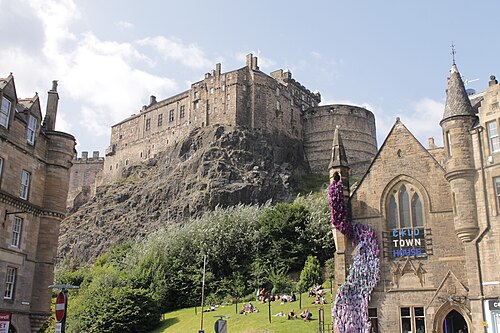 Edinburgh CastleRestored · prime 1520
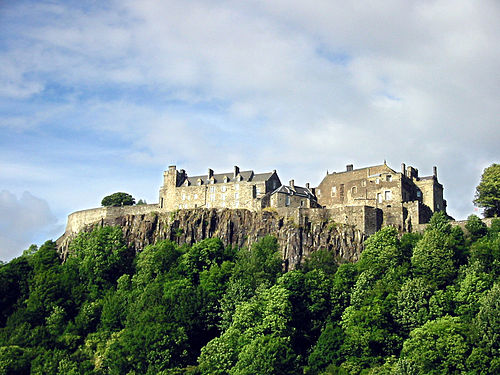 Stirling CastleRestored · prime 1542
 Glamis CastleStill standing · prime 1900
All castles in Scotland → · Strongest castles in Scotland → · Castles of Europe
Play As Your Clan
Hold a real castle against whatever you choose to send at it, take a ship out in her own service years, or stand at the shoulder of someone the record remembers. The chronicler sets the scene; the deeds are yours.
Notable bearers of the Davidson name
- Arthur Davidson (1881–1950), co-founder of Harley-Davidson Motor Company
- Donald Davidson (1917–2003), American philosopher of language
- Bruce Davidson (b. 1933), photographer (East 100th Street, Brooklyn Gang)