Müller
also Mueller, Möller, Müllner
The miller, and the mill was the village's first machine.
- Origin
- German
- Famous bearer
- Gerd Müller (1945–2021), record-breaking footballer
- Register
- German family
The Müller arms

Coat of armsMüller Coat of ArmsIlma.Bogdan · CC BY-SA 4.0

- Coat of arms: Granted to an individual and inherited down that one documented line. These are the arms of particular families of the name, not of everyone who shares the surname.
The seat of Müller
Seat vacantChief
No one leads the Müller community yet. When the movement opens, you can stand for its leadership, or help elect whoever does.
Current mission
No shared goal set yet. Once Müller has leadership, it sets the public focus: a restoration, a gathering, a real-world project that helps its own.
The Müller clan is being rebuilt. Join the waiting list for the movement today, and you help decide who leads it and what it does.
Help rebuild the Müller clan →What does the Müller name mean?
The miller, who ran the mill, Middle High German müller, from the Latin molinarius. The Low German north softens it to Möller; the south and Switzerland keep Müller. Exact cognate of English Miller and Dutch Mulder.
The history of Müller
The mill crosses the Rhine and the Danube
The German mill has a written history far older than the German surname. Ausonius, in his fourth-century poem Mosella, refers to water-powered marble saws in what is now Germany, machines on the Moselle cutting stone while the frontier was still Roman. Watermills were well established in Ireland by the early seventh century, and a century later they began to spread across the former Roman Rhine and Danube frontier into the other parts of Germany. By Carolingian times, references to them in Frankish records had become innumerable.
The machine came first; the name came far later. Müller is Middle High German müller, from the Latin molinarius, and the spellings still map onto the dialects that made them. The Low German north softens it to Möller, shared with the Netherlands; the south, Austria and Switzerland keep Müller and also produced Miller outright. Müllner is another variant. Where a family emigrated to a country with no umlaut on the typewriter, the ü was written out as ue in the ordinary German fashion, and the family became Mueller.
What the man in the Mühle actually knew
A mill was not a shed with a wheel on it. It was hydraulic engineering a village trusted to one man. Inside, the wheel's shaft turned a pit wheel meshing with the wallower, which turned the great spur wheel, which drove a stone nut, which drove the runner stone balanced on its rynd above the fixed bedstone. Every step raised the gear ratio, so the stones ran faster than the water ever did. Tentering (adjusting the gap between the stones while the mill ran, by the water flow, the grain and the grade of flour wanted) was pure judgement, and it lived in one family's hands.
Nor was flour the whole of it. Water power drove sawmills, fulling mills, oil mills, paper mills, powder mills, bark mills for the tanneries, and the forges and blast furnaces which, before the steam engine, were almost invariably water powered. The man who understood gearing held the only concentrated power in the district.
The lord's mill, and how long it lasted in the German east
The mill sat inside the manorial order as a revenue stream before it was a service: a lord's income included the charges he levied for the use of his mill, his bakery and his wine-press. That is the world the byname Müller formed in: a man holding a valuable and closely watched piece of somebody else's property.
Where the German story parts from the French is in how long it lasted. The last feudal dues in France were abolished at the Revolution; in parts of eastern Germany the Rittergut manors of the Junkers survived until the Second World War. Manorialism outlived feudalism because it did not much care who it fed; it could maintain a warrior equally well as a capitalist landlord. East of the Elbe the mill went on being somebody's asset long after a French miller had stopped paying for the privilege.
Why there are so many Müllers and no Müller family
German surnames became heritable around 1600, with the beginning of central demographic records, and the ten commonest names in Germany today are, without exception, occupational: Müller, Schmidt, Schneider, Fischer, Weber, Meyer, Wagner, Schulz, Bauer, Becker. They are common precisely because they arose independently, over and over, across the German lands. There is no ancestral Müller. There are thousands of unrelated first Müllers, each simply the man at the mill in his own valley.
This happened in a Germany with no single crown and no single register. Guild privilege rested on charters granting monopolies within one locality, and even the institution's name varied: Zünfte in one town, Gilden in the next. So did the trades: a barrel-maker in Hamburg was a Böttcher, the same man in Bavaria a Schäffler. Müller is the exception. Most trades fractured into a dozen regional words; the miller did not, because the machine and the job were the same wherever water fell, and where it did not fall, on flat ground with slow rivers and winters that froze them, the windmills went up instead.
The mill that had a name before the family did
There is a German layer beneath the surname that most name books miss. Long before street names and numbers, important buildings (inns, mills, farmsteads) carried names of their own, Hausnamen or Hofnamen. Rothschild is a red sign, Lachs a salmon, Bär a bear. A house name could be welded onto a trade, which is how Kindlmüller arose: the man at a mill named for the Christmas child or the king's child.
Because impartible inheritance tied a Hof to direct patrilineal descent over centuries, the Hofname was the first kind of commoner's family name in German-speaking Europe to become heritable, in the fourteenth and fifteenth centuries, generations ahead of surnames generally. Ulrich Zwingli, born 1484, inherited his father's surname, itself in origin a Hofname, though he never inherited the estate behind it. Where Nachname and estate name diverged, documents joined them with genannt, or vulgo in Austria. A Müller carrying such a name carries a building as well as a trade.
The commonest name in three countries
Counting spellings together, Müller and Möller are borne by about 0.83 per cent of the German population, second only to the Schmidt, Schmitt, Schmitz and Schmied cluster at 0.87 per cent. Counted as separate spellings, Müller stands first outright. It is the most common family surname in Germany and in Switzerland, and the most common in the French departments of Bas-Rhin and Moselle; in Austria it is fifth.
German law records the consequence in the driest possible terms. The Namensänderungsgesetz permits a change of name for an important reason, and among the recognised grounds (beside a name too long, too hard to spell, or inviting ridicule) is one that is simply too common, with Müller and Schmidt given as the examples. Such applications are very rarely granted. The Müllers stay Müllers.
Where the Müllers went
The miller was among the most sought emigrants of all: a new settlement's first public act after raising a church was often to dam a stream and build a mill, and a man who could cut the gearing and keep it turning was worth courting across an ocean. Müllers who crossed in the great eighteenth- and nineteenth-century waves built and ran the grist mills of Pennsylvania, the Midwest and the Canadian prairie. Many anglicised to Miller on arrival (the same trade, renamed) while others became Mueller, which is why American public life carries names like Robert Mueller (1944–2026), Director of the FBI. The name went east as readily as west: the Czech and Slovak feminine form is Müllerová, and Herta Müller, born 1953, is a Romanian-born German novelist and Nobel laureate in Literature. Ferdinand von Mueller (1825–1896) was the German-Australian botanist; Mary Müller (1819–1901) the New Zealand pamphleteer who wrote as Fémmina; George Müller (1805–1898) the evangelist and orphanage director. At home the name carries Heiner Müller (1929–1995), the playwright, and Gerd Müller (1945–2021), the record-breaking footballer.
A name this common belongs to no one side of a national history, and it would be dishonest to pretend otherwise. The Müllers of the twentieth century include Josef Müller (1898–1979), a member of the German Resistance, Joseph Müller (1894–1944), a Catholic priest and critic of the Nazi regime, and Filip Müller (1922–2013), a Holocaust survivor; and Heinrich Müller (1900–1945), head of the Gestapo. That range is the truest thing about the name. It was never a lineage or a faction. It was the man at the mill, in every German valley at once, and his descendants went everywhere.
The same name across Europe
Müller shares its meaning, not its bloodline, with these names from other corners of Europe: cognates, the same word for the same thing, formed independently in each language. Cousins by meaning, with separate ancestral stories a search box flattens into near-twins.
The castles of the homeland
The great strongholds of the homeland, look one up, see what it looked like in its prime, and recreate it to explore.
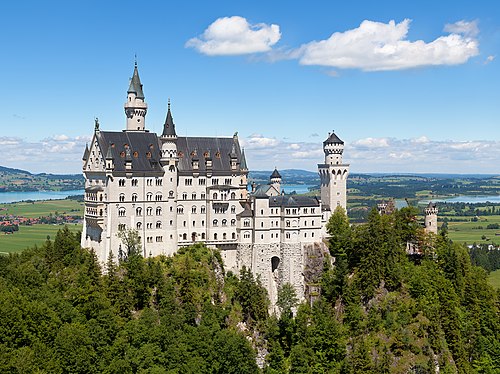 Neuschwanstein CastleStill standing · prime 1886
 Hohenzollern CastleRestored · prime 1867
 Eltz CastleStill standing · prime 1615
All castles in Germany → · Strongest castles in Germany → · Castles of Europe
Play As Your Clan
Hold a real castle against whatever you choose to send at it, take a ship out in her own service years, or stand at the shoulder of someone the record remembers. The chronicler sets the scene; the deeds are yours.
Notable bearers of the Müller name
- Gerd Müller (1945–2021), record-breaking footballer
- Heiner Müller (1929–1995), playwright