
Stadium · England · Partial ruin
Arsenal Stadium
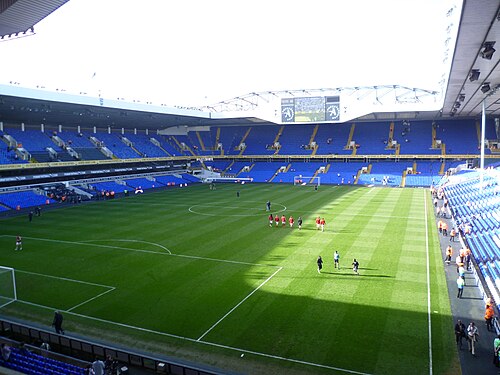
Arsenal Stadium, commonly known as Highbury, was a football stadium in Highbury, London that served as Arsenal Football Club's home from 1913 to 2006. The ground comprised four stands around a compact rectangular pitch and was noted for its Art Deco East and West Stands and the clock on the southern end.
First raised
1913
Its prime
1993
Today
Partial ruin
As it stood in 1993
What Arsenal Stadium looked like in its prime.
Cream-coloured Art Deco facades with deep vertical window recesses and red-painted sash shutters and doors; large block-letter signage reading 'ARSENAL STADIUM' across the upper frontage and a cannon relief on the southern facade. Flat roofline with simple metal railings, tall narrow window bays, terrazzo/marble-floored internal halls, and a compact rectangular grass pitch tightly enclosed by four stands whose exteriors are stuccoed and punctuated by regular pilasters and tall, narrow windows.
Its story
The story of Arsenal Stadium.
Norris's Lease at Highbury, 1913-1927
Woolwich Arsenal's chairman Henry Norris moved the club from the Manor Ground in Plumstead to Highbury in 1913, leasing the recreation fields of St John's College of Divinity for 21 years at £20,000. The lease, signed by the Archbishop of Canterbury Randall Davidson, barred matches on holy days and the sale of intoxicating liquor; both stipulations were later dropped.
Archibald Leitch designed a stadium hurriedly built over the summer of 1913 (a single stand on the eastern side, banked terracing on the other three) at a cost of £125,000. It opened unfinished on 6 September 1913 for a Second Division match against Leicester Fosse, won 2-1; Leicester's Tommy Benfield scored the first goal at the ground and George Jobey the first for Arsenal. Highbury held its first England match in 1920, and an England rugby league side beat Australia there 5-4 before 12,000 spectators in October 1921. The club bought the site outright in 1925 for £64,000, and its match against Sheffield United on 22 January 1927 was the first football match broadcast on radio.
The Art Deco Rebuild, 1932-1936
The West Stand, designed by Claude Waterlow Ferrier and William Binnie in the Art Deco style, opened in 1932; on 5 November that year Gillespie Road tube station was renamed Arsenal after persuasion by the manager Herbert Chapman, and the ground's own name changed from Highbury to Arsenal Stadium. Chapman then installed a 45-minute clock on the North Bank, over the Football Association's concern that it would undermine the referee's authority.
The North Bank terrace was roofed in 1935 and the clock moved to the front of the southern terrace, which took the name the Clock End. Leitch's main stand came down in 1936 for an East Stand matching the West, which ran far over budget at £130,000 against the West's £45,000. The largest attendance recorded there, 73,295, watched a goalless First Division match against Sunderland on 9 March 1935, and England's 3-2 win over the world champions Italy in 1934, the Battle of Highbury, saw a record seven Arsenal players start, the most from one club in an England fixture.
ARP Station, Floodlights and the Taylor Report, 1939-1993
The stadium served as an ARP station in the Second World War and was bombed, the North Bank terrace having to be rebuilt; Arsenal played at Tottenham Hotspur's White Hart Lane until Highbury reopened in 1946, and the North Bank roof was not restored until 1956. The ground held two matches in the 1948 Olympic football tournament. Arsenal fitted floodlights in 1951, the first Division One club to do so, after the Football Association lifted its ban on floodlit matches in December 1950; undersoil heating followed in 1964. The club refused to install perimeter fencing even at the height of hooliganism in the 1980s, which kept it off the FA's approved semi-final venues from 1984 to 1992.
The Taylor Report of January 1990 on the Hillsborough disaster recommended all-seater grounds; before it the North Bank and Clock End were terracing. The Clock End had been given a roof and 48 executive boxes in 1988-89, with seating fitted into its remaining standing area in 1993. The North Bank was demolished at the end of the 1991-92 season, leaving Highbury three-sided through 1992-93, the first FA Premier League season, in which Arsenal finished tenth but won both domestic cups. Its two-tier replacement opened in August 1993 at a cost of £20 million.
The Move to Ashburton Grove and Highbury Square, 1999-2010
Capacity after the Taylor Report was 38,419, and with almost every match filled to near capacity, the listed East Stand and the housing pressed against all four sides made expansion difficult and expensive. In November 1999 Arsenal decided to leave for a 60,000-seat ground at Ashburton Grove, confirmed in October 2004 as the Emirates Stadium under a sponsorship deal with the airline.
For the final season, 2005-06, the club set aside its red shirts with white sleeves for the solid redcurrant of its first Highbury season in 1913-14. The last match, against Wigan Athletic on 7 May 2006, was won from 2-1 down by a hat-trick from the captain Thierry Henry that secured Champions League qualification, Henry kneeling to kiss the turf.
The North Bank and Clock End were demolished and the site became Highbury Square, a scheme of 711 properties; the exteriors of the Grade II listed Art Deco East Stand and the matching West Stand were preserved and incorporated into the flats, and the pitch became a communal garden. The clock went to the new stadium, where a larger version was unveiled inside the ground in August 2010 and the south stands took the name Clock End.
Step inside
8 places to explore in 1993.
The record describes 8 distinct spots at Arsenal Stadium, including 3 interiors: north bank stand seating bowl (interior), north bank concourse and museum (interior), east stand marble (terrazzo) halls (interior). Create your own photoreal reconstruction and explore every one, more scenes means more photos, more angles and more of the immersive experience.
Build Your Own Castle
Recreate Arsenal Stadium with AI to explore it.
Rebuilds stop at 1945, so the artist raises this site as it stood in 1936, not today's building, as a photoreal reconstruction that belongs to you alone. Pay with coins, no subscription needed.
Recreate Stadium to Explore →Nearby
Castles within reach of Arsenal Stadium.


Landmarks within reach of Arsenal Stadium.


More landmarks of England


Explore the city


