Theatre · England · Still standing
Royal Albert Hall
The Royal Albert Hall is an oval Victorian concert hall on the northern edge of South Kensington, London, built as a memorial and public performance venue. The building is a large red-brick drum capped by a glazed wrought-iron dome and encircled by a continuous terracotta mosaic frieze and inscription band. It houses a vast central auditorium with multiple tiers of seating and numerous ancillary rooms and porches around its perimeter.
First raised
1871
Its prime
1871
Today
Still standing
As it stood in 1871
What Royal Albert Hall looked like in its prime.
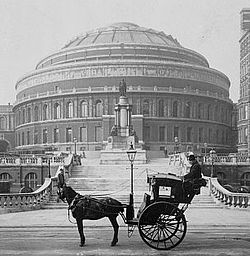
An enormous elliptical drum of warm Fareham red brick with pale terracotta decoration and a continuous mosaic frieze encircling the top; a band of large terracotta letters runs above the frieze. Three tiers of arcaded windows and shallow pilasters pierce the brickwork. The whole is roofed by a low, broad wrought-iron and glass dome with visible iron ribs. Stone porches and broad balustraded steps lead up to the entrances, the building dominating the street scale.
Its story
The story of Royal Albert Hall.
From the Great Exhibition to Royal Albert Hall, 1851–1871
The 1851 Great Exhibition in Hyde Park, organised by Prince Albert, was a success that led him to propose a permanent group of public facilities on the site, later known as Albertopolis. The Exhibition's Royal Commission bought Gore House but acted slowly, and Albert died in 1861 without seeing his plan realised; a memorial was then proposed for Hyde Park with a Great Hall opposite it. The site was purchased with profits from the Exhibition, and the hall was designed by Captain Francis Fowke and Major-General Henry Y. D. Scott of the Royal Engineers, built by Lucas Brothers of Fareham Red brick with terracotta decoration, and influenced by ancient amphitheatres.
Queen Victoria laid the foundation stone in 1867 and renamed the building, planned as the Central Hall of Arts and Sciences, the Royal Albert Hall of Arts and Sciences, in memory of her husband. Its wrought-iron and glass dome, designed by Rowland Mason Ordish, was trial-assembled in Manchester before being carted to London; when the supporting scaffold was finally struck, only volunteers stayed on site in case it collapsed, and the dome settled by just five-sixteenths of an inch. The hall opened on 29 March 1871; Victoria, too overcome to speak, had the Prince of Wales deliver the welcome, and her only recorded comment was that the building reminded her of the British constitution.
An Unsolved Echo, 1871–1969
The first concert exposed a strong acoustic echo that engineers tried to remove with a canvas awning slung below the dome; it eased the problem and shaded concertgoers from the sun but did not cure it, and it was said the hall was the only place a British composer could be sure of hearing his work twice. The awning was replaced with fluted aluminium panels in 1949, and the echo was not properly addressed until 1969, when large fibreglass acoustic diffusers, nicknamed 'mushrooms' or 'flying saucers', were hung beneath the ceiling.
Wartime Bombing and a New Home for the Proms, 1941–1945
In 1941, after an air raid destroyed the Queen's Hall, the Royal Albert Hall became the new home of the Proms, the annual season of promenade concerts founded in 1895. In October 1942 the hall itself suffered minor bomb damage but was largely spared because German pilots used its distinctive shape as a landmark; by 1944, with danger to the hall judged to have increased, part of that year's season was moved to the Bedford Corn Exchange. The Proms returned fully after the war and have been held at the hall every summer since.
Statesmen, a Colour Bar and a Restored Licence, 1918–2019
The hall hosted meetings by suffragettes, exhibition boxing bouts by Muhammad Ali, and speeches by Winston Churchill and Charles de Gaulle. In 1933 the physicist Albert Einstein led the hall's 'Einstein Meeting' for the Council for Assisting Refugee Academics, a British charity.
The hall first hosted boxing in 1918, in a tournament between British and American servicemen, but a colour bar between 1923 and 1932 barred black boxers from fighting there. Frank Bruno, Prince Naseem Hamed, Henry Cooper and Lennox Lewis later appeared at the venue, until noise complaints from residents cost the hall its boxing and wrestling licence in 1999; the licence was restored after a legal battle in 2011 and boxing resumed in 2012. In 2019 Nicola Adams won the WBO Flyweight title there, the venue's first fight for a world title since 1999.
Grade I Listed and Rebuilt for a New Century, 1958–2004
The hall has been a Grade I listed building since 1958. Between 1996 and 2004 it underwent a renovation supported by a £20 million grant from the Heritage Lottery Fund and £20 million from Arts Council England, improving ventilation, seating, backstage areas and technical facilities without disrupting the events programme. It remains a working charity, managed day to day by a chief executive under a council drawn from elected members and representatives of Imperial College London, the Royal Commission for the Exhibition of 1851, the Department for Culture, Media and Sport, the Natural History Museum and the Royal College of Music, hosting more than 390 shows a year in its main auditorium.
Step inside
7 places to explore in 1871.
The record describes 7 distinct spots at Royal Albert Hall, including 4 interiors: arena floor and stalls (interior), circle level and balustrade, upper gallery (standing) and more. Create your own photoreal reconstruction and explore every one, more scenes means more photos, more angles and more of the immersive experience.
Build Your Own Castle
Recreate Royal Albert Hall with AI to explore it.
The artist rebuilds it as it stood in 1871, a photoreal reconstruction that belongs to you alone. Pay with coins, no subscription needed.
Recreate Theatre to Explore →Nearby
Castles within reach of Royal Albert Hall.


Landmarks within reach of Royal Albert Hall.


More landmarks of England


Explore the city


