Square · England · Restored
Trafalgar Square
Trafalgar Square is a large public square in the City of Westminster, central London, laid out in the early 19th century and dominated by Nelson's Column. It is flanked by the National Gallery to the north and St Martin-in-the-Fields to the east, contains two large ornamental fountains, multiple plinths and statues, and serves as a major civic and ceremonial space. The square has long been a focus for gatherings, ceremonies and public demonstrations.
First raised
1840
Its prime
1939
Today
Restored
As it stood in 1939
What Trafalgar Square looked like in its prime.
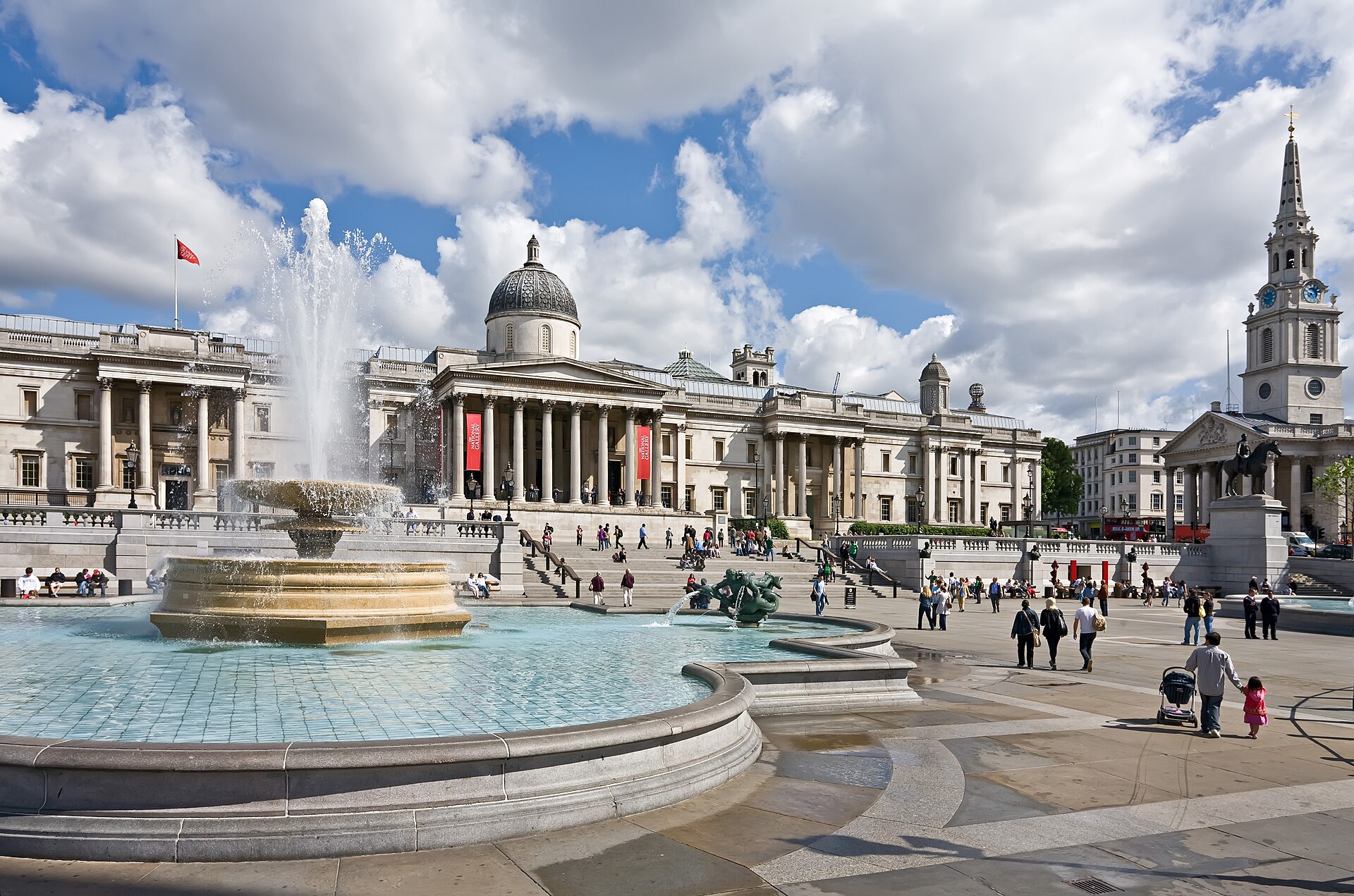
A broad, ashlar‑paved urban plaza framed by pale Portland‑stone façades: the National Gallery's columned portico and balustraded terrace to the north, St Martin‑in‑the‑Fields' white portico and tall steeple to the east. At the centre rises a tall Corinthian granite column topped by Nelson's statue, its pedestal guarded by four low, dark bronze lions. Two large circular fountain basins with pale tiled pools and high central jets sit either side of the column; scattered bronze plinths and equestrian sculptures punctuate the open space.
Its story
The story of Trafalgar Square.
The King's Mews at Charing Cross, from Edward I to George IV
Distances from London are measured from Charing Cross, a landmark since the 13th century. Under Edward I the site held the King's Mews, named for the practice of keeping hawks there to moult. After a fire in 1534 the mews were rebuilt as stables; from 1732 they were divided by a large stable block designed by William Kent, on the site the National Gallery now occupies, and they remained until George IV moved them to Buckingham Palace. The original Charing Cross stood on the south side of the present square; Hubert Le Sueur's equestrian Charles I, cast in 1633, was placed on the site in 1678.
Nash's Clearance and Barry's Layout, 1826-1844
In 1826 the Commissioners of Woods, Forests and Land Revenues had John Nash draw up plans to clear a large area south of Kent's stable block. The Charing Cross Act passed that year and clearance began soon after, but Nash died soon after construction started, impeding its progress. The square was to have been named for William IV and his accession in 1830; around 1835 it was decided instead to name it after the Battle of Trafalgar, Nelson's victory of 21 October 1805, at the suggestion of the architect George Ledwell Taylor.
William Wilkins built the National Gallery on the north side between 1832 and 1838. After Wilkins's death new plans by Charles Barry were accepted in April 1840 and construction started within weeks. Barry excavated the sloping site down to footway level and built a terrace fifteen feet high along the north side in Aberdeen granite. Two fountains were agreed in 1841; the First Commissioner of Woods and Forests welcomed them because they reduced the open space available for public gatherings and the risk of riotous assembly. The square opened to the public on 1 May 1844.
Nelson's Column and the Landseer Lions, 1838-1867
A Nelson Memorial Committee approached the government in 1838 proposing a monument funded by public subscription, and the competition was won by the architect William Railton, whose Corinthian column of 218 feet 3 inches drew widespread public objection. Construction went ahead from 1840 with the height reduced to 145 feet 3 inches, and the statue was raised in November 1843. The bronze reliefs on the pedestal were finished in May 1854, and the four seven-ton lions, sculpted by Edwin Landseer, were added only in 1867.
Barry was unhappy about the column being placed in the square, telling a parliamentary select committee in July 1840 that the area "should be wholly free from all insulated objects of art".
From the Chartists to the Poll Tax Riots, 1848-1990
The Chartist rally of 1848 began in the square, and a ban on political rallies held until the 1880s, when the Social Democratic Federation began holding protests. Unemployment protesters rallied on "Black Monday", 8 February 1886, leading to a riot in Pall Mall, and a larger riot, "Bloody Sunday", took place in the square on 13 November 1887.
Suffragettes bombed the square twice during the campaign of 1912-1914. A device planted outside the National Gallery on 15 May 1913 failed to explode; on 4 April 1914 a bomb exploded inside St Martin-in-the-Fields, blowing out the windows, showering passers-by with glass and starting a fire. Churches were a particular target because it was believed that the Church of England was complicit in reinforcing opposition to women's suffrage; thirty-two were attacked nationwide.
The Campaign for Nuclear Disarmament's first Aldermaston March set out from the square in 1958, and the Committee of 100, which included Bertrand Russell, rallied there against nuclear weapons on 19 September 1961. Ten thousand demonstrated against the Vietnam War in March 1968; a continuous anti-apartheid protest was held outside South Africa House through the 1980s; and the Poll Tax demonstration of 1990 drew 200,000 people before rioting spread into the surrounding area.
Oslo's Spruce, the Pigeons and the 2003 Rebuild
Oslo has presented a Norway spruce as London's Christmas tree every year since 1947, in gratitude for Britain's support during the Second World War. The square was also known for its feral pigeons, a flock reckoned at 35,000 at its peak; seed sales were stopped in February 2001 and bylaws banned feeding the birds in 2003.
An eighteen-month redevelopment led by W. S. Atkins with Foster and Partners was completed in 2003, closing the eastbound road along the north side and cutting a wide flight of steps through the retaining wall to the pedestrianised terrace in front of the National Gallery. The square is owned by the King in Right of the Crown and managed by the Greater London Authority and has been Grade I listed on the Register of Historic Parks and Gardens since 1996.
Step inside
7 places to explore in 1939.
The record describes 7 distinct spots at Trafalgar Square, the full exterior approach. Create your own photoreal reconstruction and explore every one, more scenes means more photos, more angles and more of the immersive experience.
Build Your Own Castle
Recreate Trafalgar Square with AI to explore it.
The artist rebuilds it as it stood in 1939, a photoreal reconstruction that belongs to you alone. Pay with coins, no subscription needed.
Recreate Square to Explore →Nearby
Castles within reach of Trafalgar Square.


Landmarks within reach of Trafalgar Square.


More landmarks of England


Explore the city


