Germany · Restored
Nuremberg Castle
Nürnberger Burg
Nuremberg Castle (Nürnberger Burg) is a complex of medieval fortified buildings on a sandstone ridge overlooking Nuremberg's old town, comprising the Imperial Castle (Kaiserburg), the former Burgraves' castle, and later city-built fortifications. It served as an important imperial residence and stronghold from the High Middle Ages through the late medieval period and was later restored after wartime destruction.
Its prime
1545
Today
Restored
Ranked among Europe’s castles
As it stood in 1545
What Nuremberg Castle looked like in its prime.
Sited on a long sandstone ridge above the town, the castle reads as a continuous fortified silhouette of grey-brown sandstone curtain walls punctuated by several distinct towers: a tall cylindrical keep with a pointed pavilion roof (Sinwell Tower), square and pentagonal towers, and a long, steep-roofed granary/stable block with many small window openings at the eastern end. Roofs are covered in red-brown tiles; inner and outer courtyards are cut into the rock with timbered service buildings clustered near the gates.
Its story
The story of Nuremberg Castle.
The Sigena Document and the Salian Rock, 1050-1130
Excavation inside the castle has turned up wall remnants dated around 1000, and older work below them that may belong to a building of Henry of Schweinfurt. The first written record is of 1050, when Henry III issued the Sigena document at Norenberc, releasing a bondswoman. He used the castle in his campaigns to extend his rule over Bohemia, Poland and Hungary.
In 1105 the rock fell to a two-month siege mounted by Henry V against his father; before the year was out Henry IV had been forced by his son to abdicate. Henry V died in 1125, the last Salian, and his successor Lothair of Supplinburg moved to take the crown lands from the Hohenstaufen brothers Frederick and Conrad, who counted Nuremberg part of their inheritance. Lothair besieged it for ten weeks in 1127 without result, and took it only at a second attempt in October 1130.
Conrad III's New Castle and the Burgraviate, 1138-1192
Lothair died in 1137 and the Hohenstaufen Conrad was elected king the following year. He soon began a new imperial castle, comprising the Palas, the Imperial Chapel and the Heathens' Tower; with Eger and the Wartburg it secured the empire's eastern frontier. Conrad also created the burgraviate so the castle would be held in the king's absence, and the first burgraves, the Austrian house of Raabs, built their own castle beside the imperial one. When the last count of Raabs died, his son-in-law Frederick of Zollern was granted the burgraviate by Henry VI in 1192; the Zollerns, soon renamed Hohenzollern, would hold it until 1427.
The Great Letter of Freedom, 1219
At his first diet in the castle, in 1219, Frederick II granted the city the Great Letter of Freedom: town rights, imperial immediacy, the privilege of minting coin and an independent customs policy, making Nuremberg an Imperial Free City answerable only to the emperor. He also handed the city responsibilities for the castle's upkeep, the start of its long quarrel with the burgraves on the same ridge. Frederick stayed at least sixteen times, his son King Henry (VII) twenty-one; in 1225 Henry married Margaret of Babenberg in the castle.
The City Against the Burgraves, 1367-1427
The Golden Bull of 1356 named Nuremberg as the place where a newly elected ruler must hold his first Imperial Diet, and the burgraves rose with the city, Sigismund granting them the Margraviate of Brandenburg. The two then turned on each other: in 1367 the city walled off the burgraves' access to the town, and in 1377 raised the Luginsland tower beside their main gate to watch what went on inside their castle. The burgraves' complaints to Charles IV came to nothing, and in 1388-89 the city took the Burgraves' Castle by force, giving it up again under the settlement made at Eger.
In 1420 Duke Louis VII of Bavaria attacked the Burgraves' Castle and burned it, probably with the city's consent. Sigismund gave the city care of the Imperial Castle in 1422, and in 1427 Frederick I, Elector of Brandenburg, sold the ruins to the council for some 120,000 gulden. That was the end of the burgraviate of Nuremberg.
Bastions, Gustavus Adolphus and the Ruin of 1944–45
The castle was left for formal occasions as emperors did business in the town hall completed in 1340; Maximilian I, the last king to hold his first Imperial Diet at Nuremberg, stayed almost six months in 1491. Between 1538 and 1545 bastions were raised on the northern side against improved artillery, to a design by the Maltese military engineer Antonio Falzon. In 1632 the armies of Gustavus Adolphus and Wallenstein appeared before the walled city; neither took it, and both were thinned less by hostilities than by typhus and scurvy. With the Imperial Diet sitting permanently at Regensburg from 1663 the castle kept practically none of its old importance; in 1806 French troops occupied Nuremberg and handed it to Bavaria.
Ludwig I set Carl Alexander Heideloff to restoration work in the 1830s but disliked his neo-Gothic manner and stopped it; August von Voit continued more plainly in the 1850s. After 1933 the castle was remade again, to serve as a setting for the Nuremberg party rallies and as lodging for senior guests of the regime: from 1934 Rudolf Esterer removed most of the nineteenth-century installations and returned the buildings to what was thought to be their original state. Air raids in 1944-45 laid a large part of the castle in ruins, only the Imperial Chapel and the Sinwell Tower remaining entirely intact. Rebuilding in historic form took some thirty years, including the Luginsland, destroyed outright, and the Kemenate, last of all in 1971. The nineteenth-century interiors were not restored, so the rooms remain as Esterer's work left them.
Step inside
12 places to explore in 1545.
The record describes 12 distinct spots at Nuremberg Castle, including 2 interiors: palas (imperial residential and ceremonial rooms), imperial chapel (kaiserkapelle) double chapel interior. Create your own photoreal reconstruction and explore every one, more scenes means more rooms, more angles, and more of the place to stand in.
Build Your Own Castle
Recreate Nuremberg Castle with AI to explore it.
The artist rebuilds it as it stood in 1545, a photoreal reconstruction that belongs to you alone. Pay with coins, no subscription needed.
Recreate this castle →Defend this castle →Whose castle
Clans who held Nuremberg Castle.
The families that held Nuremberg Castle for a decade or more across its history, follow a name to its clan.
Raabs
The first burgraves, from the Austrian House of Raabs, built the Burgraves' Castle beside the Imperial Castle.
Hohenzollern
The burgraviate passed in 1192 to Frederick of Zollern, founder of the Hohenzollern burgraves of Nuremberg.
From the archive
Nuremberg Castle on paper: the measured plan and period views.
The survey plan and photographs below are the ground truth this page's reconstructions are checked against, drawn and photographed while the castle was still a working garrison. Every image is public-domain or openly licensed, with its source named.
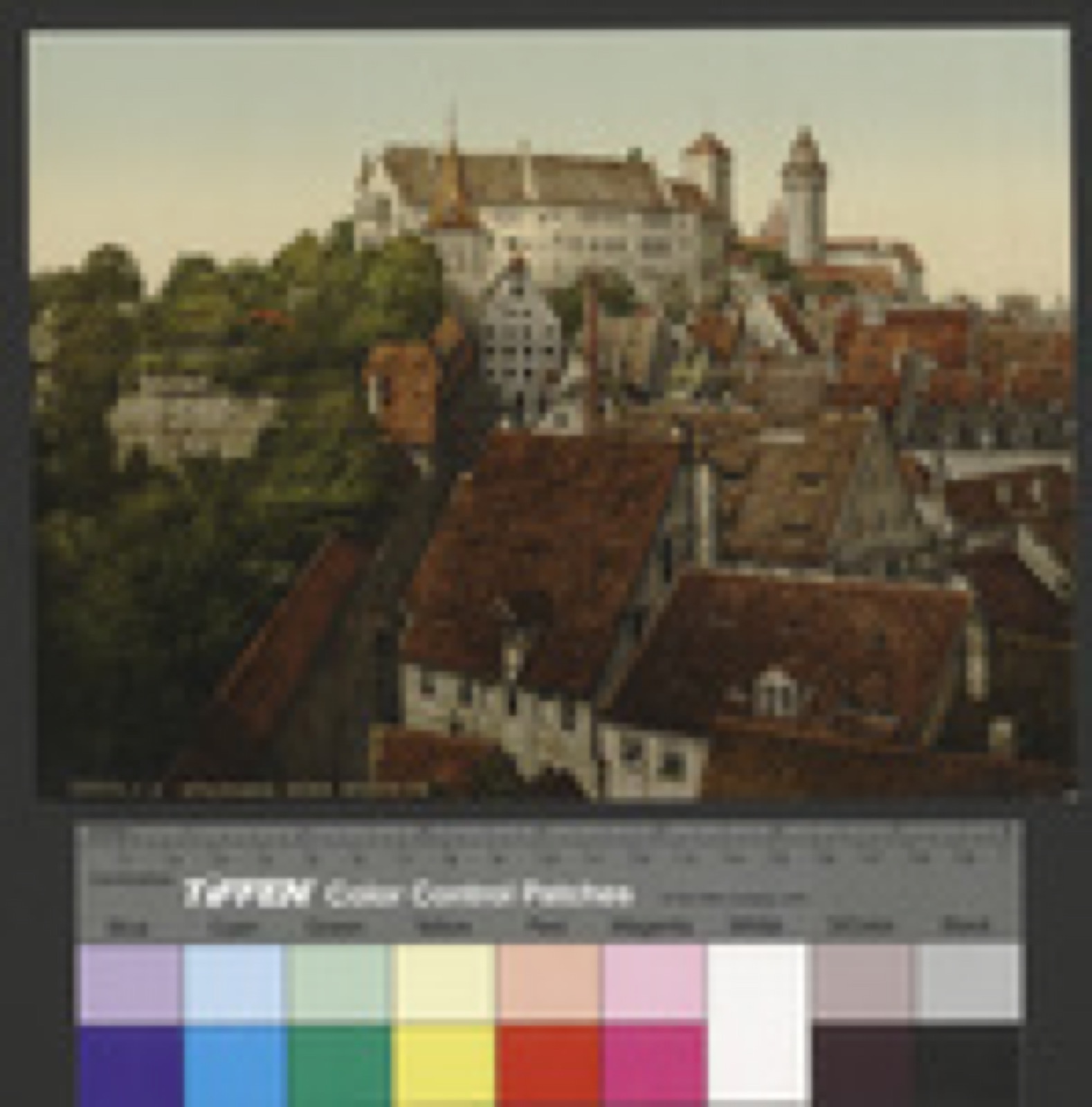
Nürnberg Burg. Südseite
· Central Library of Zurich (via Europeana)
CC0 (no rights reserved)
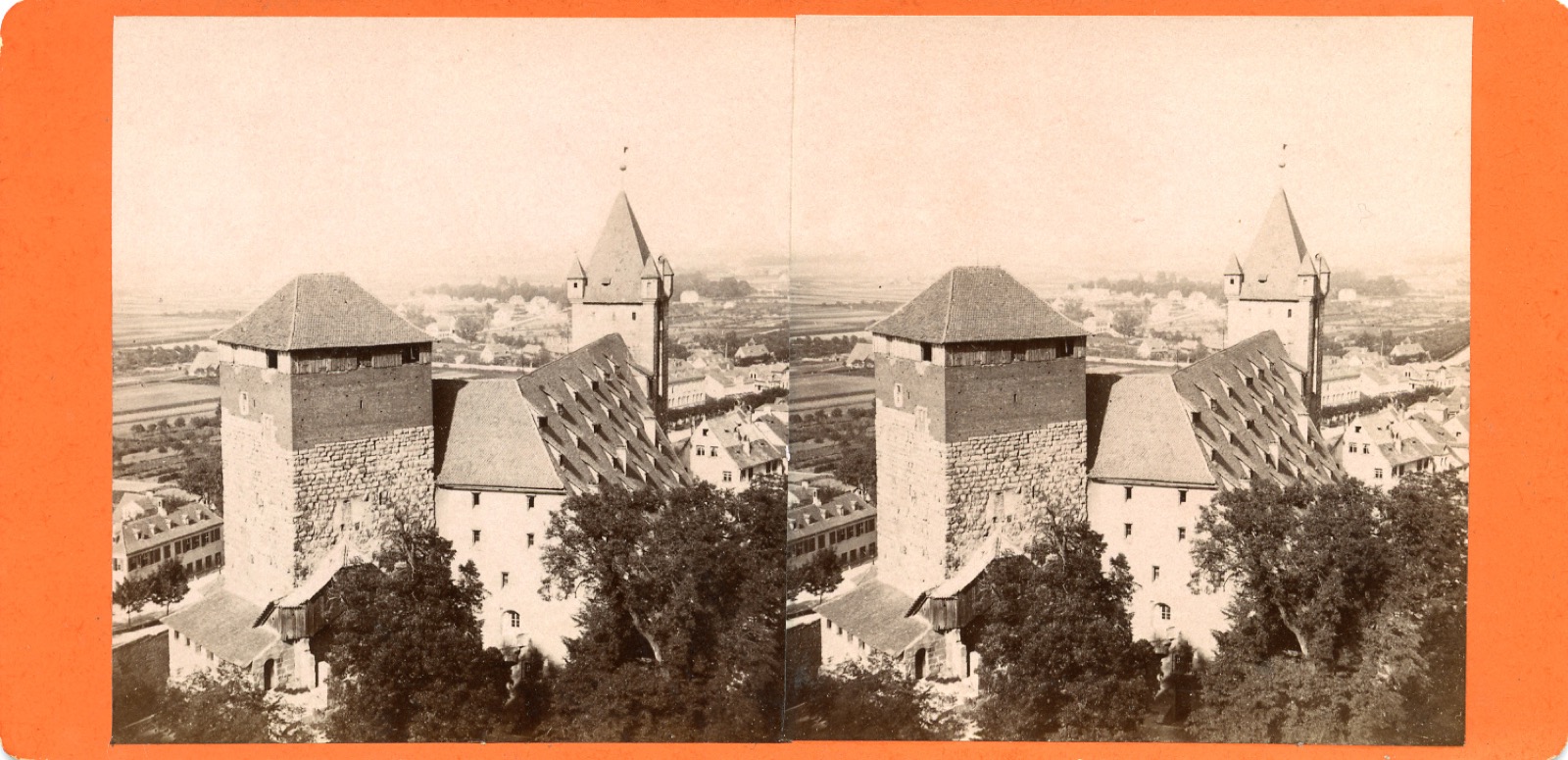
Nürnberg. Burg. Fünfeckturm der Burggrafenburg, Kaiserstallung und Luginsland
· Deutsche Fotothek (via Europeana)
Public domain
Nearby
Landmarks within reach of Nuremberg Castle.


Questions about Nuremberg Castle
What is the history of Nuremberg Castle?
What is inside Nuremberg Castle?
Who owns Nuremberg Castle now?
Why was Nuremberg Castle built, and what was it used for?
Where is Nuremberg Castle?
When was Nuremberg Castle built?
Was Nuremberg Castle ever attacked or besieged?
Which family or clan held Nuremberg Castle?
What did Nuremberg Castle look like in its prime?
Is Nuremberg Castle still standing or is it a ruin?
Can you visit Nuremberg Castle?
More castles of Germany


Explore the city