Historic Cities · Norway
Bergen through the ages
Bergen is a city and municipality in the Vestland county on the west coast of Norway. Bergen is the second-largest city in Norway after the capital, Oslo.

Bergen in 1350
Hanseatic Bergen
This is the moment Bryggen becomes a Hanseatic kontor and Bergen tightens its links to German trade. The walk passes the new timber wharves, stockfish stacks and the churches and hall that link a Norwegian royal past with an arriving mercantile order.
A narrow harbour squeezed beneath steep, green hills; a continuous line of timber gables and sea-booths along Vågen; dark wooden warehouses rising directly from the quay; bundles of pale stockfish piled like cordwood; slate roofs and simple church towers cutting the skyline; low, cobbled lanes running uphill from the water, with small boats and furled sails at the quays.
The route: 22 streets, squares and views
Vågen from Sea → Holmen Islet → Tyskebryggen (Bryggen) → Stockfish Quays → Bellgården → Svensgården → Enhjørningsgården → Bredsgården → Bugården → Engelgården → …
Step inside, 13 interiors
Chandlery Store · Schøtstue Common Room · Wharf Warehouse Loft · Kontor Counting House · Journeymen's Chamber · Merchant's Storeroom · Market Granary · Stockfish Loft · St Mary's Nave · Håkon's Great Hall · Castle Store Cellar · Monastic Refectory · Boatwright's Workshop
Planned from the Wikipedia record: Bryggen.
Bergen in 1700
Timber-town Bergen
Bergen in 1700 is Norway's largest trading port built almost entirely of timber, its medieval wharves at Bryggen rebuilt after repeated fires and still crowded with Hanseatic and Norwegian merchants. The walk moves from the fjord into the harbour: quays, the fish market at Vågsbunnen, timber lanes and ropewalks, the Bergenhus fortress and the slopes of the seven surrounding mountains.
A compact wooden city strung along a narrow inlet: long, gabled timber warehouses at Bryggen in ochres, tar-black and weathered red, slender church spires and the stone bulk of Bergenhus rising at the harbour mouth, small sailing craft and rowboats crowded in the Vågen, narrow stairway streets climbing the hills, watchmen on rooftops and bonfires on clear nights, and the seven mountains hemming the town like a dark green wall.
The route: 22 streets, squares and views
Byfjorden Approach → Vågen Harbour Mouth → Vågsbunnen Market → Bryggen Quay → Hanseatic Quarter → Strandsiden → Korskirken → Mariakirken → Øvregaten → Torget → …
Step inside, 12 interiors
Taproom at the Harbour Inn · Painted Parlour · Kontor Trading Hall · Korskirken Nave · Merchant Aisle · Fish Market Sheds · Shipwright's Mould Loft · Rope-walk Longshop · Boatbuilder's Loft · Garrison Guardroom · Tower Great Hall · Fire-watch Hut
Planned from the Wikipedia record: Bergen.
Bergen in 1890
Steamship Bergen
Bergen in 1890 is a compact harbour city at the start of the steam age: coastal steamers and fjord excursions are becoming regular, while the old wooden wharves still handle the northern stockfish trade. Walks move from the incoming steamers and the clamour of the fish market through narrow wooden streets up to villas on the hills and high mountain viewpoints.
Bryggen's rows of narrow timber warehouses and steep gables sit along the inner harbour, punctuated by the stone mass of Bergenhus fortress. Steamships and sailing craft share Vågen; wooden boathouses and white villas climb the near slopes. Streets are tight and often cobbled, lamp-posted and lined with painted timber and occasional brick public buildings beneath cloud-prone mountains.
The route: 22 streets, squares and views
Byfjorden Entrance → Vågen Quay → Bergenhus Fortress → Rosenkrantz Tower → Bryggen Wharves → Vågsbunnen Harbour → Fisketorget → Torgallmenningen → Lille Lungegårdsvann → Nykirken → …
Step inside, 13 interiors
Haakon's Hall · Governor's chamber · Hanseatic counting-house · Fish market shed · Grand Hotel dining room · Nykirken nave · Korskirken nave · Shipwright's loft · Cooper's workshop · First-class saloon · Grieg's composing room · Villa drawing room · Stave-inspired exhibition hall
Planned from the Wikipedia record: Bergen.
Its story
The story of Bergen.
Bjørgvin: The Beach Before the Foundation, 1020s–1299
Tradition holds that the town was founded in 1070 by King Olav Kyrre, son of Harald Hardråde, and named Bjørgvin, from the Old Norse elements for mountain and for a settlement made where there had been pasture. Modern research has found that a trading settlement was already established in the 1020s or 1030s, so the royal foundation formalised a shore that was already working. The sagas say Olav Kyrre raised a timber Christ Church on Holmen and began a larger church in stone; in 1163 the bishop's seat for western Norway was moved from Selja to Bergen, and the cathedral school traces its foundation to Pope Adrian IV in 1153.
King Øystein Magnusson (1103–1123), remembered as the town's second founder, built a timber royal residence beside the churches and brought the crown down from the estate of Ålrekstad, later Årstad, into the town itself. From the middle of the 13th century those timber buildings were replaced by stone halls, Håkonshallen among them, ringed by walls and towers, one of which housed the king's chancery; Bergenhus fortress dates from the 1240s and guards the harbour mouth. The cathedral was the site of the first royal coronation in Norway in the 1150s and went on hosting coronations through the 13th century. Bergen gradually assumed the function of capital in the early 13th century, as the first city with a rudimentary central administration, and lost that function to Oslo by 1299, in the reign of Haakon V (1299–1319).
Stockfish, the Kontor at Bryggen and the Attack of 1523
The trade that made the city was dried cod from the northern Norwegian coast, shipped from about 1100. King Håkon Håkonsson (1217–1263) granted Bergen a monopoly on trade from the north, and stockfish is given as the main reason the city became one of northern Europe's largest centres of trade; grain, cloth and wine came the other way.
North German merchants, present in substantial numbers since the 13th century, founded one of the four Kontore of the Hanseatic League at Bryggen during the 14th century, settling from around 1350 as a resident colony. They lived in their own quarter of the town, where Middle Low German was used, and held exclusive rights to trade with the northern fishermen who sailed down each summer. From about 1310 they were almost alone in the traffic to England, displacing Norwegian traders on the most important foreign markets, though Norwegian seafarers kept the Iceland run, the most dangerous of the routes, until 1413. By the late 14th century Bergen had established itself as the centre of trade in Norway.
In 1349 the Black Death was brought to Norway by an English ship arriving at Bergen. Between the loss of the capital's functions and the plague of 1349–50, the late Middle Ages were a weaker time for the town, its shipping reduced to a few vessels working the coastal run between northern Norway and Bergen. The Victual Brothers attacked several times in the 15th century, plundering the town in 1428 and in 1429 burning the royal castle and much of the city; in 1455 Hanseatic merchants burned down Munkeliv Abbey. The Hansa community resented the Scottish merchants who had settled in Bergen, and on 9 November 1523 several Scottish households were targeted by German residents.
The Burgher Town, the Battle of Vågen and the Monopoly to 1789
In the 16th century the town recovered as a burgher community with its own magistrate. The royal lieutenants Christoffer Valkendorf and Erik Rosenkrantz pushed the Hanseatic merchants back, confining their ground to Bryggen on the north-east side of Vågen; the districts that had grown up along the south-west shore, Strandsiden and Nordnes, and at Vågsbunnen, belonged to the new burghers. That class was fed by immigration from Denmark, Germany, Scotland and the Netherlands, which from the end of the 16th century opened connections reaching from Arkhangelsk in the north to Sicily in the south. The pattern repeated for centuries: business slackening in the first half of each hundred years, then a boom with a fresh wave of arrivals behind it, from Bremen and Lower Saxony after 1670 and from Lower Saxony again from 1777.
From around 1600 Hanseatic dominance of the city's trade gave way to Norwegian merchants, often themselves of Hanseatic descent, and in the 1750s the Kontor finally closed. In 1665 the harbour was the site of the Battle of Vågen, when an English naval flotilla attacked a Dutch merchant and treasure fleet supported by the city's garrison. During the 17th and 18th centuries Bergen was involved in the Atlantic slave trade: Jørgen Thormøhlen, the largest shipowner in Norway, was the main owner of the slave ship Cornelia, which made slave-trading voyages in 1673 and 1674, and he also built up the city's industrial sector in the neighbourhood that carries his name, Møhlenpris. The Strilekrigen took place in the city in 1765. Bergen kept its exclusive right to mediate trade between northern Norway and abroad until 1789.
Burned Down and Built Again, 1198–1979
Fire is the repeating event of the city's history, and some of it was set deliberately. In 1198 the Bagler faction fired the town during a battle against the Birkebeiner in the civil war. A great fire in 1248 took Holmen and Sverresborg with eleven churches; another in 1413 destroyed fourteen. Bryggen burned in 1476 in a blaze started by a drunk trader, and again in 1640 and 1660; in 1686 a fire on Strandsiden destroyed 231 city blocks and 218 boathouses. The greatest fire in the city's history came in 1702 and reduced most of the town to ashes, and fire returned to Strandsiden in 1756, 1771 and 1901.
Most of the old buildings of Bergen date from after 1702, Bryggen among them, rebuilt then in a mediaeval style; the fire marked the change from tar-covered and log houses to painted and partly brick-clad wooden buildings. The fire of 1855 west of Torgallmenningen led to the city's first modern central street plan, with regularly sized blocks. A great fire in the centre in January 1916 destroyed hundreds of buildings, among them the Swan pharmacy, the oldest pharmacy in Norway, and left 2,700 people homeless. On 4 July 1955 the northern part of Bryggen burned; demolition of the whole quarter was considered, and instead the surviving buildings were restored and some of the burned ones reconstructed, the six northernmost being copies. Bryggen entered the UNESCO World Heritage list in 1979.
Steam, Banks and the Loss of First Place, 1813–1935
Bergen was the largest city in Norway until the 1830s, when Christiania, now Oslo, overtook it. The Bergen stock exchange, the Bergen børs, was established in 1813; the city was separated from Hordaland as a county of its own in 1831 and constituted as a municipality on 1 January 1838. The first steamship route out of the city, to Christiania, opened in 1827, and Det Bergenske Dampskibsselskab was founded in 1851; the repeal of the British Navigation Acts in 1849 allowed the merchant fleet to carry freight for others while still handling the city's own imports and exports, and Bergen took the lead in Norwegian shipping through a rapid change from sail to steam.
The same century brought textile works, mechanical workshops, commercial mills, waterworks and gasworks, private banks and insurance companies. Fish products remained the principal export into the 20th century, timber having been shipped out in earlier times. From the 1850s the city drew heavy migration from within Norway, most of it from the western counties; the boundaries were widened in 1876, the rural municipality of Bergen landdistrikt was absorbed in 1877 and Årstad in 1915. After the First World War came bankruptcies, closed plants and ships laid up, on top of the damage of the 1916 fire, with a decided recovery from 1935.
Occupation, the Voorbode Explosion and the Bombing Raids, 1940–1945
Bergen was occupied on the first day of the German invasion, 9 April 1940, after a brief fight between German ships and the Norwegian coastal artillery. The resistance groups in the city were Saborg, Milorg, Theta-gruppen, Sivorg, Stein-organisasjonen and the Communist Party. On 20 April 1944 the Dutch cargo ship Voorbode, anchored off Bergenhus fortress loaded with over 120 tonnes of explosives, blew up, killing at least 150 people and damaging historic buildings. Allied bombing raids aimed at the German naval installations in the harbour, among them raids on 4 and 29 October 1944, caused Norwegian civilian casualties numbering about 100. Measured in money, the damage the occupation did to Bergen was greater than that suffered by any other Norwegian city, and the numbers killed and wounded in Bergen and Laksevåg were high. At the end of the war the buildings of Bergenhus, Nykirken and the Tollboden lay in ruins.
University, Merger and Vestland, 1825–2026
Research in the city goes back to work at Bergen Museum in 1825, but the institutions came late: the Bergen School of Meteorology was developed at the Geophysical Institute from 1917, the Norwegian School of Economics was founded in 1936, and the University of Bergen in 1946. Post-war plans, driven by the modernisation of the 1950s and 1960s and by war damage, proposed demolishing whole neighbourhoods of wooden houses at Nordnes, Marken and Stølen. None was carried out in its original form: the city council voted in 1964 to demolish the whole of Marken, the decision proved highly controversial and was reversed in 1974, and at Nordnes only the most heavily war-damaged area was redeveloped.
On 1 January 1972 the rural municipalities of Arna, Fana, Laksevåg and Åsane were merged into Bergen, and the city lost its status as a separate county, becoming a municipality of Hordaland, in which it accounted for more than half the population. Since 2020 it has been part of Vestland county, formed by the merger of Hordaland with Sogn og Fjordane, and is that county's administrative centre. In 2014, 42,169 residents had two foreign-born parents, with backgrounds from more than 200 countries and about half of them European; the number of Poles in the city rose from 697 in 2006 to 3,128 in 2010. At the beginning of 2026 the population was 294,860, second in Norway after Oslo. The port is the country's busiest for both freight and passengers, and the city works in aquaculture, shipping, offshore petroleum and subsea technology.
From the archive
Bergen on paper: the old town as it was mapped.
A period plan or bird's-eye view of the old town, drawn between 1500 and 1850, the streets this page's reconstructions walk. Public domain, with its source named.
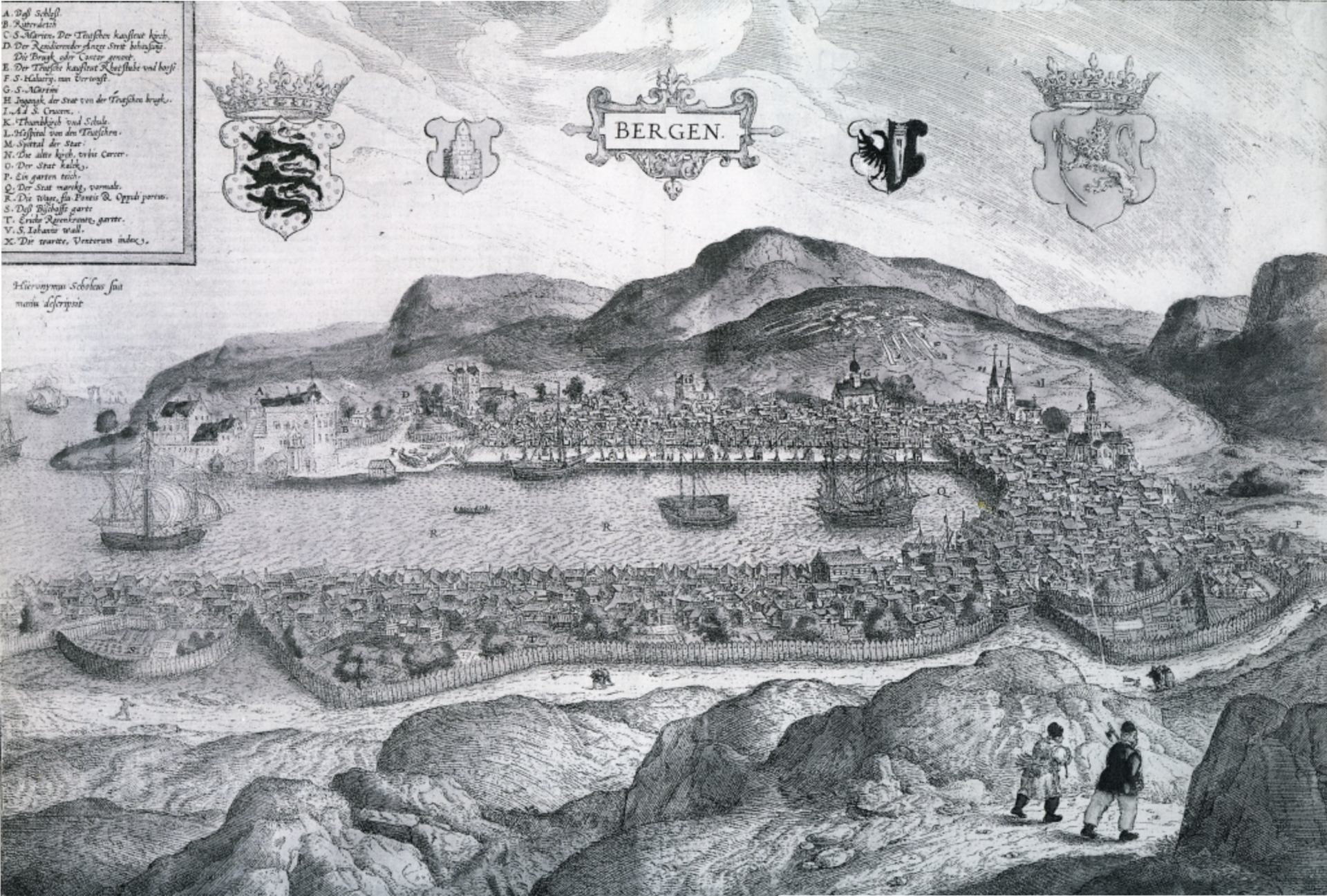
Bird's-eye view of Bergen, from Braun & Hogenberg's Civitates Orbis Terrarum
Walled and palisaded harbour town showing dense wooden house blocks, several church spires and sailing ships in the inlet.
1580 · Braun & Hogenberg · Wikimedia Commons
Public domain (plate dated 1580)

Ships tied to Bergen
- Admiral Scheer: Spent a day in the Grimstadfjord at Bergen returning from her 1941 Atlantic raid
- German cruiser Prinz Eugen: Refuelled at Bergen in May 1941 before the Denmark Strait sortie with Bismarck
- Köln: Assigned to Group 3 for the assault on Bergen in April 1940
Castles of Bergen


More cities to explore
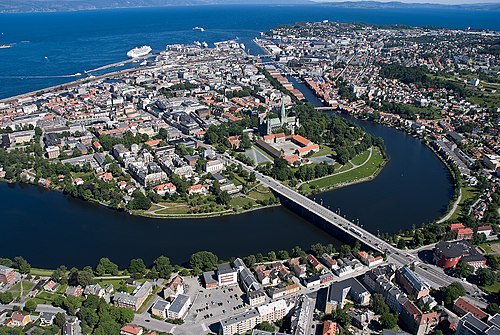 NorwayTrondheimExplore it in 1300
 NetherlandsUtrechtExplore it in 1400 · 1700
 EnglandLondonExplore it in AD 200 · 1390 · 1600 · 1885
 FranceParisExplore it in 1250 · 1670 · 1789 · 1889
Castles of Europe · Landmarks of Europe · create your own reconstruction.