Historic Cities · Norway
Trondheim through the ages
Trondheim, historically Kaupangen, Nidaros, and Trondhjem, is a city and municipality in Trøndelag county, Norway. As of 1 January 2026, it had a population of 218,460. Trondheim is the third most populous municipality in Norway, and is the fourth largest urban area. Trondheim lies on the south shore of Trondheim Fjord at the mouth of the Nidelva.

Trondheim in 1300
Nidaros of the Pilgrims
In 1300 Nidaros is Norway's great archiepiscopal centre and the foremost pilgrimage destination of the North, its stone Christ Church sheltering the shrine of St Olav. This walk follows the arrivals from the fjord and river, through timber wharves, Kaupmannagata and market places, past the archbishop's palace and the completed west front and octagon of the cathedral to wide viewpoints above the city.
The city's skyline is dominated by the pale, carved stone mass of Christ Church, its west front and octagonal choir rising above a close-knit town of timber houses, steep wooden roofs and narrow lanes. Along the curve of the Nidelva the riverbank is hung with jetties, drying racks and merchant lofts; the archbishop's complex crouches beside the cathedral, and pilgrims in cloaks and hoods thread the market and quay.
The route: 16 streets, squares and views
Munkholmen → Øra → Nidelva Bend Wharves → Merchants' Wharves → Fish Quays → Kaupmannagata → Kaupmannagata Market → Kirkegata → Cathedral Forecourt → Archbishop's Palace → …
Step inside, 9 interiors
Munkholmen Chapel · Boatbuilder's Shed · Trading Loft of the Merchants · Stockfish Drying Storehouse · Pilgrim Hospice Dormitory · Great Hall of the Archbishop · Octagonal Shrine Chamber · Elgeseter Refectory · Parish Nave
Planned from the Wikipedia record: Nidaros.
Its story
The story of Trondheim.
Kaupangen at the Mouth of the Nid
King Olav Tryggvason named the place Kaupangen, market place, in 997, and it was soon being called Nidaros, from the river Nid and the Old Norse óss, 'mouth of a river'. Tradition credits Olav with the founding, though there are strong indications that a settlement already stood on the site. The reason for the site is plain enough: the Nidelva meets Trondheim Fjord there, giving a sheltered harbour and, in the Middle Ages, a river deep enough for most boats to work up. That advantage was not permanent. In the mid-17th century an avalanche of mud and stones left the river less navigable and partly ruined the harbour.
Before there was a town there was a court. At Øretinget, the assembly of all free men by the mouth of the Nidelva, the kings of Norway were hailed: Harald Fairhair (865–933) was acclaimed there, and so was his son Haakon, called 'the Good'. The settlement served as the king's seat and as Norway's capital until 1217. In 1179 the fighting reached the town itself at the battle of Kalvskinnet, where Sverre Sigurdsson and his Birkebeiner defeated Erling Skakke, a rival for the throne. Sverre then built himself the fortification of Sverresborg in 1182–1183, named Zion after King David's castle in Jerusalem; it burned down in 1188, though the Sverresaga indicates it had been rebuilt by 1197.
St Olav's Grave and the Archbishops of Nidaros, 1070–1537
Building on the cathedral began in 1070, over the grave of Holy Olav, and the church was finished in about 1320. It drew pilgrims from across the north; it was Northern Europe's most important Christian pilgrimage site in the Middle Ages, with routes running to it from Oslo in southern Norway and from the Swedish regions of Jämtland and Värmland. The route from Oslo, roughly 640 kilometres by way of Lake Mjøsa, Gudbrandsdalen and the Dovrefjell, has since been reinstated as St Olav's Way, with a pilgrim centre in Trondheim issuing certificates to those who complete it.
From 1152 the city was the seat of the Archbishop of Nidaros for the whole of Norway, governed from the Archbishop's Palace beside the cathedral. The cathedral school, Trondheim katedralskole, was founded in the same year and is the oldest upper secondary school in Norway. The arrangement ended with the introduction of Lutheran Protestantism in 1537: the last archbishop, Olav Engelbrektsson, fled the city for the Netherlands and died in what is today Lier in Belgium. The see continued as the Lutheran Diocese of Nidaros, which it remains. One further trace of the medieval town's craft may survive elsewhere: some scholars believe the 12th-century Lewis chessmen, carved from walrus ivory and found in the Hebrides, may have been made in Trondheim.
Swedish Territory, the Siege and Kristiansten, 1658–1816
The Treaty of Roskilde, signed on 26 February 1658, handed Trondheim and the rest of Trøndelag to Sweden. The transfer lasted less than a year: after a siege of three months the area was reconquered ten months on, and the border was settled by the Treaty of Copenhagen on 27 May 1660.
Kristiansten Fortress was built on a hill east of the city in 1681–1684. It repelled an invading Swedish force in 1718, and was decommissioned in 1816 by Crown Prince Regent Charles John. The islet of Munkholmen in the fjord served in turn as a place of execution, a monastery, a fortress and a prison.
Ten Great Fires and the Cicignon Plan, 1598–1842
A city built almost entirely of wood burned repeatedly: the worst fires came in 1598, 1651, 1681, 1708, twice in 1717, then 1742, 1788, 1841 and 1842. The fire of 1651 destroyed 90 per cent of all buildings within the city limits.
After the Horneman Fire of 19 April 1681, the city was almost entirely rebuilt to a plan drawn by General Johan Caspar von Cicignon, who came from Luxembourg. He broke with the medieval street pattern and drove broad, straight avenues such as Munkegata through the town, without regard for private property rights, so that future fires would have less to feed on. The city then held fewer than 10,000 people, most of them downtown. The plan still shapes the centre, but it did not stop the burning: the houses were still timber, and a fire in 1708 destroyed the whole centre. Only after the two great fires of 1841 and 1842 did the city council impose murtvang (a requirement to build in masonry rather than wood), and the era of city-destroying fires ended.
Incorporation, Coronations and the Name War, 1814–1931
The city of Trondheim was formally established on 1 January 1838 under the formannskapsdistrikt law. The railway arrived in 1864 with the opening of the Støren line; today the Røros and Dovre lines run south to eastern Norway, the Nordland line north to Bodø, and the Meråker line east into Sweden. The city's newspaper Adresseavisen is the oldest daily paper in Norway. When independence was restored in 1814 the cathedral again became the coronation church of Norwegian kings; Haakon VII, crowned there in 1906, was the last monarch to be crowned there.
The city's name became a national quarrel. Under Danish rule the medieval Þróndheimr had been written in the Dano-Norwegian form Trondhjem; the language reforms enacted by royal resolution on 21 December 1917 set off a wave of re-Norwegianised place names, and on 1 January 1919 the diocese reverted from Trondhjem stift to Nidaros bispedømme. A local referendum in 1928 came out decisively for the status quo (17,163 votes for Trondhjem against 1,508 for Nidaros), but the Storting voted in 1929 to change the name anyway: the cathedral became Nidaros Cathedral on 1 July 1929 and the city was to become Nidaros from 1 January 1930. The change brought public outrage and riots through 1930, and the Storting reconsidered. On 6 March 1931 the name was fixed as Trondheim, the medieval Norwegian spelling rather than the Danish one. The cathedral and the diocese kept the name Nidaros.
Occupied, 9 April 1940 – 8 May 1945
German forces took Trondheim on the first day of the invasion of Norway. The landing force (the cruiser Admiral Hipper, four destroyers and 1,700 Austrian mountain troops) came in at five in the morning on 9 April 1940 and met no resistance beyond a single coastal battery that opened fire. British and French troops landed nearby on 14 and 17 April in a failed attempt to retake the city, part of the Namsos Campaign. The occupation lasted until the end of the war in Europe on 8 May 1945; during it the Germans used the exonym Drontheim for the city.
The city and its people were treated harshly, including the imposition of martial law in October 1942. Henry Rinnan, a Norwegian Gestapo agent, worked from a villa near the city and infiltrated Norwegian resistance groups. Vollan District Jail held both prisoners of war and criminals and served as a transit camp for political prisoners; it was not a concentration camp. Prisoners at Vollan were interrogated at the Mission Hotel in Trondheim, some of them by Rinnan and his gang, and many were taken from Vollan to Kristiansten Fortress and shot. Vollan closed in 1971 when the new prison at Tunga opened.
The occupiers rebuilt the port for war. Trondheim became a major submarine base (the bunker DORA I housed the 13th U-boat Flotilla), and the Germans drew up Nordstern, a scheme for an entirely new city of 300,000 people about 15 kilometres south-west of Trondheim near the wetlands of Øysand, attached to a hugely enlarged naval base intended as the future principal stronghold of the Kriegsmarine. Work began but was nowhere near finished when the war ended, and little of it now remains. The DORA bunker survives, holding the city, university and state archives.
Mergers, NTNU and the Modern Municipality, 1964–2026
The municipality took its present shape by absorption. On 1 January 1964 Strinda (population 44,600), Leinstrand, Byneset and Tiller were merged into the city of 56,982 people, nearly doubling it at a stroke; Klæbu followed on 1 January 2020. As of 1 January 2026 the municipality held 218,460 people, the third most populous in Norway. It is the seat of the County Mayor of Trøndelag, but deliberately not the county's administrative centre, that is Steinkjer, an arrangement designed to keep the county administration from being too centralised. The city celebrated its millennium in 1997.
Heavy industry gave way to research and teaching. The Lilleby smelting works ran from 1927 to 2002, and in the mid-to-late 1990s the drydock and workshops of the defunct shipbuilder Trondhjems mekaniske Værksted at Nedre Elvehavn were cleared for housing and the Solsiden shopping quarter. The Norwegian University of Science and Technology was formed in 1996 out of a reorganisation of the University of Trondheim, gathering the technical college, the medical faculty, the science museum, the art academy and the Trøndelag music conservatory. The research foundation SINTEF employs 1,800 people, 1,300 of them in Trondheim; the Geological Survey of Norway sits at Lade with 220 staff; and St Olav's University Hospital is the regional hospital for central Norway and a teaching hospital tied to the university.
From the archive
Trondheim on paper: the old town as it was mapped.
A period plan or bird's-eye view of the old town, drawn between 1500 and 1850, the streets this page's reconstructions walk. Public domain, with its source named.
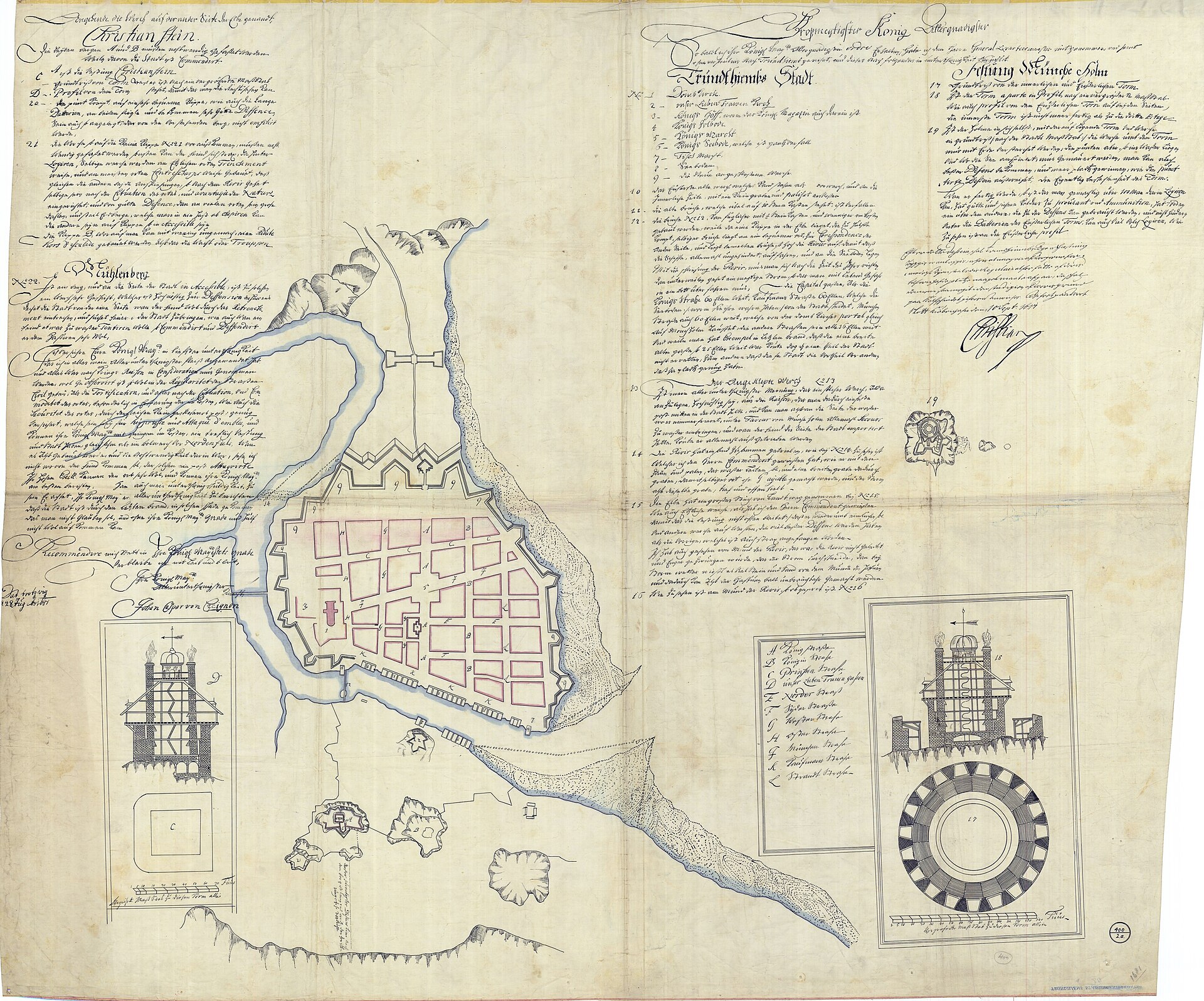
Cicignon's town plan of Trondheim (1681)
Shows the walled town with a regular grid of streets and blocks, bastioned walls and gates, the river and a marked cathedral.
1681 · Municipal Archives of Trondheim · Wikimedia Commons
CC BY 2.0 (plate dated 1681)

Ships tied to Trondheim
- Admiral Hipper: Ran the Norwegian batteries into Trondheim fjord to land mountain troops, April 1940
- German battleship Gneisenau: Covered the Trondheim landings in April 1940 and limped back there when torpedoed
- German cruiser Nürnberg: Escorted the torpedoed Gneisenau home from Trondheim in July 1940
- Köln: Reached Trondheim in July 1942 after mining the Skagerrak
- Scharnhorst: Covered the Trondheim and Narvik assaults of Operation Weserubung, April 1940
- Tirpitz: Lay in Faettenfjord near Trondheim from 1942, drawing repeated air attacks
- U-995: Stricken at Trondheim at the end of the war, 8 May 1945
Castles of Trondheim

More cities to explore
 NorwayBergenExplore it in 1350 · 1700 · 1890
 NetherlandsUtrechtExplore it in 1400 · 1700
 EnglandLondonExplore it in AD 200 · 1390 · 1600 · 1885
 FranceParisExplore it in 1250 · 1670 · 1789 · 1889
Castles of Europe · Landmarks of Europe · create your own reconstruction.