Historic Cities · Malta
Mdina through the ages
Mdina, also known by its Italian epithets Città Vecchia and Città Notabile, is a fortified city in the Western Region of Malta which was the island's capital from antiquity to the medieval period. The city has not spread beyond its ancient walls, and had a population of 242 as of July 2024. This included 120 males and 122 females; 166 Maltese nationals and 76 foreign nationals.

Mdina in 1550
The Old Capital
Mdina in 1550 sits as Malta’s old capital on its defensible ridge, diminished in political power since the Hospitallers settled at the coast but still the island’s centre of noble households and ecclesiastical authority. The walk shows thick limestone walls and gates, narrow sun-bent lanes, escutcheoned noble doorways and the cathedral’s towers, with carob and wheat fields falling away to the distant harbours.
A compact medieval citadel of warm, honey-coloured limestone, Mdina’s silhouette in 1550 is low and crenellated: curtain walls, towers and punctured bastions set above a dry ditch, a squat cathedral with bell towers, and tightly packed flat-roofed houses whose carved doorways and inner courtyards break the roofline. Streets are narrow and windward-bent, catching sharp Mediterranean light and deep shadow; below the walls lie patchwork fields of wheat and scattered carob trees that run to the horizon.
The route: 9 streets, squares and views
Rabat Plain Approach → Land Gate (Main Entrance) → Triq Villegaignon (Main Street) → Triq Inguanez → Misraħ il-Kunsill (Council Square) → St Paul’s Cathedral Exterior → Pjazza tas-Sur (Bastion Square) → Greeks Gate → Torre dello Standardo
Step inside, 5 interiors
Rabat Bakehouse · Palazzo Courtyard · Università Council Chamber · Cathedral Nave · Canon's Library
Planned from the Wikipedia record: Mdina.
Its story
The story of Mdina.
Ann, Melite and the Roman Administration
The plateau Mdina stands on is the highest ground on Malta and has been inhabited since prehistory; by the Bronze Age it served as a place of refuge because it was naturally defensible, and the valleys around it carried springs. The Phoenicians founded a colony here around the 8th century BC called Ann, after their name for the island, which presumably acted as its capital. The Roman Republic took Malta in 218 BC, early in the Second Punic War, kept the place as its centre of administration and renamed it Melita after the Greek and Latin name for the island, a name probably carried over from the main Punic port on the Grand Harbour.
Punico-Roman Melite was considerably larger than the walled town of today, its defences running out across what is now the suburb of Rabat. Very little of it survives. The most substantial remains are those of the Domus Romana, where well-preserved mosaics, statues and other material were found, together with the podium of a Temple of Apollo and fragments of the city walls. The Acts of the Apostles records that Paul the Apostle was shipwrecked on Malta in AD 60, was received by its governor Publius and cured the governor's sick father before leaving; Christian legend holds that the island's population then converted, and that Publius became Bishop of Malta and later Bishop of Athens before being martyred in 112.
The Retrenchment and the Sack of 870
At some point after the fall of the Western Roman Empire a retrenchment was thrown across the city, cutting it down to the size it has kept ever since. The purpose was a perimeter that could actually be held, and comparable reductions were common around the Mediterranean in the early Middle Ages. The work was long assumed to be Arab; it has since been argued that the Byzantines built it in around the 8th century, as the Arab threat grew.
In 870 Byzantine Melite, under a governor named Amros, probably Ambrosios, was besieged by an Aghlabid force led by Halaf al-Hādim. Halaf was killed in the fighting and Sawāda Ibn Muḥammad was sent from Sicily to take over the siege. Its length is not known, but it probably ran for some weeks or months. When the city fell, the inhabitants were massacred, the city was destroyed and its churches were looted; marble taken from them was used in the building of the ribat at Sousse in what is now Tunisia.
Refounded as Madīnah, 1048–1282
Al-Himyarī records that Malta remained almost uninhabited until it was resettled in 1048 or 1049 by Muslims from Sicily and by their slaves, who built a settlement called Madina on the site of Melite; the town's present name comes from the Arabic madīnah, meaning town or city. Archaeological evidence points to a thriving Muslim settlement here by the beginning of the 11th century, so 1048–49 may mark the town's official founding and the building of its walls rather than the first return of population. The new layout bore no relation to that of ancient Melite, and the narrow, maze-like street pattern of the present town may still carry that inheritance, with parallels in the historic medinas of North Africa. Nothing else of the Arab period survives except a Muslim cemetery found in 1881 during works on Howard Gardens and the Mtarfa road, lying over the foundations of the Domus Romana.
A Byzantine attempt to retake the town in 1053–54 was driven off by its defenders. In 1091 it surrendered peacefully to Roger I of Sicily after a short siege, and Malta passed into the County and later the Kingdom of Sicily, held by a succession of feudal lords. A castle, the Castellu di la Chitati, was raised at the south-east corner beside the main entrance, probably over an earlier Byzantine fort. The fortifications were rebuilt and extended in the 12th century, by which time the town had been reduced to roughly its present size; the ground to the south that had once been part of Roman Melite now lay outside the walls and became the suburb of Rabat. A cathedral is recorded at Mdina by 1282, in a town whose inhabitants at that period included Muslims and Jews as well as Christians.
The Università, the Hafsid Raid of 1429 and the Keys of 1530
Under Aragonese rule the islands were governed through the Università, a communal body based at Mdina which collected taxation, administered Malta's limited resources and dealt with matters of national weight such as the import of grain and wine. Its town council complained more than once to its Aragonese overlords that the islands lay at the mercy of the sea and the saracens. The population of Malta in the fifteenth century was about 10,000, of whom around 1,500 lived at Mdina, and town life was confined to Mdina, Birgu and the Gozo Citadel. Mdina itself was small and partly uninhabited: by 1419 it had already been outgrown by Rabat, the suburb outside its walls. The city withstood a siege by Hafsid invaders in 1429; the number killed or carried off into slavery is not known, but the islands were left depopulated by the raid. King Alfonso visited in 1432 and named the city a jewel in the crown of his kingdom.
When the Order of Saint John took possession of Malta in 1530, the nobles ceremonially handed the keys of the city to Grand Master Philippe Villiers de L'Isle-Adam, and the Order then settled at Birgu, and later built Valletta, leaving Mdina without the capital status it had held since antiquity. Its strategic and commercial importance went with it, and residents drifted away towards the Grand Harbour.
The Cavalry Sortie of 1565 and Vilhena's Rebuilding, 1722–46
The fortifications began to be upgraded in the 1540s under Grand Master Juan de Homedes y Coscon, and in 1551 the city withstood a brief Ottoman siege. During the Great Siege of Malta in 1565 Mdina served as the base of the Order's cavalry, which made occasional sorties against the invaders. On 7 August 1565 that cavalry attacked the unprotected Ottoman field hospital, and the raid caused the Ottomans to abandon a major assault on the main fortifications at Birgu and Senglea. In September the Ottomans moved on Mdina intending to winter in it, but gave up the attempt when the city fired its cannon inefficiently at far longer range than usual, leading them to conclude it had ammunition to spare. The military engineer Girolamo Cassar afterwards drew up plans to halve the city's area and convert it into a fortress; the nobles protested and the plans were never carried out. The defences were improved again in the mid-17th century with the large De Redin Bastion at the centre of the land front.
The 1693 Sicily earthquake did severe damage. No casualties were reported, but the 13th-century Cathedral of St. Paul was partly destroyed, and Lorenzo Gafà rebuilt it in the Baroque style between 1697 and 1703. On 3 November 1722 the newly elected Grand Master António Manoel de Vilhena ordered the restoration and renovation of the city, and put the work in the hands of the French architect and military engineer Charles François de Mondion, who drove strong French Baroque forms into what was still largely a medieval town. Much of the fortifications and the entrance were rebuilt outright: the remains of the Castellu di la Chitati were demolished to make room for Palazzo Vilhena, the old main gate was walled up and a new Mdina Gate opened nearby, and public buildings including the Banca Giuratale and the Corte Capitanale went up. The last major addition to the fortifications, Despuig Bastion, was finished in 1746.
The Garrison Massacred, 1798, and British Malta
French forces took Mdina on 10 June 1798 during the invasion of Malta, meeting little resistance, and left a garrison in the city. A Maltese uprising broke out on 2 September; the following day rebels entered through a sally port and massacred the garrison of 65 men. That began a two-year insurrection and blockade, during which the Maltese National Assembly met in Mdina's Banca Giuratale. The rebels prevailed: the French surrendered in 1800 and Malta became a British protectorate. From 1883 to 1931 the Malta Railway connected the city to Valletta.
The Silent City: Nobility, Restoration and 1.5 Million Visitors
Mdina never regained the standing it had before 1530, but it remained the seat of the Maltese nobility and of the island's religious authorities, and its property has largely continued to pass down within families from one generation to the next. The city has not spread beyond its ancient walls, and covers about 0.9 square kilometres with a population of 242 recorded in July 2024; it is governed by a directly elected five-member local council. Cars are barred apart from a limited number belonging to residents, emergency vehicles, wedding cars and horses, which is part of why locals and visitors alike call it the Silent City, Il-Belt Siekta.
Having kept its medieval character alongside the Baroque work of the 18th century, Mdina was placed on the tentative list of UNESCO World Heritage Sites on 19 May 1998 and has become one of Malta's principal tourist attractions, drawing about 1.5 million visitors a year. The city walls were extensively restored between 2008 and 2016.
From the archive
Mdina on paper: the old town as it was mapped.
A period plan or bird's-eye view of the old town, drawn between 1500 and 1850, the streets this page's reconstructions walk. Public domain, with its source named.
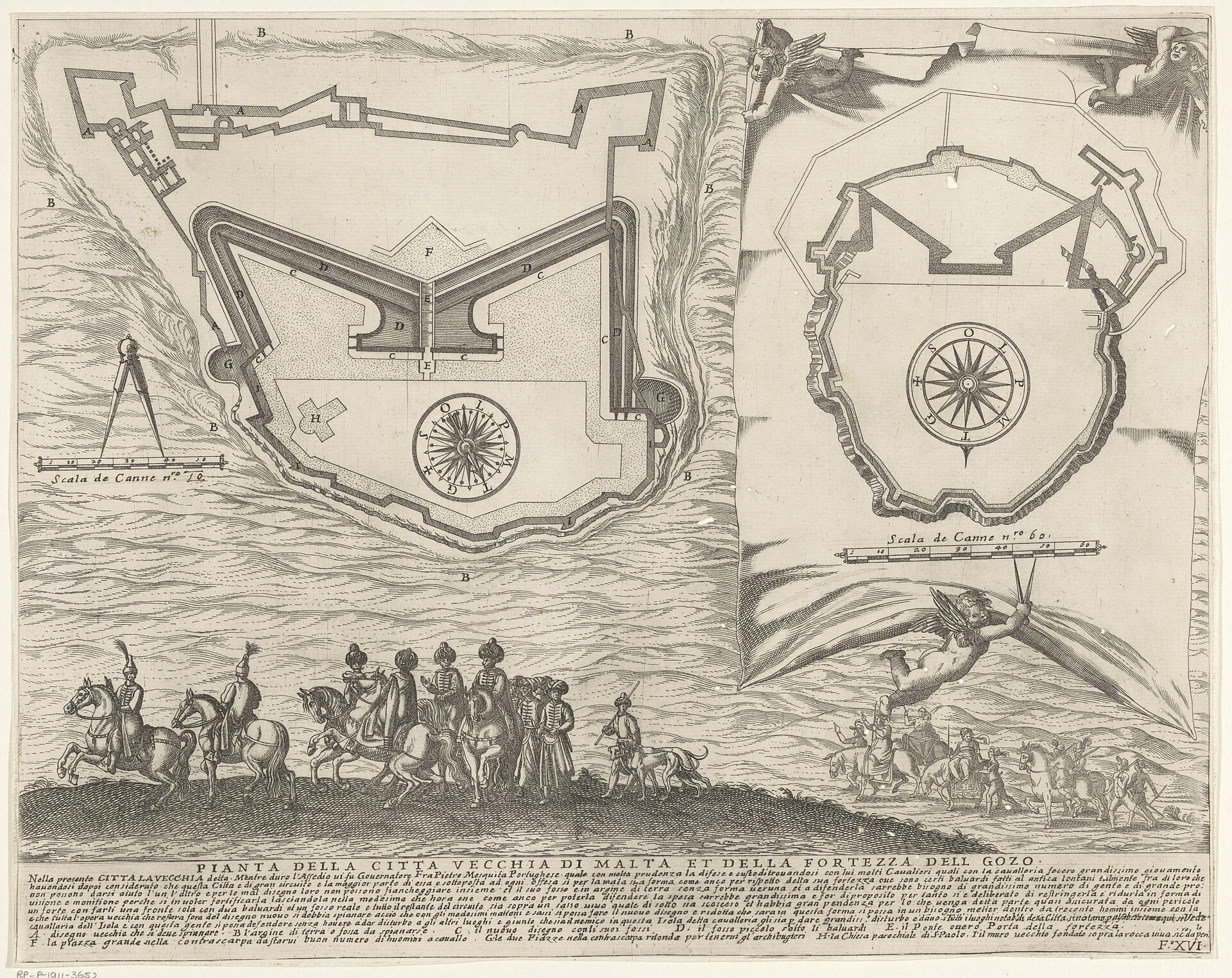
Pianta della Città Vecchia di Malta et della Fortezza dell Gozo (engraved plan)
Curtained city walls and bastioned fortifications of Mdina are shown with gates, bastions, glacis and a central compass rose.
1665 · Rijksmuseum · Wikimedia Commons
CC0 (plate dated 1665)


More cities to explore
 MaltaVallettaExplore it in 1600 · 1910
 ItalyPalermoExplore it in 1160 · 1620 · 1900
 NetherlandsUtrechtExplore it in 1400 · 1700
 EnglandLondonExplore it in AD 200 · 1390 · 1600 · 1885
Castles of Europe · Landmarks of Europe · create your own reconstruction.