Historic Cities · Italy
Palermo through the ages
Palermo is the capital and largest city of the autonomous island region of Sicily in southern Italy, located on the eponymous gulf facing the Tyrrhenian Sea. A 2,700-year-old city, it is noted for its history, culture, architecture and gastronomy, playing an important role throughout much of its existence.

Palermo in 1160
Norman Palermo
This is Palermo at the height of Norman rule under King William I: a royal capital where Latin, Greek and Arabic courts and craftsmen meet. The walk moves from the Gulf and harbour through souk-like markets and Norman palaces to terraces that look back over a city of red domes, domed mosques repurposed as churches, and gilded palace roofs.
The skyline is a close, layered horizon of low stone walls, clustered domes (many painted red) slender bell-arches and flat-roofed houses; occasional Byzantine-gilt mosaics flash from palace and church façades. Buildings use local limestone and brick with whitewashed plaster, wooden balconies, and carved stone portals; narrow streets open into shaded markets, while palm and citrus trees dot palace gardens and the sea glints beyond the harbour.
The route: 22 streets, squares and views
Gulf and Monte Pellegrino → La Cala Harbour → Bab al-Bahr (Sea Gate) → Ponte dell'Ammiraglio → Al-Khalisa Quarter → Capo Market → Ballarò Market → Vucciria Market → Cassaro → Albergheria Quarter → …
Step inside, 13 interiors
Capo Silk and Candied‑Fruit Hall · Ballarò Market Passage · Vucciria Fishmarket Arcade · Royal Audience Hall · Palatine Chapel Nave · Cathedral Nave of Palermo · San Giovanni Red‑Domed Nave · San Cataldo Apse and Domes · Martorana Mosaic Sanctuary · Zisa Fountain Iwan · Arsenale Shipwright Shed · Jewish Study Hall · Belvedere Pavilion Chamber
Planned from the Wikipedia record: Norman–Arab–Byzantine culture.
Palermo in 1620
Spanish Palermo
Palermo in 1620 is the capital city of Spanish-ruled Sicily, a dense Mediterranean port where new baroque axes and old Islamic-Norman palaces rub shoulders. The walk follows the recent cutting of Via Maqueda and the new theatrical crossroads at Piazza Vigliena, passes fish stalls and market lanes, the busy Cala with galleys, and the exterior faces of cathedral, palaces and confraternities as the city prepares for its seasonal devotions.
The skyline is a low, crenellated silhouette of Norman towers, church domes and clustered palazzi, set against the pale stone of the harbour and the dark mass of Monte Pellegrino. Streets are narrow, paved or packed earth, shaded by overhanging balconies and punctuated by open markets and church portals. New stuccoed façades and the straight cut of Via Maqueda contrast with older Arab-Norman masonry; colour comes from painted shutters, cloth awnings, baskets of citrus and the tarry hulls of ships in the Cala.
The route: 21 streets, squares and views
Gulf View from Monte Pellegrino → The Cala Quay → Shipyards and Arsenal → Vucciria Market → Mercato del Capo → Porta Felice → Via Maqueda, New Axis → Piazza Vigliena → Via Maqueda Northward → Piazza Casa Professa → …
Step inside, 13 interiors
Cala Ship-owners' Storehouse · Galley Construction Shed · Vucciria Fish Market Shed · Capo Market Lane · Maqueda Piano Nobile · Casa Professa Nave · Oratory Chapel of the Brotherhood · Podestà Council Chamber · Merchant Counting House · Cathedral Treasury · Royal Audience Hall · Palatine Mosaic Nave · Ballarò Covered Alley
Planned from the Wikipedia record: History of Palermo.
Palermo in 1900
Belle Époque Palermo
Palermo around 1900 is a city in mid-reinvention: Florio money, Ernesto Basile’s Liberty taste and the new Teatro Massimo frame an expansion beyond the medieval walls. The walk moves from the harbour across seafront promenades, through crowded open markets and narrow Baroque streets, and up to the villas and grand hotel where citrus and leisure meet the sea.
A low Mediterranean skyline of domes, crenellated Norman palaces and the new stone mass of Teatro Massimo punctuates Palermo’s profile. Ochre and pale stucco facades, dark wrought‑iron balconies and patterned tiled pavements meet narrow, shadowed alleys. Along the Marina horse-drawn carriages and fishing boats crowd the quay; citrus crates and market stalls scatter bright colour through the old town’s stone and baroque geometry.
The route: 22 streets, squares and views
Gulf of Palermo → La Cala Molo → Castello a Mare → Porta Felice → Piazza Marina → Corso Vittorio Emanuele → Quattro Canti → Piazza Pretoria → Palermo Cathedral → Palazzo dei Normanni → …
Step inside, 13 interiors
Fish Auction Hall · Aragonese Great Hall · Kiosk Café Pavilion · Cathedral Nave · Palatine Chapel · Santa Caterina Nave · Capo Market Hall · Butchers' Arcade · Ballarò Stall Arcade · Grand Auditorium · Politeama Foyer · Florio Drawing Room · Liberty Salon
Planned from the Wikipedia record: History of Palermo.
Its story
The story of Palermo.
Ziz, Panormos and the Fight for the Anchorage, Prehistory to 247 BC
Human settlement in the Palermo area goes back to prehistoric times: cave drawings at nearby Addaura, found in 1953 by the archaeologist Jole Bovio Marconi, show dancing figures performing a propitiatory rite, perhaps shamans. According to Thucydides the original inhabitants were Sicani who had arrived from the Iberian Peninsula. In the eighth century BC Phoenicians built a settlement on the natural harbour and called it Ziz, 'flower'. It became one of the three main Phoenician colonies of Sicily along with Motya and Soluntum, and Carthage was its major trading partner. The colony had two cores, the Paleapolis or 'Old City' between the rivers Kemonia and Papireto and the Neapolis or 'New City' between the old quarter and the port, which soon outgrew it.
The Greeks who reached Sicily named the place Panormos, 'wide haven', after its large anchorage, and the Carthaginians began using the Greek name on the city's coinage from the fifth century BC. It was from here that Hamilcar I launched the fleet defeated at the Battle of Himera, and in 409 BC the city was looted by Hermocrates of Syracuse. In 254 BC a Roman fleet besieged Panormus; the city surrendered and its people paid a war tribute to keep their liberty. Hasdrubal tried to take it back and was defeated by the consul Quintus Caecilius Metellus, who imposed a lasting Roman rule over the town; the Battle of Panormus of 250 BC ended Carthage's attempt to reconquer the city. In 247 BC Hamilcar camped on Monte Pellegrino, then called Ercta, but the city stayed loyal to Rome, and for that it received the Praetura, the Golden Eagle and the right to mint its own coin, as one of only five free cities in Sicily.
Roman Wheat, the Vandal Sack and Belisarius at the Port
Panormus prospered under the Roman Republic and Empire, and the geographer Strabo records that it supplied large amounts of wheat to the capital. Luxurious residences of the period have been found at Piazza della Vittoria and Palazzo Sclafani, and a large theatre was still standing in the Norman age. The city decayed after the reign of Vespasian; in 445 it was sacked by Gaiseric, king of Vandal Africa, and it then passed to Odoacer and to Theoderic's Ostrogoths.
In late 535 the Byzantine general Belisarius, commissioned by the emperor Justinian I to reconquer Italy, laid siege to the port with an army of between 7,500 and 9,000 men and a fleet. Palermo had refused to surrender, unlike every other Ostrogothic-held city in Sicily, and eventually fell. Byzantine rule lasted until 831.
Balarm, Capital of the Emirate, 831–1072
The Muslim conquest of Sicily followed the defection of the Byzantine admiral Euphemius, who fled to Tunisia in 827 and asked the Aghlabid ruler Ziyadat Allah for help. The Aghlabid army disembarked at Mazara del Vallo, and Palermo fell after a year-long siege in 831 and was made the capital of the Emirate of Sicily. The Arab rulers allowed the natives freedom of religion on condition that they paid a tax, and the Jewish community was permitted to prosper. Under Arab rule Palermo, known as Balarm, displaced Syracuse as the leading city of Sicily and was said to compete with Córdoba and Cairo in importance and splendour. The Arabs introduced agricultural crops that remain a mainstay of Sicilian cooking.
How large the city grew is genuinely disputed, because the figures given by contemporary writers are unreliable. Paul Bairoch estimated the eleventh-century population at 350,000; Stephan R. Epstein put it closer to 60,000; Kenneth Meyer Setton, working from al-Maqdisi's statement that Palermo was larger than Old Cairo, placed it above 100,000 but below 250,000. The shape of the Arab city survives in its names: the Cassaro from al-qaṣr, 'castle', the Kalsa, the emirs' seat along the sea, and the quarter of the Schiavoni, 'slaves', crossed by the Papireto. Weakened by dynastic quarrels, the emirate fell to the Normans, who had entered Sicily in 1061 and took Palermo in 1072 after a siege whose length the accounts do not agree on.
The Hauteville Kingdom and Frederick's Court, 1130–1268
The Hauteville family, descendants of Vikings from the Duchy of Normandy, restored Christianity as the official religion and made Palermo the capital of the island; Robert Guiscard, to whose efforts the reconquest was largely credited, is still regarded locally as a hero. In 1130 his nephew Roger II was crowned King of Sicily in Palermo, the County of Sicily promoted into a kingdom ruled from the Palazzo dei Normanni. Palermo Cathedral was begun in this period, and the Kingdom of Sicily became one of the wealthiest states in Europe, as wealthy as Norman England. The Muslim population, a majority in Palermo though not across Sicily, was tolerated and the Jews remained an important community, but many mosques were turned into churches; the Martorana and the Palatine Chapel carry the mixture of Arab, Byzantine and Norman work this settlement produced. The city's population had by then dropped to 150,000, yet it became the largest in Europe because Constantinople had declined further still.
The marriage of Constance of Hauteville, the last of the Norman line, to the emperor Henry VI passed the kingdom to the Hohenstaufen of Germany. The noblemen refused to be ruled by a foreigner, and Henry had to defeat a rival king before taking Palermo in 1194. Their son Frederick II became King of Sicily in 1198 and Holy Roman Emperor in 1220; Palermo was his favourite city and the effective capital of his empire, its court hosting leading intellectuals and artists and giving rise to the first Italian school of poetry. The Muslims of Palermo emigrated or were expelled during his rule. Frederick died in 1250 and was buried in the cathedral; his illegitimate son Manfred continued his policies until his defeat by Charles I of Anjou in 1268.
From the Sicilian Vespers to Garibaldi's Entry, 1282–1861
Charles of Anjou and his officials exploited Sicily heavily, and the island rebelled in 1282 in the rising known as the Sicilian Vespers, giving itself to the Aragonese. Palermo had already lost ground when the Angevins moved the capital to Naples. Under Aragon the noble families of the Ventimiglia, Alagona and Chiaramante fought for control of western Sicily; the Palazzo Steri and the Palazzo Sclafani were built, and the city traded raw materials and finished goods with Genoa and Spain. By 1330 the population had fallen to 51,000.
After the death of King Martin I in 1409 Sicily was annexed by Spain and Palermo became the seat of a viceroy. The Jews were expelled and the Holy Inquisition increased its power over the city. Building continued, but heavy taxes were imposed to pay for it, and under Charles V and Philip II the barons dominated the city through their unruly bands of bravoes. Plague struck in 1624; the discovery of Saint Rosalia's remains in a cave on Monte Pellegrino, and their carrying three times around the city, was credited with ending it, and she replaced the four earlier patrons of the city's quarters.
The Treaty of Utrecht handed Sicily to the House of Savoy in 1713; Austria held it from 1720, and by 1734 it was a Bourbon possession. Charles III chose Palermo for his coronation, but with the royal court resident in Naples the city had become a provincial capital, and when the Kingdom of the Two Sicilies was founded in 1816 Palermo held the capital only until the seat moved to Naples a year later. Sicily was shaken by upheavals from 1820, culminating on 12 January 1848 in a popular insurrection led by Giuseppe La Masa, the first in Europe that year, which proclaimed a parliament and a constitution under Ruggero Settimo. The Bourbons reconquered Palermo in 1849 and held it until Giuseppe Garibaldi took the city with the Thousand after the Siege of Palermo in May 1860; a plebiscite later that year carried Sicily into the new Kingdom of Italy in 1861.
Rebellion, the New Boulevards and the Bombing of the Harbour, 1866–1943
Most Sicilians had preferred independence to annexation by the Savoy kingdom, and in 1866 Palermo was the seat of a week-long popular rebellion, crushed after martial law was declared. The Italian government blamed anarchists and the Church, naming the Archbishop of Palermo, and began enacting anti-Sicilian and anti-clerical policies. Industrial and commercial growth was nonetheless spurred by families including the Florio, the Ducrot, the Rutelli and the Whitaker, and in the early twentieth century the city expanded beyond its old walls, mostly northwards along new boulevards such as Viale della Libertà. The Teatro Massimo opened in 1897.
Palermo was heavily bombed by Allied air forces in 1942 and 1943, and was captured on 22 July 1943 during the Allied invasion of Sicily. The harbour and the quarters around it were effectively destroyed, along with much of the city, with heavy civilian casualties. American troops entering Palermo in 1943 were greeted with a thunderous welcome by what seemed the entire population, demonstrating their feelings about Fascist rule. Two captured Italian generals claimed that they were happy because, in their view, the Sicilians were not human beings but animals; anti-Sicilian prejudice belonged to the Fascist regime's worldview and was promoted by pro-Fascist newspapers, particularly in the north of Italy.
The Sack of Palermo, the Mafia Killings and After
In 1946 the city was made the seat of the Regional Parliament, and from 1947 the capital of a Special Status Region, with its seat at the Palazzo dei Normanni. As agriculture lost its weight in the Sicilian economy, migration into the cities swelled Palermo, and instead of rebuilding the bombed centre the city was thrown into a northward expansion in which the regulatory plans were largely ignored; new districts appeared without parks, schools, public buildings or proper roads. This building speculation, mainly between the 1950s and the 1980s, destroyed a great number of historical buildings and green areas and is remembered as the 'Sack of Palermo'. The Mafia took a large part in it, and the process was an important element in its transition from a mostly rural phenomenon into a modern criminal organisation, working through corrupt officials: a former mayor, Vito Ciancimino, was convicted of bribery with mafiosi.
The Italian state effectively shared control of the territory, economic and administrative, with the Mafia; the city's modern struggle also took in outlaws such as Salvatore Giuliano, who controlled the neighbouring area of Montelepre. Many public servants were killed in the struggle against the criminal organisations of Palermo and Sicily: the Carabinieri general Carlo Alberto Dalla Chiesa, the region's president Piersanti Mattarella, the priest Pino Puglisi, and the magistrates Giovanni Falcone and Paolo Borsellino, the latter killed with five members of his escort in a car bombing in Via D'Amelio in July 1992.
Palermo remains the capital of the autonomous region of Sicily and the seat of its parliament, and the main site of the UNESCO World Heritage listing Arab-Norman Palermo and the Cathedral Churches of Cefalù and Monreale. The municipality had 626,273 inhabitants as of 2026, and its metropolitan city, with around 1.2 million people, is the fifth most populous in Italy.
From the archive
Palermo on paper: the old town as it was mapped.
A period plan or bird's-eye view of the old town, drawn between 1500 and 1850, the streets this page's reconstructions walk. Public domain, with its source named.
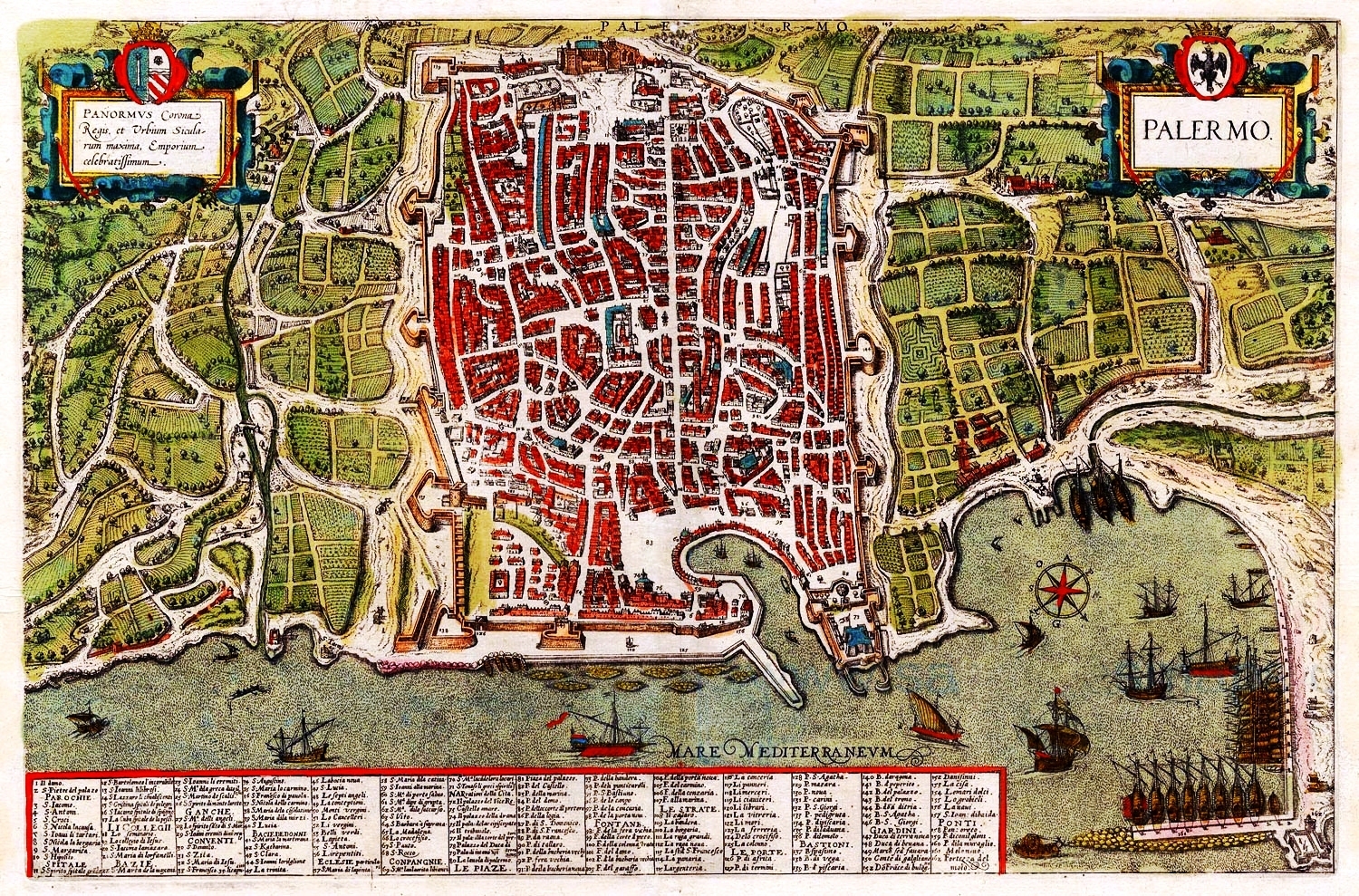
Plan of Palermo, from Braun & Hogenberg's Civitates Orbis Terrarum
Walled old town with bastioned sea defences, harbour and curved mole, dense street grid with numbered churches and a central piazza.
1588 · Georg Braun (1541-1622) - Franz Hogenberg · Wikimedia Commons
Public domain (plate dated 1588)
In this city
Landmarks of Palermo, see each in its prime


Castles of Palermo


More cities to explore
 MaltaMdinaExplore it in 1550
 MaltaVallettaExplore it in 1600 · 1910
 ItalyRomeExplore it in AD 320 · 1300 · 1600 · 1770
 ItalyVeniceExplore it in 1200 · 1500 · 1740
Castles of Europe · Landmarks of Europe · create your own reconstruction.