Byrne
also O'Byrne, Ó Broin
Of the Wicklow Mountains, the unconquered lordship at the back of the Pale.
- Origin
- Leinster, Ireland
- Motto
- Certavi et vici
- Famous bearer
- Fiach McHugh O'Byrne (c.1544–1597), lord of Ballinacor, victor of Glenmalure
- Register
- Irish family
Where the Byrne name comes from
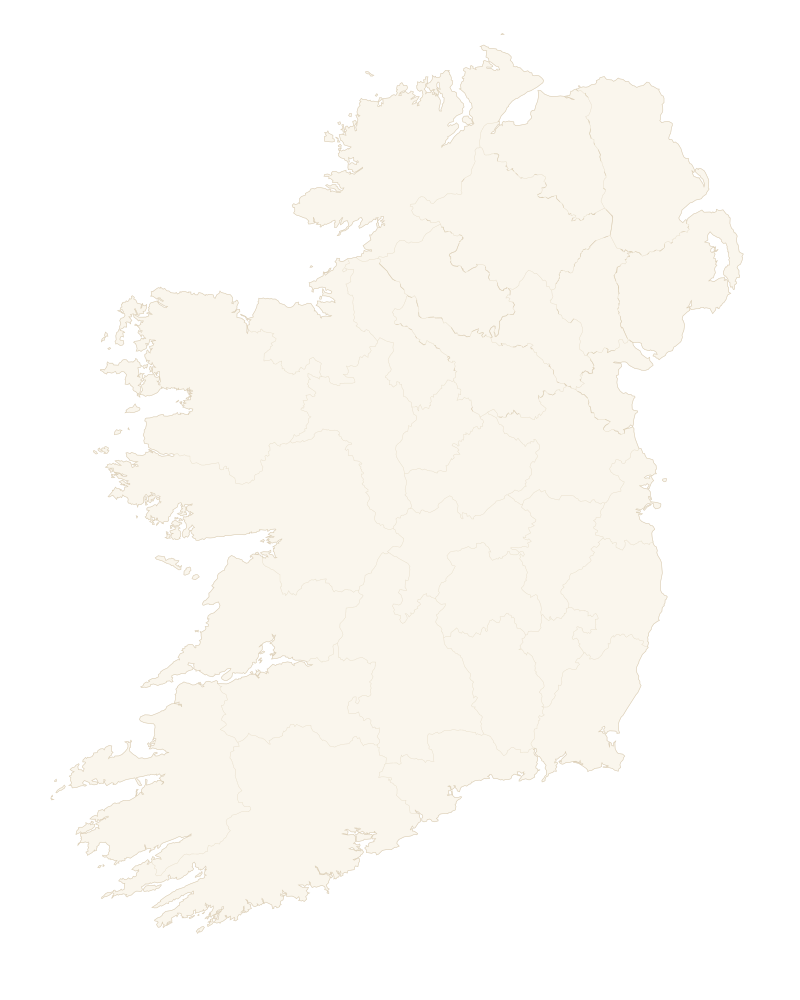
CoreHistoric reach
The seat of Byrne
Seat vacantChief
No one leads the Byrne community yet. When the movement opens, you can stand for its leadership, or help elect whoever does.
Current mission
No shared goal set yet. Once Byrne has leadership, it sets the public focus: a restoration, a gathering, a real-world project that helps its own.
The Byrne clan is being rebuilt. Join the waiting list for the movement today, and you help decide who leads it and what it does.
Help rebuild the Byrne clan →Motto
Certavi et vici
“I have fought and conquered”
What does the Byrne name mean?
From Ó Broin, descendant of Bran. The eponymous Bran was Bran mac Máelmórda, king of Leinster, who died in 1052. His descendants were driven from their flatter ancestral lands in northern Wicklow and southern Dublin by the Anglo-Norman conquest of the 1170s and took refuge in the Wicklow Mountains, where they remained an unconquered lordship for four hundred years. Anglicised forms include Byrne, O'Byrne and Beirne; the Gaelic Ó Broin survived in Irish-speaking Wicklow into the 19th century.
The history of Byrne
Descendant of Bran, king of Leinster
The name is Ó Broin, descendant of Bran, and the Bran in question can be named: Bran mac Máelmórda, king of Leinster, who died in 1052. He belonged to the Uí Faelain of the Uí Dúnlainge, the ruling kindred of the northern Laigin, the people who gave Leinster its name. Ó means descendant, historically Ua.
The O'Byrnes were one of the chiefly families of the Uí Dúnlainge, and they stayed close to their kinsmen the O'Tooles. Before the Normans landed, the Ó Broin had already begun to colonise south Wicklow, and their country took their name: Críoch Branach, the Byrne country, its people the Branaigh. The seat of the most famous branch was Ballinacor, which controlled the lands around it.
Pushed uphill into Glenmalure
The Anglo-Norman conquest of the 1170s took the flat ground. The Ó Broin lost their ancestral lands in northern Wicklow and southern Dublin and went up into the mountains, and the move that looked like a defeat was the making of them. Their stronghold became Glenmalure, a deep glaciated glen on the eastern flank of Lugnaquilla, reached by a single track and impossible to take with conventional cavalry. From there they held their country as effectively independent territory for the next four hundred years.
They did not sit in it quietly. On Easter Monday 1209 the O'Byrnes ambushed a party of newly arrived settlers from Bristol at Ranelagh, outside the walls of Dublin, and killed about five hundred of them; the city remembered the date afterwards as Black Monday. Together with their kinsmen the Ó Tuathail of Imaal, the Ó Broin made the southern boundary of the Pale a fortified line for the whole later medieval period.
The Bloody Bank at Bray, 1402
In 1402 the O'Byrnes of County Wicklow, who raided Dublin periodically, brought a large mercenary force down to the banks of the River Dargle at Bray. The direct road would have carried them past Carrickmines Castle, and they hesitated. The hesitation cost them: the Walsh family, who held Carrickmines, got an urgent warning into the city, and the Mayor of Dublin came out with a large force and fell on them. The Dubliners called the result the Battle of Bloody Bank, for the number of dead.
The lordship absorbed defeats like that because of how it was built. An Irish clan, a fine, was not only the chief and his patrilineal relatives; it also took in unrelated clients who assumed the leading lineage's name as a show of allegiance. That is why there were always more Byrnes than there were descendants of Bran, and why the name is a Wicklow name rather than a single bloodline. Succession ran by tanistry, the next chief elected from among the agnatic cousins rather than passing to an eldest son.
Fiach McHugh and the breaking of Grey de Wilton
In the Desmond Rebellions the warlord Hugh O'Byrne threw his weight behind the Earl of Desmond and died during the second rebellion. His son Fiach McHugh O'Byrne took the chieftainship. His name in Irish, Fiach mac Aodha Ó Broin, is the older Gaelic naming convention still working: Fiach, son of Aodh, of the descendants of Bran. He allied with a lord of the Pale itself, James Eustace, 3rd Viscount Baltinglass, and kept the war going against the Dublin administration.
The government sent a large English force under the Lord Deputy of Ireland, Grey de Wilton, into the mountains to finish him. On 25 August 1580 it went into Glenmalure and Fiach ambushed it there. Over eight hundred English soldiers were killed in a single afternoon, on ground the Ó Broin had been choosing their fights on since the twelfth century. Grey's own description of what was left was 'a great heap'.
Red Hugh in the glen
Fiach's house at Ballinacor became the place men ran to. When Hugh Roe O'Donnell broke out of Dublin Castle, in an escape the accounts date to 1591 and to January 1592, it was Fiach McHugh O'Byrne who took him in, and Ballinacor in Glenmalure where he stayed. Fiach sheltered him again in 1597, with the full weight of the Dublin government on him for it.
The government answered by planting a Tudor garrison in Ballinacor itself in 1595. Fiach expelled it, destroyed the fort and had his own seat back. He was finally killed at Fananerin on 8 May 1597, betrayed and caught by surprise, which is the only way anyone ever managed it. He had held the mountains against successive Lords Deputy and handed on a country that was still Byrne country.
The Leabhar Branach, and a Byrne in parliament
The family kept poets. The Leabhar Branach, the Book of the O'Byrnes, is a compilation of Irish-language verse in praise of the clan, put together in the early seventeenth century. It exists because the Ó Broin were still a lordship worth writing for at a moment when most of Gaelic Ireland's patrons were already gone.
Fiach's son Felim McFiach O'Byrne made the crossing into the new order. He submitted to Queen Elizabeth and was confirmed in his father's lands by her patent, though the holding was lost again under a patent of King James I. In 1613 he sat as Member of Parliament for County Wicklow, and he died in 1630. That is the sixteenth-century settlement in one man's life: English common law spreading across Ireland, the county and the sheriff replacing the clan chief, and surrender and regrant offering Gaelic lords titles, arms and primogeniture in place of tanistry.
The fighting era closed at Carrickmines, the castle whose warning had beaten the Byrnes in 1402. In the rising of 1641 its Walsh owners came in on the side of the native Irish, and when English forces retook the castle in 1642, over three hundred of the Walshes, O'Byrnes and O'Tooles were killed there.
Certavi et vici, and the loss of the Ó
The arms are gules, a chevron between three dexter hands couped at the wrist argent, with a mermaid holding comb and mirror for a crest, and the motto certavi et vici: I have fought and I conquered.
Anglicising a Gaelic surname usually meant stripping the prefix or fixing it in place: Ó was either dropped outright or written O', which is why the same Wicklow family appears as Byrne, as O'Byrne and as Beirne. The Irish form did not die with the lordship. Ó Broin was still spoken in Irish-speaking Wicklow in the nineteenth century.
Forty thousand Byrnes and the Walkinstown plumber's son
There are around forty thousand Byrnes on the island of Ireland today, and the densest concentration of them is still in the Wicklow heartland the name came out of. Among those who carried it outward were Donn Byrne (1889–1928), the New York-Irish novelist, David Byrne of Talking Heads (b. 1952), of Scottish Byrne descent, the comedian Ed Byrne (b. 1972), and the Australian singer and actress Anna O'Byrne.
Gabriel Byrne was born at the Coombe Hospital in Dublin on 12 May 1950, the eldest of six children of a Walkinstown plumber and Guinness brewery worker and a nurse. He went to the Christian Brothers School in Synge Street, took a BA in Archaeology and Spanish at University College Dublin in 1972, and taught both subjects at a south Dublin girls' school for three years while acting in his spare hours with Jim Sheridan's Project Theatre Company in Temple Bar.
He gave up teaching for the stage in 1975, moved to the Royal Court in London in 1978, and broke into film with John Boorman's Excalibur in 1981. Tom Reagan in the Coen brothers' Miller's Crossing (1990) and Dean Keaton in The Usual Suspects (1995) put him in the front rank, and he played the psychiatrist Paul Weston for forty-three episodes of HBO's In Treatment between 2008 and 2010, winning the Golden Globe for Best Actor in a TV Drama in 2009. He has been Cultural Ambassador of Ireland since 2014. The name he carried out of Walkinstown is the Leinster patronymic of the Uí Broin of the Wicklow Mountains.
Champions of the Byrne name
The bearers whose lives are inseparable from this surname. Each has their own page, biography, achievements, geography, connection to the family.
Historic Places, Rebuilt
Explore the streets and seats the Byrne name knew, rebuilt with AI as they stood in history.
The castles of the homeland
The great strongholds of the homeland, look one up, see what it looked like in its prime, and recreate it to explore.
 Ashford Castle, County MayoRestored · prime 1880
 Manderley CastleRestored · prime 1840
 Dublin CastleRestored · prime 1790
All castles in Ireland → · Strongest castles in Ireland → · Castles of Europe
Play As Your Clan
Hold a real castle against whatever you choose to send at it, take a ship out in her own service years, or stand at the shoulder of someone the record remembers. The chronicler sets the scene; the deeds are yours.
Notable bearers of the Byrne name
- Fiach McHugh O'Byrne (c.1544–1597), lord of Ballinacor, victor of Glenmalure
- Gabriel Byrne (b. 1950), actor
- Ed Byrne (b. 1972), comedian