Doyle
also Ó Dubhghaill, MacDowell
Dark stranger, the Hiberno-Norse families of the south-east coast.
- Origin
- Leinster, Ireland
- Motto
- Fortitudine vincit
- Famous bearer
- Sir Arthur Conan Doyle (1859–1930), physician, novelist, creator of Sherlock Holmes
- Register
- Irish family
The Doyle arms and country

Coat of armsEscutcheon of the Doyle baronets of Guernsey (1825)Borne by the Guernsey line, one branch of the name rather than all of it.Charles Matthews · CC BY-SA 4.0 
Coat of armsEscutcheon of the Doyle baronets of Buscombe (1828)Borne by the Buscombe line, one branch of the name rather than all of it.Charles Matthews · CC BY-SA 4.0
.svg)
.svg)
- Coat of arms: Granted to an individual and inherited down that one documented line. These are the arms of particular families of the name, not of everyone who shares the surname.
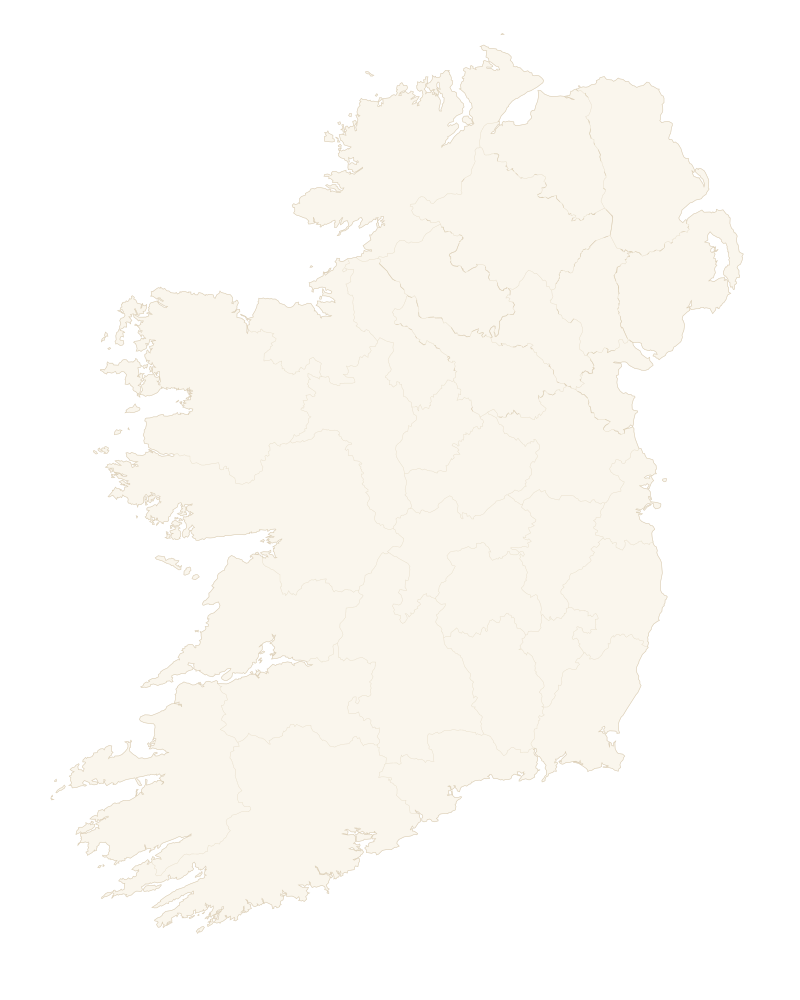
CoreHistoric reach
The seat of Doyle
Seat vacantChief
No one leads the Doyle community yet. When the movement opens, you can stand for its leadership, or help elect whoever does.
Current mission
No shared goal set yet. Once Doyle has leadership, it sets the public focus: a restoration, a gathering, a real-world project that helps its own.
The Doyle clan is being rebuilt. Join the waiting list for the movement today, and you help decide who leads it and what it does.
Help rebuild the Doyle clan →Motto
Fortitudine vincit
“He conquers by fortitude”
What does the Doyle name mean?
From Ó Dubhghaill, descendant of the dark stranger. Dubhghall is Old Irish for the Norse, specifically the dark-haired Norse from Denmark, as distinct from Fionnghall, the fair-haired Norse from Norway. The surname Doyle therefore marks a family of Hiberno-Norse descent, Vikings settled in the Irish coastal towns who took on Gaelic surname-conventions by the 11th century and were, within three generations, fully integrated into the Gaelic order around them. The same Dubhghall root produced the Scottish surname MacDowell.
The history of Doyle
Dubhghall, the dark stranger of the harbour towns
Doyle is a back-formation from O'Doyle, an anglicisation of the Irish Ó Dubhghaill, descendant of Dubhghall, a personal name built from dubh, black, and gall, stranger. In the Viking age Irish writers used Dubhghoill for one body of Norse settlers, usually understood as the Danes, and Fionnghoill, the fair foreigners, for the Norwegians. Whether those words described hair and dress or simply divided newer arrivals from older ones is still argued. What the name records is not in question: a family called after the strangers because it descended from them.
The Gaels were among the first peoples in Europe to take surnames, in the century of declining Uí Néill dominance after Brian Boru won the high kingship in 1002. The Norse settlements of the south-east coast are where the name is thickest: the longphort at Wicklow harbour, the trading station at Arklow, the Hiberno-Norse town at Wexford. Irish tradition counts the O'Doyles among the few families reckoned to be of Viking descent, with the MacCotters and the O'Hallorans of Clann Fearghaill. The Norse in Ireland founded the first towns and were then thoroughly Gaelicised; Doyle is what that assimilation left on the map.
The name that is not in the old genealogies
From the eighth century Irish scholars compiled the great genealogical collections: Rawlinson B 502, the Book of Ballymote, the Book of Lecan, the Leabhar Mór na nGenealach of Dubhaltach MacFhirbisigh. Doyle is in none of them, which has led many to argue the name is recent in Ireland. It reads better another way: those books recorded the descent of chiefs, not every household that carried a name, and Irish clans absorbed unrelated clients who took the leading lineage's surname as a show of allegiance.
Given that Doyle stood ninth among the commonest surnames in Ireland in 2014, the likelier conclusion is that several sources fed it. Doyles in Ulster may be of Scottish descent, the name having been used for MacDowell. That Galloway kindred is a different family with its own story: John Balliol as Lord of Galloway granted Garthland to Dougal in 1295, and lesser MacDowalls were recruited for the Irish plantations in the early eighteenth century. Doyle sits on the long list of names attached to Clan MacDowall, and a Wexford Doyle should not read that as descent from the lairds of Garthland. A third possibility is Norman, the surname D'Oyley from one of the places called Ouilly in Normandy.
Losing the O and keeping the name
The clan system ordered Irish life until the seventeenth century and was then taken apart. English common law and a centralised administration spread across the island in the sixteenth century, and the county and the sheriff replaced the country and the chief. The lordships did not survive that. The surnames did.
Anglicisation then went to work on the spelling. Anglicising a Gaelic name routinely stripped the prefixes Mac, Nic and Ó, so Ó Dubhghaill was flattened to O'Doyle and then to plain Doyle. The Irish forms never went away: a daughter of the house is Ní Dhubhghaill, a woman who takes her husband's name is Bean Uí Dhubhghaill, and in Irish-speaking districts a man may still be known by his father's and grandfather's given names instead. Cóilín Ó Dubhghaill, born in 1974, silversmith and co-inventor of the alloy mikana, works under the unanglicised name. By the twentieth century the surname's main concentrations were Dublin, Wexford, Wicklow, Carlow, Kerry and Cork.
The castle at Athy that was not a Doyle seat
White's Castle at Athy is the one building the Doyles are recorded as owning, and the connection is modern rather than medieval. A stronghold probably stood at the Barrow crossing by 1297. The tower there now was built in 1417 by John Talbot, first Earl of Shrewsbury, to guard the new bridge over the river, and after it fell derelict by 1505 it was rebuilt on a request put to Gerald FitzGerald, eighth Earl of Kildare, whose arms are carved beside the main doorway. Every builder and keeper on that record belongs to another family. The Doyles enter at the end of it: the castle belonged to the Doyle and Norman families in modern times and was sold in 2005 for 1.3 million euro. Between the Norse harbours and the nineteenth century there is no dated Doyle seat, charter or battle to set beside it.
The Dublin family who went to Picardy Place
One line of Dublin Catholic gentry named Doyle left Ireland for Edinburgh in the 1830s, a date some accounts of the family put a decade earlier, and produced a household of working artists. Richard Doyle, 1824 to 1883, was the great Punch illustrator of the 1840s and 1850s. His brother Charles Altamont Doyle, 1832 to 1893, was a Victorian artist who earned his living as an architectural draftsman in the Civil Service. Their uncle Henry Doyle was Director of the National Gallery of Ireland. On the twenty-second of May 1859, at 11 Picardy Place in Edinburgh, Charles and his wife Mary Foley of Waterford had a son christened Arthur Ignatius Conan Doyle.
Arthur was schooled by the Jesuits at Hodder and then at Stonyhurst in Lancashire, and read medicine at the University of Edinburgh from 1876 to 1881. His teacher in clinical surgery was Joseph Bell, the hawk-faced consulting surgeon at the Royal Infirmary who could reconstruct a patient's life history from what he could see of him. Arthur took his MB in 1881 and his MD in 1885, and went to sea twice as ship's surgeon, on the whaler Hope in 1880 and the steamer Mayumba from 1881 to 1882.
Baker Street out of an empty consulting room
In 1882 he set up a general practice at Bush Villa, Elm Grove, Southsea. Patients were slow to come and he filled the empty afternoons by writing. A Study in Scarlet, the first appearance of Sherlock Holmes and John Watson, was finished there in April 1886, sold outright to Ward Lock and Company for twenty-five pounds and printed in the Beeton's Christmas Annual of 1887. From July 1891 to June 1892 the Strand Magazine ran the first twelve short stories as The Adventures of Sherlock Holmes.
Illustrated by Sidney Paget, the series was the publishing event of the early 1890s magazine market: the Strand's circulation went from a hundred thousand copies a month before Holmes to half a million within a year. Conan Doyle was paid thirty-five pounds for the first story and a thousand pounds for the third series in 1903, the highest rate then paid to any working short-story writer in English. The canon closed at four novels and fifty-six stories, and it fixed the furniture of detective fiction for everyone after.
Holmes was never the whole of the work. He wrote the historical novels Micah Clarke in 1889, The White Company in 1891 and Sir Nigel in 1906, the fifty Brigadier Etienne Gerard comedies that ran in the Strand alongside Holmes, and The Lost World in 1912. He served as a physician with the Langman Field Hospital at Bloemfontein, wrote The Great Boer War in 1900 and the pamphlet The Conduct of the War in South Africa in 1902, and was knighted by Edward the Seventh that year. He died at Crowborough in Sussex on the seventh of July 1930. The Guinness Book of World Records lists Holmes as the most-portrayed human character in film and television history.
The Gorgeous Gael and the modern name
Jack Doyle, 1913 to 1978, was born in Cork and made his living in three trades that rarely share a man: he boxed, he acted, and he sang as a tenor, and the billing that stuck was the Gorgeous Gael. Eddie Doyle, 1897 to 1948, and Paddy Doyle of Tipperary, 1941 to 2020, hurled; Kevin Doyle, born in 1983, and Eoin Doyle are Irish footballers; Tony Doyle, 1958 to 2023, was a British track cyclist and Hollie Doyle is a British jockey. On the American baseball rosters the surname runs from Larry Doyle, 1886 to 1974, to Brenton Doyle, born in 1998.
The writing line did not end in Sussex. Roddy Doyle, born in 1958 and a Wexford Doyle on his father's side, is the Dublin novelist of The Commitments and Paddy Clarke Ha Ha Ha. Patrick Doyle, born in 1953, and Roger Doyle, born in 1949, are Scottish and Irish composers; Christopher Doyle, born in 1952, is an Australian cinematographer; Anne Doyle, born in 1952, is an Irish television newsreader. Linda Doyle, born in 1968, is an Irish engineer, professor and university head, and Willie Doyle, 1873 to 1917, was an Irish Jesuit priest. For a family the medieval genealogists never troubled to record, that is a wide inheritance, and the motto suits it: Fortitudine vincit, he conquers by fortitude.
Champions of the Doyle name
The bearers whose lives are inseparable from this surname. Each has their own page, biography, achievements, geography, connection to the family.
Historic Places, Rebuilt
Explore the streets and seats the Doyle name knew, rebuilt with AI as they stood in history.
Castles the Doyle held
Strongholds this name held for a decade or more, look one up, or rebuild it to explore.
- Whites Castle
The castle belonged to the Doyle and Norman families until it was sold in 2005.
The castles of the homeland
The great strongholds of the homeland, look one up, see what it looked like in its prime, and recreate it to explore.
 Ashford Castle, County MayoRestored · prime 1880
 Manderley CastleRestored · prime 1840
 Dublin CastleRestored · prime 1790
All castles in Ireland → · Strongest castles in Ireland → · Castles of Europe
Play As Your Clan
Hold a real castle against whatever you choose to send at it, take a ship out in her own service years, or stand at the shoulder of someone the record remembers. The chronicler sets the scene; the deeds are yours.
Notable bearers of the Doyle name
- Sir Arthur Conan Doyle (1859–1930), physician, novelist, creator of Sherlock Holmes
- Roddy Doyle (b. 1958), novelist (The Commitments, Paddy Clarke Ha Ha Ha)
- Jack Doyle (1913–1978), Cork-born boxer and tenor, 'the Gorgeous Gael'