Murphy
also Ó Murchadha, MacMurchadha, MacMurphy
The most common surname in Ireland, three independent dynasties, all 'sea warrior'.
- Origin
- Leinster, Ireland
- Motto
- Fortis et hospitalis
- Famous bearer
- Diarmait Mac Murchadha (c.1110–1171), king of Leinster who invited the Normans to Ireland
- Register
- Irish family
The Murphy arms and country

Coat of armsEscutcheon of the Murphy baronets of Wyckham (1912)Borne by the Wyckham line, one branch of the name rather than all of it.Charles Matthews · CC BY-SA 4.0 
Coat of armsEscutcheon of the Murphy baronets of Altadore (1903)Borne by the Altadore line, one branch of the name rather than all of it.Charles Matthews · CC BY-SA 4.0
.svg)
.svg)
- Coat of arms: Granted to an individual and inherited down that one documented line. These are the arms of particular families of the name, not of everyone who shares the surname.
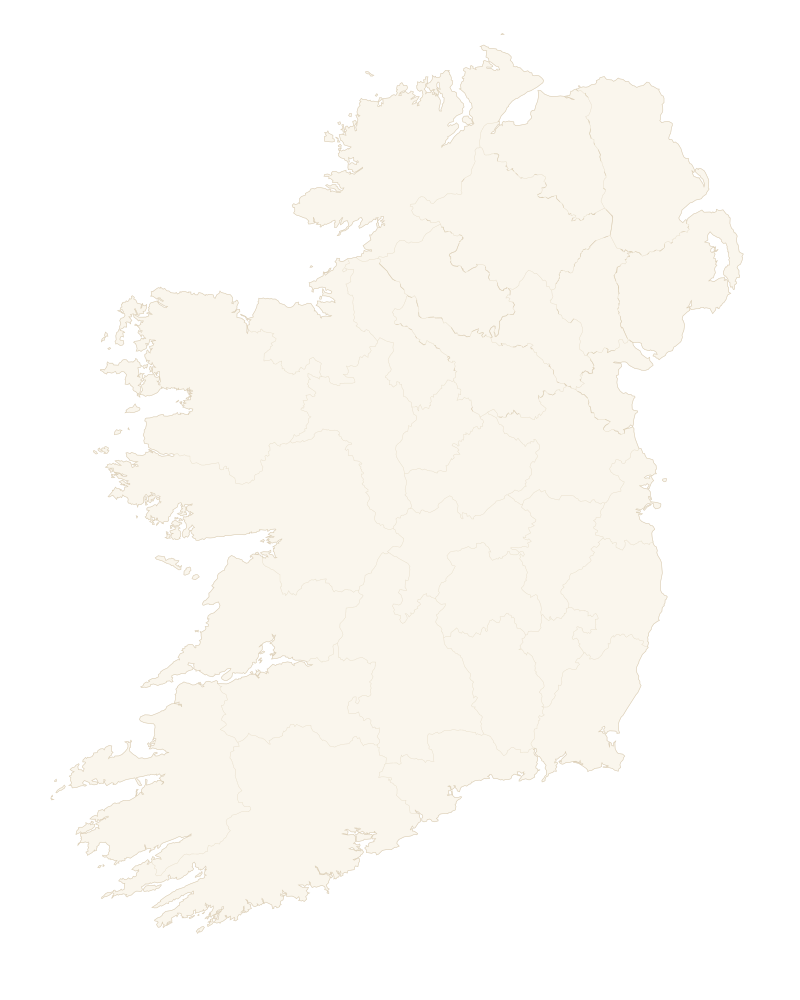
CoreHistoric reach
The seat of Murphy
Seat vacantChief
No one leads the Murphy community yet. When the movement opens, you can stand for its leadership, or help elect whoever does.
Current mission
No shared goal set yet. Once Murphy has leadership, it sets the public focus: a restoration, a gathering, a real-world project that helps its own.
The Murphy clan is being rebuilt. Join the waiting list for the movement today, and you help decide who leads it and what it does.
Help rebuild the Murphy clan →Motto
Fortis et hospitalis
“Brave and hospitable”
What does the Murphy name mean?
Anglicised from two parallel Gaelic surnames, Ó Murchadha, descendant of Murchadh, and Mac Murchadha, son of Murchadh. Murchadh was a personal name meaning 'sea warrior' (muir, sea + cadh, warrior). Three distinct Murchadh families gave rise to the modern Murphys: the Uí Cheinnselaig of Wexford, the Eóganacht line in Cork and Kerry, and the Ulster Murphys of Tyrone and Armagh. Anglicised to Murphy by the 17th century; the Gaelic forms survived in Irish-speaking districts into the 19th.
The history of Murphy
Sea warrior, and the three families who carried it
Murphy is the anglicised form of two Gaelic surnames that ran in parallel: Ó Murchadha, descendant of Murchadh, and Mac Murchadha, son of Murchadh. Murchadh was built from muir, sea, and cath, battle, so the name means something close to sea warrior, and both forms survive in Irish as Ó Murchú and Mac Murchú.
That was an ordinary name, and three separate Murchadhs founded three families who had nothing to do with one another. In the south east the Murphys were a chiefly family of the Uí Cheinnselaig of Wexford, ranked in the old genealogies beside the Kavanaghs, the Kinsellas and the O'Morchoes. In Munster a second line ran out of the Eóganacht, the dynasty that held Cashel, and filled Cork and Kerry. A third held Tyrone and Armagh.
The most consequential bearer belongs to the Leinster line. Diarmait Mac Murchadha, king of Leinster, was driven out in 1166 by the high king Ruaidrí Ó Conchobhair and went looking for an army to get his kingdom back. His bargain with Richard de Clare, Strongbow, brought the Normans ashore at Bannow Bay in 1169 and married his daughter Aoife to Strongbow at Waterford in 1170. He died in 1171.
Why so many Murphys are not cousins
Ireland was among the first countries in Europe to start using surnames. They began to appear in the century after 1002, when the Uí Néill lost the high kingship to Brian Boru of the Dál gCais, while most English families would not settle into fixed surnames until around 1400. That head start is part of why a handful of Irish names cover so many people: each had centuries longer than most English ones to multiply.
The Irish clan compounded it. A fine took in the chief and his patrilineal relatives, but also unrelated clients who lived under his protection and took the name of the leading lineage as a show of allegiance. Their descendants could never be elected chief, but they were Murphys on every list that mattered, and the old genealogies record the agnatic descent of chiefs and chieftains rather than of every member, so that crowd is invisible in them.
Murphys, then, are not one kindred and never were, and the Irish knew it. In Irish-speaking districts a man went by his father's and grandfather's names in the genitive rather than his surname, so Seán, son of Pól, son of Séamus, was Seán Phóil Shéamuis to his neighbours.
The clerks, the sheriffs and the end of the clan
The English spelling was a flattening rather than a translation. Anglicising clerks stripped the prefixes off many Gaelic surnames, and Murphy is what is left of both Ó Murchadha and Mac Murchadha once the Ó or the Mac is gone and the ending is spelled as an English ear heard it. That is how two distinct names collapsed into one. The English form was fixed by the seventeenth century, though the Gaelic forms stayed in daily use in Irish-speaking districts into the nineteenth.
The structure behind the name was dismantled as well. The sixteenth century carried English common law across Ireland, and authority passed from the clan chief and his country to the sheriff and his county. The Kingdom of Ireland was created in 1541, surrender and regrant replaced election by tanistry with succession by primogeniture, and after the Flight of the Earls in 1607 the lordships were disarmed.
Boolavogue, and the densest Murphy ground in Ireland
Wexford is still the county where the name sits thickest, the old Uí Cheinnselaig country of the Leinster line, and it is where the name entered modern Irish political memory. Father John Murphy, born in 1753, was parish priest of Boolavogue and led the Wexford rising of 1798. Boolavogue attached itself to the surname the way a battle honour attaches to a regiment.
The Wexford family that ended up holding Santa Clara County
Martin Murphy Sr. was born in County Wexford in 1785 and emigrated in 1820 to Quebec, then Lower Canada, with his wife Mary Foley and a family the genealogy puts at nine children. From Lower Canada they moved west into California, in the years when Mexican land grants were changing hands.
Martin Murphy Sr. settled at Rancho Ojo del Agua de la Coche in Santa Clara County, at the place now called San Martin. Martin Murphy Jr., born in County Wexford in 1807 and also an emigrant of 1820, settled at Rancho Pastoria de las Borregas, which is now Sunnyvale; his residence was later recreated as the Martin Murphy House museum. With Rancho Las Uvas, Rancho La Purísima Concepción and others, the family holdings ran to well over a hundred thousand acres.
John Marion Murphy, born at Frampton in Lower Canada in 1824, and Daniel Martin Murphy, born there in 1826, both started the mining town of Murphys. Daniel Martin's daughter Diana Helen Murphy inherited the ranch land and with her husband Hiram Morgan Hill co-founded Morgan Hill.
Five Murphys in the California legislature
Land turned into office inside one generation. Patrick W. Murphy, born in Quebec in 1837 and a son of Martin Murphy Jr., sat in the California State Assembly and then as a State Senator; his brother Bernard D. Murphy, born in 1841, was a lawyer who served a term in the State Senate and several as Mayor of San Jose. John Marion Murphy, who had helped found the town of Murphys, was Santa Clara County Sheriff and Recorder and also Mayor of San Jose. Five of the family sat in the state legislature: Patrick W., Bernard D., John C., J. E. and R. W. Murphy, and a Santa Clara County historical marker to the family stands at San Martin.
The Hunt County boy they turned away for being too small
Audie Leon Murphy was born on 20 June 1925 near Kingston in Hunt County, Texas, one of twelve children in a poor sharecropping family of Irish descent. His mother died when he was a teenager, and he picked cotton and shot small game to feed his younger brothers and sisters. Slight and boyish, he was turned down by the Marines and the paratroops as too young and too light; in 1942 he talked an Army recruiter into taking him.
He fought through Sicily and the Italian mainland in 1943 and landed in southern France in 1944, rising from private to staff sergeant and then by battlefield commission to lieutenant. On 26 January 1945 near Holtzwihr in Alsace his company was attacked by German infantry with tank support. He sent his depleted men back to cover, stayed forward alone directing artillery by field telephone, then climbed onto a burning tank destroyer and worked its machine gun for the better part of an hour until the attack broke. He was given the Medal of Honor for it.
He came home the most decorated American combat soldier of the war, holding every decoration for valour the Army offered. He wrote a plain memoir, To Hell and Back, which became a film in which he played himself, and acted mostly in Westerns thereafter. He is buried at Arlington, where his grave is among the most visited in the country.
The commonest name in Ireland, and what it carries
At home the name went into business and print. William Martin Murphy, born at Bantry in 1845, ran the Dublin tramways and owned the Irish Independent, and the 1913 dispute between his companies and their workers became the Dublin Lockout, which shaped the politics that led to the 1916 Rising. Cillian Murphy, born in 1976, is an actor from Cork, the Munster ground of the name rather than the Leinster one.
Murphy is the most common surname in Ireland by a clear margin, carried by roughly fifty-five thousand people on the island. It is fourteenth in Northern Ireland and sixty-fourth in the United States, and after Kelly the largest Irish surname in the diaspora. Folklore in Cork, Kerry and Mayo kept the sea in it, casting Murphys as protectors of coasts and fishing routes, an echo of Murchadh the sea warrior.
Two things follow for anyone who carries it. The name is not a single family tree, so there is no chief to look for and no one county to claim. And three separate Irish kindreds reached for the same word for the same reason, which every Murphy still carries: muir and cath, the sea and the battle.
Champions of the Murphy name
The bearers whose lives are inseparable from this surname. Each has their own page, biography, achievements, geography, connection to the family.
Historic Places, Rebuilt
Explore the streets and seats the Murphy name knew, rebuilt with AI as they stood in history.
The castles of the homeland
The great strongholds of the homeland, look one up, see what it looked like in its prime, and recreate it to explore.
 Ashford Castle, County MayoRestored · prime 1880
 Manderley CastleRestored · prime 1840
 Dublin CastleRestored · prime 1790
All castles in Ireland → · Strongest castles in Ireland → · Castles of Europe
Play As Your Clan
Hold a real castle against whatever you choose to send at it, take a ship out in her own service years, or stand at the shoulder of someone the record remembers. The chronicler sets the scene; the deeds are yours.
Notable bearers of the Murphy name
- Diarmait Mac Murchadha (c.1110–1171), king of Leinster who invited the Normans to Ireland
- Father John Murphy (1753–1798), parish priest of Boolavogue, leader of the 1798 Wexford Rising
- William Martin Murphy (1845–1919), newspaper proprietor, antagonist of the 1913 Lockout
- Audie Murphy (1925–1971), most-decorated American WWII soldier, actor
- Cillian Murphy (b. 1976), actor, Cork