Daly
also O'Daly, Daley, Ó Dálaigh
Of Corca Adain, the bardic family that taught Gaelic Ireland to write.
- Origin
- Leinster, Ireland
- Motto
- Deo fidelis et regi
- Famous bearer
- Donnchadh Mór Ó Dálaigh (c.1175–1244), bardic master-poet, abbot of Boyle
- Register
- Irish family
Where the Daly name comes from
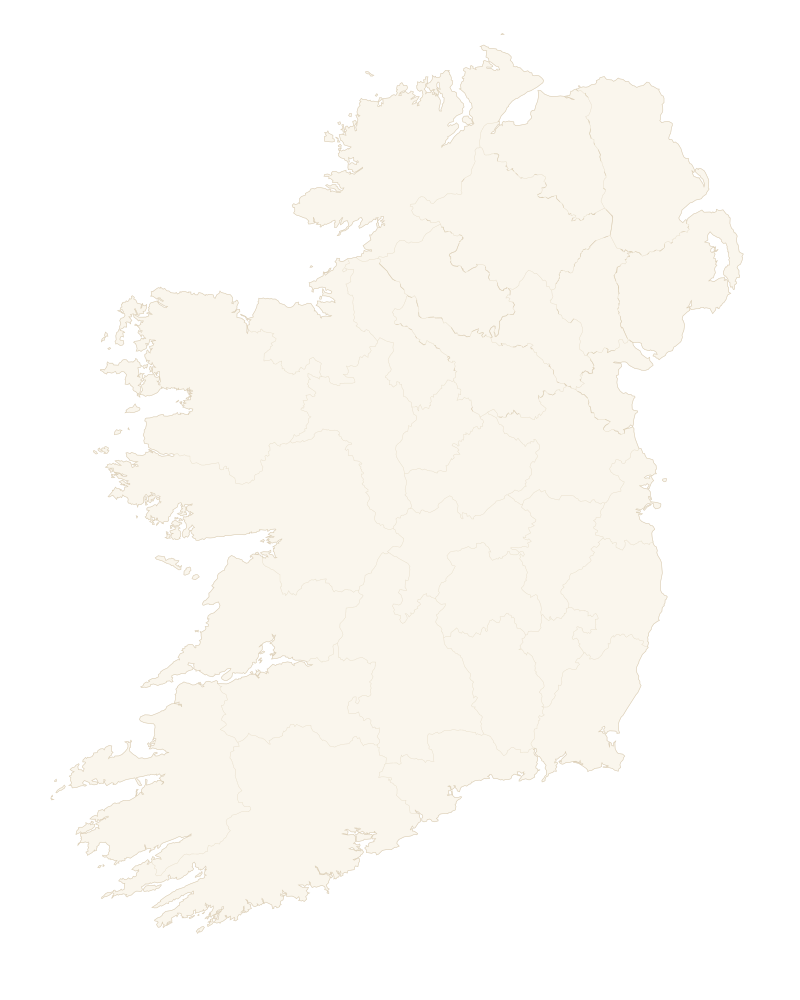
CoreHistoric reach
The seat of Daly
Seat vacantChief
No one leads the Daly community yet. When the movement opens, you can stand for its leadership, or help elect whoever does.
Current mission
No shared goal set yet. Once Daly has leadership, it sets the public focus: a restoration, a gathering, a real-world project that helps its own.
The Daly clan is being rebuilt. Join the waiting list for the movement today, and you help decide who leads it and what it does.
Help rebuild the Daly clan →Motto
Deo fidelis et regi
“Faithful to God and king”
What does the Daly name mean?
From Ó Dálaigh, descendant of Dálach. Dálach was an early-12th-century chief of a kindred at Corca Adain in west Meath, but the surname is overwhelmingly remembered for what came after: from the late 12th century onwards the Ó Dálaigh were the most prestigious bardic family in Gaelic Ireland, the hereditary file (poets) of the four provincial royal houses, holding bardic schools in Westmeath, Cavan, Clare and Cork that trained the entire poet-class of mediaeval Ireland for four hundred years.
The history of Daly
The chief at Corca Adain who left only his name
Ó Dálaigh means descendant of Dálach, and Dálach was a real man: an early-twelfth-century chief of a kindred at Corca Adain in west Meath. Surnames came into use in Ireland in the eleventh century, during the decline of Uí Néill dominance over the high kingship, which put the Irish among the first people in Europe to carry them; England's are generally dated from the preparation of the Domesday Book in 1086.
The genealogists place the O'Dallys among the chiefly families of Fir Teathbha, one of the southern Uí Néill groupings of the midlands, alongside the MacAwleys and the O'Shiels. The Irish word for such a kin-group, clann, is a borrowing from the Latin planta, an offshoot, and the O'Dalys were known poetically as Clann Dálaigh. But nothing that made the name famous rests on Dálach's lordship, which was small and local. That was made in the schools.
Twelve years to make an ollamh
From about 1170 the Ó Dálaigh were the hereditary file, the trained court poets, of the four great provincial royal houses of Ireland, and they ran the schools that produced the rest of the poet class, in Westmeath, Cavan, Clare and Cork, attested from that date to the collapse of the Gaelic order in the seventeenth century.
A fully trained ollamh, a master-poet, had spent twelve years inside one of them, memorising the metre and the fixed forms, the genealogies of the houses he would serve, and the law-tracts, all in the difficult bardic register of Classical Irish. What the family held was the licensing of the men who told the provinces who they were, and in a society where a lord's title was recited rather than filed, that was the more durable asset.
Donnchadh Mór at Boyle, Aonghus Fionn under the Tudors
Donnchadh Mór Ó Dálaigh (c.1175-1244) is the earliest of the great names, a bardic master-poet who was also abbot of Boyle: a man sitting across the join between the two learned systems of medieval Ireland, holding a religious house while ranked a master of the secular hereditary art.
Aonghus Fionn Ó Dálaigh (1540-1601) stands at the far end of the tradition, a Tudor-era bardic poet whose working life ran through the years in which English common law was pushed out across Ireland and the county and the sheriff replaced the country and the clan chief. The form he had trained in was intact; the political world that paid for it was being dismantled around him.
The lordships go, and the poets lose their patrons
The Kingdom of Ireland was created in 1541 and the Dublin administration set about bringing the Gaelic chiefs inside it, inventing titles for them such as Earl of Tyrone and Baron Inchiquin and granting them new coats of arms in 1552. The policy attached to this, surrender and regrant, changed succession to European primogeniture in place of Irish tanistry, under which a chief had been elected from among the agnatic cousins descended from a common grandfather.
That was the sentence of death on a bardic family, though it does not read like one. The Ó Dálaigh product was praise, genealogy and legitimation, and it existed because a Gaelic lordship had to be argued rather than simply inherited by rule. An eldest son does not need a poet to certify him, and a sheriff does not need a genealogy. The early seventeenth century finished the job: the Tudor reconquest destroyed the Gaelic aristocracy, the senior Ulster chiefs left in 1607 and ended their lives in Rome, and the Plantation of Ulster followed. Aonghus Fionn had died in 1601. The schools did not outlast the order they served.
Corbally becomes Castledaly, bought with Jamaican plantation money
The castle in the townland of Castledaly, County Galway, was called Corbally for centuries, and from the late sixteenth century it belonged to the Blakes, one of the fourteen Tribes of Galway, the merchant families who dominated the city from the thirteenth century to the nineteenth. In 1829 it was acquired by Peter Daly, with profits made from sugar plantations in Jamaica, and renamed after him.
This is the name re-entering landed Ireland by purchase and by plantation money, not by descent from any lordship. The Dalys remodelled the house through the nineteenth century, and from 1894 it was a seat of James Daly; the family's memorial tablets and the Daly mausoleum stand near the church. Today only the façade is standing, and the chief archaeological interest of the site is the older tower house swallowed inside the later building.
The Black Lady's tower, bought in 1895 and still lived in
Castle Salem, near Rosscarbery in County Cork, began as Benduff Castle, a fortified house built around 1470, almost certainly by Catherine Fitzgerald, daughter of Thomas, 7th Earl of Desmond, on her marriage to Finghin MacCarthy Reagh. Charles Smith, who called it "a strong romantic building", credited its construction to the O'Donovans instead, and Catherine is probably the figure remembered as the Black Lady in the legends told of Benduff.
Almost everything between then and the Dalys is confiscation. The land was taken in the Cromwellian settlement and granted under the Act of Settlement in 1678 to William Morris, whose family made the house their home from around 1660 until the early 1800s. The massive central tower of the late-medieval house still stands, with later domestic ranges attached. In 1895 the Daly family bought it, and their descendants run Castle Salem as a guest house today. Set against the bare façade at Castledaly, it is the one house of the name that was kept.
The Limerick baker who came out of Chatham into the Lord Mayor's chair
John Daly was born at Wickham Street, Limerick, on 18 October 1845, third son of a Limerick baker, in the Catholic working-class Limerick of the Famine generation, and was sent to the Christian Brothers' school at Sexton Street. Apprenticed to the family bakery at fifteen, he joined the Limerick Irish Republican Brotherhood at sixteen in 1861 and spent two decades as a baker and a Limerick IRB centre, a local-branch organiser, with a minor part in the Munster movement of 1867.
The Land War of 1879 to 1882 radicalised him. He took the Limerick centre-of-centres position in 1881 and ran Limerick's land-and-labour organising under Davitt's Land League, moving to Clan na Gael when the League collapsed. He was arrested at Birkenhead in April 1884, tried at the Warwickshire Assizes that July, convicted on the treason-felony charge and sentenced to penal servitude for life. He served twelve years, at Chatham, Portland and Wakefield, and was released on the Gladstone-Asquith amnesty of August 1896.
Limerick met him at the railway station. He went back to the bakery, won a town council seat at the 1898 Local Government Act elections, and on 1 January 1899, at fifty-three, was elected Lord Mayor of Limerick, the first IRB-affiliated person to hold the Lord Mayoralty of any Irish city; he served the 1899 and 1900 terms. Tom Clarke, whom he had known inside Chatham and Portland, married his niece Kathleen, and the Daly house at Wickham Street became the Limerick organisational centre of the pre-1916 IRB reorganisation. Clarke was the first of the 1916 signatories executed at Kilmainham. Daly died at Wickham Street on 30 June 1916, six weeks after him, seventy years old, and is buried at Mount Saint Lawrence.
The Ó falls off in the crossing
Anglicisation did to this name what it did to most Gaelic surnames: it took the prefix off. Ó Dálaigh, in which the Ó means descendant, became Daly and Daley, and the O'Daly form is now uncommon in either spelling. The changes were not stamped on anyone at a border post, whatever the Ellis Island story says; emigrants almost always made them at their own discretion, for clerks and neighbours who could not spell what they heard.
The name went to work at both ends of the empire it had left. Marcus Daly (1841-1900) was an Irish-born American copper-mining businessman. Dominick Daly (1798-1868) served the Crown as Governor of Prince Edward Island, of Tobago and of South Australia. A surname made to legitimise Gaelic kings finished up administering colonies for the state that had broken the lordships it once served.
Champions of the Daly name
The bearers whose lives are inseparable from this surname. Each has their own page, biography, achievements, geography, connection to the family.
Historic Places, Rebuilt
Explore the streets and seats the Daly name knew, rebuilt with AI as they stood in history.
Historic Places, Rebuilt · New
The MacCarthy lords' great tower-house in its prime, the battlements and the famous stone, high over wooded Muskerry.
Historic Places, Rebuilt · New
The O'Brien Earls of Thomond's great four-towered tower-house, hung with banners and famed for its feasts.
Historic Places, Rebuilt · New
The walled City of the Tribes at its Spanish-trade height, the quays, Lynch's Castle, and the fourteen merchant families.
Castles the Daly held
Strongholds this name held for a decade or more, look one up, or rebuild it to explore.
- Daly Castle
Acquired by Peter Daly in 1829 and renamed Castledaly; a Daly seat from 1894.
- Castle Salem
Bought by the Daly family in 1895; their descendants run it as a guest house.
Castles that share the Daly name
The same name on the map, look one up, see what it looked like in its prime, and recreate it to explore.

All castles in Ireland → · Strongest castles in Ireland → · Castles of Europe
Play As Your Clan
Hold a real castle against whatever you choose to send at it, take a ship out in her own service years, or stand at the shoulder of someone the record remembers. The chronicler sets the scene; the deeds are yours.
Notable bearers of the Daly name
- Donnchadh Mór Ó Dálaigh (c.1175–1244), bardic master-poet, abbot of Boyle
- Aonghus Fionn Ó Dálaigh (1540–1601), Tudor-era bardic poet
- Cearbhall Ó Dálaigh (1911–1978), President of Ireland, Chief Justice
- Richard J. Daley (1902–1976), Mayor of Chicago
- John Daly (b. 1966), American golfer; two-time major champion (PGA 1991, Open 1995)