Flynn
also O'Flynn, Ó Floinn
The reddish one, across three Ó Floinn septs.
- Origin
- Connacht, Ireland
- Famous bearer
- Errol Flynn (1909–1959), Hollywood actor (Captain Blood, Robin Hood)
- Register
- Irish family
Where the Flynn name comes from
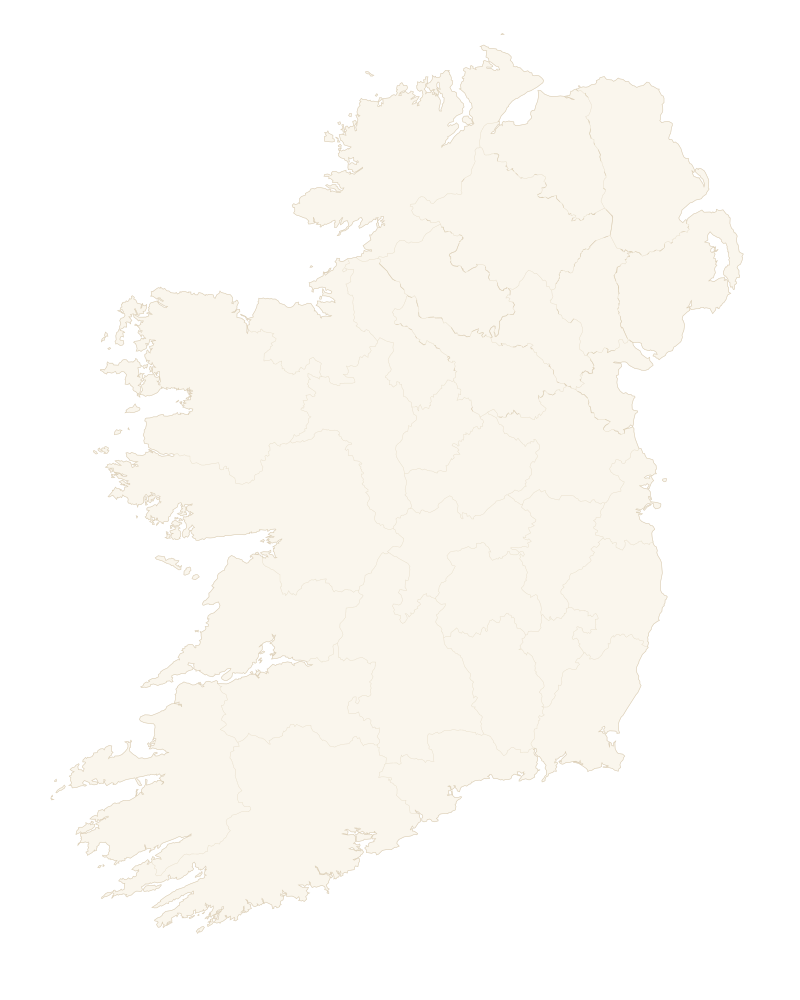
CoreHistoric reach
The seat of Flynn
Seat vacantChief
No one leads the Flynn community yet. When the movement opens, you can stand for its leadership, or help elect whoever does.
Current mission
No shared goal set yet. Once Flynn has leadership, it sets the public focus: a restoration, a gathering, a real-world project that helps its own.
The Flynn clan is being rebuilt. Join the waiting list for the movement today, and you help decide who leads it and what it does.
Help rebuild the Flynn clan →What does the Flynn name mean?
From Ó Floinn, descendant of Flann ('reddish' or 'ruddy'). At least three distinct Ó Floinn lines: the Connacht Ó Floinn of north-east Roscommon (the principal sept), the Munster Ó Floinn of north Cork around the river Bregog, and the Ulster Ó Floinn of east Antrim (a sub-sept of the O'Neill confederation). All Anglicised as Flynn. The personal name Flann itself was widely current in early Christian Ireland, the high king Flann Sinna (d. 916) is its most famous bearer.
The history of Flynn
Flann the ruddy, and why Flynn is not one family
Flynn is the English form of Ó Floinn, and possibly in some lines of Mac Floinn: descendant, or son, of Flann. Flann was a personal name meaning reddish or ruddy, a remark about complexion or hair that fixed on one man before it ever attached to his children. Irish kept using such tags in speech long after surnames hardened; a Pádraig Rua was red-haired Patrick. Flann was widely current in early Christian Ireland, and its most famous bearer was the high king Flann Sinna, who died in 916.
That is why the surname cannot be run back to one ancestor. At least three distinct Ó Floinn lines are on record, and they are not branches of each other: the Connacht Ó Floinn of north-east Roscommon, the principal sept; the Munster Ó Floinn of north Cork around the river Bregog; and the Ulster Ó Floinn of east Antrim. Each descends from its own Flann, and all three anglicised to the same word. Flynn is three histories wearing one spelling.
The Roscommon chiefs of Síol Maoil Ruain
The principal line held north-east Roscommon as chiefs of Síol Maoil Ruain, with their seat at Castlerea. Under Brehon law an Irish chief was appointed by his kinsmen as custodian of the clan and its property, answerable for maintaining and protecting both, and succession ran by tanistry: when a chief died the next was elected from the agnatic cousins descended from a shared grandfather or great-grandfather, not handed to an eldest son.
The country beneath them was cut into túatha, small divisions whose names still show through in the Irish baronies inside the modern counties. Flynn is densest today in Connacht, in Mayo and Roscommon above all, though the name is found across the island.
The Cork Ó Floinn and the argument about their descent
The Munster line held Muskerry-Flin, the country around modern Coachford in County Cork, on the Bregog. John O'Donovan, in work published in 1849, counted the Flynns of County Cork among the modern descendants of Lugaid mac Con, alongside the O'Driscolls, O'Learys, Coffeys and Hennessys. C. Thomas Cairney later set the same cluster among the chiefly families of the Corca Laoghdne, whom he traced to the Erainn.
Both rest on T. F. O'Rahilly's scheme of four waves of Celtic settlement, and that scheme is disputed. Francis John Byrne would not accept it, and Myles Dillon and Nora K. Chadwick noted that O'Rahilly had taken it from the eleventh-century Lebor Gabála Érenn, traditional history rather than contemporary evidence. What survives the quarrel is the company the Cork Flynns keep: the genealogists list them again and again with the same south-west Munster families.
East Antrim, and the men who took the name without the blood
The third line held lands around Larne in east Antrim as a sub-sept within the O'Neill confederation, separate again in descent from both Roscommon and Cork. Attaching to a greater lordship was ordinary practice, and it did something to surnames that a purely biological reading of them misses.
An Irish clan, a fine, was never only a bloodline. It held the chief and his patrilineal relatives, and it also held unrelated clients, who assumed the name of the leading lineage as a show of allegiance; they and their male-line descendants carried that surname permanently while remaining ineligible to be elected chief. A name could spread by politics as readily as by birth.
1541, surrender and regrant, and the end of chief-making
When the Kingdom of Ireland was created in 1541, Dublin set out to draw the Gaelic chiefs into it. New titles were minted for them, and new coats of arms granted in 1552. The price was surrender and regrant, and the sting sat in the succession clause: a title passed thereafter by primogeniture, not by tanistry, so the kinsmen who had elected their own custodian for centuries were written out of the choice.
Across the same century English common law was extended throughout Ireland under a centralised royal administration, and the county and the sheriff replaced the country and the clan chief. All three Ó Floinn lines lost political ground in the Tudor confiscations and again under Cromwell.
How Ó Floinn became Flynn
The Gaels were among the first peoples in Europe to take hereditary surnames, in the century of declining Uí Néill dominance that closed when Brian Boru of the Dál gCais took the high kingship in 1002. In Irish the name kept its grammar: a man was Ó Floinn, his daughter Ní Fhloinn.
Anglicisation stripped that away. The prefix went first, so Ó Floinn became O'Flynn and then simply Flynn, complete across the board by the eighteenth century. The flattening was not peculiar to this name: Ó Leannáin and Ó Lionáin, two separate names, both came out as Lennon. English spelling merged what Irish had kept apart, which is how three unrelated septs ended as one entry in a register.
Errol Flynn, from a Hobart laboratory to Captain Blood
Errol Leslie Thomson Flynn was born at Hobart, Tasmania, on 20 June 1909, only son of Theodore Thomson Flynn, an Australian marine biologist and University of Tasmania zoologist who later held the chair of Biology at Queen's University Belfast, and of Marelle Young, an Irish-Australian teacher. He was schooled at the Hobart Friends' School, and spent his late teens and early twenties roaming the western Pacific: shipping clerk at Sydney, gold prospector in New Guinea, Royal Australian Navy reservist.
He came to England in 1933 on a repertory opening at Northampton and served a classical-stage apprenticeship through the Northampton, Coventry and Birmingham companies across 1933-34. A Warner Brothers screen test at Birmingham in early 1935 won him a contract, and he sailed for Hollywood that June. Captain Blood, Michael Curtiz's adaptation of Rafael Sabatini's pirate novel, reached cinemas that December and handed him the lead at twenty-six.
What followed set the type for a generation: The Charge of the Light Brigade (1936), The Adventures of Robin Hood (1938), still the canonical Hollywood Robin Hood, The Sea Hawk (1940), They Died with Their Boots On (1941) and Gentleman Jim (1942), with a Walk of Fame star in 1960. His father's line traces to a Carlow Flynn emigrant family, so the name went from Ireland to Tasmania and back across the water into a Belfast chair before it reached a Warner Brothers marquee.
The Flying Doctor, the Flynn effect and Flynn's taxonomy
Three separate fields carry a Flynn's name permanently. John Flynn (1880-1951), a minister, founded the Royal Flying Doctor Service of Australia. James Flynn (1934-2020), an intelligence researcher working in New Zealand, is known for discovering the Flynn effect. Michael J. Flynn (born 1934), an American computer scientist, devised Flynn's taxonomy.
In sport, Edward Flynn (1909-1976) took gold as an American boxer at the 1932 Olympic Games, and Ray Flynn (born 1957) ran middle distance for Ireland. Gaelic games hold two men of the name and no connection between them: Paul Flynn (born 1986), the Dublin Gaelic footballer, and Paul Flynn (born 1974), the Waterford hurler.
The writing side is thick with the name: the American novelists Gillian Flynn (born 1971) and Vince Flynn (1966-2013) of the Mitch Rapp books, and the Irish historian Kitty Flynn (1926-2025). William J. Flynn (1867-1928) directed the Bureau of Investigation from 1919 to 1921. On screen the line runs on through Jerome Flynn (born 1963), who played Bronn across all eight seasons of Game of Thrones.
Champions of the Flynn name
The bearers whose lives are inseparable from this surname. Each has their own page, biography, achievements, geography, connection to the family.
Historic Places, Rebuilt
Explore the streets and seats the Flynn name knew, rebuilt with AI as they stood in history.
Historic Places, Rebuilt · New
The MacDonnell stronghold on its Antrim sea-stack, whole and inhabited, Clan Donald astride the North Channel.
Historic Places, Rebuilt · New
The MacCarthy lords' great tower-house in its prime, the battlements and the famous stone, high over wooded Muskerry.
The castles of the homeland
The great strongholds of the homeland, look one up, see what it looked like in its prime, and recreate it to explore.
 Ashford Castle, County MayoRestored · prime 1880
 Manderley CastleRestored · prime 1840
 Dublin CastleRestored · prime 1790
All castles in Ireland → · Strongest castles in Ireland → · Castles of Europe
Play As Your Clan
Hold a real castle against whatever you choose to send at it, take a ship out in her own service years, or stand at the shoulder of someone the record remembers. The chronicler sets the scene; the deeds are yours.
Notable bearers of the Flynn name
- Errol Flynn (1909–1959), Hollywood actor (Captain Blood, Robin Hood)
- Vince Flynn (1966–2013), thriller novelist (Mitch Rapp series)
- Jerome Flynn (b. 1963), actor (Game of Thrones)