O'Connor
also O'Conor, Ó Conchobhair, Connor
The royal house of Connacht, the last high kings of Ireland.
- Origin
- Connacht, Ireland
- Motto
- Ó Dia gach an cabhair
- Famous bearer
- Ruaidrí Ó Conchobhair (1116–1198), last high king of Ireland
- Register
- Irish family
Ranked of all time
The 10 Oldest Clans in Ireland
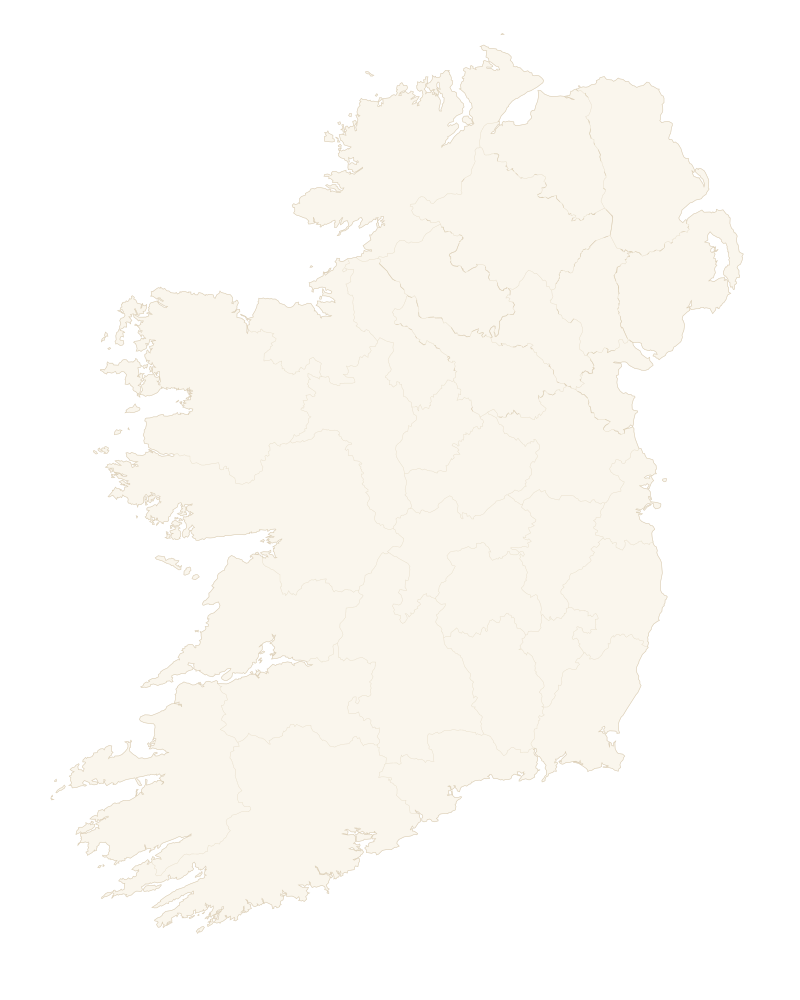
Where the O'Connor name comes from
CoreHistoric reach
The seat of O'Connor
Seat vacantChief
No one leads the O'Connor community yet. When the movement opens, you can stand for its leadership, or help elect whoever does.
Current mission
No shared goal set yet. Once O'Connor has leadership, it sets the public focus: a restoration, a gathering, a real-world project that helps its own.
The O'Connor clan is being rebuilt. Join the waiting list for the movement today, and you help decide who leads it and what it does.
Help rebuild the O'Connor clan →Motto
Ó Dia gach an cabhair
“All help is from God”
What does the O'Connor name mean?
From Ó Conchobhair, descendant of Conchobhar. Conchobhar means 'lover of hounds' (con, hound + cobhar, desire). The principal Conchobhar of the surname was Conchobhar mac Tairdelbach (d. 1067), king of Connacht, whose grandson Tairdelbach Mór Ó Conchobhair (1088–1156) was high king of Ireland. The Connacht O'Conors of Roscommon are the line; lesser Ó Conchobhair kindreds gave rise to the O'Connors of Kerry, Offaly (Uí Failí), and Sligo.
The history of O'Connor
Ó Conchobhair means descendant of Conchobhar, and five unrelated peoples said it
Ireland began fixing hereditary surnames earlier than most of Europe, in the century of declining Uí Néill dominance that opened when Brian Boru of the Dál gCais took the high kingship in 1002. The machinery was simple: Ó, historically Ua, means descendant, and takes a personal name in the genitive behind it. Ó Conchobhair froze one ancestor (Conchobhar, from con, hound, and cobhar, desire) into property passed down the male line. What it could not do was make every household that used it kin.
The medieval genealogists knew this. The compilations in the Book of Ballymote, the Book of Lecan and Dubhaltach MacFhirbisigh's Leabhar Mór na nGenealach place at least five separate Conchobhar kindreds on the island, drawn from populations the tract-writers held to be distinct: the Síol Muireadaigh of the Uí Briúin in Connacht, who produced the O'Connor Donn and the O'Connor Sligo alongside the MacDermots and MacDonaghs; the O'Connors of Kerry among the Ciarraighe Luachra; the O'Connors of Offaly, chiefs of the Uí Failghe beside the O'Dempseys and MacColgans; the O'Connors of Corcomroe among the Corco Modhruadh of north Clare, with the MacCurtins and O'Loghlens; and the O'Connors of Keenaght among the Cianachta, whose barony still carries the tribe's name though the Ó Catháin had conquered them by the twelfth century.
The branching was built into the succession rule as well. Under tanistry a chief was elected from the agnatic cousins descended from a shared grandfather or great-grandfather, so every contest that a cousin lost still left a household of sons entitled to the surname and to nothing else. Genetic work on these pedigrees suggests they hold up reasonably well back into the Middle Ages and fail badly before the seventh century, which is to say the surname is a real record of the medieval lordship, and a fiction about anything older.
Coill-an-clochain and Athenry: two deaths seven years apart
The Annals of the Four Masters record for 1309 the killing at Coill-an-clochain of Hugh, son of Owen, son of Rory, son of Hugh, son of Cathal Crobhdearg, a direct line from the Connacht kingship and, in the annalist's judgement, worthy heir to the monarchy of Ireland, the most hospitable and expert at arms of all the Irish born in his time. His killer was Hugh Breifneach, son of Cathal O'Conor. The chiefs cut down around him included Conor Mac Dermot and Dermot Roe, son of Teige O'Conor; on the other side fell Gilla-na-naev Mac Egan, chief Brehon of Connaught. The surname was on both ends of the spears.
Seven years later the same lordship threw everything it had at the Anglo-Norman settlement. Felim O'Conor mustered a very great army of the chiefs of Connacht and marched on Athenry, where William Burke and the Baron Mac Feorais Bermingham, lord of the town, had gathered the English of west Connacht and much of Leath Chuinn. The engagement was fierce and the Irish were beaten. Felim, from whom the annalist wrote the Irish had expected more than from any other Gael then living, was killed, and his standard-bearer Gilla-na-naev, son of Dailredocair Ua Dobhailén, went down with the banner.
Athenry did not extinguish the name: it demoted it. When Seán Mór Ó Dubhagáin drew up his verse register of the chiefs of Ireland, Triallam timcheall na Fodla, about 1372, the Ó Conchobhair kindreds were still there to be listed, but as lords among lords in a province now shared with Burkes and Berminghams rather than as a house that appointed high kings.
Dumhach Uí Chonchúir, the sandbank the Clare O'Connors bought with a castle
The Corcomroe branch put down its principal stronghold in 1306 at the mouth of the Inagh River, on the dunes Irish still calls Dumhach Uí Chonchúir, the sandbank of the O'Connors. The position was chosen for revenue as much as defence: from that spit the lords of Corcomroe controlled both the land road and the water traffic working the estuary. It is the clearest statement of what a lesser Ó Conchobhair lordship actually was: not a kingdom, a toll gate with walls.
Nothing the O'Connors built there still stands. By 1584 Dough Castle was in the hands of the family of Sir Donal O'Brien, and the fragment of tower that survives in the sandy ground beside Lahinch is O'Brien work on an O'Connor site. Local tradition kept a stranger tenant on the same dunes: Donn Dumhach, Donn of the sandhills, a sí prince said to walk there still, the folklore outliving both families that fought over the ground.
Sligo: holding a castle in subjection to the O'Donnells
Sligo Castle was raised in 1245 by Maurice FitzGerald, Justiciar of Ireland, and the Annals of Connacht note the humiliation attached: Fedlim O'Conchobar, king of Connacht, was bidden to build it at his own cost, and the stone and lime came from the spital house of the Trinity, a site the Justiciar had earlier granted to the clergyman Clarus Mag Mailin for a hospital. On 9 December 1294 the forces of Richard de Burgh, Earl of Ulster, destroyed it; John fitz Thomas answered by seizing the earl and holding him in Lea castle three months, until he relinquished all authority over fitz Thomas in Connacht.
By the 1530s the rebuilt castle was held by the O'Conors Sligo, but generally in subjection to the O'Donnells, princes of Tyrconnell, to whom both the castle and the territory of Carbury had belonged. That is the honest shape of the northern branch's power: a royal surname operating as a sub-lordship on somebody else's ground, wedged between Tyrconnell above and the earldom below.
They could still hit hard inside that box. John Dolan of Fermanagh, writing his family's history in 1718, records that in 1528 the O'Dolans took the O'Rourke side in a battle against the O'Connor Sligo, lost, and were driven out of Corran in County Sligo. Nothing of Sligo Castle now survives; its probable site is the plot occupied by the town hall on Quay Street, and ruins nearby were long known locally as Castle Connor.
Surrender and regrant: how a chief was converted into a tenant
When the Kingdom of Ireland was created in 1541, the Dublin administration set out to bring the Gaelic chiefs inside the new structure rather than simply destroy them. It invented titles for them (Baron Upper Ossory, Earl of Tyrone, Baron Inchiquin) and granted them new coats of arms in 1552. The price, buried in the policy called surrender and regrant, was the succession itself: a lordship handed back and reissued by the Crown descended thereafter by primogeniture, not by the election of a tanist from among the agnatic cousins. One signature ended the practice that had made the surname multiply.
Ballymote Castle shows the transaction in miniature. Built around 1300 by Richard Óg de Burgh, second Earl of Ulster, the Red Earl, as the last of the Norman castles in Connacht, a keepless rectangle with thick curtain walls, six three-quarter round towers and a double-towered north gate on the Beaumaris pattern, it had passed to the MacDonaghs by 1381 and belonged in 1561 to Tadhg MacDermot, one of the last kings of Moylurg. By about 1571 it appears in the hands of the O'Connor Sligo, who surrendered it and had it regranted: the Norman fortress accepted from the Crown on Crown terms.
The hold was brief. In 1598 the English gave the castle up to the MacDonaghs, who sold it shortly afterwards to Red Hugh O'Donnell, one account putting the price at £400 and 300 cows. Through the same decades English common law spread across the island and the county and the sheriff replaced the country and the clan chief; after the Flight of the Earls in 1607 the lordships were disarmed for good.
Ní, Bean Uí and Óg: the grammar the anglicised name lost
In Irish the surname declines. A man is Ó Conchobhair; his daughter takes Ní, a reduction of Iníon Uí, descendant's daughter, and the following name is lenited; a woman who takes her husband's name becomes Bean Uí Chonchobhair, or simply Uí Chonchobhair with the Bean dropped. The woman recorded as Máireag Bean Uí Conchobhair Fáilghe, who died in 1451, is legible at a glance to anyone with the grammar: not born to the name but married into it, and specifically into the Offaly line, Uí Failghe, rather than the Connacht one.
Epithets did the work that Roman numerals and 'junior' do elsewhere, sitting between the given name and the surname: Mór for the elder, Óg or Beag for the younger, so Tairdelbach Mór Ó Conchobhair is the senior of that name. Colour terms did the rest informally: Pádraig Rua for the red-haired, Máire Bhán for the fair. In the Gaeltacht a man is still named by a double patronymic, father and grandfather in the genitive, on the pattern of Seán Phóil Shéamuis: the older system the surname was cut from, still running underneath it.
Around the chiefs stood hereditary professions with names of their own. The Mac Tuile family, anglicised Tully, were hereditary physicians to the O'Connors of Connacht and to the O'Reillys of Breifne, and one Mac Tuile is reported by an eye-witness to have stood as physician at the inauguration of Cathal O'Conor. A Gaelic lordship carried its doctors, brehons and poets as offices held by families, which is why the death of a Mac Egan brehon at Coill-an-clochain was worth recording alongside the death of a prince.
How one spelling swallowed five dynasties
Anglicisation flattened the whole system. Clerks writing Gaelic names in English routinely dropped the prefix altogether (Ó Fathaigh went down as Fahey or Fay, Ó Ceallaigh and Ó Cadhla both came out as Kelly) and where the prefix survived, Ó and Ui were rendered as O'. That convention is why Ó Conchobhair reaches the modern page as O'Connor, and why the stripped forms Connor and Connors carry no trace of the Ó at all, as John O'Sullivan Jr. quietly becomes John Sullivan Jr. The senior Connacht house kept the older written form, O'Conor.
The other half of the answer is that a Gaelic clan, a fine, was never only a bloodline. It contained the chief and his patrilineal relatives, and also unrelated clients who assumed the leading lineage's name as a show of allegiance; those client families and their descendants were permanently ineligible to be elected chief, but they and their children were Ó Conchobhair on every roll. Five unrelated royal kindreds, each with its clients, each losing branches at every failed succession, then all funnelled through one English spelling: that is the arithmetic behind how many O'Connors there are.
Under the same pressure the feminine forms died in English. Nic gave way to Mac regardless of sex among English-speaking families of Gaelic heritage, wives began taking their husbands' surnames outright, and the declensions that once told a reader whether a woman was born to a name or married into it stopped being written down.
The name after the lordship: Chartists, Bolívar's officers, and Grafton Street
Once the lordships were disarmed the surname went where the Irish went, and it turns up wherever there was a fight to join. Arthur O'Connor (1763–1852) was a United Irishman who ended his career as a general in Napoleon's army; Feargus O'Connor (1794–1855) led the Chartists; Francis Burdett O'Connor served as an officer in the Irish Legion of Simón Bolívar's army in Venezuela. Luke O'Connor (1831–1915) was the first man to receive the Victoria Cross and rose to general. Rory O'Connor (1883–1922), Director of Engineering of the anti-Treaty IRA, held the Four Courts in Dublin and was executed for it.
Others built and wrote. C. Y. O'Connor (1843–1902) was an Irish engineer; T. P. O'Connor (1848–1929), an Irish journalist and politician; Batt O'Connor, an Irish builder who worked for the revolutionary Michael Collins; Basil O'Connor (1892–1972), the American lawyer who co-founded the National Foundation for Infantile Paralysis with Franklin D. Roosevelt. Flannery O'Connor (1925–1964) wrote from the American side of the same diaspora.
Sinéad O'Connor (1966–2023) took the name furthest. Born at Glenageary in Dublin to John O'Connor, a structural engineer who later went to the bar and chaired the Divorce Action Group of Ireland, she was placed at fifteen in the Grianán centre at the High Park Magdalene laundry over adolescent shoplifting, and was found at seventeen busking on Grafton Street by the producer Fachtna Ó Ceallaigh, who signed her to Mother Records in 1985. The Lion and the Cobra followed in November 1987; in January 1990 her recording of Nothing Compares 2 U, an unreleased Prince composition, went to number one in seventeen countries. In 2002 she recorded Sean-Nós Nua, a full album of traditional Irish song in the unaccompanied sean-nós style, the oldest thing the surname owns, sung by its most famous modern bearer.
Champions of the O'Connor name
The bearers whose lives are inseparable from this surname. Each has their own page, biography, achievements, geography, connection to the family.
Historic Places, Rebuilt
Explore the streets and seats the O'Connor name knew, rebuilt with AI as they stood in history.
Castles the O'Connor held
Strongholds this name held for a decade or more, look one up, or rebuild it to explore.
- Ballymote Castle
Held by the O'Connor Sligo from about 1571, surrendered and regranted.
- Dough Castle
Established by the O'Connors, lords of Corcomroe, in 1306 as their principal stronghold.
- Sligo Castle
The O'Conors Sligo held the rebuilt castle in the 1530s, generally in subjection to the O'Donnells.
The castles of the homeland
The great strongholds of the homeland, look one up, see what it looked like in its prime, and recreate it to explore.
 Ashford Castle, County MayoRestored · prime 1880
 Manderley CastleRestored · prime 1840
 Dublin CastleRestored · prime 1790
All castles in Ireland → · Strongest castles in Ireland → · Castles of Europe
Play As Your Clan
Hold a real castle against whatever you choose to send at it, take a ship out in her own service years, or stand at the shoulder of someone the record remembers. The chronicler sets the scene; the deeds are yours.
Notable bearers of the O'Connor name
- Ruaidrí Ó Conchobhair (1116–1198), last high king of Ireland
- Tairdelbach Mór Ó Conchobhair (1088–1156), high king, builder of churches at Tuam and Clonfert
- Sandra Day O'Connor (1930–2023), first woman justice of the US Supreme Court
- Sinéad O'Connor (1966–2023), singer
- Rory O'Connor (1883–1922), anti-Treaty IRA Director of Engineering, executed 1922