Ford
The crossing, stamped on Shakespearian country.
- Origin
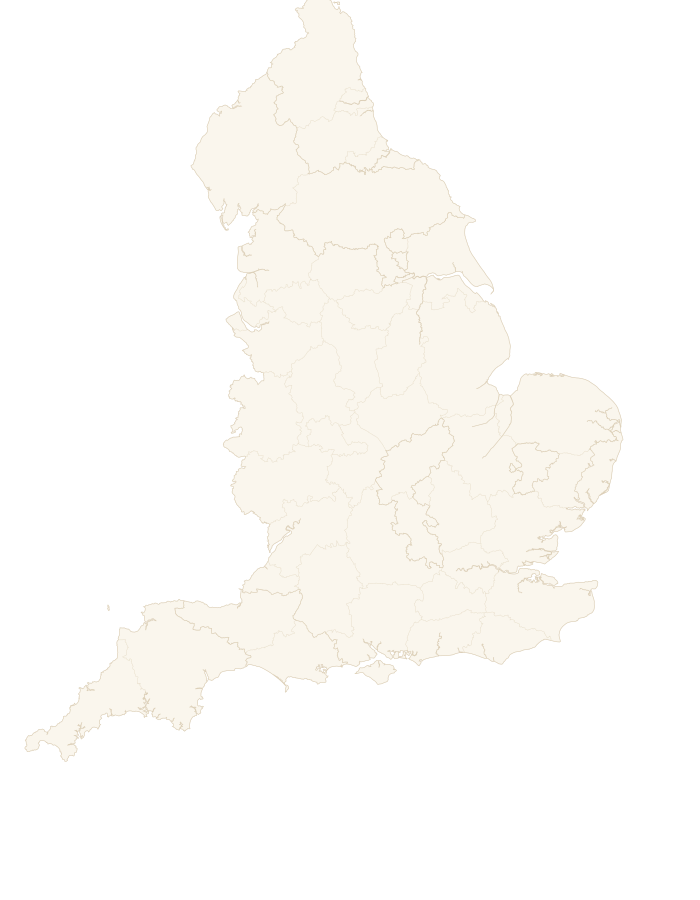
- South West, England
- Register
- English family
Where the Ford name comes from
CoreHistoric reach
The seat of Ford
Seat vacantChief
No one leads the Ford community yet. When the movement opens, you can stand for its leadership, or help elect whoever does.
Current mission
No shared goal set yet. Once Ford has leadership, it sets the public focus: a restoration, a gathering, a real-world project that helps its own.
The Ford clan is being rebuilt. Join the waiting list for the movement today, and you help decide who leads it and what it does.
Help rebuild the Ford clan →What does the Ford name mean?
Locative, the ford. Old English ford.
The history of Ford
The crossing, not the stream
Ford is one of the plainest words in English and one of the most consequential. It comes straight from the Old English and Middle English ford: the shallow, gravelled place where a river could be walked, ridden or driven across. Before bridges were ordinary things, that was the only place a road could reach the far bank. The ford did not sit beside the road. The ford was the road.
That is what separates this name from the other water surnames in the catalogue. A brook or a burn names the water. Ford names the crossing, and a crossing means traffic: drovers, pack trains, pilgrims, tax collectors and armies all funnelled down to the one shallow place and slowed to a walk. Villages clustered at fords because hooves had to pause.
So a man written down in a medieval roll as living at the ford was not living somewhere incidental. He lived at a choke point, the busiest ground in the parish, where strangers arrived and where a district's traffic could be counted, taxed or stopped. When the byname hardened into a surname, what it fixed on his descendants was that position.
September 1066, decided at the crossings
For the argument in its shortest form, take the five weeks of 1066 in which England changed hands. Harald Hardrada of Norway beat an English army under the earls Edwin and Morcar at the Battle of Fulford on 20 September; Harold Godwinson marched north and caught the Norwegians at Stamford Bridge on 25 September, where Hardrada and Tostig were killed and only 24 of their 300 ships were needed to carry the survivors home. Two battles five days apart, each fought where an army had to get across water.
What followed Hastings makes the point harder still. William marched round the coast of Kent to London, beat an English force at Southwark, then found he could not storm London Bridge. Unable to take that crossing he had to find another: he moved up the Thames valley and crossed at Wallingford in Berkshire, where Archbishop Stigand submitted to him, then swung north-east along the Chilterns to come at London from the far side.
The Conqueror's road to the throne was written by where a river would let an army over, and that is the logic behind every Ford in the country. The crossing decided where the road ran, the road decided where people settled, and the settlement gave its name to the families living at it.
de la forda, æt Fordan, de la Forthe
The surname can be watched forming, and the earliest instances are dated. A de la forda appears in the eleventh century, an æt Fordan in the twelfth, a de la Forthe in the thirteenth, and Foorde and de Furd in the fifteenth. Read in order they are the language politics of conquered England: a French preposition wrapped round an English word, then the Old English æt reasserting itself, then the spelling drifting before it settled. The Conquest had made Anglo-Norman the language of the ruling class and turned official documents from Old English into Latin, but it left placenames alone. The ford stayed a ford; the scribe put de la in front of it.
The habit of naming a man for his land came in with the new landholders. Family names in England are generally credited to the making of the Domesday Book in 1086, and the early Norman nobility marked themselves out by putting de, of or from, before their village or estate in France. That territorial surname began at the top; the oldest recorded surname inherited by more than one generation is dated to about 1140. From the gentry the habit spread down, and by the 14th century most English and most Lowland Scottish people used surnames, the great majority hereditary by 1400. Before that, the man at the ford was described. After it, his grandchildren were Ford wherever they lived.
A Ford in nearly every shire
Some Fords took the name from the crossing at the foot of their own fields; others from a settlement actually called Ford, and there are a great many of those. Ford in Northumberland, a Ford in Somerset, Ford in Shropshire and Ford in West Sussex are named directly from the Old English ford, and Forde in Dorset belongs with them. Beyond those the map carries Fords in Argyll, Buckinghamshire, Derbyshire, Gloucestershire, Herefordshire, Merseyside, Pembrokeshire, Staffordshire and Wiltshire, and five more in Devon alone.
Which means there is no single Ford family and never was. The name was struck independently at dozens of unconnected hearths wherever a river ran shallow and a household lived close enough to say so, so a Ford in Ohio and a Ford in Dunedin are likelier to descend from two different crossings than from one ancestor. The University of the West of England study concluded in 2016 read sources from the 11th to the 19th century for all 45,602 surnames in Britain and Ireland, over 90 per cent of them native to these islands, and its leader Richard Coates put Ford's class of name simply: names linked to a place, as Hill or Green are.
The weight of the name in this catalogue sits across the west and south-west of England, from Devon and Cornwall through Somerset, Dorset and Wiltshire to Shropshire, Staffordshire, Worcestershire and Herefordshire, Warwickshire and the Black Country. Ford is the place name behind half of Warwickshire's crossroads poetry, and it was ordinary enough in Shakespeare's own country that he gave it to a citizen and his wife, Ford and Mistress Ford of The Merry Wives of Windsor.
The Irish Fords and a mistranslation that stuck
Ireland has its own Fords, and most of them never had anything to do with a river crossing. Three Irish surnames were anglicised to Ford, two by outright mistake. Mac Giolla na Naomh, son of Giolla na Naomh, and Mac Conshámha, son of Conshnámha, were both rendered as Ford because the final syllable of each was once wrongly taken for the Irish áth, a ford. Both were borne by septs centred in Connacht.
The third is stranger. Ó Fuartháin means descendant of Fuarthán, a personal name from the Irish fuar, cold. It was later read instead as fuarathán, a cold little ford, and on the strength of that misreading it too was translated into English as Ford. Its sept was centred in County Cork, in Munster. So a Munster family whose name meant the descendants of a man called Cold came out of anglicisation holding an English word for a river crossing: these names were not so much translated as overwritten by clerks working in the wrong language.
Not every Irish Ford arrived that way, because the name in Ireland may be of English or Irish origin: one noted family of the name in County Meath came over from Devon in the fourteenth century. Ireland has generally preferred the variant spelling, the birth records for 1890 showing 154 Fordes registered against only 39 Fords, so a family that spells it Forde is holding a clue. Two further doors lead in from the continent, an americanised form of like-sounding Jewish surnames and a translation of the German Fürth.
The Fords who carried the name
The most consequential English bearer made the name twice over: Ford Madox Ford, 1873 to 1939, novelist and publisher, grandson of the painter Ford Madox Brown. He founded the English Review, discovered D. H. Lawrence and collaborated with Joseph Conrad, and his two great books, The Good Soldier and the Parade's End tetralogy, stand among the foundational modernist English novels. Others carried the name into public life closer to home: Clare Ford, 1828 to 1899, English diplomat; E. B. Ford, 1901 to 1988, British ecological geneticist; and David Ford, born 1951, Minister for Justice in Northern Ireland.
The Ford who changed the world was a Michigan farm boy. Henry Ford, 1863 to 1947, founded the Ford Motor Company at Detroit in June 1903 and introduced the Model T in October 1908, turning the motor car from an expensive luxury into the universal vehicle of the modern world; in January 1914 the moving assembly line went into his Highland Park plant. Anyone arriving here from a car badge should know that the Michigan dynasty is one Ford family among thousands, and most people called Ford have no connection to it.
The surname reached America and Australasia in the ordinary way, in the luggage of tenant farmers, labourers and soldiers leaving English shires and Irish counties, and it arrived already several hundred years old. What those families carry is a piece of local geography that mattered: somewhere there is a shallow place in a river where a road came down to the water, where the traffic of a whole district had to slow to a walk, and where somebody's ancestors lived close enough to be known by it. That is the inheritance in the name: not a castle and not a crest, but the place everyone else had to pass through.
Champions of the Ford name
The bearers whose lives are inseparable from this surname. Each has their own page, biography, achievements, geography, connection to the family.
- Ford Madox Ford
The grandson of the painter Ford Madox Brown who founded the English Review, discovered D. H. Lawrence, collaborated with Joseph Conrad, and wrote The Good Soldier and the Parade's End tetralogy, two of the foundational modernist English novels.
- Henry Ford
The Michigan farm-boy whose June 1903 founding of the Ford Motor Company at Detroit and his October 1908 introduction of the Model T transformed the motor car from an expensive luxury into the universal vehicle of the modern world, and whose January 1914 introduction of the moving assembly line at the Highland Park plant founded the modern method of industrial mass production.
Historic Places, Rebuilt
Explore the streets and seats the Ford name knew, rebuilt with AI as they stood in history.
Castles that share the Ford name
The same name on the map, look one up, see what it looked like in its prime, and recreate it to explore.

All castles in England → · Strongest castles in England → · Castles of Europe
Play As Your Clan
Hold a real castle against whatever you choose to send at it, take a ship out in her own service years, or stand at the shoulder of someone the record remembers. The chronicler sets the scene; the deeds are yours.