Morton
The moor settlement, marcher villages.
- Origin
- North West, England
- Register
- English family
The Morton arms and country

Coat of armsMortonArmsLobsterthermidor · CC BY-SA 3.0

- Coat of arms: Granted to an individual and inherited down that one documented line. These are the arms of particular families of the name, not of everyone who shares the surname.
CoreHistoric reach
The seat of Morton
Seat vacantChief
No one leads the Morton community yet. When the movement opens, you can stand for its leadership, or help elect whoever does.
Current mission
No shared goal set yet. Once Morton has leadership, it sets the public focus: a restoration, a gathering, a real-world project that helps its own.
The Morton clan is being rebuilt. Join the waiting list for the movement today, and you help decide who leads it and what it does.
Help rebuild the Morton clan →What does the Morton name mean?
Locative, moor farm (mōr-tūn). Midlands and northern toponyms.
The history of Morton
The farm at the edge of the moor
Morton is mor-tun, the farm on the moor: grazing too high and too sour for corn, sheep working above the fog line, peat underfoot. The second element, tun, is the workhorse ending of English habitation names and it did not hold still: an enclosure in one name, a farmstead, village, manor or whole estate in others, depending on when and where it was coined. What the name fixed was the ground rather than the buildings, and the ground was moor.
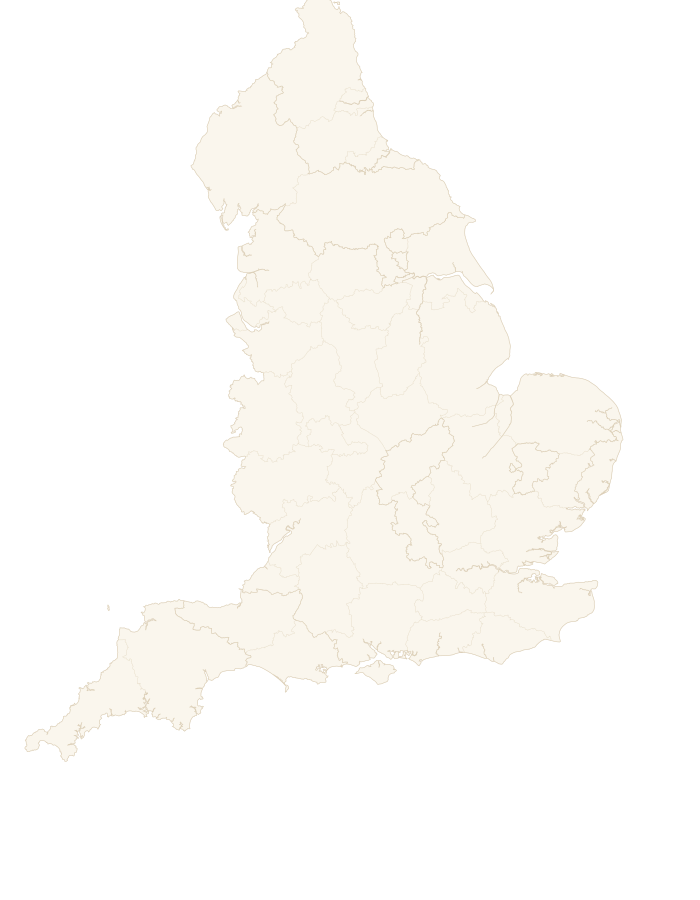
That ground is the reason there is no single Morton. Wherever English speakers farmed the fringe of upland grazing they had cause to call the place the moor farm, and they did it independently, over and over. The name settles across Lincolnshire, Nottinghamshire, the Derbyshire Peak, Leicestershire and Northamptonshire, west into Gloucestershire, Somerset and Cornwall, and up the northern spine through Cheshire, Lancashire, Cumbria and the Yorkshire ridings. Northern Mortons share their turf with Scottish Morton placenames, and the surname is reckoned English, Irish and Scottish at once rather than any one of the three.
You only became a Morton once you had left Morton
A habitation surname is conferred by outsiders. Inside the moor farm nobody needed it; the man was Robert, and everyone knew which Robert was meant. The road made the name. Medieval traffic ran from the small settlement towards the larger, and arriving there forced a newcomer to be told apart from every other Robert already in the place. The obvious label was the place he had walked out of, which is why habitation surnames cluster on small communities: far more people carry the name of a village than of a large city.
The consequence is worth stating plainly. Mortons across the Midlands and the north are not one kindred that spread outward; they are many unconnected households who each left a different moor farm and were named for it at the far end of the journey. The four-year study led from the University of the West of England, which concluded in 2016 and published its findings in the Oxford English Dictionary of Family Names in Britain and Ireland, found more than ninety per cent of its 45,602 names native to Britain and Ireland, and its lead Richard Coates set names linked to a place apart from the patronymics that enshrine a father. A Morton is named for a landscape, not an ancestor.
Domesday, the Norman de, and the century the name froze
The machinery that turned a place into a heritable surname was Norman. The conquest replaced the English landholding class almost entirely: historians put the number of Norman landholders at roughly 8,000, and by the time the Domesday Book was completed in 1086 only about five per cent of the land in England south of the Tees was left in English hands. Domesday was the instrument as much as the record, a catalogue divided by shire listing every tenant-in-chief's holdings and naming who had held each piece of ground before 1066. The introduction of family names in England is generally dated to that survey.
The new aristocracy brought the habit that set the pattern. Norman lords distinguished themselves by putting de, meaning of, in front of the village or estate they held, a territorial surname produced directly by feudal landownership, and because their holdings lay scattered piecemeal across England and Normandy, naming the place did real work. What the conquest did not change was the placenames, so Old English moor-farm names went on being spoken by the people who worked them, and when territorial bynames spread down from the gentry the label waiting to be picked up was an English one.
Christopher Daniell dates what may be the first recorded surname inherited by multiple generations to 1140. By 1400 most English families, and those of Lowland Scotland, were using hereditary surnames, though mandatory surnames met resistance in late-medieval England because people associated them with taxation. Henry VIII, who reigned from 1509 to 1547, ordered marital births recorded under the father's surname, and the transmission that carries Morton to the present was locked in place.
The reporter who drove a Bullnose Morris round England
Henry Canova Vollam Morton was born at Ashton-under-Lyne in July 1892, the son of a journalist who moved the family to Birmingham. He joined his father's paper at sixteen, went to London in 1912 for the Daily Mail and from 1921 the Daily Express, and at thirty-one gave the Express the first English newspaper interview with Howard Carter at the opening of Tutankhamun's tomb.
The book that made him began with an illness. Taken ill on assignment in Palestine in 1923 and expecting the worst, he promised himself that if he recovered he would go home and see his own country before he saw more of anyone else's. Through the autumn of 1926 he drove a Bullnose Morris around England, filing weekly columns for the Express, and collected them in 1927 as In Search of England. It sold over a million copies across thirty-nine printings before the war and reset what an English popular travel book could be: chatty, anecdotal, antiquarian, ready to stop the car at any market cross or pub sign, addressed to a readership nobody had written for before.
In Search of Scotland (1929), In Search of Ireland (1930) and In Search of Wales (1932) sealed the quartet, and the 1930s carried him out to the Holy Land: In the Steps of the Master (1934) retraced the gospel sites, In the Steps of St Paul (1936) the Pauline journeys. Methuen kept him continuously in print from 1927 and sales across the catalogue ran into the millions, making him the most-read English travel writer of the inter-war years. He moved to South Africa in 1947, wrote several more books there, and died at Somerset West on 18 June 1979, aged eighty-six.
The Mortons who took American public office
The name crossed the Atlantic and went almost directly into office. Levi P. Morton (1824-1920) served as the twenty-second vice-president of the United States, and Oliver Hazard Perry Morton (1823-1877) sat in the Senate for Indiana. In Massachusetts the name held both the executive and the bench: Marcus Morton (1784-1864) was governor of the state, and Marcus Morton (1819-1891) was chief justice of its Supreme Judicial Court.
Julius Sterling Morton (1832-1902) served as United States Secretary of Agriculture and Joy Morton owned the Morton Salt Company. James St. Clair Morton (1829-1864) was an American military officer, Dudley W. Morton (1907-1943) commanded a United States Navy submarine in the Second World War, Samuel George Morton (1799-1851) was a physician and natural scientist, and Henry Morton (1836-1902) was the first president of the Stevens Institute of Technology.
Sculpture, speedway and the screen at home
The modern English weight of the name lies where the northern moors are, from Cumbria and Lancashire through Cheshire and Merseyside into the Yorkshire ridings. Mary Morton (1879-1965) was a British sculptor and May Morton (1894-1965) an English actress; Samantha Morton, born in 1977, is an Academy Award-nominated English actress. Scotland carries the name in the actor and singer Euan Morton, born the same year, and the comedian Eleanor Morton.
Sport supplies much of the rest. Chris Morton, born 1956, was an English motorcycle speedway rider, as were Ray Morton and Wal Morton; Les Morton, born 1958, was an English racewalker, Ian Morton, born 1970, an English cricketer, Tyler Morton, born 2002, an English footballer, and Jordan Morton a Scottish footballer. Keith William Morton, born 1930, is a British mathematician.
The moor farm carried overseas
Beyond Britain and America the name settled wherever English speakers went. Kate Morton, born 1976, is an Australian author; Tex Morton (1916-1983) was a New Zealand entertainer, songwriter and actor; Cale Morton, born 1990, is an Australian footballer and Craig Morton, born 1961, an Australian international rugby union player. Adam Morton (1945-2020) was a Canadian philosopher, Alexandra Morton, born 1957, is an American and Canadian marine biologist, and in New Zealand Susan Morton is a professor of epidemiology and population health.
None of them descend from one Morton hall, and that is the point of the name. It began as the plainest description an English farmer could give of where he lived, up on the moor above the good land, and it has gone a great deal further than the moor ever could.
Champions of the Morton name
The bearers whose lives are inseparable from this surname. Each has their own page, biography, achievements, geography, connection to the family.
Castles that share the Morton name
The same name on the map, look one up, see what it looked like in its prime, and recreate it to explore.

All castles in England → · Strongest castles in England → · Castles of Europe
Play As Your Clan
Hold a real castle against whatever you choose to send at it, take a ship out in her own service years, or stand at the shoulder of someone the record remembers. The chronicler sets the scene; the deeds are yours.