Stone
The stone, boundary-mark name.
- Origin
- South West, England
- Famous bearer
- Reverend Edward Stone (1702–1768), discoverer of willow-bark anti-pyretic
- Register
- English family
The Stone arms and country

Coat of armsStone (of Bedingham, Norfolk) armsBorne by the Bedingham line, one branch of the name rather than all of it.Lobsterthermidor · CC BY-SA 3.0
_arms.svg)
- Coat of arms: Granted to an individual and inherited down that one documented line. These are the arms of particular families of the name, not of everyone who shares the surname.
CoreHistoric reach
The seat of Stone
Seat vacantChief
No one leads the Stone community yet. When the movement opens, you can stand for its leadership, or help elect whoever does.
Current mission
No shared goal set yet. Once Stone has leadership, it sets the public focus: a restoration, a gathering, a real-world project that helps its own.
The Stone clan is being rebuilt. Join the waiting list for the movement today, and you help decide who leads it and what it does.
Help rebuild the Stone clan →What does the Stone name mean?
Locative or descriptive, the stone landmark or stony ground.
The history of Stone
The ground anyone could point at
A four-year study led by the University of the West of England, concluded in 2016, found that more than 90 per cent of the 45,602 surnames in its dictionary are native to Britain and Ireland. Its leader, Richard Coates, sorted them in the resulting Oxford English Dictionary of Family Names in Britain and Ireland: occupational names such as Smith and Baker, patronymics such as Jackson, and names that fix a person to a feature of the ground, like Hill, or Green for the village green. Stone belongs to that last class, taken from the thing a neighbour giving directions would have pointed at.
The rival reading is harder to test. Coates observes that Short may be an ironic nickname for a tall man, and Bernard Deacon argues that the first bearer of King or Bishop was more likely a man who behaved like one. A man called Stone may have lived beside a stone, or been thought immovable as one. Either way the name arrives with no single point of origin.
1086 to 1536: when the second name stopped being optional
The introduction of family names in England is generally attributed to the preparation of the Domesday Book, completed in 1086, and what that survey recorded was expropriation on a colossal scale. By then only about 5 per cent of land south of the Tees was left in English hands, and after 1075 every earldom was held by a Norman. The roughly 8,000 Norman and continental landholders who settled on that ground carried the first surnames in England: a man placed de before his village or estate back in France, a statement of what he held. The English had no such holdings left to be named from, but a man could still be fixed in the record by the stone at the edge of his field.
Christopher Daniell dates what may be the first modern surname inherited by multiple generations to 1140, when the sons of a Frenchman named Robert took FitzGerald in honour of an earlier relative called Gerald. Below baronial rank the process was slow: English second names referred to a trade, a father's name, a birthplace or a physical feature, and were not necessarily inherited by anybody, and only by 1400 had most English families adopted hereditary surnames. It was Henry VIII, reigning from 1509 to 1547, who ordered that marital births be recorded under the surname of the father, and from that order a family of Stones is written down generation upon generation.
West Country stone, East Anglian stone
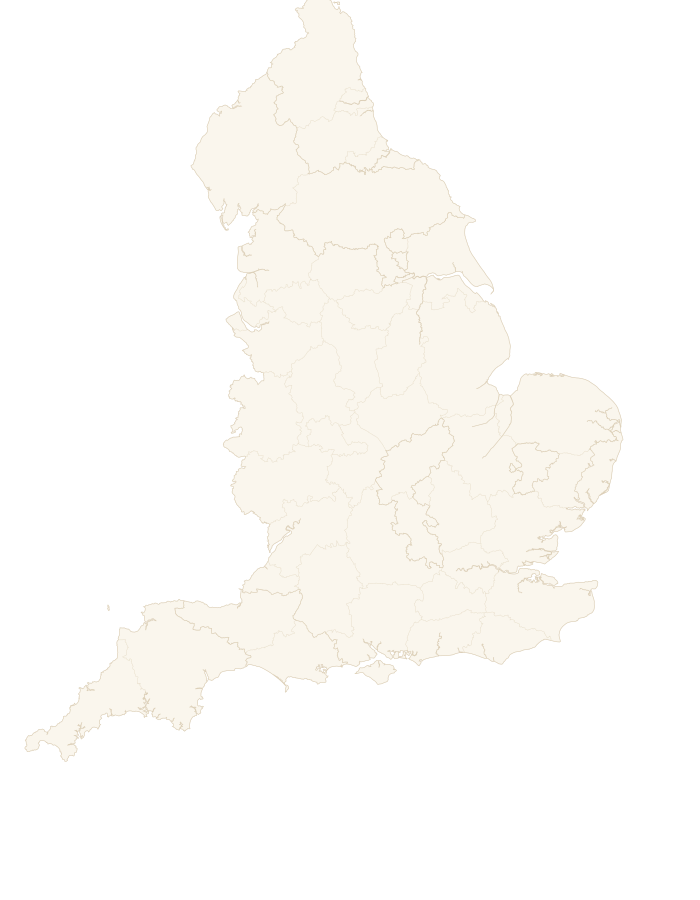
Nothing in the record gives Stone a single homeland. Its living ground runs the length of the West Country, through Cornwall, Devon, Somerset and Bristol, Dorset and Wiltshire and Gloucestershire, then crosses the width of England to Norfolk, Suffolk, the Cambridgeshire fens, Essex and Hertfordshire. Two countries at opposite ends of the kingdom, sharing a name and no line of descent whatsoever.
The older reach is wider still, taking in Kent, Surrey, both Sussexes, Hampshire with the Isle of Wight, Berkshire and Oxfordshire, Buckinghamshire and London; the west midland belt of Staffordshire, Warwickshire, Shropshire and Worcestershire; and the north-west from Cheshire through Lancashire into Cumbria. The scholarship accounts for that spread without a migrating family to carry it: movement in medieval Europe ran chiefly from smaller communities towards the cities, and new arrivals needed a defining surname once they got there.
The Reverend Edward Stone and the ague at Chipping Norton
The first bearer with a dated achievement behind him is the Reverend Edward Stone, born in 1702 and dead in 1768, a clergyman at Chipping Norton in Oxfordshire, inside the Berkshire and Oxfordshire country where the name had long been at home. His problem was the ague, the recurrent fevers running through his parishioners.
What he did about it was not pastoral. He took the bark of the willow, dried it, reduced it to powder, gave it to the fevered people of his parish, and attended to what happened next. In 1763 he reported the result: dried and powdered willow bark acted against the ague-fevers of his parishioners. It is a clergyman's record that a thing tried on the sick had reduced their fevers.
A hundred and thirty-four years from a parish to a laboratory
That 1763 report is the foundational empirical observation behind one of the most consequential compounds in modern medicine. A hundred and thirty-four years after Edward Stone wrote it down, in 1897, the Bayer laboratory achieved the synthesis of acetylsalicylic acid. The line running back from that synthesis reaches an Oxfordshire parish, a minister with a supply of willow bark and a congregation full of fevers.
Stone produced no earls to be dispossessed after 1066 and no barons whose second names were entered in record in the eleventh century. A name of the de type points at a place a family owned; a name of the Stone type points at a place a family lived beside, and a boundary rock confers nothing and can be taken from nobody. What it produced instead was a parish minister who wrote down what he had seen.
Firebase Burt, New Year's Day 1968
William Oliver Stone was born at New York City on the fifteenth of September 1946, the only child of Louis Stone, a New York Stock Exchange senior partner and investment advisor of French-Jewish New York stock, and Jacqueline Goddet, a French Catholic who had come from Paris. He was raised on Manhattan's Upper East Side and at the family country house at Stamford, Connecticut, schooled at the Trinity School and at the Hill School at Pottstown in Pennsylvania, and entered Yale University in September 1964 in his eighteenth year. He dropped out after his first year to teach at the Free Pacific Institute, a Chinese-language secondary school at Cho Lon outside Saigon in South Vietnam.
He returned to Yale in 1966, dropped out again the same year, and enlisted in the United States Army in April 1967. From September 1967 to November 1968 he served with the 25th Infantry Division and the 1st Cavalry Division in the central highlands and the Mekong Delta. He was awarded the Bronze Star with Valor for action at Firebase Burt on the New Year's Day battle of 1968, was wounded twice, and was discharged in November 1968 as a Specialist 4th Class. He took the BFA at New York University Film School in 1971, under the head of department Martin Scorsese, and spent the early 1970s writing screenplays in Los Angeles and taking small directing-and-writing assignments.
Platoon, and a war carried from the Mekong Delta to the Academy
His first Academy Award was for screenwriting Alan Parker's Midnight Express in 1978, the adaptation of Billy Hayes's account of his Turkish prison experience. Screenwriting carried him through Conan the Barbarian (1982), Scarface (1983, the Tony Montana drug-empire feature for Brian De Palma) and Year of the Dragon (1985, for Michael Cimino), and in 1986 he directed his own first film, Salvador, on the Salvadoran civil war. That same year came Platoon, which he had been writing in various drafts since 1971 and now wrote and directed himself: four Academy Awards including Best Picture and Best Director, the first Vietnam-veteran director to take that award, and one hundred and thirty-eight million dollars worldwide on a six-million-dollar budget.
The decade that followed is the body of historical and political film on which the reputation rests. Wall Street (1987) gave Michael Douglas the Gordon Gekko greed-is-good speech, and Born on the Fourth of July (1989), the adaptation of Ron Kovic's Vietnam-veteran memoir starring Tom Cruise, took a second Best Director Academy Award. Then The Doors (1991); JFK (1991), three hours and eight minutes on the Kennedy assassination with Kevin Costner as Jim Garrison, eight nominations and two wins; Heaven and Earth (1993), completing the Vietnam trilogy; Natural Born Killers (1994); Nixon (1995), Anthony Hopkins as Richard Nixon; and U Turn (1997).
The later work runs from Alexander (2004) through W. (2008) on George W. Bush, Wall Street: Money Never Sleeps (2010) and Snowden (2016), with documentary films on Castro (2003) and Hugo Chavez (2009) and the four-part Putin Interviews of 2017. Three Academy Awards, two of them for Best Director in 1987 and 1990, sit against a surname that came into England from a rock at the edge of a field.
Champions of the Stone name
The bearers whose lives are inseparable from this surname. Each has their own page, biography, achievements, geography, connection to the family.
Historic Places, Rebuilt
Explore the streets and seats the Stone name knew, rebuilt with AI as they stood in history.
Castles that share the Stone name
The same name on the map, look one up, see what it looked like in its prime, and recreate it to explore.

All castles in England → · Strongest castles in England → · Castles of Europe
Play As Your Clan
Hold a real castle against whatever you choose to send at it, take a ship out in her own service years, or stand at the shoulder of someone the record remembers. The chronicler sets the scene; the deeds are yours.
Notable bearers of the Stone name
- Reverend Edward Stone (1702–1768), discoverer of willow-bark anti-pyretic