
Square · England · Still standing
Piccadilly Circus
Piccadilly Circus is a road junction and public space in London's West End, created in 1819 to link Regent Street with Piccadilly. It is famous for the large curved LED advertising screens on the north-west corner and the Shaftesbury Memorial Fountain with the winged figure (commonly called Eros). The Circus sits above Piccadilly Circus tube station and connects several major streets including Regent Street, Shaftesbury Avenue and Coventry Street.
First raised
1819
Its prime
2017
Today
Still standing
As it stood in 2017
What Piccadilly Circus looked like in its prime.
A busy, paved road junction framed by late-Georgian and Victorian stucco and stone façades. The north‑west corner is dominated by a single large curved high‑definition LED screen wrapping the building's upper storeys; below it are retail shopfronts with classical window arches. At the south‑west corner stands a bronze winged figure atop a multi‑tier fountain set on a stone plinth. Black cast‑iron lampposts, marked pedestrian crossings and frequent red double‑deck buses define the street-level scene.
Its story
The story of Piccadilly Circus.
Regent Circus South, 1819-1880s
The name Piccadilly is older than the junction, first appearing in 1626 as Piccadilly Hall, a house belonging to one Robert Baker, a tailor known for selling piccadills. The circus itself was created in 1819 where Regent Street, then being laid out under the planning of John Nash, met Piccadilly on the site of a house and garden belonging to a Lady Hutton.
It was known at first as Regent Circus South, paired with Regent Circus North at Oxford Street, and did not begin to be called Piccadilly Circus until the mid-1880s, when the Regent Street Quadrant was rebuilt and Shaftesbury Avenue driven through. In the same period it lost its circular form.
The Shaftesbury Fountain, the Tube and the First Electric Signs, 1892-1932
The Shaftesbury Memorial Fountain was erected in 1892-93 to commemorate the philanthropic works of Anthony Ashley Cooper, 7th Earl of Shaftesbury; its figure is the Greek god Anteros, given the name The Angel of Christian Charity and generally mistaken for his brother Eros. Piccadilly Circus tube station opened beneath the junction on 10 March 1906 on the Bakerloo line and that December on the Piccadilly line, and was extensively rebuilt in 1928 to handle an increase in traffic. The fountain was taken away in 1922 so that Charles Holden's new station could be built below it, and returned in 1931.
The first electric advertisements appeared in 1908, beginning with a sign for Perrier, and from 1923 electric billboards were set up on the facade of the London Pavilion. The circus became a one-way roundabout on 19 July 1926, with traffic lights installed on 3 August. Electric street lamps did not replace the gas ones until 1932.
Rainbow Corner and the Piccadilly Commandos, 1939-1948
The circus has been targeted by Irish republican terrorists more than once; an explosion on 24 June 1939 caused no injuries. During the Second World War many servicemen's clubs in the West End served American soldiers based in Britain, among them Rainbow Corner, established by the American Red Cross just off the circus. So many prostitutes roamed the area approaching the soldiers that they received the nickname "Piccadilly Commandos", and both Scotland Yard and the Foreign Office discussed possible damage to Anglo-American relations. The Shaftesbury fountain was removed a second time during the war and replaced by advertising hoardings, returning in 1948.
Bond, the Beatles and the Rejection of the Holford Plan, 1962-1972
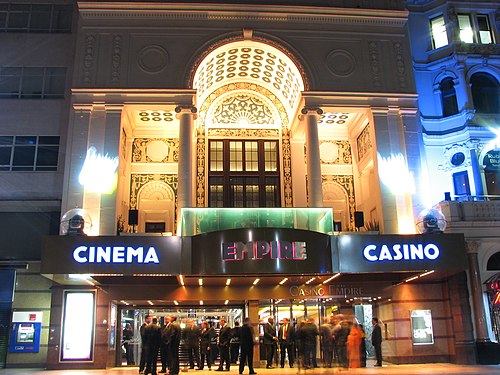
The London Pavilion, a music hall rebuilt in 1885 when Shaftesbury Avenue was built through its former site and converted into a cinema in 1934, premiered Dr. No in October 1962 and A Hard Day's Night in July 1964. At the start of the decade it had been determined that the circus needed redevelopment to allow greater traffic flow, and in 1962 Lord Holford presented a plan for a "double-decker" Piccadilly Circus, an elevated pedestrian concourse linking the buildings around the perimeter above a lower deck given over to traffic.
The scheme was kept alive through the rest of the 1960s, and a final version in 1972 proposed three octagonal towers, the tallest 240 feet, in place of the Trocadero, the Criterion and the Monico buildings. Sir Keith Joseph and Ernest Marples rejected the plans permanently, the key reason given being that the scheme allowed only a 20 per cent increase in traffic where the Government required 50.
Bombs, Screens and Protected Status, 1974-2022
A bomb injured 16 people on 25 November 1974, and a 2 lb device injured five on 6 October 1992. Apart from extensive pedestrianisation of the south side in the 1980s, during which the Shaftesbury Memorial was moved from the centre of the junction to the south-western corner, the circus has escaped major redevelopment. It has drawn political demonstrations, among them the anti-war protest of 15 February 2003.
Only one building still carries illuminated advertising, the corner site between Shaftesbury Avenue and Glasshouse Street usually called Monico after the cafe that stood there, owned by the property investor Landsec since the 1970s. LED displays had entirely replaced neon by 2011; in January 2017 the six remaining screens were switched off to be combined into a single curved Daktronics display, the longest the signs had been dark since the 1940s, and the new screen was lit on 26 October 2017. Following the death of Elizabeth II all advertising at the circus was replaced by an image honouring the Queen, part of an industry-wide suspension of out-of-home advertising.
The Criterion Theatre on the south side is Grade II* listed; the County Fire Office, with its Britannia statue on the roof, is Grade II listed, as are the below-ground concourse and subway entrances of the tube station.
Step inside
7 places to explore in 2017.
The record describes 7 distinct spots at Piccadilly Circus, including 3 interiors: criterion theatre entrance and descending tiled stairway, london pavilion façade and shopping arcade, tube station entrances and underground concourse. Create your own photoreal reconstruction and explore every one, more scenes means more photos, more angles and more of the immersive experience.
Build Your Own Castle
Recreate Piccadilly Circus with AI to explore it.
Rebuilds stop at 1945, so the artist raises this site as it stood in 1930, not today's building, as a photoreal reconstruction that belongs to you alone. Pay with coins, no subscription needed.
Recreate Square to Explore →Nearby
Castles within reach of Piccadilly Circus.


Landmarks within reach of Piccadilly Circus.


More landmarks of England


Explore the city


